Hidden Valley Hike: A Study in Atmospheric Depth and Winter Quietude

The photograph from Hidden Valley in Rocky Mountain National Park captures a snow-covered trail among dense trees, showcasing Greg Urbano’s skill in monochromatic winter photography. Emphasizing subtlety over grandeur, it conveys solitude and wilderness through careful composition and tonal restraint, highlighting ecological specifics and the beauty of intimate landscapes.

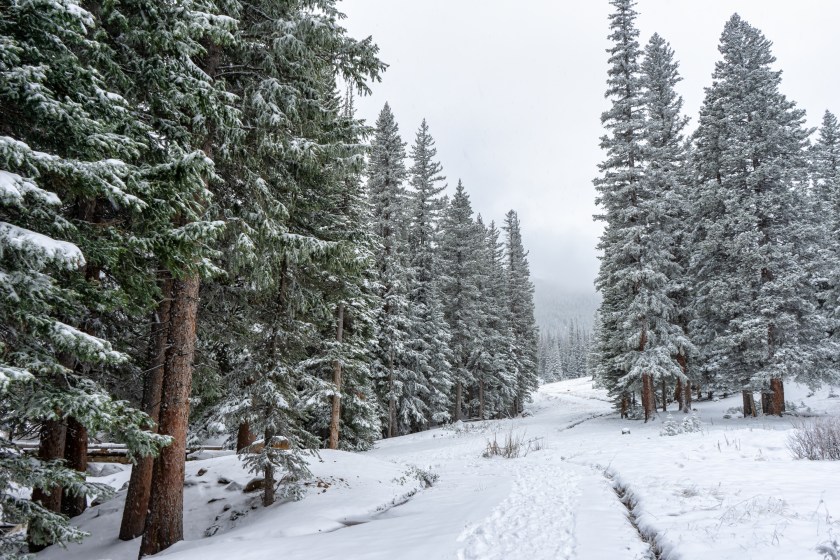
Snow-covered hiking trail winding through evergreen forest at Hidden Valley in Rocky Mountain National Park.
A snowy trail leads through dense evergreen trees at Hidden Valley in Rocky Mountain National Park, Colorado.

Within Chapter 3 of Greg Urbano’s Top 100 Journey—devoted to Colorado Landscapes & Cityscapes—this photograph from Hidden Valley in Rocky Mountain National Park represents a masterful engagement with the challenges of monochromatic winter photography. The image captures a snow-laden trail ascending through dense coniferous forest, where atmospheric conditions have reduced the distant peaks to mere suggestions within a veil of falling snow and fog.

The photographer’s compositional strategy reveals a sophisticated understanding of visual hierarchy. The trail itself functions as both literal and metaphorical pathway, drawing the viewer’s eye from the textured foreground snow through the middle ground’s architectural arrangement of pines and firs, before dissolving into the atmospheric void of the background. This recession creates a palpable sense of depth despite the flattening effect that overcast winter light typically imposes on landscape photography.

What distinguishes this work within Urbano’s broader Colorado portfolio is its restraint. Rather than pursuing the dramatic vistas and saturated alpine glow that characterize much Rocky Mountain photography, he has chosen to document a moment of visual subtlety—a soft, nearly monochromatic palette punctuated only by the warm sienna of exposed tree bark. The decision to work within such a limited tonal range demonstrates confidence in form and composition rather than relying on chromatic spectacle.

The technical execution merits particular attention. The photographer has maintained remarkable detail in the snow-weighted evergreen boughs while preserving the delicate gradation of gray tones that define the misty background. This balance suggests careful exposure management in conditions that would challenge most practitioners—the high reflectivity of fresh snow against dark timber, compounded by active precipitation and low contrast lighting.

From a thematic perspective, this photograph speaks to the contemplative dimension of Urbano’s landscape practice. The absence of human figures—save for the implicit presence suggested by the trail itself—invites meditation on solitude and the experience of wilderness in its less hospitable moments. This is not the Colorado of tourism brochures, but rather an intimate encounter with the state’s winter reality, where beauty reveals itself through subtlety rather than grandeur.

The image also functions as documentation of a specific ecological zone within Rocky Mountain National Park. The mixed conifer forest, dominated by what appear to be Engelmann spruce and subalpine fir, places the photograph within the park’s upper montane and subalpine life zones. The photographer’s attention to these botanical particulars grounds the work in a specific geographic and ecological context, elevating it beyond generic winter scenery.

Within the arc of the Top 100 Journey project, this photograph demonstrates stylistic evolution—a willingness to embrace quieter moments alongside more conventionally dramatic subjects. It suggests that Urbano’s curatorial eye has matured toward valuing atmospheric mood and compositional sophistication over spectacular subject matter alone.

The final consideration is one of timing and patience. Winter photography in Rocky Mountain National Park demands both technical preparation and willingness to work in physically demanding conditions. That this image exists at all speaks to the photographer’s commitment to documenting the full range of Colorado’s landscape character, not merely its most accessible or comfortable manifestations. The result is a work that rewards sustained attention, revealing its carefully calibrated tonal relationships and spatial complexities gradually, much like the trail itself emerging from and dissolving into winter’s embrace.
Big Thompson Long Exposure

The photograph of the Big Thompson River showcases a masterful interplay of permanence and fluidity through long exposure techniques. Captured in Colorado, the image emphasizes detail in granite boulders alongside soft, flowing water. It reflects the photographer’s evolving artistic journey, expanding thematic boundaries while presenting a cohesive and naturalistic landscape composition.

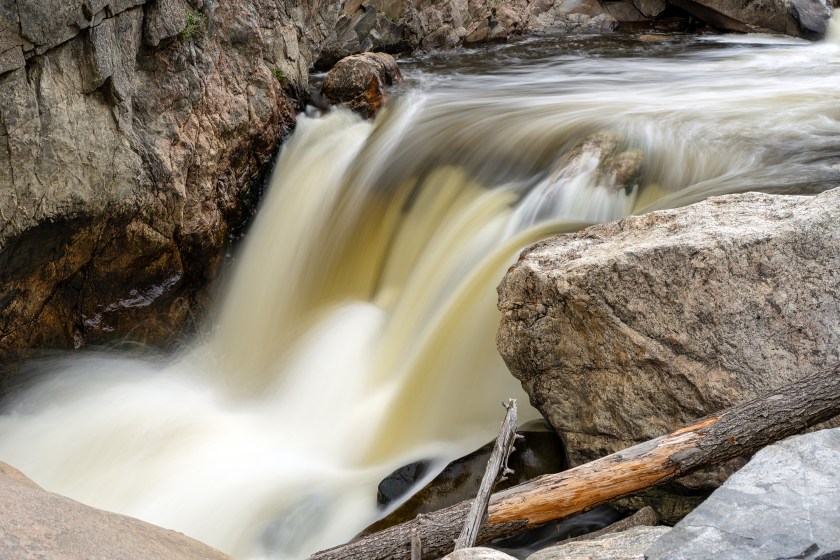
Long exposure view of fast-moving water flowing over a rocky drop on the Big Thompson River between granite boulders.
Water flows over a small rocky drop along the Big Thompson River, photographed with a long exposure.

The photographer’s technical mastery converges with natural drama in this commanding study of the Big Thompson River, captured in Colorado’s rugged high country. Shot with a Sony Alpha a7 II paired with the Sony FE 28-70mm f/3.5-5.6 OSS lens at 62mm, the image employs long exposure technique enhanced by neutral density filtration to transform rushing water into ethereal ribbons of motion. At ƒ/9.0 and ISO 50, the exposure settings reveal a deliberate approach to capturing both sharpness in the surrounding geology and the silken blur of flowing water.

What immediately arrests the viewer is the dramatic interplay between permanence and fluidity. Massive granite boulders—textured, ancient, immovable—frame a cascade that appears simultaneously powerful and gossamer-soft. The long exposure technique transforms the torrent into bands of cream and amber, creating visual movement that guides the eye through the composition in sweeping arcs. The golden tint in the water suggests the presence of sediment or tannins, lending warmth to what might otherwise read as a cool mountain scene.

The compositional architecture demonstrates sophisticated understanding of visual weight and balance. A substantial boulder occupies the right foreground, its weathered surface rendered in exquisite detail, while a piece of driftwood creates a diagonal element that adds depth and natural geometry. The left side reveals stratified rock walls, their vertical presence providing counterpoint to the horizontal flow. This triangulation of elements—stone, water, wood—creates a cohesive environmental portrait rather than merely documenting a waterfall.

The inclusion of this image within Chapter 2—Florida Landscapes & Cityscapes—presents an intriguing curatorial question. Clearly captured in Colorado’s Rocky Mountain ecosystem rather than Florida, the photograph signals an expansion in the photographer’s geographical scope and thematic boundaries. This apparent departure from the chapter’s titular focus suggests an evolving artistic journey, one where the photographer moves beyond regional constraints to explore universal themes of landscape and natural process. Perhaps the chapter title reflects the photographer’s home base or primary focus, while individual works demonstrate his widening field of exploration.

The technical execution reveals growing confidence with long exposure photography as a expressive tool. The neutral density filter allows for extended exposure times in daylight conditions, creating that characteristic motion blur while maintaining proper exposure across the frame’s dynamic range. The choice of ƒ/9.0 ensures adequate depth of field to keep both foreground rocks and background elements acceptably sharp, a critical consideration in landscape work where context matters as much as subject.

What elevates this beyond technical exercise is the photographer’s eye for natural composition. The cascade’s S-curve creates inherent grace, while the careful positioning relative to the boulder forms suggests patient observation and deliberate framing. The subdued color palette—grays, tans, muted greens—speaks to naturalistic rendering rather than heightened saturation, allowing texture and form to dominate over chromatic spectacle.

Within the broader trajectory of the Top 100 Journey project, this image represents an artist testing boundaries and methodologies. It demonstrates that landscape photography, when executed with technical precision and compositional awareness, can reveal the sublime within the observable—the eternal dance between stone and water, stillness and motion, captured in a single decisive exposure.

Into the Green Cathedral: Highlands Hammock State Park, 2011

Greg Urbano’s 2011 photograph from the Cypress Swamp Trail reflects the intersection of technical skill and artistic vision in photography. Using a Pentax K-x, he captures a weathered boardwalk amidst Florida’s lush swamp, illustrating the relationship between nature and human presence. The image balances light and texture, inviting viewers into a transformative experience.

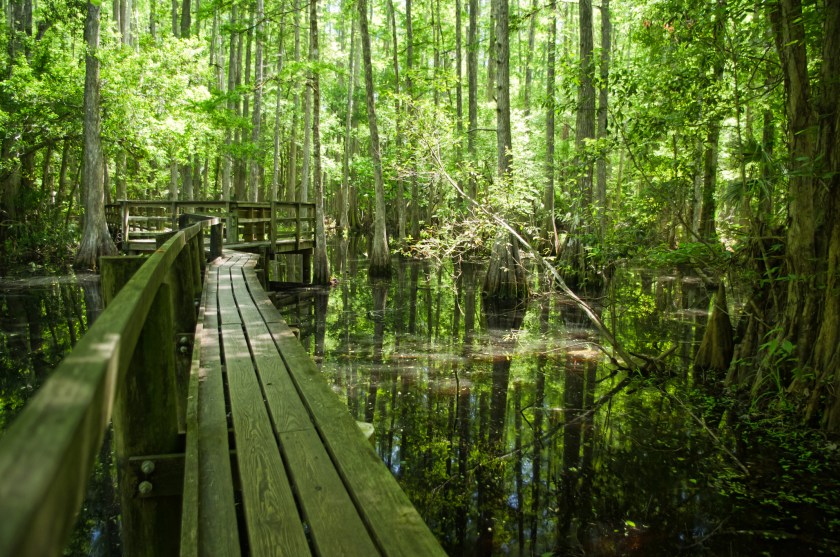
Wooden boardwalk winding through a cypress swamp with tall trees, exposed roots, and reflective dark water, photographed in 2011 with a Pentax K‑x.
A 2011 photograph of the Cypress Swamp Trail boardwalk at Highlands Hammock State Park in Florida.

In the early stages of any photographer’s journey, there exists a pivotal moment when technical capability intersects with artistic vision—when the craft begins to serve something deeper than mere documentation. Greg Urbano’s 2011 photograph from the Cypress Swamp Trail at Highlands Hammock State Park captures precisely this threshold, presenting a meditation on entrance, passage, and the liminal spaces where human intervention meets primordial nature.

The composition anchors itself on a weathered wooden boardwalk that curves through the left third of the frame, its moss-stained surface bearing witness to countless footsteps and Florida’s relentless humidity. Shot at 18mm on a Pentax K-x with the kit lens, Urbano demonstrates an understanding that wide-angle photography isn’t about capturing everything—it’s about creating context and relationship. The boardwalk serves as both literal path and visual guide, drawing the eye from the immediate foreground deep into the swamp’s verdant interior.

What distinguishes this image from typical nature photography is its masterful handling of light in a notoriously challenging environment. Shooting at f/4.0 with a 1/40s shutter speed and ISO 400, Urbano navigated the technical constraints of a modestly equipped camera to capture the dappled luminosity filtering through the canopy. The exposure balances the bright patches of sky visible through the trees with the darker water below, creating a tonal range that feels both accurate and atmospheric. The slightly elevated ISO introduces a subtle grain that, rather than detracting from the image, contributes to its organic texture.

The swamp water itself becomes a secondary canvas, reflecting the surrounding cypress trunks and creating visual echoes that blur the boundary between substance and reflection. Fallen branches break the surface tension, their pale, skeletal forms contrasting with the vibrant greens of new growth. This juxtaposition of decay and vitality speaks to the swamp’s essential nature as a place of transformation, where death continuously feeds life.

The color palette reveals a sophisticated eye for harmony—countless variations of green layer upon one another, from the luminous chartreuse of sunlit leaves to the deep olive shadows beneath the boardwalk. The aged wood introduces warmer earth tones, grounding the composition and providing respite from the overwhelming verdancy. These are the subtle decisions that separate intentional photography from happy accidents.

Within the context of a photographer’s formative work, this image represents more than technical competence. It demonstrates an emerging awareness of how to use man-made structures not as intrusions upon nature, but as framers of experience—the boardwalk doesn’t dominate the swamp; it offers a way to witness it. The slight curve of the path suggests journey and discovery, inviting viewers to imagine themselves walking deeper into this green cathedral.

Shot with entry-level equipment during a period when digital photography was becoming democratized, this photograph affirms that vision matters more than gear. The Pentax K-x and kit lens proved sufficient tools for capturing not just a place, but an atmosphere—the particular quality of light, air, and time that defines Florida’s ancient swamplands. It stands as evidence of a photographer learning to see, to compose, and to recognize moments worth preserving.

See this image on:

500px

Flickr