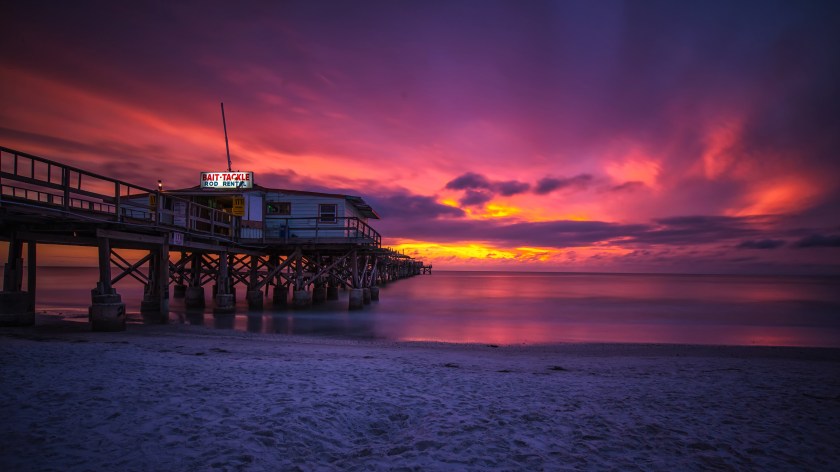
Redington Long Pier Sunset

The photograph of Redington Long Pier at sunset highlights the interplay between Florida’s coastal architecture and natural beauty. Captured with a long exposure technique, it merges structure and color, showcasing the significance of humble elements like a bait shop sign. This image advocates for a broader definition of landscape photography, embracing authenticity over idealization.

Long exposure photograph of the Redington Long Pier on Redington Beach, Florida, taken after sunset with vivid sky colors and calm reflective water.
Long exposure sunset view of the Redington Long Pier on Redington Beach.

The photographer’s approach to Florida’s coastal architecture reveals itself most compellingly in this extended exposure from Redington Beach, where a humble fishing pier becomes a study in structural grace against an incandescent sky. Captured on a Nikon D610 with an 18-35mm lens set to its widest focal length, the thirty-second exposure at f/8.0 transforms the Gulf of Mexico into liquid silk, while the pier’s weathered geometry provides essential counterpoint to the sky’s theatrical display.

What distinguishes this image within the Florida Landscapes & Cityscapes chapter is its subtle negotiation between the vernacular and the sublime. The “Bait·Tackle Rod Rental” sign—a modest beacon of commercial utility—anchors the composition with an authenticity that elevates rather than diminishes the scene’s natural grandeur. This juxtaposition speaks to the photographer’s evolving understanding of Florida’s coastal identity, where working piers and rental shacks exist not as intrusions upon beauty but as integral components of it.

The technical execution demonstrates considerable restraint. The eighteen-millimeter perspective captures the pier’s diagonal recession into the frame while maintaining clarity in the structural cross-bracing beneath the deck. The thirty-second exposure, calibrated to ISO 200, achieves that liminal smoothness in the water without sacrificing detail in the sky’s stratified clouds. The photographer has timed his capture for that brief window after sunset when the western horizon blazes with residual light while the zenith deepens toward purple—a moment lasting perhaps ten minutes when the dynamic range compresses just enough for a single exposure to hold both fire and shadow.

Color becomes the image’s primary language. The gradient from molten gold through crimson to violet speaks to the atmospheric conditions particular to Gulf Coast evenings, where humidity and marine air create these saturated transitions. The pier itself, rendered in silhouette, serves as a tonal anchor that prevents the composition from dissolving into pure chromaticism. The photographer’s choice to shoot into this gradient, rather than capturing the pier against a uniformly lit sky, reveals an understanding of how structure and color can modulate one another.

Within the broader trajectory of this chapter, the image represents a maturation of approach. Where earlier Florida work might have privileged either the natural landscape or the built environment, this photograph insists they cannot be separated. The pier extends from beach to horizon as a human gesture toward the infinite, its pilings disappearing into softened water that suggests both permanence and impermanence. The long exposure technique—a methodology that appears repeatedly throughout his landscape work—here serves not merely as technical flourish but as philosophical statement about time’s accumulation within a single frame.

The composition’s formal elegance belies its democratic subject matter. This is not a pristine wilderness or an architectural landmark, but a working-class fishing pier on a stretch of developed coastline. By rendering it with such visual authority, the photographer argues for an expanded definition of landscape photography—one that acknowledges Florida’s actual character rather than retreating to fantasies of unspoiled nature. The sunset may be spectacular, but it is the bait shop sign, glowing like a minor constellation above the water, that makes this image distinctly Floridian, distinctly true

See this image on:

Flickr

500px

Cocoa Beach Pier Sunrise: Architecture in Dialogue with the Atlantic

The photograph of Cocoa Beach Pier captures a sunrise through meticulous long exposure, transforming the landmark into a study of light and architecture. The image emphasizes structural details, blending engineering with nature. It highlights Florida’s coastal identity, embodying resilience and the interplay between human construction and natural forces against the backdrop of a serene seascape.

Long exposure sunrise photograph of the Cocoa Beach Pier in Florida, showing wooden pilings, warm light on the horizon, and reflections on wet sand.
Sunrise over the Atlantic Ocean at the Cocoa Beach Pier, captured in a long exposure.

Within Chapter 2 of the Top 100 Journey—Florida Landscapes & Cityscapes—this sunrise study of the Cocoa Beach Pier represents the photographer’s engagement with one of Florida’s most iconic coastal structures. Captured with deliberate technical restraint, the image transforms a familiar landmark into a meditation on light, time, and the intersection of human construction with natural forces.

The photograph was executed during the liminal hour of sunrise, that brief window when the sun emerges from the Atlantic horizon, casting warm, directional light across the scene. The photographer positioned himself beneath the pier’s substantial wooden framework, creating a composition that emphasizes the structure’s engineering and architectural presence. The pilings—weathered cylinders marked by barnacles and tidal wear—march in rhythmic repetition from foreground to background, their reflections doubling in the wet sand left by receding waves. This repetition creates visual cadence, leading the viewer’s eye through the layered space beneath the pier toward the glowing horizon.

The technical execution reveals calculated decision-making. Shooting at f/16 with a ten-second exposure on ISO 100, the photographer achieves several objectives simultaneously: the narrow aperture ensures sharpness throughout the deep composition, from the foreground sand texture to the distant pier house; the extended exposure time smooths the ocean into a misty, ethereal plane, contrasting with the solid geometry of wood and metal; and the low ISO preserves maximum image quality in the challenging dynamic range between shadowed understructure and brilliant sunrise. The 20mm focal length on a full-frame Nikon D610 provides sufficient width to capture the pier’s span while maintaining rectilinear integrity in the vertical pilings.

What distinguishes this work is its treatment of architectural form within the natural environment. Rather than photographing the pier as a tourist attraction—a vantage point from which to view the ocean—the photographer inverts the relationship, making the structure itself the primary subject while the seascape becomes supporting element. The underside perspective reveals construction details typically ignored: diagonal cross-bracing, the density of support columns, the engineering solutions required to anchor a recreational structure in shifting sand and relentless surf. The barnacle-encrusted pilings become textural studies, documenting the biological claim that marine life makes on human infrastructure.

The color palette reinforces the temporal specificity of the moment. Golden light bathes the right side of the frame, warming the wooden planks and casting long shadows that define the pier’s three-dimensional form. The left side remains in relative shadow, creating tonal gradation that adds depth and volume. The sky transitions from warm cream near the sun to deeper blue overhead, while the smoothed water reflects this gradient, creating visual harmony between sky and sea.

Within the broader context of Florida Landscapes & Cityscapes, this image represents the photographer’s recognition that Florida’s coastal identity includes not only pristine natural beauty but also the structures through which residents and visitors experience that environment. The Cocoa Beach Pier, a mid-century landmark rebuilt multiple times after hurricane damage, embodies Florida’s complicated relationship with its shoreline—simultaneously celebrating and challenging the power of the Atlantic.

The photograph ultimately documents persistence: of structures rebuilt after storms, of daily tides that reshape the beach, of light that returns each morning to illuminate the coast.

Burning Sands: A Meditation on Ephemeral Beginnings

The 2014 photograph from Greg Urbano’s “Burning Sands” captures a sand sculpture at Treasure Island, Florida, portraying the transient nature of creation. It juxtaposes themes of existence and decay through an overcast atmosphere, intricate details, and a solitary figure, emphasizing the cycle of beginnings and endings inherent in art and life.

Detailed sand sculpture on a beach under an overcast sky at the Sanding Ovations event in Treasure Island, Florida, photographed with a Nikon D7100 at 11.5mm.
A 2014 photograph of a sand sculpture at the Sanding Ovations event on Treasure Island Beach, Florida.

In the opening chapter of Greg Urbano’s photographic journey, “Burning Sands” stands as a profound meditation on the transient nature of creation itself. Captured in 2014 at the Sanding Ovations event in Treasure Island, Florida, this image transcends its origins as documentary photography to become something altogether more contemplative—a visual poem about the delicate threshold between existence and dissolution.

The photograph presents an intricate sand sculpture rendered in monochromatic tones, its draped forms suggesting both shelter and sorrow. A solitary figure crouches within an arched doorway, while skeletal remains sprawl at the sculpture’s base, creating a narrative that feels simultaneously ancient and immediate. What elevates this work beyond mere documentation is the atmospheric haze that envelops the scene—that distinctive quality the photographer describes as having a “Burning Man vibe.” The overcast morning has transformed the beach into an otherworldly playa, where the sun becomes a pale disk suspended in a beige firmament.

Urbano’s technical approach demonstrates a sophisticated understanding of environmental photography. Shot with a Nikon D7100 at 11.5mm, the ultra-wide angle encompasses not only the foreground sculpture but also the secondary forms receding into the atmospheric distance, creating layers of depth that pull the viewer’s eye through the composition. The aperture of f/6.3 maintains critical sharpness across the sculptural details while allowing the background to soften naturally into the haze. At 1/1600s, the shutter freezes what is essentially a meditation on impermanence—an irony not lost on the careful observer.

The positioning of this work within Chapter 1—Beginnings feels particularly apt. Sand sculptures exist in perhaps the most precarious state of any art form: they are born from the beach and inevitably return to it, whether through wind, tide, or the simple passage of time. There is something profoundly instructive about beginning a photographic journey with such ephemeral subject matter. It suggests an artist already attuned to photography’s essential purpose: to preserve the fleeting, to honor what cannot last.

The sculpture’s symbolic vocabulary—the draped archway, the protective figure, the bones suggesting mortality—reads as universal rather than specific. These are archetypal forms that resonate across cultures and epochs. Yet the photographer’s framing transforms these symbols into something fresh. The ropes cordoning the installation, visible in the foreground, serve as a subtle reminder of the boundary between art and observer, between preservation and inevitable decay.

What makes “Burning Sands” particularly compelling within Urbano’s broader body of work is its early demonstration of his eye for the liminal—those in-between spaces where conditions create unexpected beauty. The hazy atmosphere wasn’t planned or controlled; it was observed, recognized, and captured. This sensitivity to environmental gift-giving would become a hallmark of his photographic practice.

In the context of beginnings, this image offers a paradox: it documents creation while simultaneously evoking dissolution. The pale sun, the encompassing haze, the skeletal remains—all suggest endings as much as beginnings. Perhaps that’s the deeper wisdom captured here: that every beginning contains within it the seed of its own conclusion, and the artist’s task is simply to bear witness to both with equal reverence.

Fallen Tree: The Foundation of Seeing

The photograph from Hillsborough River State Park, taken by Greg Urbano in 2013 with a Nikon D7100, captures a pivotal moment in his artistic development. It reflects his early understanding of composition and intentionality, showcasing the dense subtropical landscape through HDR processing. This image symbolizes the importance of beginnings and learning in photography.

HDR photograph of a forest trail in Hillsborough River State Park with a large fallen tree across the path, dense vegetation, and filtered natural light, taken with a Nikon D7100 at 10mm.
A 2013 HDR landscape photograph of a fallen tree along a forest trail in Hillsborough River State Park, Florida.

In the opening chapter of Greg Urbano’s photographic journey, this image from Hillsborough River State Park stands as a testament to the essential nature of beginnings. Shot in 2013 with a Nikon D7100, the photograph captures more than a forest scene—it documents the foundational moment when a photographer learns to truly see the landscape before him.

The composition reveals an intuitive understanding of depth and perspective. Shot at 10mm, the wide-angle lens creates an immersive quality that draws viewers directly onto the trail. The fallen log in the foreground serves as both literal and metaphorical threshold, inviting passage into the deeper woods beyond. This diagonal element cuts across the frame with authority, its weathered texture rendered in sharp detail by the f/8.0 aperture, demonstrating Urbano’s early grasp of how to balance foreground interest with background context.

The HDR processing technique employed here reflects the experimental spirit characteristic of this pre-2015 period. While HDR would later fall somewhat out of favor in fine art photography circles, its application in this image serves a clear purpose: to capture the dynamic range of a Florida forest understory, where dappled sunlight creates extreme contrasts between shadow and highlight. The palmetto fronds and oak canopy are rendered with an almost hyper-real clarity that emphasizes the dense, layered nature of this subtropical ecosystem.

What makes this photograph particularly significant within the “Beginnings” chapter is its honesty about place and limitation. Urbano’s accompanying note—that this Florida park offered his “best opportunity to capture flowing water over river rocks” before relocating to Colorado—reveals something crucial about artistic development. Great photography emerges not from waiting for perfect conditions, but from working intensively with what’s available. This trail became his classroom, this fallen log his teacher.

The technical choices demonstrate a photographer thinking through his craft. The 1/50s shutter speed suggests deliberate handholding technique, while the ISO 200 setting indicates available light conditions and a preference for image quality. These aren’t the settings of someone simply pointing and shooting; they reveal consideration and intentionality, even in these early stages.

The color palette—predominantly greens with earth-toned accents—creates a cohesive, naturalistic feel despite the HDR processing. The slight motion blur in the foliage adds an organic quality, a reminder that this is a living landscape caught in a specific moment. The trail itself winds invitingly into the frame’s depth, disappearing around a bend that promises further discovery—a fitting metaphor for the artistic journey being documented.

In the context of Urbano’s larger body of work, this image represents more than just an early attempt. It embodies the crucial truth that mastery begins with showing up, with making photographs even when the circumstances aren’t ideal, even when the technique hasn’t been perfected. The photograph’s inclusion in his top 100 collection isn’t about technical perfection but about recognizing the importance of foundation.

Every artist’s journey requires a starting point, a place where curiosity meets commitment. This fallen tree, this Florida trail, this moment of learning to see—these are the essential ingredients that would eventually lead to mountain streams in Colorado and a mature photographic vision. The imperfect attempt, it turns out, isn’t just necessary. It’s everything.

The Gulf Pier: A Foundation in Light and Structure

Greg Urbano’s “Landscapes in HDR” captures the Gulf Fishing Pier at Fort de Soto Park, reflecting his artistic development in photography. Utilizing a Nikon D7100, he balances composition with HDR techniques, achieving naturalistic vibrancy without over-processing. The image embodies a pivotal moment in skill mastery, exploring the connection between environment and human creation.

HDR landscape photograph of the Gulf Fishing Pier at Fort De Soto Park in Pinellas County, Florida, extending over calm water under a bright sky, taken with a Nikon D7100 at 14mm.
A 2013 HDR landscape photograph of the Gulf Fishing Pier at Fort De Soto Park in Pinellas County, Florida.

In the early stages of any photographer’s journey, there exists a pivotal moment when technical curiosity converges with artistic vision. Greg Urbano’s “Landscapes in HDR” from 2013 captures precisely this convergence—a photograph that speaks to the fundamentals of seeing while revealing the seeds of a maturing artistic voice.

The Gulf Fishing Pier at Fort de Soto Park presents itself as an exercise in classical composition, yet the image transcends mere documentation. Shot with a Nikon D7100 at 14mm, the photographer embraced the distortion inherent in ultra-wide-angle photography, using it not as a limitation but as a tool for emphasis. The pier’s concrete pathway stretches toward the horizon with geometric insistence, its weathered surface textured with salt stains and age—details that anchor the ethereal quality of the surrounding environment.

What distinguishes this work within the context of Chapter 1—Beginnings is the deliberate exploration of HDR processing, a technique that dominated landscape photography in the early 2010s. Rather than falling into the trap of over-processing that plagued much HDR work of this era, Urbano demonstrates restraint. The luminous gradations in the sky—from deep azure to wispy white—retain a naturalistic quality while revealing detail across an impressive tonal range. The turquoise waters of the Gulf of Mexico maintain their vibrancy without crossing into hypersaturation, suggesting an eye already sensitive to the boundaries between enhancement and artifice.

The technical choices reveal a photographer building his fundamental vocabulary. The aperture of ƒ/8.0 ensures critical sharpness from the foreground concrete to the distant structures, while the fast shutter speed of 1/400s freezes the subtle motion of the scene—likely the flutter of distant flags or the movement of the few figures visible along the pier. At ISO 100, the image maintains clarity in its textures, from the horizontal railings that create rhythmic lines to the architectural shelters that punctuate the composition’s middle ground.

What makes this photograph significant in understanding Urbano’s artistic evolution is not its perfection but its purposefulness. The nearly symmetrical composition, the careful attention to the leading lines, the consideration of how architectural elements frame the natural environment—these are the building blocks upon which more complex visual narratives are constructed. The weekly visits to this location mentioned in his notes speak to something essential in photographic development: the practice of returning, of seeing the same subject under different conditions, of learning through repetition.

The landscape itself offers something eternal—the meeting point of human construction and natural expanse. The pier extends confidently into the Gulf, a gesture of connection between land and water, between the photographer’s position and the infinite horizon. In capturing this scene, Urbano was not merely documenting a favorite location but engaging with fundamental questions about how we frame our relationship to place and space.

Within the broader context of “Beginnings,” this image exemplifies the necessary stage of mastering craft before transcending it. The imperfect attempts referenced in the chapter description are not failures but essential experiments. Here, we witness a photographer learning to see in high dynamic range, to compose with geometric precision, and to capture the luminous quality of coastal light—all foundational skills that would inform the more sophisticated work to come.

This is where journeys begin: in the clarity of intention, the discipline of practice, and the recognition that every master was once a student of light.

Lady in a Hat: A Study in Perspective and Presence

In 2013, Greg Urbano’s photograph “Lady in a Hat” encapsulated his experimental spirit in photography. Taken at a Veterans benefit car show in Florida, it features a classic car and a woman in a hat, illustrating the dynamic between subject and observer. This image showcases the evolution of Urbano’s artistry and HDR techniques, emphasizing compositional storytelling.

HDR photograph from a 2013 car show featuring a woman wearing a hat standing near classic vehicles, taken with a Nikon D5100 at 10mm.
A 2013 HDR photograph from a Veterans benefit car show at Bay Pines VA in Pinellas County, Florida.
Shot with a Nikon D5100.

In the early years of Greg Urbano’s photographic journey, there existed a willingness to experiment boldly with emerging digital techniques—a quality that would become foundational to his artistic identity. “Lady in a Hat,” captured in 2013 at a Veterans benefit car show in Bay Pines, Florida, exemplifies this experimental spirit while revealing an intuitive understanding of compositional storytelling that would define his later work.

The photograph presents a gleaming black classic car, its hood raised to display immaculate chrome and engineering, positioned at a dramatic low angle that transforms the vehicle into something monumental. But what elevates this image beyond typical automotive photography is the deliberate inclusion of a figure in the background—a woman in a distinctive hat, observing the scene. This compositional choice transforms what could have been a straightforward documentation of mechanical beauty into a meditation on observation itself, on the relationship between spectator and spectacle.

Urbano shot this image with a Nikon D5100 at 10mm, an ultra-wide focal length that creates pronounced perspective distortion. The technical settings—f/10 at 1/320s, ISO 160—suggest bright midday conditions, yet the photographer’s use of HDR processing pushes the tonal range far beyond what the camera captured in a single exposure. This was 2013, when HDR photography was experiencing widespread popularity in automotive and architectural work, and Urbano was actively exploring its possibilities. The processing intensifies the reflections on the car’s black paint, brings out texture in the engine bay, and maintains detail in both the bright Florida sky and the shadowed undercarriage.

What makes this image significant within the context of Chapter 1—Beginnings is not its technical perfection, but rather what it reveals about the photographer’s developing eye. The ultra-wide perspective could easily overwhelm the frame, yet Urbano maintains balance through careful positioning. The car dominates the foreground, grounded by fallen leaves and grass texture, while the human element remains present but unobtrusive in the middle distance. This suggests an emerging awareness of layered storytelling, of creating images that reward sustained viewing.

The title itself demonstrates artistic intentionality. “Lady in a Hat” redirects our attention from the obvious subject—the pristine classic car—to the peripheral human presence, suggesting that the photographer understood even then that compelling photographs often exist in the tension between primary and secondary subjects, between what commands attention and what quietly observes.

This photograph also documents a specific moment in Urbano’s technical education. HDR processing, with its characteristic emphasis on local contrast and detail recovery, taught photographers of this era to see scenes in terms of tonal relationships rather than single exposures. This training in visualizing extended dynamic range would later inform his approach to lighting and exposure, even when shooting single frames.

Within the broader narrative of the Top 100 Journey project, “Lady in a Hat” represents the necessary phase of bold experimentation that precedes refinement. It captures a photographer unafraid to push processing techniques to their limits, to shoot from unconventional angles, and to include elements that complicate rather than simplify the frame. These imperfect attempts, as Urbano himself acknowledges, formed the foundation for everything that followed—a reminder that artistic growth requires the courage to create before one fully understands how.

Marie Selby Roots, 2012

In Greg Urbano’s 2012 black and white photograph of banyan tree roots at the Marie Selby Botanical Gardens, the ordinary is elevated to extraordinary. Using a Nikon D5100, he emphasizes natural architecture and texture, inviting viewers to appreciate the monumental presence of the roots and their intricate details, symbolizing persistence and growth.

Black‑and‑white close‑up photograph of large banyan tree roots spreading across the ground at Marie Selby Botanical Gardens, taken with a Nikon D5100.
A 2012 black‑and‑white photograph of banyan tree roots at Marie Selby Botanical Gardens in Sarasota, Florida.

In the Marie Selby Botanical Gardens of Sarasota, Florida, Greg Urbano discovered a subject that speaks to photography’s essential pursuit: finding extraordinary vision in the ordinary world. His 2012 image of a banyan tree’s root system transforms what many visitors might walk past into a study of natural architecture, texture, and the quiet monumentality of growth.

Shot on a Nikon D5100 at 18mm, the photograph embraces the wide-angle perspective to emphasize the sculptural sprawl of roots as they emerge from and return to the earth. The technical choices here are deliberate—an aperture of ƒ/4.5 provides sufficient depth of field to keep the intricate root structures sharp from foreground to middle ground, while the 1/80s shutter speed at ISO 100 captures clean detail in what appears to be soft, overcast light. The conversion to black and white strips away the distraction of color, allowing the image to become purely about form, line, and the interplay of light across weathered surfaces.

What makes this photograph compelling is its invitation to reconsider scale and presence. Banyan trees are known for their dramatic aerial root systems, which drop from branches to establish new anchor points in the soil. These roots, over time, become massive supporting structures that can make a single tree look like an entire forest. Urbano positions his lens low and close, giving these roots the monumentality they deserve. They undulate across the frame like organic highways, their surfaces marked by the patient work of decades—moss-covered in places, smooth and silvered in others, each groove and crack a record of growth and adaptation.

The composition draws the eye through natural pathways. The roots create flowing curves that lead deeper into the frame, while pockets of accumulated leaves and debris provide textural contrast and visual rest stops. There’s an almost sculptural quality to the way light models the cylindrical forms, revealing their three-dimensionality through subtle gradations of gray. The photograph operates on multiple levels: as documentation of a specific botanical specimen, as an abstract study of natural form, and as a meditation on time, persistence, and the hidden infrastructure that supports visible life.

Within the context of the Top 100 Journey project, this image represents the photographer’s developing eye for architectural elements in nature. The banyan’s root system is, after all, a kind of natural architecture—functional, structural, and beautiful in its purposeful design. The black and white treatment connects this work to photography’s documentary traditions while simultaneously elevating the subject into the realm of fine art.

There’s something humbling about standing before such a root system, and Urbano’s photograph captures that sense of being in the presence of something both ancient and ongoing. These roots speak to persistence, to the slow but inexorable way living things claim their space in the world. The photographer’s choice to work at ground level, to get close and look carefully, reveals a fundamental photographic truth: the world rewards sustained attention. What appears as mere roots at first glance becomes, through the lens, a landscape unto itself—complex, textured, and worthy of extended contemplation.

See this image on:

500px

Flickr