Boulder Falls Long Exposure

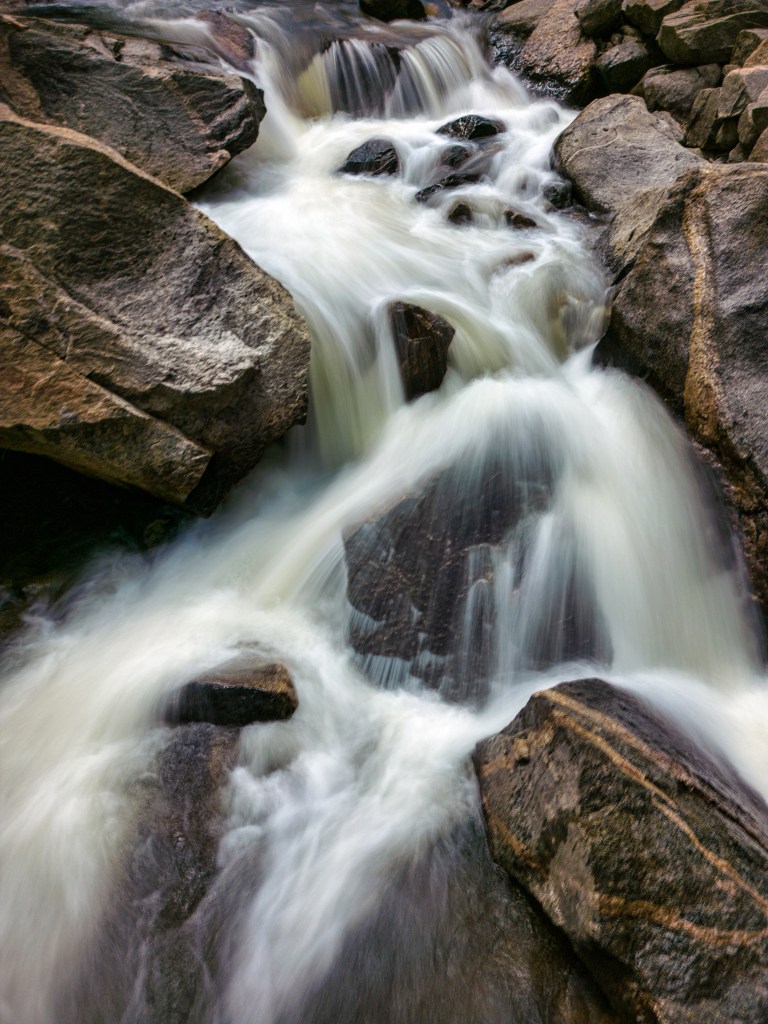
The photograph of Boulder Falls captures the intricate interplay of water and rock in Colorado’s canyon, showcasing the photographer’s mastery of long exposure techniques. Using a Nikon D610, the image balances smooth water motion with structural clarity. This work signifies a matured artistic voice within the broader context of his evolving landscape photography.

Long-exposure view of Boulder Falls flowing over rocks into a shallow pool within a rocky canyon.
Long-exposure photograph of Boulder Falls cascading through a rocky canyon in Colorado.

The photographer’s mastery of long exposure technique reaches full maturity in this commanding portrait of Boulder Falls, where water, stone, and light converge in a composition of remarkable spatial depth and textural complexity. Captured with a Nikon D610 and an 18-35mm f/3.5-4.5 lens at its widest setting of 18mm, the image employs a half-second exposure at ƒ/4.0 and ISO 100 to render cascading water as ethereal veils against the canyon’s ancient geological architecture.

The composition operates on multiple planes, drawing the eye through a carefully orchestrated visual journey. In the immediate foreground, stream-smoothed boulders—some dry and tan, others wet and rust-colored—create a rocky platform that grounds the viewer’s perspective. Water flows around and between these stones in delicate ribbons, their motion captured as soft blur that contrasts with the sharp detail of stationary rock. The middle ground presents the falls itself, a luminous white cascade plunging through a dramatic cleft in the granite amphitheater. Finally, the background reveals towering rock walls in warm earth tones, their fractured surfaces speaking to millennia of geological upheaval, crowned by evergreen forest and a brilliant blue sky.

What distinguishes this work from countless waterfall photographs is the photographer’s sophisticated understanding of how long exposure serves composition rather than merely creating predictable aesthetic effects. The half-second shutter speed proves precisely calibrated—long enough to smooth the water into silken forms while short enough to preserve structural definition in the cascade. The falls maintain sculptural presence rather than dissolving into amorphous white masses. Similarly, the foreground stream retains enough texture and gradation to read as water in motion rather than abstract blur.

The technical choices reveal deliberate control over the medium. The wide 18mm focal length encompasses the entire scene’s grandeur while maintaining exceptional corner-to-corner sharpness, crucial when working with such complex spatial relationships. The ƒ/4.0 aperture balances depth of field considerations—keeping both foreground rocks and distant walls acceptably sharp—with the light reduction necessary for the extended exposure. At ISO 100, the image maintains optimal clarity across its tonal range, from the brightest highlights in the falling water to the shadowed crevices in the surrounding stone.

The inclusion of this photograph in Chapter 3—Colorado Landscapes & Cityscapes—marks a significant development in the photographer’s journey. Where earlier chapters saw him exploring beyond Florida’s boundaries, this chapter formalizes Colorado as a central subject within his practice. The image embodies what might be termed “high country aesthetics”: the interplay of water and granite, the vertical drama of canyon topography, the crystalline light of elevated altitude. These elements recur throughout Rocky Mountain landscape photography, yet the photographer brings fresh eyes to familiar territory through precise craft and compositional intelligence.

Within the broader context of the Top 100 Journey project, “Boulder Falls Long Exposure” represents an artist who has moved beyond technical experimentation toward mature artistic voice. The photograph demonstrates that mastery emerges not from discovering novel techniques but from wielding established ones with intention, subtlety, and unwavering attention to the specific demands of place and moment.

Boulder Creek Long Exposure

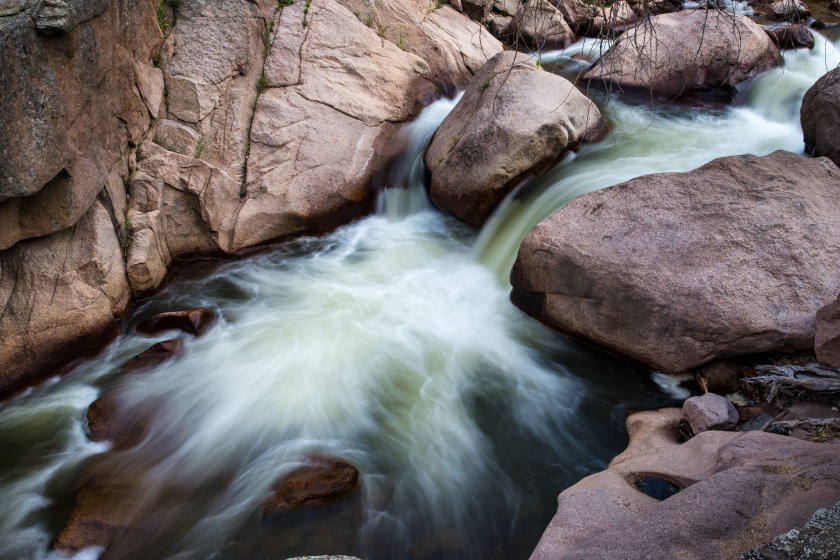
The aerial photograph of Boulder Creek, captured with a DJI Mini 3 Pro drone, showcases a harmonious blend of long exposure techniques and modern technology. The composition balances flowing water and angular granite boulders, creating an abstract visual narrative that highlights the juxtaposition of motion and permanence in landscape photography.

Long-exposure view of flowing creek water cascading over large rocks in a narrow channel.
Long-exposure water flows over boulders in Boulder Creek along Boulder Canyon Drive, Colorado.

This aerial perspective of Boulder Creek represents a striking departure in both technical approach and creative vision, captured not with traditional camera equipment but with a DJI Mini 3 Pro drone equipped with a Freewell ND2000 filter. The photographer’s willingness to embrace emerging technologies while maintaining classical long exposure techniques demonstrates an adaptive practice that refuses to be constrained by conventional methodologies. Shot at 6.7mm with ƒ/1.7 aperture, 1/2 second exposure, and ISO 100, the image transforms cascading water and weathered granite into an abstract study of motion and permanence.

The aerial vantage point offers what might be termed a “god’s eye” perspective—looking directly down upon the creek as it navigates through massive boulders along Boulder Canyon Drive. This top-down orientation fundamentally alters the traditional landscape viewing experience. Rather than observing the scene from a human standpoint at creek level, the viewer hovers above, granted access to compositional relationships and water patterns typically invisible from ground perspective. The half-second exposure blurs the rushing water into silken ribbons that weave between dark stones, creating organic shapes that appear almost calligraphic against the textured rock surfaces.

The geological elements provide crucial counterpoint to the flowing water. Angular granite boulders, their surfaces marked by striations and mineral deposits, display warm ochre and gray tones that anchor the composition’s cooler water tones. These stones reveal billions of years of geological history—compression, uplift, erosion—rendered in layers and fractures visible even from the drone’s elevation. The photographer frames the scene to balance solid mass with liquid movement, allowing neither element to dominate but instead creating a dynamic equilibrium between opposing forces.

The technical execution demonstrates sophisticated problem-solving. Achieving long exposure effects from an airborne platform presents unique challenges—the drone itself must remain perfectly stable while the camera shutter stays open. The ND2000 filter proves essential, reducing light transmission sufficiently to permit a half-second exposure in daylight conditions without overexposure. At ƒ/1.7, the lens operates wide open, yet the minimal depth of field concerns inherent in macro or portrait photography become irrelevant when shooting from such elevation; everything within the frame exists at roughly equivalent focus distance.

Within Chapter 2—Florida Landscapes & Cityscapes—this Colorado waterway continues the photographer’s geographic expansion evident throughout this section of the Top 100 Journey. The consistent choice to photograph Rocky Mountain landscapes suggests deliberate exploration of environments radically different from Florida’s flat, subtropical character. Perhaps this juxtaposition serves the project’s broader narrative: an artist defining his vision through contrast, discovering what landscape means by experiencing its various manifestations across diverse topographies.

“Boulder Creek Long Exposure 001” ultimately represents the democratization of aerial perspective through consumer drone technology, married to time-honored long exposure aesthetics. The photographer recognizes that tools matter less than vision—that a small drone can produce work as artistically valid as traditional large-format equipment when wielded with intention and compositional awareness. The image stands as testament to adaptive practice in contemporary landscape photography, where technical innovation serves timeless artistic goals.