Elkins Apple Spiced Liqueur: Vernacular Object as Subject

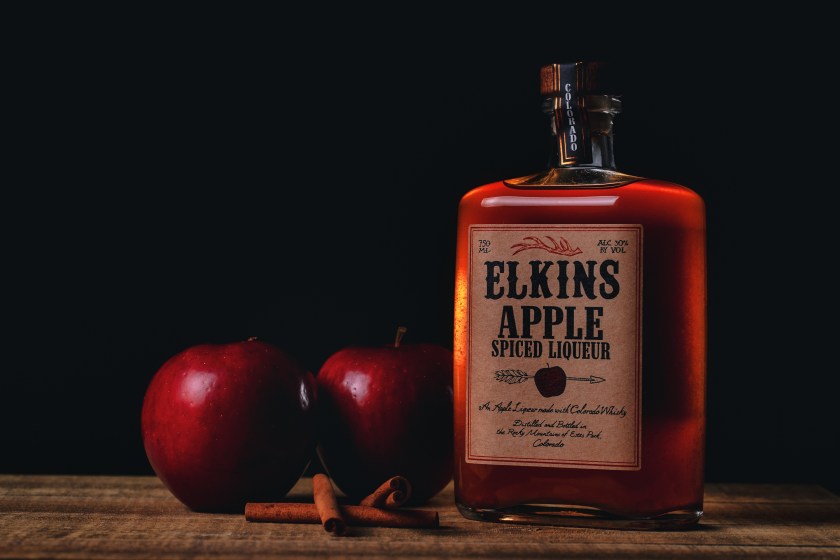
The photograph of Elkins Apple Spiced Liqueur exemplifies a blend of commercial product photography and fine art still life, using classical composition techniques. The arrangement of the bottle with apples and cinnamon sticks highlights flavor context while demonstrating technical skill in lighting and focus. The image showcases an accessible beauty in everyday items, merging artistic intent with commercial appeal.

Bottle of Elkins Apple Spiced Liqueur on a wooden surface with red apples and cinnamon sticks against a dark background.
Elkins Apple Spiced Liqueur is photographed with apples and cinnamon sticks in a studio still life.

This photograph demonstrates the photographer’s engagement with commercial product photography conventions while maintaining artistic intentionality characteristic of fine art still life practice. The composition centers on a bottle of Elkins Apple Spiced Liqueur from Estes Park, Colorado, flanked by red apples and cinnamon sticks—elements that function both as contextual reinforcement of the product’s flavor profile and as formal echoes of color and shape within the frame.

The arrangement follows classical still life principles: objects positioned on a weathered wooden surface against a dark, graduated background that moves from deep black to subtle illumination. This chiaroscuro approach recalls Dutch Golden Age painting traditions, where selective lighting carves form from darkness and imbues everyday objects with weight and presence. The bottle’s amber-red liquid becomes luminous against the void, while the apples emerge from shadow with enough detail to register their texture and mass without competing for primary focus.

Technically, the image reveals deliberate choices in equipment and lighting strategy. Shot with a Sony A7ii and 85mm f/1.8 lens, the photographer employs a focal length typically reserved for portraiture, which compresses space slightly and allows selective focus while maintaining natural perspective. The use of a Godox softbox combined with a secondary flash creates dimensional lighting—the main light source appears positioned to camera right, creating highlights on the bottle’s curved surface and label while the fill light softens shadows without eliminating them entirely. This two-light setup produces the polished yet natural quality that distinguishes professional product photography from amateur attempts.

The label itself becomes a compositional element worth examining. Its vintage-inspired design, complete with wheat motif and hand-drawn typography, speaks to contemporary craft distillery aesthetics that reference historical authenticity. The photographer allows this graphic element full legibility, understanding that typography and branding function as visual information within the frame. The cork cap with its branded sleeve adds vertical interest and completes the bottle’s narrative as an artisanal product.

Within Chapter 5’s spectrum from classic to experimental still life, this work occupies the classical end—a straightforward, beautifully executed product study that prioritizes clarity, atmosphere, and material fidelity over conceptual disruption. Yet the photographer’s decision to include this image in his top 100 suggests recognition that mastery of foundational approaches remains essential even as one pushes toward experimental territories. The work demonstrates technical competence: precise focus, appropriate depth of field, balanced exposure across a challenging tonal range, and color palette that feels both rich and naturalistic.

The supporting elements—grocery store apples and cinnamon sticks—ground the image in accessible reality rather than aspirational luxury. This democratic approach to sourcing props reflects contemporary still life practice that finds beauty in the everyday rather than the exotic. The wooden surface, likely the photographer’s own workspace, bears authentic wear that reads as character rather than distress.

Post-processing in Luminar 4 appears restrained, enhancing rather than transforming the captured scene. The final image possesses the polish of commercial work while retaining the considered composition and atmospheric quality that elevates it to fine art documentation of material culture and regional craft production.
Kelly

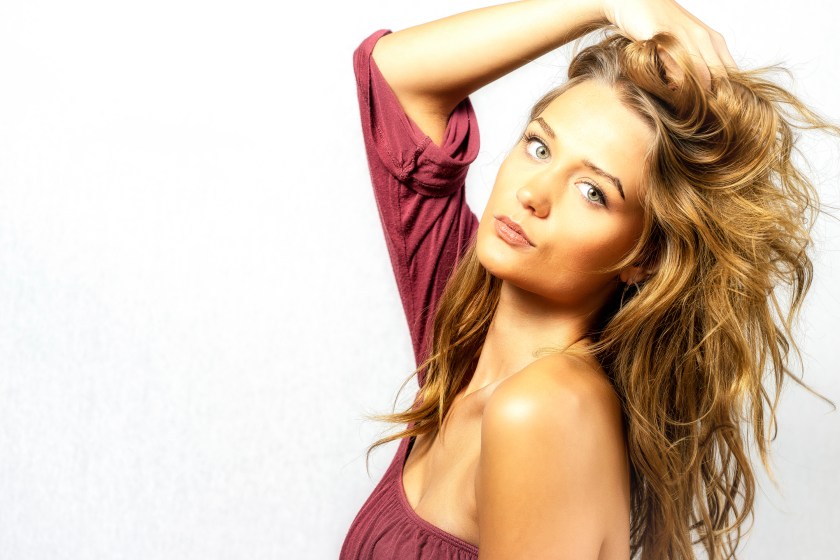
PKelly R. Bienfang’s studio portrait captures the essence of minimalist photography, focusing on the subject against a clean white backdrop. Utilizing controlled lighting and strategic posing, the image showcases the photographer’s skill and adaptability. It highlights the evolving rapport between photographer and subject, emphasizing the importance of genuine collaboration in achieving impactful portraits.

Woman with long light brown hair posing against a white background, one arm raised to her head, wearing a sleeveless top.
PKelly R. Bienfang poses during a studio portrait session in Fort Collins, Colorado.

This portrait from Chapter 4 of Greg Urbano’s Top 100 Journey exemplifies the photographer’s refined approach to studio portraiture, demonstrating how minimalist environments and controlled lighting can distill a subject’s presence to its essential elements. Captured at Old Town Yoga in downtown Fort Collins, Colorado, the image reveals the photographer’s ability to transform functional spaces into effective portrait studios, a skill central to the chapter’s exploration of diverse shooting contexts.

The composition centers on the subject, Kelly, photographed against a pure white backdrop that eliminates all contextual information, focusing attention entirely on her form, expression, and movement. Her pose—arm raised to gather flowing hair, head tilted, gaze directed toward the camera—suggests a moment caught between deliberate positioning and natural gesture. The wind-swept quality of her hair introduces dynamic motion into an otherwise static studio setup, creating visual energy that prevents the portrait from settling into conventional headshot territory.

The photographer’s technical execution demonstrates consistent mastery of the equipment established throughout this chapter. Working with the Sony A7ii and 85mm f/1.8 lens, supplemented by a Godox V1s flash modified through a shoot-through umbrella, he has created illumination that reads as both bright and dimensioned. The lighting wraps evenly across the subject’s features while maintaining sufficient shadow information to model her facial structure and the curves of her shoulders and arms. The high-key approach—white background, luminous skin tones—requires precise exposure control to prevent blown highlights while retaining textural detail in hair and fabric.

Color becomes a critical compositional element in this reduced visual field. The deep burgundy of Kelly’s garment provides the primary chromatic accent against the neutral backdrop and warm skin tones, creating a complementary relationship that anchors the eye. The photographer has allowed the subject’s honey-blonde hair to cascade freely, its varied tones adding subtle complexity to the upper portion of the frame. Post-processing in Luminar 4 has yielded clean, commercial-quality results—polished without appearing artificial, enhanced without sacrificing the authentic quality of skin and texture.

Within the broader context of Chapter 4, this photograph represents the studio portrait in its most distilled form. While other works in this series incorporate environmental elements or natural light scenarios, this image strips away such variables to focus purely on subject, light, and photographer’s vision. The setting at Old Town Yoga—likely chosen for its available space and clean backgrounds rather than thematic connection—underscores the photographer’s adaptability, his capacity to identify and utilize whatever resources a location offers.

The portrait also reflects evolving confidence in direction and collaboration. The pose suggests active guidance rather than passive documentation, indicating the photographer’s growing comfort in shaping rather than merely recording moments. Kelly’s ease before the camera—the natural grace of her gesture, the direct engagement of her gaze—speaks to successful rapport between photographer and subject, that intangible but essential element of portrait work that transcends technical proficiency.

This image stands as evidence of the photographer’s progression toward professional fluency in controlled portrait environments, demonstrating that compelling imagery emerges not from elaborate setups but from clear vision executed with precision.

Maia del Mazo Urban : A Study in Contemporary Youth Portraiture

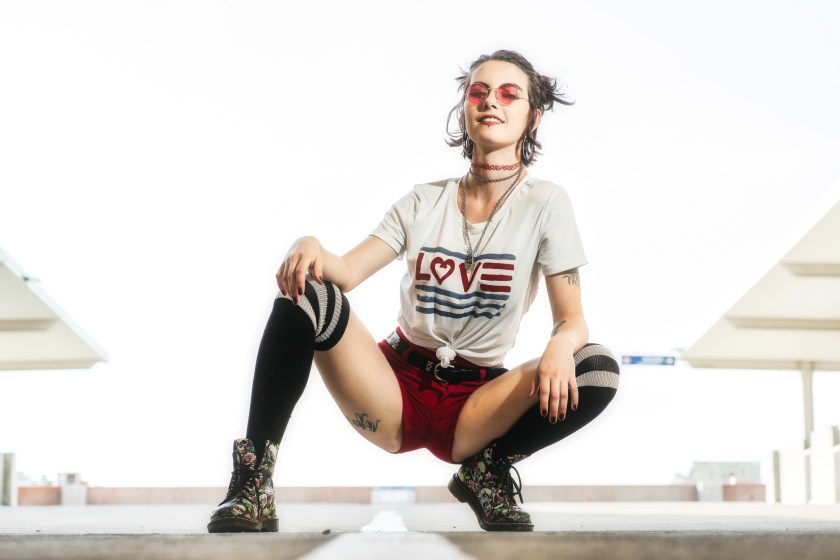
Maia del Mazo’s portrait, captured in Old Town Fort Collins, exemplifies the intersection of contemporary youth culture and environmental portraiture. Utilizing natural light and artificial enhancement, the photographer balances technical precision with spontaneity. The subject’s confident pose and styling reflect a subcultural moment, fostering an authentic connection with the viewer.

Woman wearing red shorts and knee-high socks crouches on a concrete surface in an urban setting with bright sky behind her.
Maia del Mazo poses in an urban location in Old Town Fort Collins, Colorado.

Within Chapter 4 of the photographer’s Top 100 Journey—dedicated to studio, outdoor, and workshop portraiture—this image of Maia del Mazo emerges as a compelling examination of contemporary youth culture and environmental portraiture. Shot in Old Town Fort Collins, Colorado, the photograph demonstrates the artist’s evolving command of natural light augmented by carefully controlled artificial illumination, a technical approach that has become increasingly refined throughout this chapter of his documentary project.

The composition presents the subject in a confident, grounded squat position against a minimalist architectural backdrop. Her styling—vintage band aesthetic meeting modern streetwear, complete with floral combat boots, striped knee socks, and layered chokers—speaks to a specific subcultural moment. The photographer has positioned her centrally within the frame, allowing the clean lines of the urban architecture to recede into soft focus, creating negative space that amplifies the subject’s presence rather than competing with it.

Technically, the image represents a sophisticated balance between available daylight and artificial enhancement. Shot with a Sony A7ii paired with an 85mm f/1.8 lens, the photographer employed a handheld Godox V1s flash without modification—a bold choice that suggests confidence in reading ambient conditions. The direct flash technique produces a subtle fill that lifts shadows without flattening the image’s dimensionality, while the 85mm focal length compresses the background just enough to isolate the figure without creating unnatural bokeh. The slight wind-swept quality of the subject’s hair adds dynamism to what might otherwise read as a static pose.

What distinguishes this work within the chapter’s broader context is its departure from traditional studio control. While maintaining the technical precision associated with formal portraiture, the photographer embraces environmental elements—concrete surfaces, architectural geometry, natural wind movement—that introduce spontaneity into the frame. This hybrid approach reflects an evolution in his practice, moving beyond purely controlled studio environments toward a more flexible methodology that captures authentic personality within structured compositions.

The post-processing in Luminar 4 demonstrates restraint appropriate to the subject matter. Color grading emphasizes warm tones in the subject’s skin and the amber cast of her sunglasses while maintaining the cooler neutrals of the concrete and sky. The processing enhances rather than transforms, supporting the documentary quality inherent in the photographer’s approach to his Top 100 Journey project.

The subject’s body language—relaxed yet assertive, casual yet deliberate—suggests a collaborative relationship between photographer and sitter. This comfort level allows for genuine expression rather than performative posing, a quality that distinguishes effective contemporary portraiture from mere documentation. The direct, knowing gaze above the rose-tinted frames establishes connection with the viewer while maintaining a degree of cool remove characteristic of youth subculture.

As part of the photographer’s long-term Top 100 Journey, this image contributes to an ongoing investigation into portraiture’s capacity to capture both individual personality and broader cultural moments. It represents the workshop and outdoor component of Chapter 4’s mission, demonstrating how environmental factors and technical adaptability can produce work that honors both formal photographic traditions and contemporary visual language. The result is a portrait that feels simultaneously timeless in its compositional confidence and distinctly anchored in its cultural moment.