The Studio as Theater: Classical Portraiture in Contemporary Practice

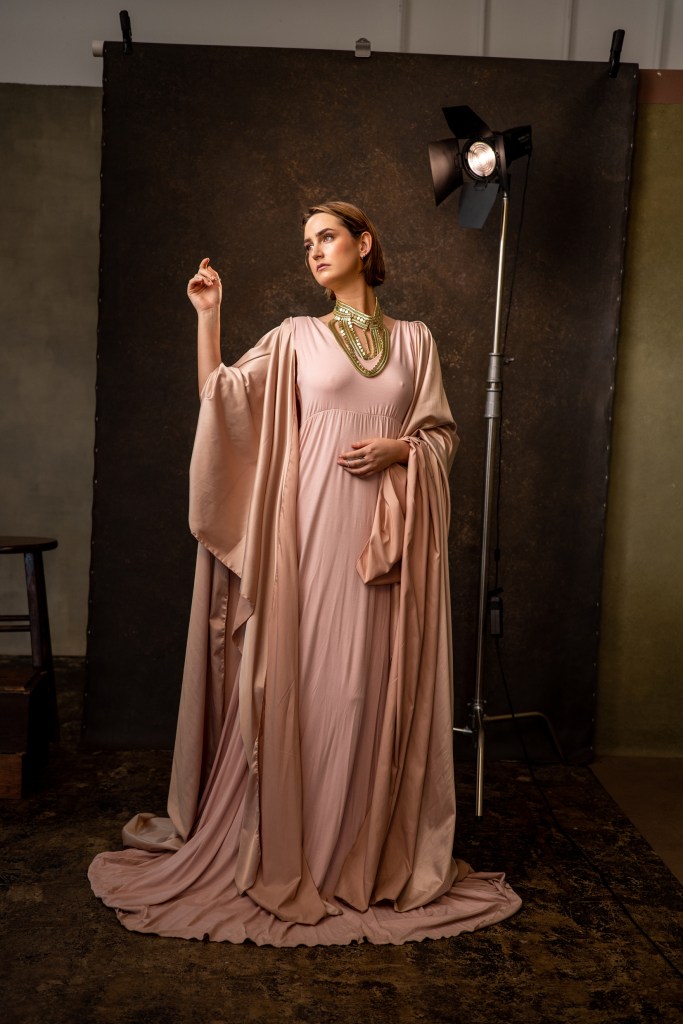
Jessica Lynn’s studio portrait showcases a fusion of classical portraiture and contemporary technique, created during a workshop at Atelier Alchimia. The photograph illustrates the artist’s growth through collaboration, using refined lighting to enhance the subject’s regal appearance. This work embodies artistic evolution, blending tradition with innovation while emphasizing continuous learning.

Studio portrait of Jessica Lynn standing in a flowing blush-colored gown, posed in front of a dark backdrop with a studio light visible behind her.
Jessica Lynn (QueenJess Rising) photographed in a studio setting during a workshop at Atelier Alchimia in Westminster, Colorado.

This studio portrait from Chapter 6 of the photographer’s Top 100 Journey represents a deliberate engagement with the formal traditions of classical portraiture, reimagined through contemporary technical means. Created during a workshop at Atelier Alchimia in Westminster, Colorado, the image demonstrates how collaborative learning environments can yield work of considerable aesthetic merit while advancing the artist’s technical vocabulary.

The subject, Jessica Lynn, is presented in a flowing blush-toned gown with dramatic bell sleeves that cascade to the floor, creating a silhouette reminiscent of Renaissance or Pre-Raphaelite painting. An ornate collar necklace in gold and green adds a regal quality that justifies the image’s title. The photographer has positioned her in a classical contrapposto-inspired stance—weight on one leg, torso gently twisted, one hand raised in a gesture of contemplation or perhaps benediction. This pose, combined with the upward gaze and theatrical lighting, evokes both historical portraiture and contemporary fashion photography’s ongoing dialogue with art history.

The technical execution reveals careful attention to studio craft. A single key light with barn doors, visible in the frame’s right edge, provides directional illumination that sculpts the subject’s features and creates tonal gradation across the fabric’s folds. The mottled canvas backdrop transitions from warm browns to darker tones, providing depth without competing for attention. The lighting setup, developed collaboratively with studio owner Jonny Edwards, demonstrates the photographer’s increasing comfort with controlled environments—a marked evolution from earlier work in the series that frequently engaged with natural light and outdoor settings.

What makes this image particularly relevant to “The Road Ahead: Recent Work & Ongoing Exploration” is its frank acknowledgment of artistic development through structured learning. Shot during a workshop led by Eric Brown, the photograph embodies a philosophy of continuous growth and technical refinement. Rather than presenting only work created in solitary practice, the photographer includes images born from educational contexts, recognizing that mastery often emerges through collaboration and mentorship.

The choice to work with studio lighting represents an expansion of technical range. The careful balance of exposure—maintaining detail in both the luminous fabric and the darker background—suggests growing confidence with artificial light sources. The warm color palette creates cohesion between subject, costume, and environment, while the visible studio elements (backdrop clamps, light stand) provide documentary transparency about the image’s construction.

Within the broader arc of the Top 100 Journey, this portrait signals a willingness to explore different photographic modes. Where earlier chapters emphasized environmental and location work, this studio piece demonstrates versatility and an interest in controlled aesthetic experiences. The theatrical quality—the visible apparatus of image-making—invites viewers into the creative process rather than presenting a seamless illusion.

The photograph succeeds both as a study in classical beauty and as evidence of artistic evolution. It captures a moment of learning translated into accomplished execution, showing that the road ahead need not abandon traditional craft in pursuit of innovation. Instead, it suggests that mastery comes through accumulation—building new skills atop established foundations, always remaining open to guidance, collaboration, and the timeless appeal of light falling gracefully upon fabric and form.
Joy

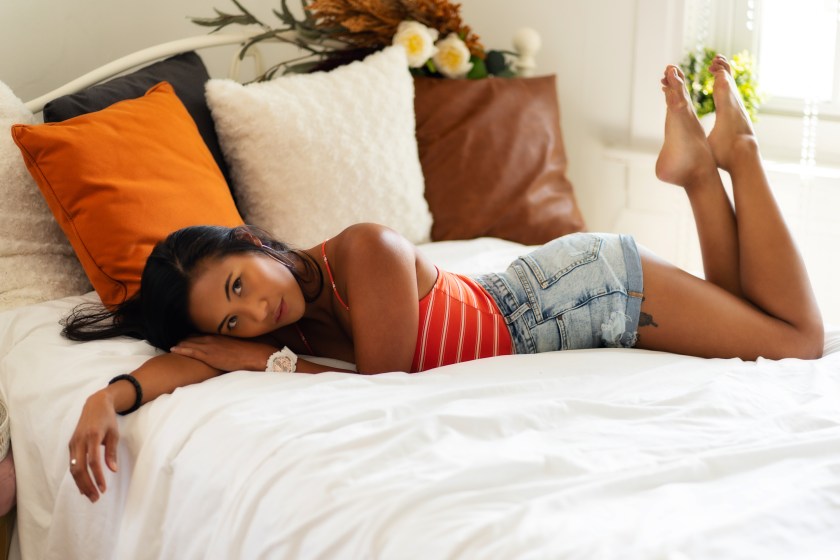
Joy’s portraiture, captured during a studio session in Denver, exemplifies contemporary photography that harmonizes technical prowess with intimate atmosphere. Using controlled lighting and thoughtful composition, the image showcases Joy’s comfort and presence. It reflects the photographer’s growth in creating authentic portrayals within collaborative workshop settings, emphasizing spontaneity amidst structure.

Woman lies on her stomach on a bed with pillows, looking toward the camera in a softly lit indoor space.
Joy reclines on a bed during a studio session at Headquarters in Denver, Colorado.

Within Chapter 4 of Greg Urbano’s Top 100 Journey—a section dedicated to studio, outdoor, and workshop portraiture—this photograph stands as a compelling study in contemporary portraiture that balances technical precision with an atmosphere of relaxed intimacy. Captured during the Sunday Night Meets sessions at the Headquarters in Denver, Colorado, the image demonstrates the photographer’s evolving command of controlled lighting environments and his ability to translate spontaneity into refined compositional structure.

The subject, identified simply as Joy, reclines across a bed adorned with an array of textured pillows in warm earth tones—burnt orange, cream, and cognac leather—that create a sophisticated color palette against crisp white linens. Her pose suggests ease and self-possession, legs bent upward, body stretched diagonally across the frame in a manner that fills the space without appearing contrived. The composition guides the viewer’s eye from her contemplative expression through the length of her form, utilizing the diagonal as a classical device to create visual momentum within an otherwise still domestic scene.

Technically, the photographer employed a Sony A7ii paired with an 85mm f/1.8 lens, supplemented by a Godox V1s flash fired through a shoot-through umbrella. This setup reveals a deliberate approach to managing the challenge of interior lighting. The umbrella modifier produces soft, directional illumination that wraps around the subject’s features and limbs, creating gentle gradations of shadow that model form without harsh contrast. The 85mm focal length, a portrait standard, maintains proper perspective while allowing sufficient working distance in what appears to be a modest interior space. The choice to augment available window light with flash demonstrates an understanding that control, rather than pure naturalism, often serves the portrait best.

The environmental context—a workshop setting where photographers gather to practice and experiment—adds significance to the technical choices evident here. Such collaborative sessions demand efficiency and adaptability, requiring the photographer to balance artistic vision with the practical constraints of shared time and space. That this image emerged from such circumstances speaks to his ability to synthesize technical preparation with responsive observation, recognizing and capturing moments of genuine presence even within structured shooting scenarios.

Post-processing in Skylum’s Luminar 4 has yielded a polished yet authentic aesthetic. The skin tones register warmly against the cooler neutrals of the background, while the overall color grading maintains consistency with the chapter’s broader visual language. The photographer has avoided the temptation toward heavy manipulation, instead allowing the fundamental strength of the capture—lighting, composition, and subject rapport—to carry the image.

Within the trajectory of Chapter 4, this photograph represents the photographer’s progression from purely technical competency toward a more holistic understanding of portraiture as collaborative performance. The subject’s comfort before the camera, the thoughtfully curated environment, and the measured application of artificial light combine to create an image that feels both intentional and uncontrived. It exemplifies the workshop paradigm at its most productive: controlled conditions that paradoxically enable spontaneity, resulting in portraiture that documents not just appearance, but a quality of presence that transcends the specifics of its making.

Kelly: Classical Portraiture in Natural Light

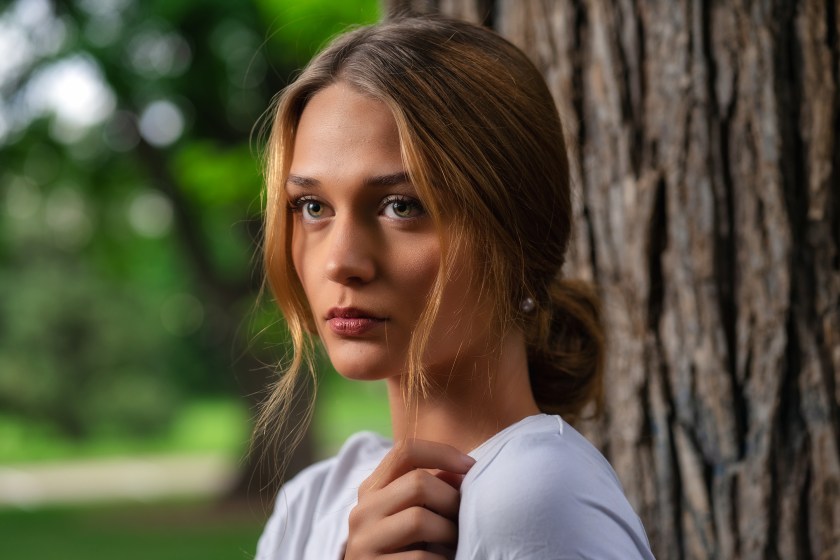
Kelly R. Bienfang’s portrait in Fort Collins’ City Park showcases refined environmental portraiture, merging classic lighting techniques with natural settings. The composition emphasizes psychological presence through thoughtful framing and soft lighting, achieving dimensionality. Using traditional optics and careful post-processing, the image balances contemporary authenticity with technical precision, reinforcing the importance of classical methods in outdoor photography.

Woman with light brown hair stands beside a tree in a park, looking toward the camera with a soft green background.
Kelly R. Bienfang poses beside a tree in City Park, Fort Collins, Colorado.

This portrait of Kelly exemplifies the photographer’s command of environmental portraiture, demonstrating how classical lighting techniques can be sensitively adapted to outdoor contexts. Created in City Park, Fort Collins, the image represents a refinement of traditional portrait methodology—translating studio principles into naturalistic settings while preserving the intimacy and control typically associated with interior work.

The composition centers on a three-quarter view of the subject positioned against the textured bark of a substantial tree trunk. This anchoring element provides both physical and visual grounding, its vertical mass creating structural balance while its organic texture contrasts productively with the smooth contours of the subject’s face. The decision to place Kelly against this natural backdrop rather than opening the frame to broader park vistas reflects deliberate focus—prioritizing psychological presence over environmental documentation.

The lighting execution reveals sophisticated outdoor flash technique. Employing a single strobe with shoot-through umbrella, the photographer has created illumination that appears to extend rather than contradict the existing ambient light. The soft directional quality—evident in the delicate gradation across the subject’s face and the luminous edge separation along her profile—suggests careful positioning to mimic golden hour sun while maintaining consistent exposure control. This hybrid approach, blending natural and artificial light sources, achieves what purely available light could not: sculptural dimensionality without harsh shadow or unflattering overhead illumination.

The subject’s positioning and expression demonstrate thoughtful directorial collaboration. Kelly’s gaze, angled slightly upward and away from the lens, creates contemplative distance while her hand’s gentle placement at the shoulder introduces subtle gesture without performative emphasis. This combination of turned body and averted eyes establishes a portrait that feels observed rather than confrontational—inviting viewer attention while maintaining the subject’s interior privacy. The styling choice of a simple white garment serves the image’s tonal strategy, providing clean highlight mass that draws focus toward facial features and natural coloring.

Technical choices throughout support this classical approach. The Sony 85mm f/1.8 lens, deployed on the Sony A7II body, offers the compression and shallow depth of field characteristic of traditional portrait optics. The resulting background dissolution—visible in the soft green bokeh representing distant foliage—eliminates visual competition while establishing atmospheric color context. Post-processing in Luminar 4 has enhanced the warm color palette, emphasizing the golden light quality playing across skin tones and hair while maintaining natural saturation levels.

Within Chapter 4’s examination of portrait methodologies, this photograph demonstrates the photographer’s ability to execute formal portraiture outside controlled studio environments. The work shows less interest in contemporary street portrait spontaneity than in translating time-tested studio aesthetics into outdoor practice—a technically demanding approach requiring precise light manipulation and environmental awareness simultaneously.

The image also illustrates evolution in his workshop-informed practice. The confidence evident in both lighting execution and subject direction suggests accumulated knowledge from collaborative learning environments, where traditional portrait techniques are studied and adapted. This photograph represents portraiture rooted in classical principles—emphasizing beauty, technical precision, and dignified subject representation—while acknowledging contemporary preferences for natural settings and authentic expression.

As part of his broader Top 100 Journey documentation, this work affirms the continuing relevance of foundational portrait techniques when executed with skill and sensitivity. It demonstrates how environmental portraiture can achieve the polish and intentionality of studio work without sacrificing the organic qualities that location shooting provides.