Maia del Mazo Urban : A Study in Contemporary Youth Portraiture

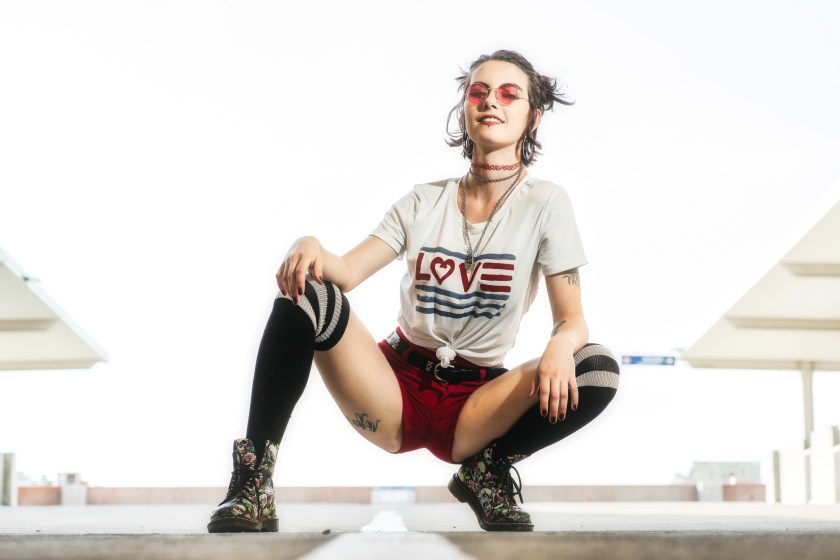
Maia del Mazo’s portrait, captured in Old Town Fort Collins, exemplifies the intersection of contemporary youth culture and environmental portraiture. Utilizing natural light and artificial enhancement, the photographer balances technical precision with spontaneity. The subject’s confident pose and styling reflect a subcultural moment, fostering an authentic connection with the viewer.

Woman wearing red shorts and knee-high socks crouches on a concrete surface in an urban setting with bright sky behind her.
Maia del Mazo poses in an urban location in Old Town Fort Collins, Colorado.

Within Chapter 4 of the photographer’s Top 100 Journey—dedicated to studio, outdoor, and workshop portraiture—this image of Maia del Mazo emerges as a compelling examination of contemporary youth culture and environmental portraiture. Shot in Old Town Fort Collins, Colorado, the photograph demonstrates the artist’s evolving command of natural light augmented by carefully controlled artificial illumination, a technical approach that has become increasingly refined throughout this chapter of his documentary project.

The composition presents the subject in a confident, grounded squat position against a minimalist architectural backdrop. Her styling—vintage band aesthetic meeting modern streetwear, complete with floral combat boots, striped knee socks, and layered chokers—speaks to a specific subcultural moment. The photographer has positioned her centrally within the frame, allowing the clean lines of the urban architecture to recede into soft focus, creating negative space that amplifies the subject’s presence rather than competing with it.

Technically, the image represents a sophisticated balance between available daylight and artificial enhancement. Shot with a Sony A7ii paired with an 85mm f/1.8 lens, the photographer employed a handheld Godox V1s flash without modification—a bold choice that suggests confidence in reading ambient conditions. The direct flash technique produces a subtle fill that lifts shadows without flattening the image’s dimensionality, while the 85mm focal length compresses the background just enough to isolate the figure without creating unnatural bokeh. The slight wind-swept quality of the subject’s hair adds dynamism to what might otherwise read as a static pose.

What distinguishes this work within the chapter’s broader context is its departure from traditional studio control. While maintaining the technical precision associated with formal portraiture, the photographer embraces environmental elements—concrete surfaces, architectural geometry, natural wind movement—that introduce spontaneity into the frame. This hybrid approach reflects an evolution in his practice, moving beyond purely controlled studio environments toward a more flexible methodology that captures authentic personality within structured compositions.

The post-processing in Luminar 4 demonstrates restraint appropriate to the subject matter. Color grading emphasizes warm tones in the subject’s skin and the amber cast of her sunglasses while maintaining the cooler neutrals of the concrete and sky. The processing enhances rather than transforms, supporting the documentary quality inherent in the photographer’s approach to his Top 100 Journey project.

The subject’s body language—relaxed yet assertive, casual yet deliberate—suggests a collaborative relationship between photographer and sitter. This comfort level allows for genuine expression rather than performative posing, a quality that distinguishes effective contemporary portraiture from mere documentation. The direct, knowing gaze above the rose-tinted frames establishes connection with the viewer while maintaining a degree of cool remove characteristic of youth subculture.

As part of the photographer’s long-term Top 100 Journey, this image contributes to an ongoing investigation into portraiture’s capacity to capture both individual personality and broader cultural moments. It represents the workshop and outdoor component of Chapter 4’s mission, demonstrating how environmental factors and technical adaptability can produce work that honors both formal photographic traditions and contemporary visual language. The result is a portrait that feels simultaneously timeless in its compositional confidence and distinctly anchored in its cultural moment.
Colorado Capital Rotunda: A Study in Civic Monumentality

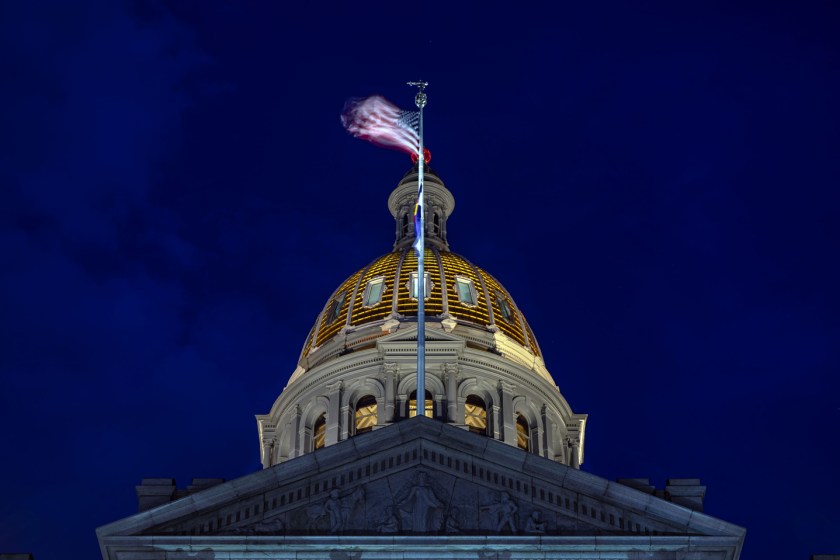
The photograph of the Colorado State Capitol at night showcases the blend of technical skill and atmospheric expression in architectural photography. Captured during the blue hour, it emphasizes the dome’s gilded brilliance against a cobalt sky, revealing a balance of light, color, and human presence, while symbolizing civic power and cultural heritage.

Night view of the Colorado State Capitol dome with a motion-blurred American flag against a deep blue sky.
The illuminated rotunda of the Colorado State Capitol rises above the building exterior at night in Denver, Colorado.

In this commanding nocturnal study of the Colorado State Capitol, the photographer demonstrates a refined understanding of architectural photography’s dual responsibilities: technical precision and atmospheric interpretation. Selected for Chapter 3 of his Top 100 Journey project—Colorado Landscapes & Cityscapes—this image represents a pivotal moment in his exploration of the built environment, where civic architecture becomes a vehicle for examining light, color, and symbolic presence.

The composition centers on the capitol’s gilded dome, captured during the blue hour when natural and artificial light exist in delicate equilibrium. This timing proves essential to the photograph’s success. The deep cobalt sky provides a saturated backdrop that amplifies the dome’s golden luminosity, creating a color relationship that feels both dramatic and harmonious. The warm interior lights visible through the arched windows add a third tonal layer, suggesting human activity within the monumental structure and grounding the image in the present moment rather than rendering it as pure abstraction.

Technical choices reveal deliberate restraint. Shot with a Sony A7 II and the modest FE 28-70mm f/3.5-5.6 OSS kit lens at 67mm, the equipment demonstrates that compelling imagery emerges from vision rather than gear acquisition. The exposure settings—f/6.3 at two seconds, ISO 50—indicate careful balancing of depth of field with the need to maintain sharpness during a moderately long exposure. The low ISO preserves image quality while the aperture ensures adequate detail across the dome’s ornate surface. The two-second shutter speed captures the flag’s motion blur, introducing a kinetic element that contrasts with the building’s permanence.

The symmetrical framing amplifies the capitol’s authority. By positioning the dome centrally and shooting from a low vantage point, the photographer emphasizes verticality and grandeur, compositional strategies long employed in architectural documentation to convey institutional power. Yet this image transcends mere documentation. The illuminated structure against the darkening sky transforms civic architecture into something more atmospheric—a beacon, a sculptural form isolated from its urban context.

Within the broader narrative of Chapter 3, this photograph serves as an essential counterpoint to natural landscape work. Where mountain vistas and wilderness scenes explore Colorado’s geological character, the capitol image examines human imprint on the landscape. The gold-leafed dome—a material detail worth noting for its literal and metaphorical weight—echoes the state’s mining heritage while asserting permanence and prosperity. The photographer captures not merely a building but a symbol, rendering it with enough aesthetic sophistication that the image functions simultaneously as architectural record and contemplative study.

The cool base lighting washing across the pediment introduces contemporary illumination techniques into classical architecture, creating temporal layering that speaks to preservation and adaptation. This detail, easily overlooked, suggests the photographer’s attention to how light shapes meaning and perception.

As part of the Top 100 Journey, this image demonstrates evolving technical confidence and conceptual maturity. The photographer moves beyond straightforward landscape capture toward work that interrogates place, power, and representation. The capitol becomes more than subject matter—it becomes a meditation on how we mark territory, assert identity, and illuminate what we value. In this nocturnal portrait of civic architecture, monumentality meets vulnerability, permanence meets fleeting light, and documentation becomes art.