Shannon Quinn Creative Red Mesh 01: Portraiture as Transformation

The portrait of model Shannon Quinn, captured with red mesh fabric, highlights the photographer’s creative departure during a commissioned headshot session in Denver. This image explores themes of identity and concealment, merging fashion and classical techniques. It reflects a sophisticated understanding of light and invites viewers to contemplate the complexities of photographic representation.

Studio portrait of model Shannon Quinn standing against a dark background, partially draped in red mesh fabric with hands raised and visible through the translucent material.
Model Shannon Quinn photographed in a studio portrait using red mesh during a creative headshot session in Denver, Colorado.

Within the context of a commissioned headshot session, the photographer discovered an opportunity for creative departure—a moment when commercial purpose yielded to artistic exploration. This photograph, featuring model Shannon Quinn enveloped in crimson mesh fabric, exemplifies his ability to recognize and pursue unexpected visual possibilities within structured professional environments. The resulting image transcends its utilitarian origins, offering instead a meditation on identity, concealment, and the transformative potential of portraiture.

The composition centers on the subject’s steady, outward gaze, her expression poised between vulnerability and defiance. She holds the translucent red fabric above her head with both hands, creating a canopy that simultaneously reveals and obscures. This gesture—part unveiling, part self-protection—establishes a compelling psychological tension. The mesh filters light across her features while maintaining visual clarity, creating a liminal space where the subject exists between states: seen yet veiled, present yet ethereal, contemporary yet somehow timeless.

The photographer’s handling of light demonstrates technical sophistication and restraint. Working against a dark, neutral background, he allows the ambient illumination to bathe the subject’s face in warm tones that harmonize with the red mesh. The fabric itself becomes an active participant in the lighting scheme, casting subtle patterns and chromatic shifts across her skin and clothing. Her black attire—a textured top with bow detail—provides essential contrast, anchoring the composition while allowing the red fabric to command attention without overwhelming the frame.

What distinguishes this work is its navigation of multiple photographic traditions simultaneously. Elements of fashion photography appear in the subject’s confident pose and styled presentation, while the dramatic use of fabric recalls classical painting techniques where drapery conveys narrative and emotional weight. The dark background and controlled studio lighting situate the image within portraiture’s formal conventions, yet the unconventional use of the mesh material disrupts these expectations, injecting contemporary conceptual sensibility into an otherwise traditional setup.

Positioned within Chapter 6 of his Top 100 Journey—”The Road Ahead: Recent Work & Ongoing Exploration”—this photograph signals the artist’s ongoing investigation into portraiture’s evolving possibilities. The chapter’s emphasis on recent work and exploration finds perfect expression here: a commissioned session becomes a laboratory for creative experimentation, demonstrating that artistic vision need not be confined to personal projects alone. Professional practice and artistic development exist not as separate domains but as mutually enriching pursuits.

The red mesh functions as both literal and metaphorical element—a physical barrier that paradoxically enhances rather than diminishes our connection to the subject. This duality speaks to fundamental questions about photographic representation itself: what do we truly see when we look at a portrait? How do layers of interpretation, context, and visual mediation shape our understanding of another person’s presence?

In Shannon Quinn’s direct gaze, there exists a knowing quality, an awareness of the camera’s scrutiny and the complex transaction occurring between subject, photographer, and eventual viewer. This consciousness elevates the image beyond mere technical accomplishment, transforming it into a collaborative exploration of visibility, identity, and the porous boundaries between commercial and fine art photography. It stands as evidence of his commitment to finding artistic merit wherever circumstances allow, refusing to separate professional obligation from creative possibility.
Suspended Between Earth and Sky: A Study in Geometric Embrace

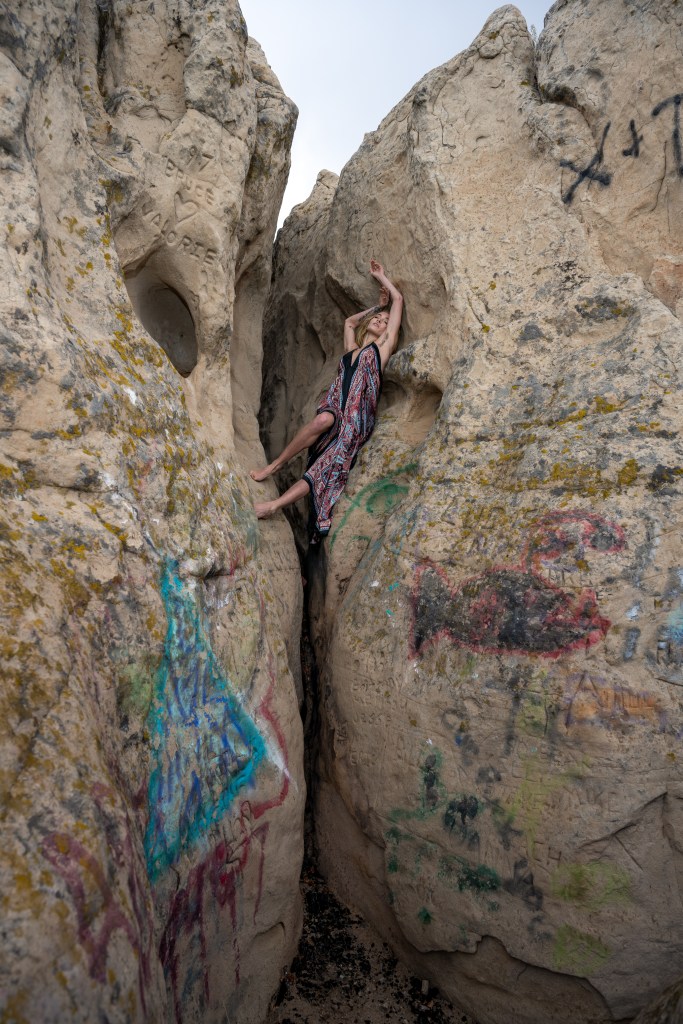
The photograph of Jennie Parks in a sandstone crevice at the Colorado-Wyoming border conveys a powerful interplay between human form and rugged landscape. The composition showcases Parks as both an integral part of the environment and a symbol of human vulnerability, enriched by graffiti that connects ancient rock with contemporary existence.

Model Jennie Parks posed barefoot within a narrow sandstone rock crevice, surrounded by weathered stone walls with graffiti and lichen.
Jennie Parks positioned inside a sandstone crevice at the Natural Fort rock formation on the Colorado–Wyoming border.

In this striking composition from Chapter 6 of the photographer’s Top 100 Journey, the human figure becomes a graceful counterpoint to the harsh geometry of desert stone. Shot at the natural fort rock formation straddling the Colorado-Wyoming border, the image captures model Jennie Parks wedged within a narrow crevasse, her body forming a living bridge between two massive limestone walls that tower overhead.

The photographer demonstrates a sophisticated understanding of environmental portraiture here, positioning his subject not merely within the landscape but as an integral element of its architecture. Parks’s extended pose—one arm reaching upward, legs braced against opposing walls—transforms the human form into a line of tension that mirrors the vertical thrust of the surrounding stone. The patterned fabric of her dress introduces rhythmic visual complexity against the textured, graffiti-marked surfaces of the rock, creating a dialogue between organic movement and geological permanence.

Technically, the composition exploits the natural framing device of the rock formation with considerable skill. The converging walls create strong diagonal lines that draw the eye upward toward the narrow strip of overcast sky, while the low vantage point emphasizes the vertiginous scale of the formation. The photographer has worked with available light to maintain detail in both the shadowed crevasse and the brighter upper reaches, a challenging exposure balance that preserves the dimensional quality of the weathered stone surfaces.

What distinguishes this work within the context of “The Road Ahead: Recent Work & Ongoing Exploration” is its synthesis of earlier themes with new formal rigor. The image continues the photographer’s established interest in the relationship between human vulnerability and natural grandeur, yet demonstrates an evolving sophistication in how that relationship is articulated. Rather than placing the figure as a small element overwhelmed by landscape—a common approach in environmental portraiture—he positions Parks as an active participant in the space’s geometry, neither dominated by nor dominating the scene.

The inclusion of graffiti on the rock faces introduces an unexpected documentary element. These colorful marks of human passage—blue and turquoise abstractions, faded pink tags—situate the timeless geological formation within contemporary reality. Rather than diminishing the image’s aesthetic power, this urban palimpsest enriches the reading: the rock has witnessed countless human gestures, from ancient weathering to modern spray paint to this moment of choreographed grace.

As representative of ongoing exploration, the photograph reveals an artist continuing to refine his visual vocabulary while remaining open to chance encounters and improvisation. The natural fort formation itself suggests the kind of site-responsive work that characterizes mature landscape photography—locations discovered rather than constructed, where the photographer’s role becomes one of recognition and revelation rather than wholesale invention.

In the broader trajectory of the Top 100 Journey, this image marks a moment of confident synthesis. The technical command is assured, the conceptual framework clear, yet there remains an element of spontaneity in how Parks inhabits the narrow space. It is work that looks both backward to established concerns and forward to possibilities yet unrealized—precisely the balance one expects from a chapter titled “The Road Ahead.”