Northern Hotel Lobby: Architecture as Stage in the Contemporary Photographic Journey

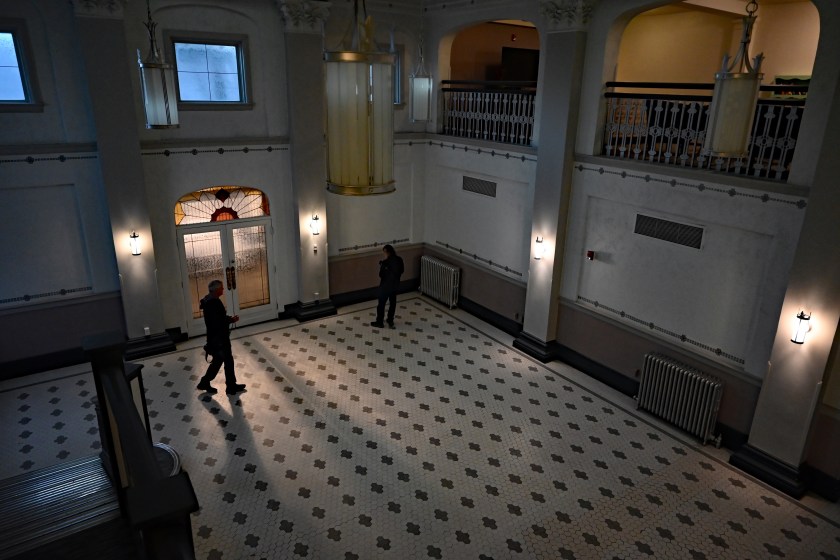
The photograph of the Northern Hotel lobby, taken during Scott Kelby’s Worldwide Photowalk, captures the interplay of light, architecture, and human presence. Elevating the viewer’s experience, it harmonizes historical preservation with contemporary exploration, highlighting the importance of collaborative practice in photography and the evolving narrative of space and community.

View of the Northern Hotel lobby from an upper staircase, showing patterned tile flooring, hanging lights, and two people walking across the open space below.
The Northern Hotel lobby in Fort Collins, photographed from the top of the staircase during Scott Kelby’s Worldwide Photowalk.

In this commanding architectural study, the photographer positions his lens at the apex of a staircase, transforming the Northern Hotel’s lobby into a theater of light, geometry, and human scale. Captured during Scott Kelby’s Worldwide Photowalk in Fort Collins, the image represents a significant entry in Chapter 6 of his Top 100 Journey—a section devoted to recent work and ongoing exploration. Here, the photographer’s evolving visual language finds purchase in the interplay between preserved historical space and contemporary documentary practice.

The composition demonstrates a mature understanding of spatial dynamics. Shot from an elevated vantage point, the frame encompasses the lobby’s full vertical reach, from the patterned terrazzo floor below to the arched balconies above. Two fellow photographers occupy the lower portion of the frame, their dark silhouettes providing crucial scale against the expanse of white walls and geometric flooring. This human element prevents the space from becoming merely an exercise in architectural documentation; instead, it anchors the viewer’s experience in a moment of shared discovery.

The photographer’s technical execution reveals deliberate choices regarding exposure and white balance. The warm incandescent glow from wall sconces contrasts with cooler ambient light filtering through windows, creating a subtle temperature gradient that enhances the lobby’s dimensionality. Pendant lights suspended from the ceiling echo this interplay, their cylindrical forms acting as vertical punctuation marks in the composition. The decorative tile borders running horizontally along the walls establish rhythm, while the radiators beneath provide industrial counterpoint to the space’s ornamental flourishes.

What distinguishes this work within the context of Chapter 6 is its relationship to process and community. Unlike the more introspective or solitary work that might characterize earlier chapters, this photograph emerges from collaborative exploration—a photowalk that brings practitioners together in shared discovery. The photographer’s decision to include his companions becomes a subtle commentary on the social dimensions of photographic practice, acknowledging that contemporary image-making often unfolds in dialogue with others.

The Northern Hotel itself, with its restored early twentieth-century details, offers fertile ground for examining how historical architecture persists in contemporary life. The stained glass transom above the entrance door, the ornamental ironwork of the balcony railings, and the carefully preserved floor pattern all speak to preservation efforts that transform commercial spaces into cultural touchstones. The photographer approaches this material not with nostalgia but with documentary clarity, allowing the space’s formal qualities to assert themselves.

In the broader trajectory of his Top 100 Journey, this image signals an openness to environmental portraiture and architectural narrative. The “ongoing exploration” referenced in Chapter 6 manifests here as a willingness to work within structured events and communal frameworks while maintaining individual vision. The photograph neither dominates its subject with excessive intervention nor withdraws into passive recording; rather, it strikes a balance between observation and interpretation.

The Northern Hotel lobby becomes, under his lens, both subject and metaphor—a preserved space that hosts contemporary seekers, a historical vessel filled with present-tense activity. This duality resonates throughout the photographer’s recent work, suggesting that the road ahead involves continued negotiation between tradition and innovation, solitude and community, documentation and artistic expression.
Jonny Edward — Portrait

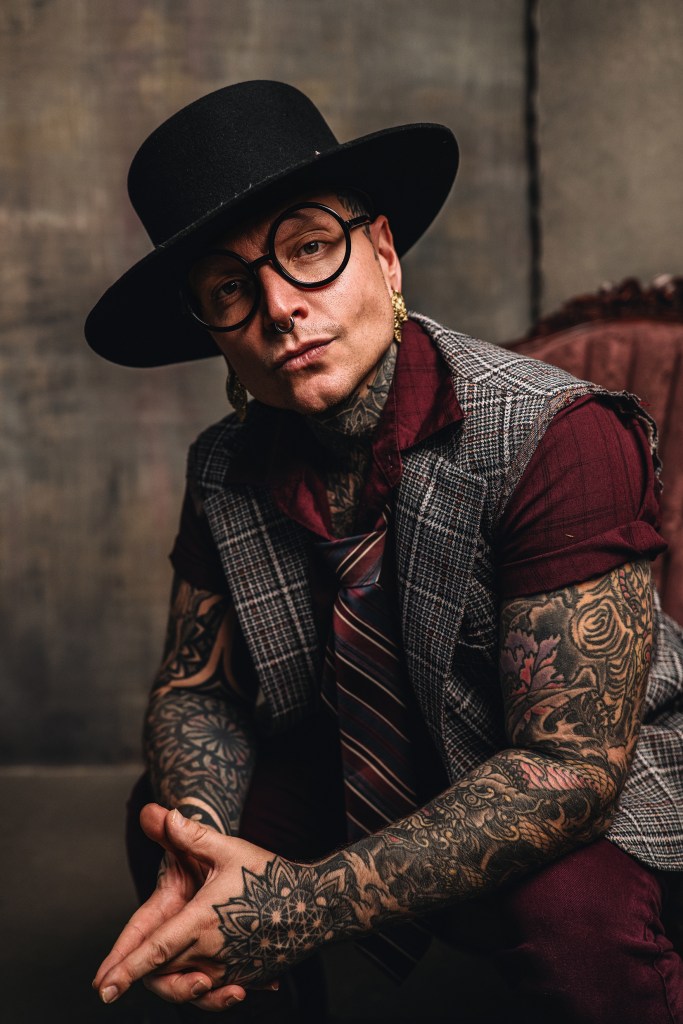
In this sixth chapter of the visual odyssey, Jonny Edward’s portrait embodies the blend of environment and identity, created in his studio, Atelier Alchimia. The image emphasizes texture and iconography, showcasing a stylistic marriage between traditional garments and modern tattoos. It marks a pivot to evocative, symbolic portraiture, exploring the philosophy of aesthetic existence.

Portrait of a person wearing a black hat and round glasses, seated indoors with tattooed arms, dressed in a vest, shirt, and tie against a textured studio backdrop.
Portrait of Jonny Edward photographed seated in his studio, wearing a hat, glasses, and layered clothing, with tattoos visible on both arms.

In the sixth chapter of this ongoing visual odyssey, the photographer explores the intersection of environment and identity, moving beyond the mere capture of a likeness to conduct a sophisticated study of texture and personal iconography. This portrait of Jonny Edward, captured within the subject’s own creative sanctuary, Atelier Alchimia, serves as a cornerstone of the “Recent Work & Ongoing Exploration” phase. It represents a pivot toward a more layered, atmospheric approach to portraiture, where the subject and the space they inhabit become indistinguishable components of a singular narrative.

The composition is a masterclass in the management of complex visual information. The subject is positioned with a calculated stillness, his gaze direct and piercing through circular frames that provide a geometric anchor for the viewer. There is a profound intentionality in the styling: the marriage of classic haberdashery—a wide-brimmed felt hat, a patterned cravat, and a structured waistcoat—against the modern, intricate cartography of extensive tattoo work. The photographer skillfully navigates these disparate elements, ensuring that the elaborate patterns of the skin and the plaid of the vest complement rather than compete with one another.

Technically, the image excels in its tonal range and tactile quality. The lighting is deliberate, casting a soft yet directional glow that carves out the contours of the subject’s face and highlights the physical relief of the ink on his forearms. There is a tangible weight to the textures presented: the coarseness of the waistcoat’s weave, the smoothness of the felt hat, and the weathered patina of the background wall. This background, reminiscent of a Renaissance fresco in its muted, distressed tones, provides a timeless quality that lifts the portrait out of a specific era and into a more permanent, artistic realm.

As a significant entry in the “Top 100 Journey,” this work illustrates the photographer’s evolving mastery of the “creative workshop” environment. By collaborating within a space designed for artistic alchemy, he has successfully distilled the essence of a fellow creator. The image functions as a dialogue between two artists—one in front of the lens and one behind it—resulting in a portrait that feels less like an observation and more like an excavation.

In the context of Chapter 6: The Road Ahead, this photograph signals a refined direction. It moves away from traditional, literal portraiture toward a more symbolic and evocative methodology. The hands, clasped in a gesture of quiet strength, draw the eye to the lower third of the frame, grounding the composition and reinforcing the sense of grounded presence. It is an exploration of the “modern alchemist,” capturing a figure who is both a product of and a contributor to the creative landscape of Colorado. This portrait does not merely record a face; it documents a philosophy of aesthetic existence, marking a high point in the photographer’s continued pursuit of visual excellence.