Aspen Stand, Poudre Canyon: A Study in Natural Geometry and Seasonal Light

The photograph of aspen trees along Poudre Canyon Road showcases their autumn colors, balancing structural elements with individual characteristics. It features a rhythmic vertical pattern in soft light, capturing a unique moment in Colorado’s landscape photography. This singular image asserts confidence in representing the iconic aspens effectively and artistically.

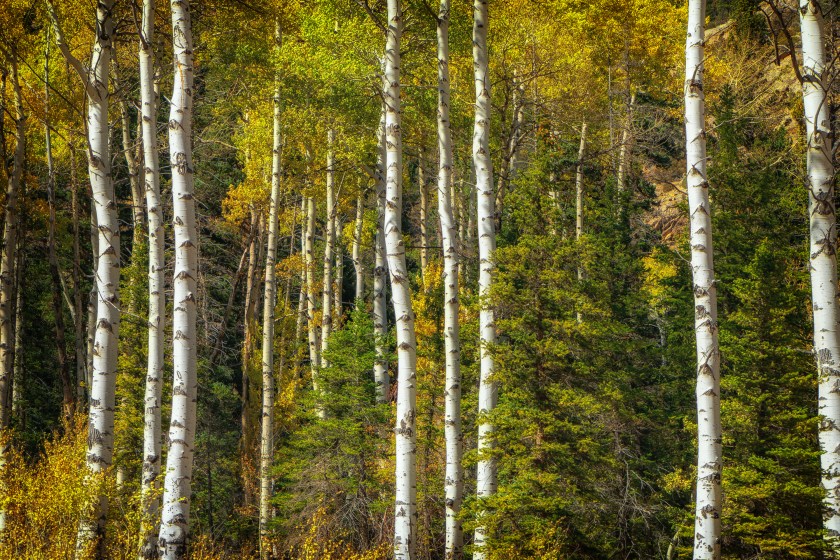
Tall white-barked aspen trees with yellow autumn leaves standing among green forest vegetation.
A stand of aspen trees displays fall foliage along Poudre Canyon Road in Colorado.

Within Chapter 3 of Greg Urbano’s Top 100 Journey—dedicated to Colorado Landscapes & Cityscapes—this photograph of aspen trees along Poudre Canyon Road represents a pivotal encounter with one of the American West’s most celebrated subjects. The image captures a dense stand of aspens in their autumn transformation, their white-barked trunks creating a rhythmic vertical pattern against a backdrop of golden and green foliage. What distinguishes this work from countless other interpretations of the same subject is the photographer’s restraint and his attention to the structural elements that give the composition its quiet authority.

The vertical emphasis dominates immediately. Dozens of aspen trunks rise through the frame, their characteristic pale bark marked by dark knots and horizontal striations that break the otherwise smooth surfaces. These natural imperfections serve as visual anchors, preventing the repetition from becoming monotonous. The photographer has positioned himself to maximize this rhythm while maintaining sufficient depth to reveal the layered complexity of the forest. Evergreens punctuate the composition in the background, their darker masses providing tonal contrast to the luminous aspens and golden understory.

The treatment of light deserves particular attention. Soft, even illumination suggests either overcast conditions or the photographer’s careful timing to avoid harsh midday sun. This choice allows the full tonal range of the foliage to register—from the brilliant yellows of peak autumn color to the deeper golds and lingering greens of leaves in transition. The post-processing, executed using DXO’s Color Efex Pro 4, enhances these chromatic relationships without pushing them into artificiality. There is saturation here, certainly, but it reads as an intensification of what was present rather than an invention.

For a photographer whose body of work encompasses diverse subjects and geographies, this image represents his only definitive statement on the iconic Colorado aspen to date—a fact he acknowledges directly in his own description. This singularity is worth considering. Rather than pursuing multiple variations or returning season after season to refine his approach, he has selected this single frame as representative. The decision suggests confidence in what was captured during that Saturday excursion from Fort Collins, and indeed, the composition supports that confidence.

The photograph functions effectively within its designated chapter, contributing to a broader portrait of Colorado’s varied landscapes. Where other images in this collection might address the state’s dramatic peaks, urban environments, or expansive vistas, this work explores the intimate scale of the mid-elevation forest. The aspens become both subject and structure, their seriality creating pattern while their individuality—visible in every unique scarring and branch configuration—asserts the organic nature of the scene.

Technically, the image demonstrates solid fundamentals: adequate depth of field to maintain sharpness across the forest layers, balanced exposure that preserves detail in both the bright foliage and darker bark, and a color palette that feels cohesive despite its range. The vertical format suits the subject matter, emphasizing the trees’ upward growth and the viewer’s sense of standing within the grove rather than observing it from outside.

This photograph documents a specific moment along Poudre Canyon Road while simultaneously engaging with a broader photographic tradition of Western landscape representation. It is work that respects its subject without overstating its case—a measured, observant addition to an ongoing artistic journey.

Colorado Capital Rotunda: Vertical Aspiration and Ornamental Complexity

The photograph of the Colorado State Capitol rotunda represents a shift in architectural perspective, focusing on the interior’s ornate details rather than external views. Using a wide-angle lens, the image captures the dome’s grandeur and intricate design, embodying the civic experience and inviting public engagement while highlighting historical and democratic ideals.

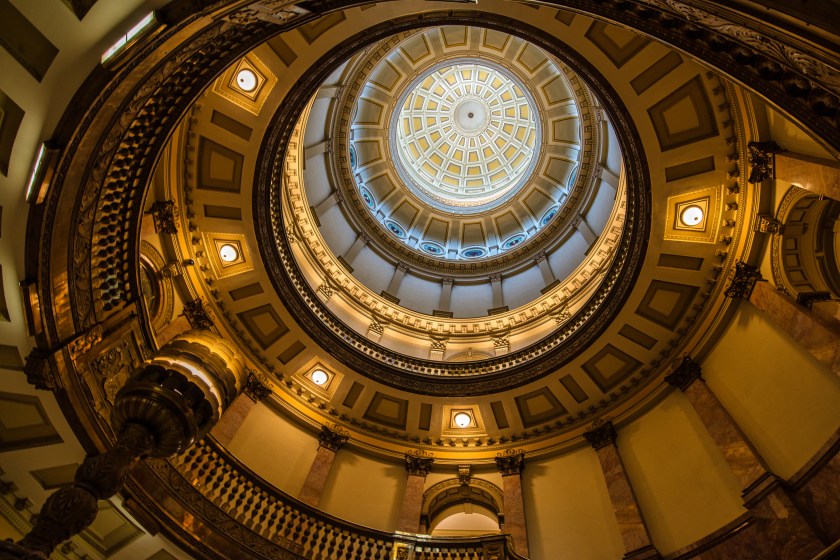
Upward view of the ornate rotunda ceiling inside the Colorado State Capitol, showing concentric arches and a central skylight.
An interior view looking up into the rotunda of the Colorado State Capitol in Denver, Colorado.

This interior study of the Colorado State Capitol rotunda marks a significant compositional departure within Chapter 3 of the Top 100 Journey. Where previous images in this collection have examined architecture from external vantage points—emphasizing façade, silhouette, and contextual placement—this photograph inverts the perspective, directing the viewer’s gaze upward through concentric rings of ornamental detail toward a luminous oculus. The shift from exterior monumentality to interior intimacy reveals the photographer’s expanding investigation of how architectural space shapes civic experience and visual perception.

Shot with a Nikon D610 and an 18-35mm f/3.5-4.5 lens at 19mm, the wide-angle focal length proves essential to capturing the rotunda’s full vertical sweep within a single frame. The fisheye-like distortion inherent at this focal length amplifies the dome’s centripetal geometry, creating a vortex effect that draws the eye inexorably toward the coffered ceiling and its central aperture. The exposure settings—f/8.0 at 1/10s, ISO 400—balance the need for depth of field across multiple architectural tiers with the practical constraints of handheld low-light shooting. The resulting image maintains sharpness from the foreground balustrade through to the uppermost decorative elements.

The color palette divides into two distinct thermal zones. Warm golden tones dominate the lower registers, where artificial lighting illuminates gilt detailing, coffered panels, and classical ornamentation. These warm hues gradually transition to cooler whites and pale blues as the eye travels upward, culminating in the natural daylight filtering through the oculus. This chromatic shift reinforces the spiritual and hierarchical symbolism embedded in rotunda architecture—earthly richness below, celestial purity above—while simultaneously demonstrating the photographer’s attentiveness to mixed lighting conditions.

Compositional rigor anchors what could easily become visual chaos. The photographer positions himself at the precise center point beneath the dome, ensuring perfect radial symmetry. This decision transforms architectural documentation into geometric meditation, where repeating patterns of coffering, balustrades, and Corinthian capitals establish rhythmic visual cadence. The inclusion of the ornate balustrade in the lower left introduces human scale and tactile detail, preventing the image from becoming pure abstraction while emphasizing the building’s accessibility—a public space designed for citizen engagement.

Within the broader narrative of Chapter 3, this rotunda photograph functions as conceptual bridge between exterior civic monumentality and the quotidian experience of urban space. It reveals what lies beneath the gilded dome captured in his nocturnal exterior study, exposing the elaborate craftsmanship and symbolic program that nineteenth-century architects employed to manifest democratic ideals through built form. The image documents not merely architectural opulence but the spatial theater of governance—the designed environment through which political power seeks legitimacy through aesthetic grandeur.

The photographer’s note regarding access—”as simple as passing through a metal detector”—introduces subtle contemporary commentary. This threshold between public and civic space, between everyday citizen and architectural spectacle, becomes invisible in the final image yet remains conceptually present. The photograph captures a space designed for transparency and public access, its ornamental complexity serving not to exclude but to dignify the democratic project. In rendering this vertical architecture with technical precision and compositional thoughtfulness, the photographer documents both historical aspiration and ongoing civic function, making visible the constructed environments through which Colorado’s political identity continues to be performed and experienced.

Vertical Ascension: Modernist Form in Downtown St. Petersburg

The black and white photograph of the Signature Place high-rise in St. Petersburg captures its architectural monumentality through a minimalist lens. Stripping color emphasizes form and texture, while a dynamic composition highlights urban development. The work reflects the photographer’s evolving vision, merging documentary and artistic interpretation within contemporary architectural photography.

Black and white low‑angle photograph of the Signature Place condominium tower in downtown St. Petersburg, Florida, showing strong geometric lines and modern architecture.
Black and white architectural study of the Signature Place high‑rise in downtown St. Petersburg.

In this striking image from Chapter 2 of the photographer’s Top 100 Journey, the Signature Place Condominium tower emerges as a study in architectural monumentality and photographic restraint. Shot in downtown St. Petersburg, Florida, the photograph transforms a contemporary residential structure into something both documentary and abstract—a meditation on verticality, light, and the geometric language of modern urban development.

The decision to render this scene in black and white proves essential to the image’s success. By stripping away color, the photographer directs attention to the fundamental elements of architectural photography: form, texture, and tonal gradation. The building’s repetitive window pattern creates a rhythmic grid that draws the eye upward, while the dramatic contrast between the illuminated facade and the darkening sky suggests a specific moment of transition—likely the golden hour, when natural light rakes across surfaces to reveal dimension and depth.

Technical execution demonstrates thoughtful consideration of both optics and exposure. Working at 35mm on an 18-35mm lens mounted to a full-frame Nikon D610, he selected a narrow aperture of f/18 to maximize depth of field and ensure crisp detail throughout the frame. The resulting sharpness allows the viewer to appreciate the building’s material qualities—the interplay of glass, concrete, and steel that defines contemporary high-rise construction. A shutter speed of 1/8 second at ISO 100 suggests the use of a tripod, essential for maintaining clarity at this exposure length while preserving clean shadow detail.

The composition employs a low vantage point that accentuates the tower’s dramatic thrust skyward. This perspective, common in architectural photography but executed here with particular effectiveness, creates a sense of imposing scale while maintaining architectural integrity. The building’s angular crown punctures the upper portion of the frame, while a lower podium structure grounds the composition and provides contextual anchoring in the urban landscape.

Within the broader framework of Chapter 2—Florida Landscapes & Cityscapes—this photograph represents an important counterpoint to the state’s more commonly photographed natural environments. Rather than beaches, wetlands, or subtropical flora, the photographer turns his lens toward Florida’s built environment, acknowledging the contemporary reality of rapid urban development along the Gulf Coast. St. Petersburg’s downtown skyline, transformed dramatically over recent decades, serves as a compelling subject for examining how modern architecture reshapes regional identity.

The image also speaks to the photographer’s evolving vision throughout the Top 100 Journey. Where other selections might emphasize natural wonder or environmental preservation, this work demonstrates equal comfort with urban subject matter. The modernist aesthetic—clean lines, geometric precision, monochromatic palette—suggests an appreciation for architectural form as a legitimate subject for serious photographic inquiry.

What elevates this photograph beyond mere documentation is its atmospheric quality. The graduated sky, rendered in smooth tones from deep black to luminous gray, provides a canvas against which the building performs. The partially visible vegetation at the frame’s base hints at the subtropical context without overwhelming the primary subject. This careful balance between architectural documentation and artistic interpretation positions the work within a tradition extending from early twentieth-century modernist photography through contemporary fine art practice—a lineage that recognizes buildings not merely as structures to be recorded, but as forms to be interpreted.