Convention Center Station: Urban Infrastructure as Light Study

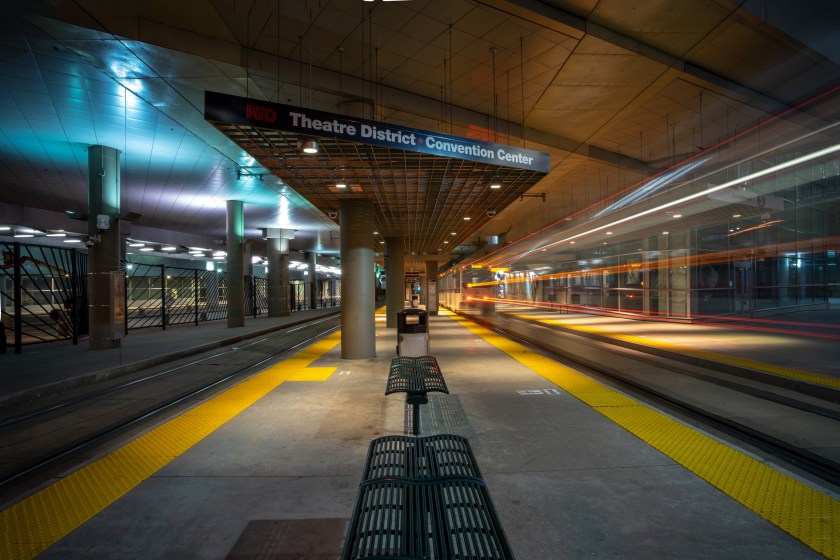
The photograph at Denver’s Convention Center RTD station captures an arriving light rail train through long exposure, emphasizing urban environments over natural landscapes. The technical choices create depth and contrast between warm light trails and cooler architectural tones. This piece illustrates Colorado’s identity, showcasing urban transit as significant as its natural vistas.

Text: Long exposure view of the RTD light rail platform at the Convention Center with blurred train lights in downtown Denver.
A long exposure captures an arriving RTD light rail train at the Convention Center station in downtown Denver, Colorado.

In the urban component of Chapter 3—Colorado Landscapes & Cityscapes—this long exposure photograph of Denver’s Convention Center RTD station marks a deliberate shift from natural subjects to the constructed environments that define contemporary Colorado life. The image captures a light rail train arriving at the platform, its motion rendered as luminous streaks of amber and red that cut through the architectural geometry of the underground station. This is urban photography that privileges process and temporal collapse over the decisive moment, transforming public transit infrastructure into an exercise in controlled abstraction.

The photographer’s technical approach is fundamental to the image’s success. Using a Sony A7ii paired with a Samyang 18mm wide-angle lens, he has embraced the distortions and expansiveness that such focal lengths provide. The wide angle compresses the station’s perspective while simultaneously stretching its architectural lines, creating a sense of depth that pulls the viewer’s eye from the central platform toward both vanishing points. The long exposure—likely several seconds given the degree of light trail elongation—allows the moving train to register as pure energy rather than solid form, a ghost of motion suspended within the static framework of concrete, steel, and tile.

Color plays a crucial structural role. The safety-yellow platform edges create strong horizontal bands that anchor the composition and provide visual weight at the bottom of the frame. These bright strips contrast sharply with the cooler tones dominating the upper portions—cyan-tinted fluorescent lighting that bathes the ceiling panels and creates atmospheric zones of cool illumination. The train’s light trails introduce warm amber tones that bridge these temperature extremes, serving as the compositional focal point despite their ethereal nature. The signage identifying the Theatre District/Convention Center stop glows in the upper third, grounding the image in specific geographic and civic context.

What distinguishes this work within the broader chapter is its commitment to representing Colorado’s urban character with the same attention previously devoted to its natural landscapes. Denver’s RTD system, as critical infrastructure connecting the metropolitan region, deserves documentation as much as any mountain vista or aspen grove. The photographer recognizes this and approaches the subject with seriousness of purpose. The empty platform—devoid of waiting passengers—allows the architecture and light to speak without human interruption, though the absence of people also raises questions about time of day, accessibility, and the photographer’s relationship to urban space during off-peak hours.

The symmetry is notable but not absolute. The central platform creates a strong vertical axis, reinforced by support columns and the overhead ceiling structure. Yet the composition retains enough asymmetry—particularly in the light trails and architectural details—to avoid static formalism. The textured platform surface, captured with clarity despite the low light conditions, provides tactile detail that prevents the image from becoming purely graphic.

Within a collection that spans Colorado’s diverse visual territories, this photograph asserts that the state’s identity includes its cities and their infrastructure. It is work that finds aesthetic potential in transit stations, that sees light trails as valid subjects alongside geological formations, and that expands the definition of landscape to include the spaces humans build for movement and connection.
Passagrille Sunset

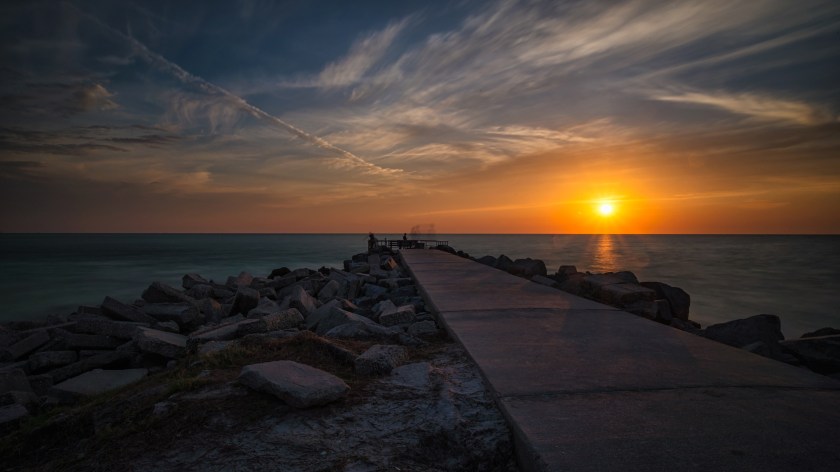
The photograph of a sunset over the Gulf of Mexico from the Pass-a-Grille jetty captures a sense of departure and geometric clarity. It juxtaposes the structural jetty against soft, ethereal water and sky, reflecting the photographer’s evolving approach while highlighting the tension between permanence and impermanence in landscapes.

Sunset photograph of the Pass‑a‑Grille jetty in Florida, with a concrete pier extending into the Gulf of Mexico and silhouetted figures at the horizon.
Sunset over the Gulf of Mexico from the Pass‑a‑Grille jetty.

This image from Chapter 2 of the Top 100 Journey carries with it a distinct sense of departure—a final engagement with a familiar location rendered with the careful attention of someone taking leave. Shot at Pass-a-Grille, the southern terminus of St. Pete Beach, the photograph distills the photographer’s technical vocabulary into a study of geometric clarity against atmospheric flux.

The concrete jetty commands the composition with unwavering linear authority, stretching from the immediate foreground toward the distant horizon where the sun hangs in perfect alignment. This centered positioning—often avoided in landscape photography as overly symmetrical—here becomes an asset, emphasizing the directional thrust of both structure and light. The jetty serves as more than mere subject; it functions as visual pathway, invitation, and barrier simultaneously. Flanked by massive boulder riprap on either side, the walkway creates a corridor that focuses attention while the rough-hewn stones provide textural contrast to the smooth concrete surface.

The technical approach reveals the photographer’s continued exploration of extended exposure. At fifteen seconds and f/22, the water on both sides of the jetty transforms into a milky abstraction, its individual waves collapsed into a singular luminous mass. This treatment—shorter than the sixty-second exposure employed in his Pier 60 work yet still substantially extended—suggests a refinement in his methodology. The turquoise-tinted water retains enough definition to read as liquid rather than dissolving into pure atmosphere, maintaining a crucial anchor to physical reality.

Above, the sky performs its transitional theater. Wispy cirrus formations streak diagonally across the frame from upper left, their directional movement contrasting with the horizontal stratification of color closer to the horizon. The gradient moves from deep slate blues through amber and peach tones to the incandescent disc of the sun itself. A single contrail cuts through the upper portion—a contemporary detail that situates this timeless scene firmly in the present moment, a reminder that even pristine natural settings exist within our flight-path-crossed modern reality.

The photographer has positioned himself low, allowing the foreground boulders to occupy significant visual weight in the left portion of the frame. These lichen-stained rocks, rendered in earth tones that echo the warm sunset palette, ground the image literally and figuratively. Their solidity counterbalances the ethereal qualities of water and sky, creating a dialogue between permanence and impermanence that resonates with the image’s contextual note about departure.

Within the framework of Chapter 2—Florida Landscapes & Cityscapes—this photograph demonstrates the photographer’s evolving relationship with infrastructure as subject. Where tourist piers offer human presence and activity, this utilitarian jetty provides something more austere: pure form against elemental forces. The viewing platform visible at the jetty’s terminus, occupied by silhouetted figures, offers scale and human connection without sentimentality.

The work succeeds in balancing documentary precision with interpretive mood. It captures a specific engineered structure at a specific coastal location while transcending those particulars to engage broader themes: the paths we walk toward light, the structures we build against erosion, the moments we choose to mark as endings before moving forward.

Under Naples Pier at Sunset: Architecture Meets the Ethereal

Greg Urbano’s long exposure photograph beneath Naples Pier captures the interplay of human architecture and nature, highlighting time and impermanence. Shot with meticulous technique, the image transforms a familiar locale into a contemplative space where smooth Gulf waters contrast with weathered pilings, emphasizing Florida’s geography and the enduring power of the natural world.

Long exposure photograph taken beneath the Naples Pier in Florida, showing weathered support columns receding into the distance with smooth, blurred water and soft sunset light.
Long exposure view beneath the Naples Pier in Florida, captured with softened water and warm evening light.

In Greg Urbano’s exploration of Florida’s coastal landscapes, this long exposure beneath Naples Pier represents a masterful convergence of structural geometry and natural fluidity. The photograph transforms a familiar tourist destination into something altogether more contemplative—a meditation on time, permanence, and the quiet persistence of natural forces.

The technical execution reveals deliberate artistic choices that elevate the image beyond documentary. Shot at a 30-second exposure with an aperture of ƒ/10, Urbano allows the Gulf waters to smooth into an almost supernatural plane of silk, while the pier’s wooden pilings remain sharply rendered, their weathered surfaces recording years of salt spray and tidal rhythms. The ISO 100 setting preserves exceptional clarity in both the concrete deck overhead and the barnacle-encrusted bases of each column, where marine life has claimed the structure as its own.

What distinguishes this photograph within the Florida Landscapes & Cityscapes chapter is its unique vantage point. Rather than capturing the pier from the beach or along its walkway—the conventional approaches—Urbano positions himself in the liminal space beneath, where human architecture and marine environment intersect. This perspective creates a vanishing point that draws the eye through the repetitive columns, suggesting infinity while simultaneously framing the horizon in measured increments. The composition speaks to Florida’s essential character: a place where human development exists in constant negotiation with water, weather, and an environment that ultimately cannot be controlled.

The color palette captures that transitional moment when day surrenders to evening. Soft blues dominate the frame, punctuated by warmer tones filtering through the gaps between pilings where the setting sun still reaches. The long exposure has rendered a handful of beachgoers as ghostly presences, barely perceptible in the distance—a reminder that even in this serene moment, human activity continues, though made insignificant by the photograph’s emphasis on timelessness over immediacy.

The textural contrasts throughout the frame reward sustained viewing. The smooth, almost liquid sand in the foreground shows subtle patterns from receding water, while the pier pilings display years of weathering—concrete cracking and staining, wooden supports silvered by sun and salt. Most striking are the organic clusters clinging to each column where water regularly submerges them, dark masses of mussels and barnacles that testify to the structure’s dual existence above and below the tideline.

This image exemplifies why Urbano selected Naples Pier for inclusion in his exploration of Florida’s diverse landscapes. The state’s geography is defined by its relationship with water—the Atlantic, the Gulf, the Everglades, countless rivers and springs. Here, that relationship is made architectural, structured, yet the photograph ultimately reveals nature’s quiet supremacy. The pier may impose order with its regular spacing and engineered strength, but the barnacles reclaim it, the water smooths away footprints, and time—made visible through long exposure—reveals the impermanence of even our most solid constructions.

Within the broader context of the Top 100 Journey, this photograph demonstrates Urbano’s ability to find fresh perspectives on familiar subjects, transforming a popular sunset location into a study of geometry, time, and the persistent dialogue between built and natural environments that defines Florida’s coastal identity.