Holiday Traffic: Urban Kinetics and the Ground-Level Perspective

Greg Urbano’s long-exposure photograph captures holiday traffic at a city intersection, blending urban dynamism with modern landscape photography. The low, ground-level perspective emphasizes movement and depth, contrasting traditional views. Utilizing experimental techniques, Urbano transforms mundane urban elements into visually engaging art, reflecting an intersection of Colorado’s natural and built environments.

Long exposure light trails streak across a city intersection at night, with a sewer grate and patches of ice in the foreground.
Long exposure light trails cross a city intersection at night, viewed from curb level during holiday traffic.

This long-exposure photograph marks a decisive departure from traditional landscape photography within Chapter 3 of Greg Urbano’s Top 100 Journey, demonstrating that the “cityscapes” component of his Colorado documentation extends beyond skyline silhouettes into the kinetic reality of urban infrastructure. Positioned at street level—literally at the curb—the photographer has created a dynamic study of nocturnal traffic patterns that transforms the mundane intersection of College Boulevard into a theater of light and motion.

The technical approach reveals deliberate experimentation with newly acquired equipment. Working with a Samyang 18mm wide-angle lens on his Sony A7ii, the photographer has exploited the optical characteristics of ultra-wide focal lengths to create exaggerated perspective and spatial depth. The low vantage point amplifies this effect dramatically: the sewer grate in the immediate foreground looms with tactile presence, its metal bars and residual ice providing textural anchor, while the light trails streak overhead in explosive radial patterns that suggest velocity and urban energy.

The compositional strategy employed here is remarkably sophisticated for what the photographer describes as “one of my early outings” with this lens. The image functions as a composite of multiple 25-30 second exposures, a technique that allows for selective accumulation of specific light sources while maintaining overall exposure balance. The resulting layering creates what might be termed a temporal palimpsest—multiple moments collapsed into a single frame, where red taillights and white headlamps trace the choreography of holiday traffic against the static geometry of traffic signals, street lamps, and seasonal decorations visible in the background.

What distinguishes this work from conventional light trail photography is its grounded perspective. Rather than adopting the elevated, observational stance typical of urban night photography, the photographer has chosen a worm’s-eye view that positions the viewer within the street infrastructure itself. This decision transforms the image from documentation into experience—we are not watching traffic from safe remove, but inhabiting the same plane as the vehicles themselves, separated only by the curb’s modest elevation.

The inclusion of the ice-rimmed drain grate serves multiple functions. Practically, it provides a foreground anchor that prevents the eye from being immediately swept into the light trails. Conceptually, it connects this urban image to the winter conditions documented elsewhere in the chapter, suggesting continuity between Colorado’s natural and built environments. The detail also introduces narrative specificity—this is not generic cityscape, but a particular moment following “last week’s big snowfall,” situating the photograph within both seasonal and meteorological context.

Within Urbano’s broader practice, this image represents important evolution. It demonstrates willingness to explore the full spectrum of Colorado’s visual character, from wilderness solitude to urban dynamism. The experimental nature of the work—testing new equipment, exploring composite techniques, embracing an unconventional viewpoint—suggests a photographer actively expanding his technical vocabulary rather than retreating to established formulas.

The photograph ultimately succeeds by finding aesthetic potential in overlooked urban moments. The holiday season’s increased traffic becomes raw material for abstract light painting, while municipal infrastructure—storm drains, asphalt, street furniture—gains unexpected visual dignity through careful framing and extended exposure. It is urbanism made kinetic, infrastructure rendered poetic.
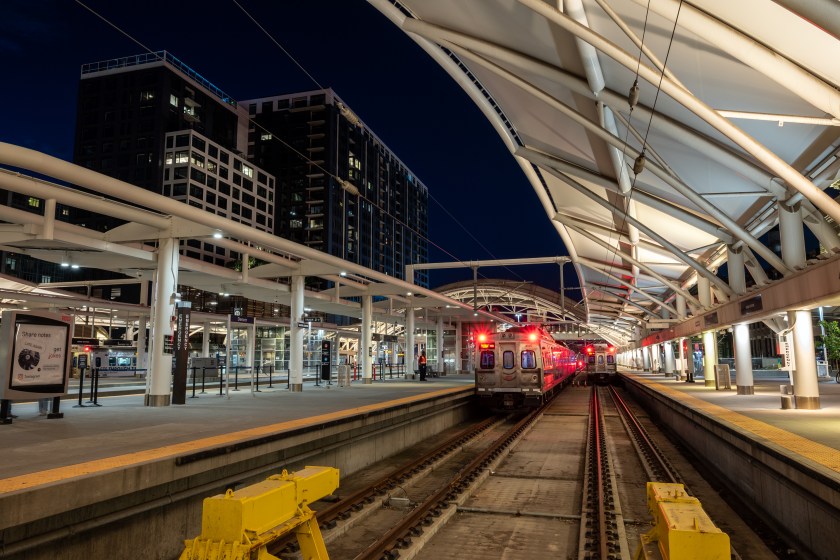
Denver Union Station Two Trains: Urban Infrastructure as Visual Poetry

The photograph of Denver Union Station marks a shift in the photographer’s journey from natural landscapes to urban architecture. It highlights the interplay of light, color, and geometry while capturing quiet moments in public spaces. The image symbolizes Denver’s evolution in sustainable transit, merging historical preservation with contemporary design.

Two light rail trains sit on parallel tracks beneath the covered platforms at Denver Union Station at night.
Two RTD light rail trains are stopped on adjacent tracks at Denver Union Station in downtown Denver, Colorado.

This nocturnal study of Denver Union Station represents a compelling pivot within Chapter 3 of the photographer’s Top 100 Journey project—a shift from natural landscapes to the constructed geometries of urban infrastructure. Where previous works in this chapter have explored Colorado’s geological grandeur, this image examines the state’s architectural identity through one of its most significant transit hubs.

The composition is defined by bold linear perspective. Shot with a 14-30mm wide-angle lens, the photographer has positioned himself within the transit platform itself, allowing the parallel tracks to create strong diagonal lines that converge toward the vanishing point. This classical use of perspective transforms functional railway infrastructure into formal geometric study. The canopy overhead—a sweeping white lattice of structural supports—echoes and reinforces these diagonals, creating a rhythmic repetition that draws the eye inexorably toward the illuminated train in the distance.

Color plays a crucial role in establishing atmosphere. The deep navy blue of twilight sky provides saturated contrast against the warm artificial lighting of the station. The train’s red running lights introduce an accent of vivid color that punctuates the otherwise neutral palette of whites, grays, and concrete tones. A yellow maintenance box in the lower foreground adds an unexpected chromatic note—industrial, utilitarian, yet compositionally important as a counterweight to the red lights above.

The technical execution demonstrates careful consideration of low-light conditions. The exposure balances multiple light sources: the cool fluorescent platform lighting, the warm glow from the station building visible on the left, and the colored signals of the train itself. The photographer has managed to maintain detail throughout the frame—from the textured concrete of the platform to the lit windows of the distant residential tower—suggesting precise metering and likely the use of a tripod for stability during what was presumably a longer exposure.

What distinguishes this work is its treatment of public space during a quiet moment. The platform is nearly empty; a single figure appears as a small presence near the center, emphasizing scale and the architectural vastness of the station. This human element, though minimal, is essential—it prevents the image from becoming purely abstract geometry and reminds viewers that this is infrastructure designed for movement, for connection, for the daily transit of thousands.

Within the context of Colorado Cityscapes, this photograph documents Denver’s ongoing evolution as a metropolitan center investing in sustainable transit infrastructure. Union Station, a historic landmark renovated in recent years, represents the intersection of preservation and progress. The photographer captures this duality: the contemporary design of the platform canopy suggests forward-looking urban planning, while the fundamental elements—trains, tracks, waiting passengers—evoke the timeless ritual of rail travel.

The use of the Nikon Z5 with ultra-wide glass allows the photographer to emphasize architectural span while maintaining sharpness across the frame. The wide angle compresses multiple planes of depth into a single coherent visual statement, creating an image that functions simultaneously as documentary record and formal composition.

This photograph confirms the photographer’s ability to find visual poetry in utilitarian spaces, demonstrating that the “cityscape” portion of Chapter 3 merits equal attention to Colorado’s celebrated natural landscapes.