Architectural Authority: The Denver Public Library

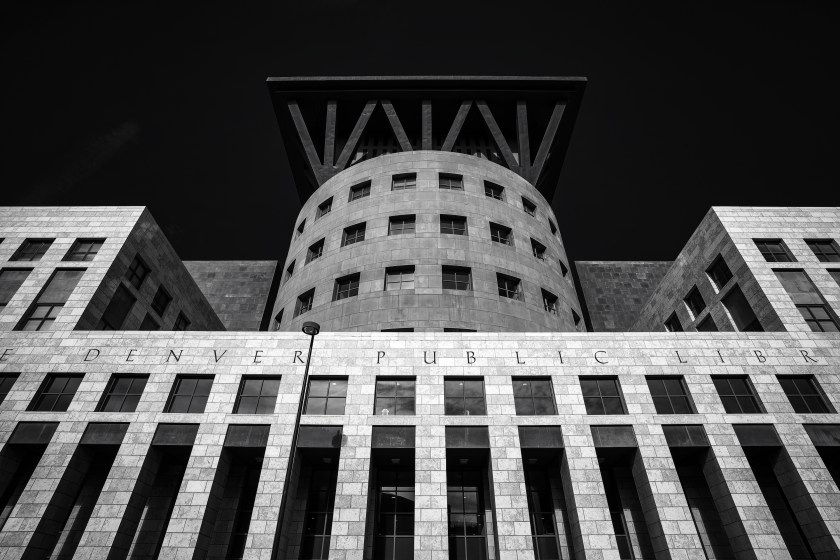
The photograph of the Denver Public Library showcases the interplay of monumental architecture and urban landscape. The black and white imagery emphasizes geometric shapes and textures, transforming harsh midday light into stark contrasts. This representation transcends mere documentation, reflecting civic aspiration and how societies express values through built form within the Colorado context.

Black and white view of the Denver Public Library exterior, showing a cylindrical central structure framed by angular stone façades.
The exterior of the Denver Public Library is shown in black and white in downtown Denver, Colorado.

In this commanding study of civic architecture, the photographer demonstrates a sophisticated understanding of how monumental structures assert themselves within the urban landscape. Shot at midday when harsh overhead light typically challenges photographers, he transforms potentially difficult conditions into an asset, using deep contrast to emphasize the building’s geometric severity and sculptural mass.

The composition centers on the Denver Public Library’s distinctive cylindrical tower, which rises from the frame like a monolithic drum. The extreme upward angle, facilitated by his Samyang 18mm wide-angle lens, creates a dramatic sense of monumentality while the symmetrical flanking wings establish visual order. This architectural framework—circular form nested within angular geometry—speaks to postmodern design principles that dominated American civic architecture in the late twentieth century. The photographer’s decision to shoot in black and white strips away temporal markers and weather conditions, rendering the structure as a timeless study in form, shadow, and material.

What distinguishes this image within Chapter 3’s exploration of Colorado landscapes and cityscapes is its departure from natural grandeur toward human-made authority. Where mountain vistas offer sublime, untamed power, this photograph presents institutional permanence. The stone cladding, methodically rendered in graduated tones from light gray to near-black, becomes a study in texture and depth. The dramatic diagonal supports visible at the structure’s crown introduce dynamic tension, their angular thrust contrasting sharply with the tower’s curved facade.

The technical execution reveals maturity in the photographer’s approach to architectural documentation. Shot with the Sony A7ii, the image maintains clarity across multiple planes of depth despite the wide-angle distortion inherent to the 18mm focal length. The midday timing, often avoided by landscape photographers, proves deliberate here—the high sun creates stark shadows that carve out the building’s volumes and reveal the recessed windows as dark voids. This interplay between solid and void, light and shadow, transforms descriptive documentation into interpretive art.

The street lamp appearing at center-bottom provides crucial human scale, a reminder that this imposing structure exists within the pedestrian realm. Its modest presence underscores the building’s overwhelming verticality and mass. The text carved into the facade—”DENVER PUBLIC LIBR”—becomes both identifier and compositional element, the letterforms creating horizontal rhythm that grounds the tower’s upward thrust.

Within the photographer’s Top 100 Journey project, this image represents an important evolution. Chapter 3’s focus on Colorado landscapes and cityscapes broadens beyond wilderness to encompass how humans shape their environment. The library, as a democratic institution dedicated to public knowledge, carries symbolic weight that elevates the photograph beyond mere architectural record. It becomes a meditation on civic aspiration, on how societies express values through built form.

The conversion to monochrome proves essential to the image’s impact. Color would introduce distraction—blue sky, stone variations, surrounding urban context. Instead, the black and white treatment creates graphic clarity, emphasizing pattern, geometry, and tonal relationships. The nearly black sky becomes void, pushing the building forward as the sole subject demanding attention.

This photograph confirms the photographer’s ability to find compelling visual architecture within urban environments, applying the same compositional rigor and tonal sensitivity he brings to natural landscapes.

Tampa Skyline Long Exposure: A Study in Urban Stillness

This long exposure photograph of Tampa’s skyline captures the city at dusk, highlighting the interplay of light, architecture, and time. With a 241-second exposure, the image transforms the water into a reflective surface, merging urban forms and enhancing their beauty. The composition emphasizes symmetry and color, inviting deeper appreciation of urban landscapes.

Long exposure dusk photograph of the Tampa, Florida skyline with illuminated buildings and reflections on the Hillsborough River.
Long exposure dusk view of the Tampa skyline with river reflections.

Within the framework of Chapter 2—Florida Landscapes & Cityscapes—this long exposure photograph of Tampa’s downtown core represents a sophisticated meditation on the intersection of natural light, architectural form, and temporal manipulation. Shot at dusk from across the Hillsborough River, the image captures the city skyline in a state of suspended transition, where the photographer’s technical mastery serves to transform a familiar urban vista into something altogether more contemplative.

The technical specifications reveal deliberate choices that speak to the photographer’s evolving understanding of long exposure craft. An exposure time of 241 seconds—over four minutes—has rendered the water’s surface into a mirror-like plane of silk, creating an almost supernatural calm that contrasts sharply with the structural solidity of the buildings above. This extended duration collapses time, erasing the ephemeral movements of waves and current to reveal something closer to the river’s essential character. The choice of an 18mm focal length at f/8.0 provides expansive depth of field while maintaining critical sharpness across the entire frame, from the foreground water to the distant architectural pinnacles.

The composition demonstrates a rigorous formalism. The horizontal bands of bridge infrastructure bisect the frame at roughly the golden ratio, their purple-lit supports creating rhythmic vertical elements that guide the eye through the middle ground. The skyline itself presents as a study in geometric variation: cylindrical towers, angular glass facades, and the distinctive peaked crown of the tallest structure each catch and reflect the fading daylight in subtly different ways. The photographer has positioned himself to capture not merely the buildings themselves, but their perfect inversions in the still water below, creating a symmetry that doubles the visual information while emphasizing the transformative effect of his chosen technique.

Color plays a crucial role in the image’s success. The graduated sky transitions from warm peachy tones at the horizon to deepening blue overhead, providing a naturalistic backdrop that throws the artificial illumination into relief. The purple accent lighting on the bridge structure introduces an unexpected chromatic note, while the warm reflections—amber, gold, and rose—animate the lower half of the frame with points of concentrated light. This interplay between cool atmospheric tones and warm architectural lighting creates visual tension that keeps the eye engaged despite the overall compositional stillness.

The small electronic device visible in the immediate foreground—likely the camera’s intervalometer—serves as an unintentional but effective scale reference, grounding the viewer’s perspective and subtly acknowledging the technical apparatus required to achieve such results. It’s a moment of transparency that connects the finished image back to its means of production.

Within the broader arc of the Top 100 Journey project, this Tampa skyline represents the photographer’s deepening engagement with Florida’s urban environments as subjects worthy of the same sustained attention he brings to natural landscapes. The long exposure technique, applied here to a cityscape, reveals patterns and qualities invisible to ordinary perception—the fundamental architecture of light, the liquidity of solid water, the strange beauty of modern cities seen through the lens of time. It’s work that asks viewers to reconsider what they think they know about familiar places, finding in them unexpected dimensions of visual poetry.