Architectural Symmetry and Urban Solitude: An HDR Study of Denver Union Station

The photographer’s nocturnal exploration of Denver Union Station highlights its architectural beauty through HDR techniques. Using a Nikon Z5, he captures the arched canopy and geometric metalwork, emphasizing both urban context and functional identity. This work redefines landscape photography, recognizing the significance of transportation infrastructure in Colorado’s cultural identity.

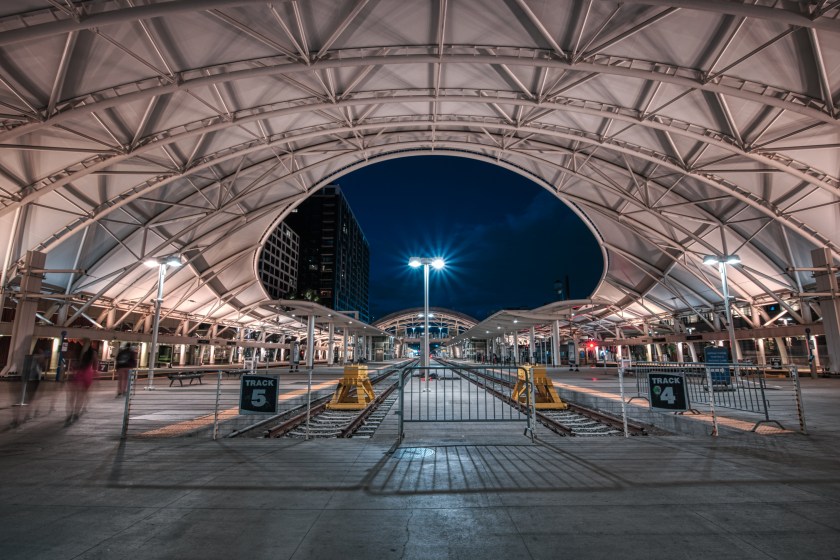
Symmetrical view of covered light rail platforms inside Denver Union Station at night, with tracks centered beneath a white arched roof.
The light rail platforms inside Denver Union Station are shown at night beneath the station’s arched canopy.

The photographer’s exploration of Colorado’s built environment finds a striking culmination in this nocturnal study of Denver Union Station’s interior architecture. Captured with a Nikon Z5 and Nikkor 14-30mm wide-angle lens, this HDR composition demonstrates a mature understanding of how contemporary digital techniques can reveal the inherent drama within civic spaces.

The image centers on the station’s distinctive arched canopy structure, a feat of engineering that dominates the frame with rhythmic precision. Metal trusses radiate outward in geometric patterns, their repetition creating a sense of ordered monumentality. The wide-angle lens choice proves deliberate rather than merely expedient—it allows the photographer to encompass both the sweeping overhead architecture and the rail infrastructure below while maintaining the spatial relationship that gives the composition its power. The central void, opening to the deep blue evening sky and a distant office tower, punctuates the manufactured enclosure with a reminder of the urban context beyond.

His HDR processing through Aurora software reveals a considered approach to tonal range. The metalwork retains textural detail without the artificial hyper-clarity that often plagues high dynamic range photography. The warm metallic tones of the canopy structure contrast effectively with the cooler blues of the twilight sky and platform lighting, establishing a color palette that feels naturalistic despite the technical manipulation required to balance such extreme luminance values.

The human element appears deliberately subdued—motion-blurred figures at the platform edges suggest activity without demanding attention, reinforcing the architectural subject while maintaining the space’s functional identity as a transportation hub. Yellow bumper stops and safety railings provide geometric counterpoints to the dominant curves above, their utilitarian forms grounding the composition in operational reality.

Within the context of Chapter 3’s focus on Colorado landscapes and cityscapes, this work represents a conceptual bridge. While the chapter presumably encompasses the state’s renowned natural vistas, the photographer recognizes that Colorado’s urban environments possess their own topography worth documenting. Denver Union Station, a historic structure serving contemporary transit needs, embodies the intersection of preservation and progress that characterizes much of the American West’s relationship with its past.

The technical execution reflects growing confidence with the Z5 system’s capabilities in challenging lighting conditions. Night photography in mixed-light environments demands both equipment competence and processing discipline, both evident here. The decision to shoot during the transitional moment between day and night—when ambient light still registers in the sky while artificial illumination dominates the platform—demonstrates an understanding of how fleeting conditions can elevate architectural documentation beyond mere record-keeping.

This image functions as more than a single photograph within his Top 100 Journey project; it suggests an expanding definition of landscape photography itself. The constructed landscape of transportation infrastructure, with its own valleys and peaks of metal and light, receives the same considered attention he might afford a mountain vista. The result is a document that honors both the anonymous designers who created this functional space and the ongoing human movement that gives it purpose.

In positioning this work within his curated collection, the photographer asserts that Colorado’s identity exists not only in its natural grandeur but in the spaces where communities gather, depart, and return—the thresholds that connect wilderness to civilization.

Under Golden Gate Bridge, 2010: Engineering as Art

In this 2010 photograph, Greg Urbano captures the underside of San Francisco’s Golden Gate Bridge from Fort Point, showcasing its geometric elegance and structural beauty. This early work signifies Urbano’s evolving artistic vision, highlighting unique perspectives and the interplay of architecture and art, while demonstrating the potential of innovative photography tools.

Top 100 Journey – Early Vision

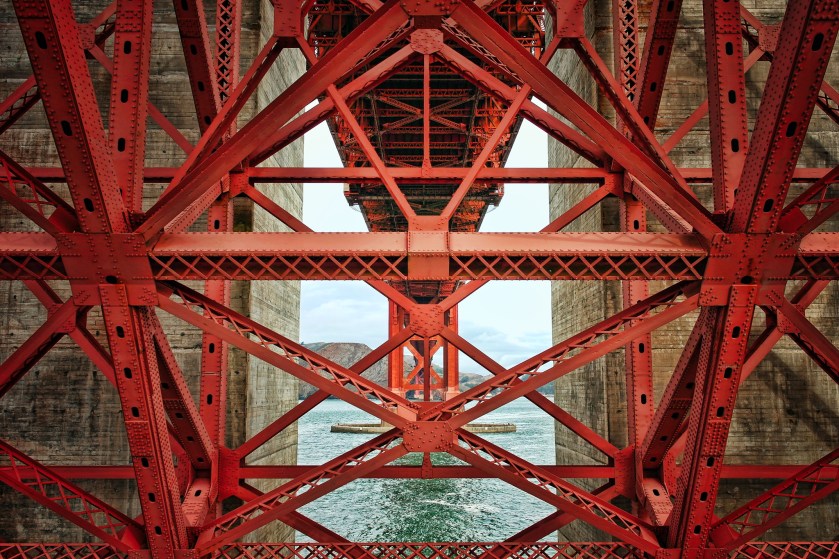
Upward view through the geometric steel framework beneath the Golden Gate Bridge from Fort Point, showing symmetrical orange-red trusses, concrete support pillars, and San Francisco Bay visible through the structure.
Beneath the Golden Gate Bridge from Fort Point, San Francisco – Architectural Photography 2010. Unique upward perspective capturing the intricate steel framework, geometric patterns, and engineering details of San Francisco’s iconic suspension bridge. View of San Francisco Bay through the International Orange structural beams and trusses.

This striking composition from 2010 captures the underside of San Francisco’s Golden Gate Bridge from Fort Point, revealing an intricate world of geometric patterns and structural elegance that most visitors never encounter. The photograph represents a pivotal moment in Greg Urbano’s photographic journey—an early work that demonstrates his emerging ability to transform industrial architecture into compelling visual poetry.

Shot with a Samsung NX100 at 22mm, the image presents a masterclass in symmetry and depth. The famous International Orange paint transforms the steel framework into a chromatic study, its warm coral-red tones contrasting beautifully against the cool concrete of the bridge’s support piers. Through the latticed structure, fragments of turquoise water and distant mountains create a layered composition that draws the eye through multiple planes of depth.

What distinguishes this photograph is its unconventional perspective. Rather than capturing the Golden Gate Bridge from the typical vantage points—across the bay or from the Marin Headlands—Urbano positions himself directly beneath the structure, looking upward through its architectural skeleton. This choice reveals the bridge not as an icon but as an engineering marvel, a cathedral of steel where form and function merge into unexpected beauty.

The technical execution shows thoughtful consideration of exposure and composition. At ƒ/4.5 and 1/250s, the photographer maintains sharpness throughout the frame while preserving detail in both the shadowed steel and the bright sky beyond. The ISO 100 setting ensures clean image quality, allowing the intricate patterns of rivets, crossbeams, and diagonal bracing to remain crisp and legible. The 22mm focal length provides enough width to capture the structure’s overwhelming scale while maintaining proper perspective control.

The geometric complexity invites prolonged viewing. X-patterns and triangular forms repeat throughout the composition, creating a rhythm that feels almost musical. The vertical piers anchor the image, while the diagonal members create dynamic tension. This interplay between stability and movement, between the monumental and the intricate, gives the photograph its visual power.

Within the context of Urbano’s early photographic development, this image reveals an artist learning to see beyond the obvious. The decision to climb Fort Point, to look upward rather than outward, demonstrates curiosity and willingness to explore unconventional viewpoints. These qualities—the search for fresh perspectives, the appreciation of overlooked details, the ability to find abstraction within reality—would become hallmarks of his mature work.

The photograph also captures a specific moment in technological transition. The Samsung NX100, one of the early mirrorless cameras, represented new possibilities in digital photography. This image proves that vision matters more than equipment—that a photographer’s eye can create compelling work with whatever tools are available.

Ultimately, “Under Golden Gate Bridge, 2010” succeeds because it transforms a familiar landmark into something unfamiliar and wondrous. It asks viewers to reconsider what they think they know, to look more carefully at the structures around them, and to appreciate the unexpected beauty hiding in plain sight. For a photographer still finding his voice, it represents an important early statement: architecture can be abstraction, engineering can be art, and poetry can be found in steel.

See this image on:

500px

Flickr