Lights Camera Action: Urban Pulse and Architectural Legacy

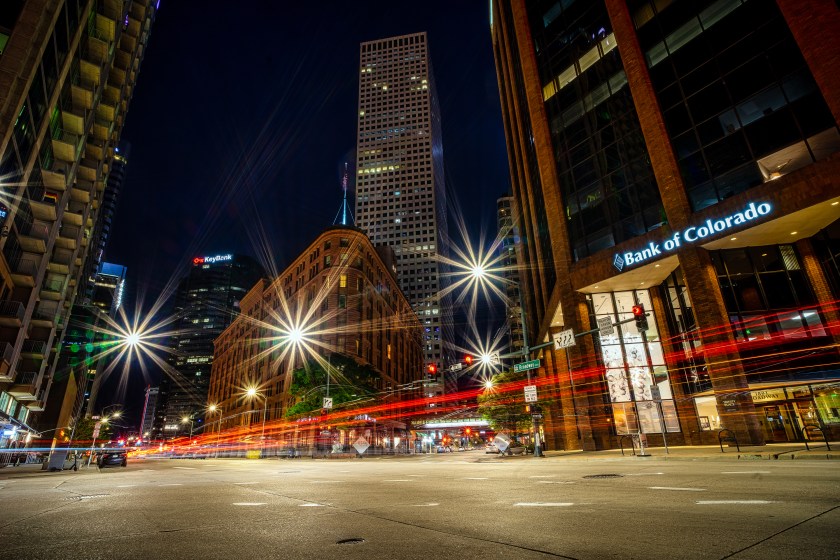
The photograph captures the Broadway and Tremont intersection in downtown Denver, highlighting the contrast between historic architecture and modern life through long exposure techniques. It features the Brown Palace Hotel amidst urban vitality, emphasizing Denver’s artistic complexity. The image challenges traditional views on Colorado’s landscape, advocating for cityscapes’ recognition in photographic surveys.

Long exposure light trails streak through a downtown Denver intersection at night, with tall buildings and streetlights surrounding the scene.
Long exposure traffic moves through the Broadway and Tremont intersection in downtown Denver, Colorado, with city buildings illuminated at night.

In this dynamic nocturnal study of downtown Denver, the photographer captures the essential duality of contemporary urban experience—the historic permanence of architecture set against the ephemeral flow of modern life. Positioned at the intersection of Broadway and Tremont, the image exemplifies his expanding vision within Chapter 3 of the Top 100 Journey, demonstrating how cityscapes demand entirely different technical and conceptual approaches than the natural landscapes that dominate much of his Colorado work.

The composition centers on the iconic triangular form of the Brown Palace Hotel, its distinctive Italianate Renaissance architecture rendered in warm amber tones against the deep blue of evening sky. This historic structure, framed between modern high-rises including the recognizable Republic Plaza tower, serves as both literal and metaphorical anchor—a touchstone of Denver’s Victorian-era prosperity surrounded by evidence of contemporary economic vitality. The photographer’s selection of this particular vantage point acknowledges the city’s layered temporal identity, where preservation and progress coexist in productive tension.

Working with an 18mm Samyang wide-angle lens mounted to his Sony A7II, he employs long exposure to transform vehicular traffic into ribbons of light—brilliant red taillights streaking horizontally across the frame’s lower third. These light trails provide kinetic energy and directional movement, leading the eye through the urban canyon while simultaneously suggesting the ceaseless motion of city life. Street lamps contribute their own starburst effects, punctuating the composition with points of crystalline brilliance that add theatrical dimension to the scene.

The technical execution reveals sophisticated understanding of night photography’s particular challenges. The exposure balances multiple light sources—artificial street lighting, illuminated building interiors, vehicle headlights, and residual ambient sky—without sacrificing detail in highlights or shadows. Corporate signage for KeyBank and Bank of Colorado glows with intentional clarity, grounding the image in specific place while contributing to the overall color harmony. The photographer’s post-processing in Luminar 4 has enhanced these chromatic relationships without pushing them into garishness, maintaining naturalistic tonality despite the inherently artificial lighting conditions.

What distinguishes this photograph within the broader chapter is its successful integration of Colorado’s urban identity alongside the state’s more frequently celebrated natural splendor. While mountain vistas and wilderness landscapes tend to dominate photographic representations of Colorado, this image argues persuasively for Denver’s visual complexity and photographic merit. The cityscape becomes landscape—vertical rather than horizontal, constructed rather than geological, but equally worthy of sustained aesthetic attention.

The wide-angle perspective introduces subtle geometric distortion that emphasizes the vertiginous quality of urban space, the way buildings frame and compress sky into channels of deep blue-black. Empty pavement in the immediate foreground provides breathing room, allowing viewers to enter the scene before being swept into the light-streaked energy of the intersection itself. This compositional breathing space demonstrates restraint and confidence, resisting the temptation to fill every pixel with information.

Within his evolving practice, this photograph represents important formal development. The controlled chaos of long-exposure urban photography requires different skills than landscape work—timing traffic flow, managing mixed lighting, balancing architectural detail against motion blur. His success here suggests a photographer expanding his technical vocabulary while maintaining consistent artistic sensibility. The image asks viewers to reconsider what constitutes Colorado landscape, proposing that cityscapes deserve equal consideration in any comprehensive photographic survey of the state’s visual identity.

Holiday Traffic: Urban Kinetics and the Ground-Level Perspective

Greg Urbano’s long-exposure photograph captures holiday traffic at a city intersection, blending urban dynamism with modern landscape photography. The low, ground-level perspective emphasizes movement and depth, contrasting traditional views. Utilizing experimental techniques, Urbano transforms mundane urban elements into visually engaging art, reflecting an intersection of Colorado’s natural and built environments.

Long exposure light trails streak across a city intersection at night, with a sewer grate and patches of ice in the foreground.
Long exposure light trails cross a city intersection at night, viewed from curb level during holiday traffic.

This long-exposure photograph marks a decisive departure from traditional landscape photography within Chapter 3 of Greg Urbano’s Top 100 Journey, demonstrating that the “cityscapes” component of his Colorado documentation extends beyond skyline silhouettes into the kinetic reality of urban infrastructure. Positioned at street level—literally at the curb—the photographer has created a dynamic study of nocturnal traffic patterns that transforms the mundane intersection of College Boulevard into a theater of light and motion.

The technical approach reveals deliberate experimentation with newly acquired equipment. Working with a Samyang 18mm wide-angle lens on his Sony A7ii, the photographer has exploited the optical characteristics of ultra-wide focal lengths to create exaggerated perspective and spatial depth. The low vantage point amplifies this effect dramatically: the sewer grate in the immediate foreground looms with tactile presence, its metal bars and residual ice providing textural anchor, while the light trails streak overhead in explosive radial patterns that suggest velocity and urban energy.

The compositional strategy employed here is remarkably sophisticated for what the photographer describes as “one of my early outings” with this lens. The image functions as a composite of multiple 25-30 second exposures, a technique that allows for selective accumulation of specific light sources while maintaining overall exposure balance. The resulting layering creates what might be termed a temporal palimpsest—multiple moments collapsed into a single frame, where red taillights and white headlamps trace the choreography of holiday traffic against the static geometry of traffic signals, street lamps, and seasonal decorations visible in the background.

What distinguishes this work from conventional light trail photography is its grounded perspective. Rather than adopting the elevated, observational stance typical of urban night photography, the photographer has chosen a worm’s-eye view that positions the viewer within the street infrastructure itself. This decision transforms the image from documentation into experience—we are not watching traffic from safe remove, but inhabiting the same plane as the vehicles themselves, separated only by the curb’s modest elevation.

The inclusion of the ice-rimmed drain grate serves multiple functions. Practically, it provides a foreground anchor that prevents the eye from being immediately swept into the light trails. Conceptually, it connects this urban image to the winter conditions documented elsewhere in the chapter, suggesting continuity between Colorado’s natural and built environments. The detail also introduces narrative specificity—this is not generic cityscape, but a particular moment following “last week’s big snowfall,” situating the photograph within both seasonal and meteorological context.

Within Urbano’s broader practice, this image represents important evolution. It demonstrates willingness to explore the full spectrum of Colorado’s visual character, from wilderness solitude to urban dynamism. The experimental nature of the work—testing new equipment, exploring composite techniques, embracing an unconventional viewpoint—suggests a photographer actively expanding his technical vocabulary rather than retreating to established formulas.

The photograph ultimately succeeds by finding aesthetic potential in overlooked urban moments. The holiday season’s increased traffic becomes raw material for abstract light painting, while municipal infrastructure—storm drains, asphalt, street furniture—gains unexpected visual dignity through careful framing and extended exposure. It is urbanism made kinetic, infrastructure rendered poetic.