Nocturnal Gateway: Union Station Illuminated

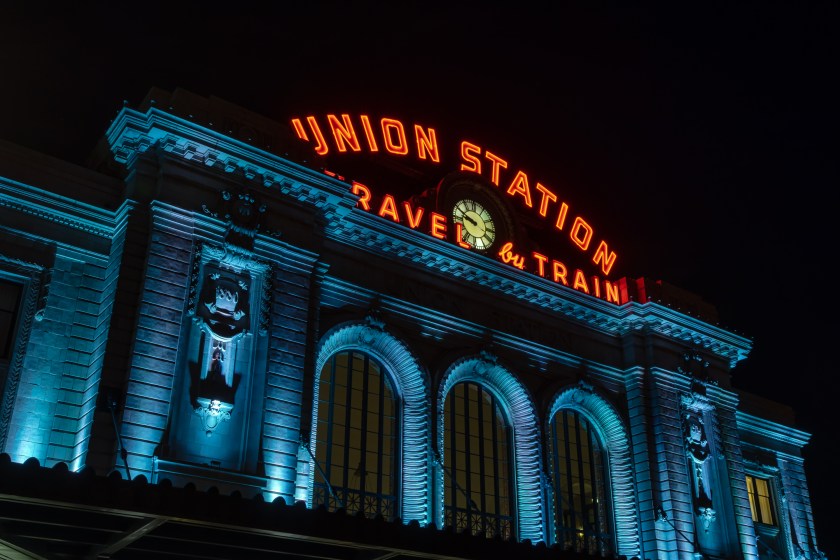
The photograph of Denver’s Union Station at night highlights its Beaux-Arts architecture through dramatic neon and electric blue lighting. Captured at ground level, it displays harmonious contrasts of light and structure, emphasizing the station’s role as a vibrant urban hub. This image underscores both preservation and the ongoing transformation of civic identity.

The illuminated front façade of Denver Union Station at night, with glowing neon signage and a clock above arched windows.
The front façade of Denver Union Station is illuminated at night, highlighted by its neon sign and historic architectural details.

In this nocturnal study of Denver’s Union Station, the photographer captures the transformation that occurs when historic architecture meets contemporary illumination. The image presents the iconic Beaux-Arts facade bathed in electric blue uplighting, while the famous neon signage glows in warm orange against the night sky—a study in complementary contrasts that speaks to both heritage and urban vitality.

The composition demonstrates restraint and classical sensibility. Shot with the Sony A7ii and kit lens, the photographer positions himself at ground level, allowing the building’s ornate cornice and horizontal bands to sweep across the upper portion of the frame. The three arched entrances anchor the lower third, their rhythmic repetition creating visual harmony while the vertical pilasters between them establish structural order. This frontal approach honors the station’s Beaux-Arts symmetry, respecting the intentions of the original 1914 design while documenting its twenty-first-century theatrical presentation.

What distinguishes this photograph is its embrace of artificial light as primary subject matter. The cool cyan wash transforms classical architectural details—the decorative moldings, the sculptural cartouches, the rusticated stonework—into relief elements that appear almost aquatic in their luminosity. This dramatic lighting choice, typically employed during special events or seasonal celebrations, removes the building from everyday documentation and positions it as urban spectacle. The warmth of the neon lettering provides essential counterpoint, its orange glow referencing mid-century Americana and the golden age of rail travel.

The working clock embedded within the signage adds temporal specificity, a reminder that this is a functioning transportation hub rather than mere architectural monument. The small silhouettes of gathered observers at the frame’s base provide crucial human scale, grounding the building’s theatrical presentation within the social realm. Their presence suggests communal gathering, the station serving its historic role as urban meeting point and threshold between destinations.

Within Chapter 3’s exploration of Colorado landscapes and cityscapes, this image represents the photographer’s engagement with Denver’s architectural heritage and its ongoing urban renewal. Union Station, revitalized in recent years as a mixed-use hub, embodies the tension between preservation and progress that defines many American cities. The photographer documents this transformation without editorial comment, allowing the dramatic lighting to speak to both celebration and commodification of historic space.

Technically, the night exposure presents challenges that the photographer navigates successfully. The deep black sky eliminates distracting context, focusing attention entirely on the illuminated facade. The exposure balances the intense neon signage against the softer architectural lighting, maintaining detail in both the brilliant highlights and the deeper blue shadows. The kit lens, often dismissed by photography purists, proves adequate to the task, capturing the scene with sufficient sharpness and minimal distortion.

This photograph pairs effectively with the earlier Denver Public Library study, together presenting divergent approaches to civic architecture. Where the library image emphasized monumental permanence through stark monochrome daylight, Union Station celebrates temporal display through saturated nocturnal color. Both reveal the photographer’s interest in how built environments express civic identity and cultural values.

The image ultimately serves as document, celebration, and subtle meditation on urban transformation—the historic gateway reimagined as luminous beacon in Denver’s evolving downtown landscape.
Contemporary Urban Narrative: The Scooter as Cultural Marker in Denver’s Historic District

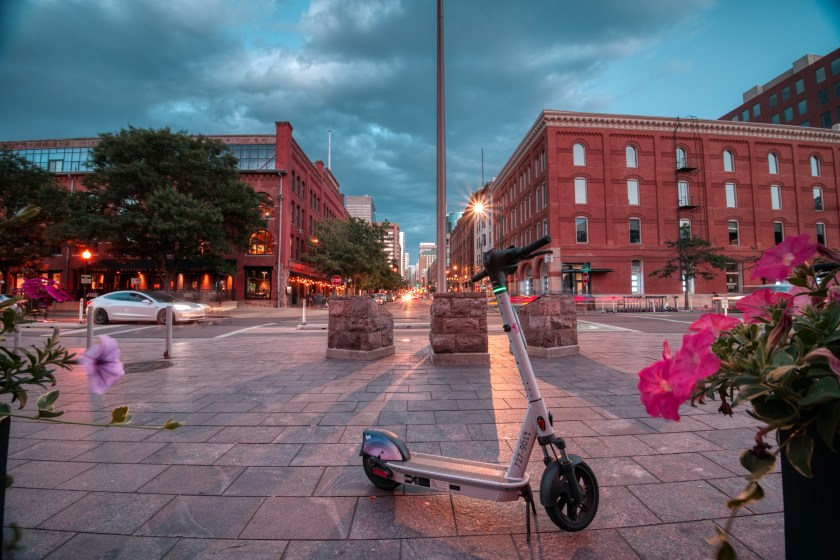
The photograph captures Denver’s Union Station, highlighting urban mobility through an electric scooter, symbolizing the modern sharing economy. Blending historic architecture and contemporary transit, it embodies Denver’s revitalization. The technical execution showcases skill in low-light conditions, emphasizing the cityscape’s complexity as part of Colorado’s evolving identity.

An electric scooter stands on a plaza at Denver Union Station, framed by brick buildings and evening traffic under a cloudy sky.
An electric scooter sits in the foreground near Denver Union Station as evening light and traffic move through downtown Denver.

In this street-level composition from Denver’s Union Station district, the photographer constructs a narrative about contemporary urban mobility that extends beyond mere documentation. The electric scooter, positioned prominently in the foreground, functions as both subject and symbol—a deliberate choice that anchors this image firmly in its specific cultural moment while engaging with the broader themes of his Colorado cityscapes chapter.

Shot with the Nikon Z5 and Nikkor 14-30mm wide-angle lens during the transitional blue hour, the image demonstrates technical command over challenging mixed-lighting conditions. His HDR processing through Aurora software balances the warm sodium vapor glow of street lamps with the cooler tones of approaching dusk, creating a color palette that feels authentic to the urban evening experience. The dramatic cloud formations overhead add atmospheric weight without overwhelming the architectural elements below.

The composition’s strength lies in its layered storytelling. The scooter occupies the immediate foreground, a symbol of the sharing economy and evolving transportation patterns that have reshaped American cities in recent years. Behind it, motion-blurred pedestrians and vehicle light trails suggest continuous movement—the perpetual flow of urban life. The red brick Victorian-era buildings flanking the street provide historical context, their solid permanence contrasting with the ephemeral nature of the modern transit device and the transient human figures.

This juxtaposition between historic preservation and contemporary innovation becomes the photograph’s central thesis. Denver’s Union Station neighborhood represents a successful urban revitalization, where nineteenth-century industrial architecture has been adapted for twenty-first-century use. The photographer captures this temporal complexity not through obvious before-and-after documentation, but through subtle visual relationships: old brick against new pavement, traditional street furniture against app-based transportation, architectural permanence against digital-age impermanence.

The wide-angle perspective creates dynamic leading lines through the paved plaza, drawing the viewer’s eye from the scooter through the middle ground and toward the vanishing point where downtown high-rises punctuate the skyline. Pink flowers frame the right edge, their organic forms softening the geometric rigor of the built environment while adding unexpected color that complements the warm building tones.

Within the context of Chapter 3’s exploration of Colorado landscapes and cityscapes, this image represents an important counterpoint to mountain vistas and natural panoramas. It acknowledges that Colorado’s contemporary identity includes rapidly growing urban centers navigating questions of density, mobility, and livability. The photographer treats the cityscape with the same observational care one might afford wilderness photography, suggesting that urban environments deserve equally thoughtful documentation.

The technical execution reflects growing proficiency with the Z5 system in low-light scenarios. The exposure balances bright highlights from street lamps and vehicle headlights while retaining shadow detail in the building facades and foreground elements. This dynamic range management, enhanced through HDR processing, avoids the artificial appearance that often compromises such techniques.

Ultimately, this photograph functions as cultural documentation—a moment preserved when electric scooters had become ubiquitous urban fixtures, when historic districts balanced preservation with progress, and when cities like Denver negotiated their identity between Western heritage and metropolitan aspiration. The photographer’s choice to include this image in his curated Top 100 Journey acknowledges that landscape photography can encompass the human-altered terrain of city streets, where the stories being told are equally complex and worthy of attention.