Passagrille Sunset

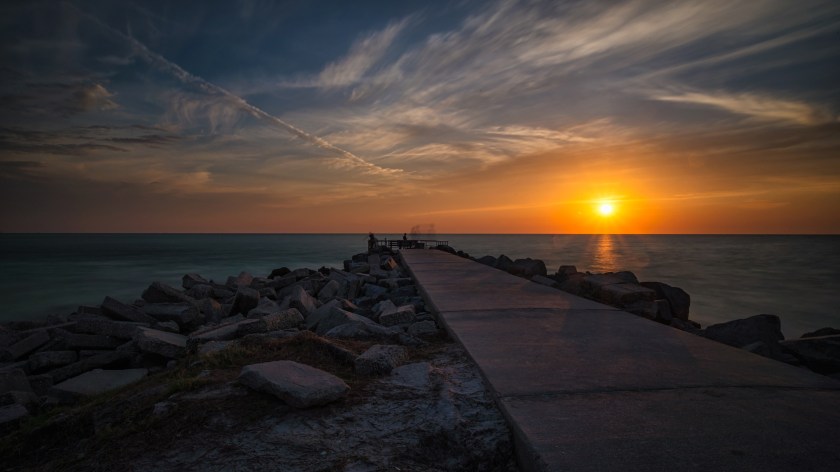
The photograph of a sunset over the Gulf of Mexico from the Pass-a-Grille jetty captures a sense of departure and geometric clarity. It juxtaposes the structural jetty against soft, ethereal water and sky, reflecting the photographer’s evolving approach while highlighting the tension between permanence and impermanence in landscapes.

Sunset photograph of the Pass‑a‑Grille jetty in Florida, with a concrete pier extending into the Gulf of Mexico and silhouetted figures at the horizon.
Sunset over the Gulf of Mexico from the Pass‑a‑Grille jetty.

This image from Chapter 2 of the Top 100 Journey carries with it a distinct sense of departure—a final engagement with a familiar location rendered with the careful attention of someone taking leave. Shot at Pass-a-Grille, the southern terminus of St. Pete Beach, the photograph distills the photographer’s technical vocabulary into a study of geometric clarity against atmospheric flux.

The concrete jetty commands the composition with unwavering linear authority, stretching from the immediate foreground toward the distant horizon where the sun hangs in perfect alignment. This centered positioning—often avoided in landscape photography as overly symmetrical—here becomes an asset, emphasizing the directional thrust of both structure and light. The jetty serves as more than mere subject; it functions as visual pathway, invitation, and barrier simultaneously. Flanked by massive boulder riprap on either side, the walkway creates a corridor that focuses attention while the rough-hewn stones provide textural contrast to the smooth concrete surface.

The technical approach reveals the photographer’s continued exploration of extended exposure. At fifteen seconds and f/22, the water on both sides of the jetty transforms into a milky abstraction, its individual waves collapsed into a singular luminous mass. This treatment—shorter than the sixty-second exposure employed in his Pier 60 work yet still substantially extended—suggests a refinement in his methodology. The turquoise-tinted water retains enough definition to read as liquid rather than dissolving into pure atmosphere, maintaining a crucial anchor to physical reality.

Above, the sky performs its transitional theater. Wispy cirrus formations streak diagonally across the frame from upper left, their directional movement contrasting with the horizontal stratification of color closer to the horizon. The gradient moves from deep slate blues through amber and peach tones to the incandescent disc of the sun itself. A single contrail cuts through the upper portion—a contemporary detail that situates this timeless scene firmly in the present moment, a reminder that even pristine natural settings exist within our flight-path-crossed modern reality.

The photographer has positioned himself low, allowing the foreground boulders to occupy significant visual weight in the left portion of the frame. These lichen-stained rocks, rendered in earth tones that echo the warm sunset palette, ground the image literally and figuratively. Their solidity counterbalances the ethereal qualities of water and sky, creating a dialogue between permanence and impermanence that resonates with the image’s contextual note about departure.

Within the framework of Chapter 2—Florida Landscapes & Cityscapes—this photograph demonstrates the photographer’s evolving relationship with infrastructure as subject. Where tourist piers offer human presence and activity, this utilitarian jetty provides something more austere: pure form against elemental forces. The viewing platform visible at the jetty’s terminus, occupied by silhouetted figures, offers scale and human connection without sentimentality.

The work succeeds in balancing documentary precision with interpretive mood. It captures a specific engineered structure at a specific coastal location while transcending those particulars to engage broader themes: the paths we walk toward light, the structures we build against erosion, the moments we choose to mark as endings before moving forward.

The Gulf Pier: A Foundation in Light and Structure

Greg Urbano’s “Landscapes in HDR” captures the Gulf Fishing Pier at Fort de Soto Park, reflecting his artistic development in photography. Utilizing a Nikon D7100, he balances composition with HDR techniques, achieving naturalistic vibrancy without over-processing. The image embodies a pivotal moment in skill mastery, exploring the connection between environment and human creation.

HDR landscape photograph of the Gulf Fishing Pier at Fort De Soto Park in Pinellas County, Florida, extending over calm water under a bright sky, taken with a Nikon D7100 at 14mm.
A 2013 HDR landscape photograph of the Gulf Fishing Pier at Fort De Soto Park in Pinellas County, Florida.

In the early stages of any photographer’s journey, there exists a pivotal moment when technical curiosity converges with artistic vision. Greg Urbano’s “Landscapes in HDR” from 2013 captures precisely this convergence—a photograph that speaks to the fundamentals of seeing while revealing the seeds of a maturing artistic voice.

The Gulf Fishing Pier at Fort de Soto Park presents itself as an exercise in classical composition, yet the image transcends mere documentation. Shot with a Nikon D7100 at 14mm, the photographer embraced the distortion inherent in ultra-wide-angle photography, using it not as a limitation but as a tool for emphasis. The pier’s concrete pathway stretches toward the horizon with geometric insistence, its weathered surface textured with salt stains and age—details that anchor the ethereal quality of the surrounding environment.

What distinguishes this work within the context of Chapter 1—Beginnings is the deliberate exploration of HDR processing, a technique that dominated landscape photography in the early 2010s. Rather than falling into the trap of over-processing that plagued much HDR work of this era, Urbano demonstrates restraint. The luminous gradations in the sky—from deep azure to wispy white—retain a naturalistic quality while revealing detail across an impressive tonal range. The turquoise waters of the Gulf of Mexico maintain their vibrancy without crossing into hypersaturation, suggesting an eye already sensitive to the boundaries between enhancement and artifice.

The technical choices reveal a photographer building his fundamental vocabulary. The aperture of ƒ/8.0 ensures critical sharpness from the foreground concrete to the distant structures, while the fast shutter speed of 1/400s freezes the subtle motion of the scene—likely the flutter of distant flags or the movement of the few figures visible along the pier. At ISO 100, the image maintains clarity in its textures, from the horizontal railings that create rhythmic lines to the architectural shelters that punctuate the composition’s middle ground.

What makes this photograph significant in understanding Urbano’s artistic evolution is not its perfection but its purposefulness. The nearly symmetrical composition, the careful attention to the leading lines, the consideration of how architectural elements frame the natural environment—these are the building blocks upon which more complex visual narratives are constructed. The weekly visits to this location mentioned in his notes speak to something essential in photographic development: the practice of returning, of seeing the same subject under different conditions, of learning through repetition.

The landscape itself offers something eternal—the meeting point of human construction and natural expanse. The pier extends confidently into the Gulf, a gesture of connection between land and water, between the photographer’s position and the infinite horizon. In capturing this scene, Urbano was not merely documenting a favorite location but engaging with fundamental questions about how we frame our relationship to place and space.

Within the broader context of “Beginnings,” this image exemplifies the necessary stage of mastering craft before transcending it. The imperfect attempts referenced in the chapter description are not failures but essential experiments. Here, we witness a photographer learning to see in high dynamic range, to compose with geometric precision, and to capture the luminous quality of coastal light—all foundational skills that would inform the more sophisticated work to come.

This is where journeys begin: in the clarity of intention, the discipline of practice, and the recognition that every master was once a student of light.

Under Golden Gate Bridge, 2010: Engineering as Art

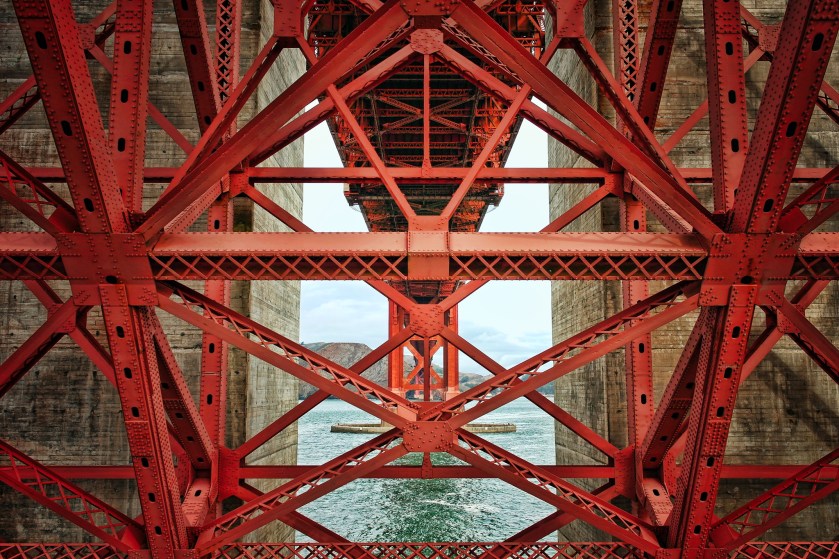
In this 2010 photograph, Greg Urbano captures the underside of San Francisco’s Golden Gate Bridge from Fort Point, showcasing its geometric elegance and structural beauty. This early work signifies Urbano’s evolving artistic vision, highlighting unique perspectives and the interplay of architecture and art, while demonstrating the potential of innovative photography tools.

Top 100 Journey – Early Vision

Upward view through the geometric steel framework beneath the Golden Gate Bridge from Fort Point, showing symmetrical orange-red trusses, concrete support pillars, and San Francisco Bay visible through the structure.
Beneath the Golden Gate Bridge from Fort Point, San Francisco – Architectural Photography 2010. Unique upward perspective capturing the intricate steel framework, geometric patterns, and engineering details of San Francisco’s iconic suspension bridge. View of San Francisco Bay through the International Orange structural beams and trusses.

This striking composition from 2010 captures the underside of San Francisco’s Golden Gate Bridge from Fort Point, revealing an intricate world of geometric patterns and structural elegance that most visitors never encounter. The photograph represents a pivotal moment in Greg Urbano’s photographic journey—an early work that demonstrates his emerging ability to transform industrial architecture into compelling visual poetry.

Shot with a Samsung NX100 at 22mm, the image presents a masterclass in symmetry and depth. The famous International Orange paint transforms the steel framework into a chromatic study, its warm coral-red tones contrasting beautifully against the cool concrete of the bridge’s support piers. Through the latticed structure, fragments of turquoise water and distant mountains create a layered composition that draws the eye through multiple planes of depth.

What distinguishes this photograph is its unconventional perspective. Rather than capturing the Golden Gate Bridge from the typical vantage points—across the bay or from the Marin Headlands—Urbano positions himself directly beneath the structure, looking upward through its architectural skeleton. This choice reveals the bridge not as an icon but as an engineering marvel, a cathedral of steel where form and function merge into unexpected beauty.

The technical execution shows thoughtful consideration of exposure and composition. At ƒ/4.5 and 1/250s, the photographer maintains sharpness throughout the frame while preserving detail in both the shadowed steel and the bright sky beyond. The ISO 100 setting ensures clean image quality, allowing the intricate patterns of rivets, crossbeams, and diagonal bracing to remain crisp and legible. The 22mm focal length provides enough width to capture the structure’s overwhelming scale while maintaining proper perspective control.

The geometric complexity invites prolonged viewing. X-patterns and triangular forms repeat throughout the composition, creating a rhythm that feels almost musical. The vertical piers anchor the image, while the diagonal members create dynamic tension. This interplay between stability and movement, between the monumental and the intricate, gives the photograph its visual power.

Within the context of Urbano’s early photographic development, this image reveals an artist learning to see beyond the obvious. The decision to climb Fort Point, to look upward rather than outward, demonstrates curiosity and willingness to explore unconventional viewpoints. These qualities—the search for fresh perspectives, the appreciation of overlooked details, the ability to find abstraction within reality—would become hallmarks of his mature work.

The photograph also captures a specific moment in technological transition. The Samsung NX100, one of the early mirrorless cameras, represented new possibilities in digital photography. This image proves that vision matters more than equipment—that a photographer’s eye can create compelling work with whatever tools are available.

Ultimately, “Under Golden Gate Bridge, 2010” succeeds because it transforms a familiar landmark into something unfamiliar and wondrous. It asks viewers to reconsider what they think they know, to look more carefully at the structures around them, and to appreciate the unexpected beauty hiding in plain sight. For a photographer still finding his voice, it represents an important early statement: architecture can be abstraction, engineering can be art, and poetry can be found in steel.

See this image on:

500px

Flickr