The Gateway Image: Passagrille Jetty Silhouette and the Dawn of a Photographic Vision

In a 2014 photograph taken at Passagrille Beach, Greg Urbano captures a stunning sunset over the Gulf of Mexico, which inspires his beach photography. Featuring a silhouetted fisherman against an orange sky, the image combines technical skill and emotional depth, symbolizing Urbano’s artistic journey and his evolving relationship with landscape imagery.

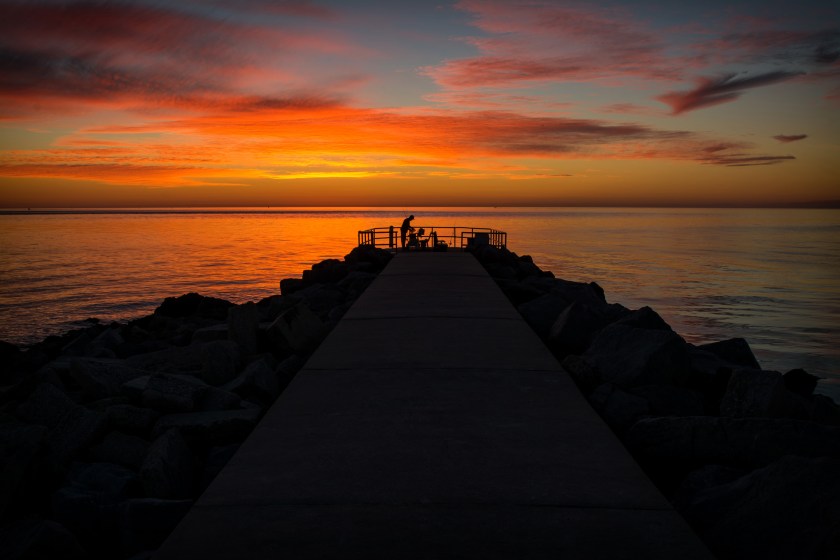
Silhouette of a lone fisherman standing on a rock jetty at Passagrille Beach during an orange Gulf of Mexico sunset, photographed with a Nikon D7100 at 24mm.
A 2014 sunset silhouette of a fisherman on the rock jetty at Passagrille Beach, Florida.

In the context of Greg Urbano’s “Beginnings” chapter, this 2014 sunset photograph from Passagrille Beach holds particular significance—not merely as a technically accomplished image, but as a foundational moment that would shape the photographer’s artistic trajectory for years to come. The image captures that precise intersection where technical competence meets emotional resonance, creating what Urbano himself identifies as his “inspiration for years of beach photography.”

The compositional structure reveals a photographer already thinking in strong geometric terms. The jetty’s dark pathway cuts through the frame with striking linearity, creating a powerful visual corridor that draws the viewer’s eye toward the observation platform at the terminus. This use of leading lines demonstrates sophisticated spatial awareness, transforming the rocky breakwater into a narrative device—a journey into the sublime moment captured in the sky above.

What distinguishes this photograph from countless other sunset images is Urbano’s commitment to silhouette as an artistic choice. Shot at ƒ/11 with a relatively slow shutter speed of 1/20 second at ISO 100, the exposure prioritizes the spectacular gradation of color in the sky while allowing the foreground elements to fall into deep shadow. The lone fisherman—barely discernible yet unmistakably present—becomes an everyman figure, a contemplative sentinel witnessing the day’s transition. This human element, reduced to pure form, prevents the image from becoming merely a spectacular sky study; instead, it grounds the natural drama in human experience.

The technical execution warrants examination. Using the Nikon D7100 with a 10-24mm lens at its maximum 24mm focal length, Urbano captures an expansive view that encompasses both the architectural elements of the jetty and the full breadth of the atmospheric display. The cropped sensor’s field of view provides enough width to establish context while maintaining focus on the central narrative. The aperture choice of ƒ/11 ensures sharpness throughout the frame, from the textured rocks in the immediate foreground to the distant horizon where sea meets sky.

The color palette—ranging from deep oranges and burning yellows to subtle purples and grays in the cloud formations—displays nature at its most theatrical. Yet Urbano’s restraint in post-processing (evident in the natural tonal transitions) allows the scene to speak with authenticity rather than hyperbole. This restraint would become a hallmark of his approach, distinguishing his work from the over-saturated aesthetic that dominates much contemporary landscape photography.

Perhaps most revealing is Urbano’s own reflection on this image as inspirational—a north star that guided subsequent explorations. One can trace forward from this moment to understand his ongoing fascination with the Gulf Coast’s theatrical sunsets, his appreciation for human elements within natural landscapes, and his sophisticated use of silhouette as a storytelling device. The photograph represents not an endpoint but a beginning, a discovery of visual vocabulary that would be refined and expanded throughout his career.

In the broader context of the “Beginnings” chapter, this Passagrille jetty image serves as both literal and metaphorical gateway—the concrete walkway leading toward beauty, the artist’s path toward photographic maturity, and the viewer’s invitation into Urbano’s evolving body of work.

Stacked Chrome Muscle: The Architecture of American Power

In a 2014 throwback photo, Greg Urbano captures a chrome muscle car engine at a car show, transforming it into a sculptural testament of American automotive culture. The monochrome composition highlights its intricate details and engineering philosophy, transcending typical automotive photography into fine art, reflecting power and craftsmanship.

Black‑and‑white close‑up photograph of a chrome muscle car engine with multiple intake stacks, polished components, and detailed mechanical parts, taken with a Nikon D7100 at 24mm.
A 2014 black‑and‑white close‑up of a stacked chrome muscle car engine captured at a car show.

In this striking image from Greg Urbano’s early photographic explorations, the viewer encounters not merely an engine, but a sculptural monument to American automotive culture. Shot at a car show in 2014, this photograph demonstrates how technical documentation can transcend its utilitarian origins to become a meditation on form, texture, and cultural identity.

The composition centers on a magnificent array of individual throttle bodies—eight polished chrome velocity stacks rising like organ pipes from the engine block below. Urbano’s decision to shoot at f/8.0 provides exceptional depth of field, rendering every fluted trumpet in sharp detail while maintaining visual coherence across the crowded mechanical landscape. The MSD Digital 6AL ignition box in the upper left corner grounds the image in specificity, reminding us this is a real machine, not an abstract study.

What elevates this work beyond conventional automotive photography is the photographer’s masterful use of monochrome. The conversion to black and white strips away distraction and reveals the essential geometry of performance engineering. Chrome becomes a study in gradation—from brilliant highlights on the velocity stack lips to the deep blacks of the engine valley below. The ribbed valve covers create rhythmic patterns that echo throughout the frame, establishing a visual cadence that draws the eye deeper into the mechanical complexity.

The lighting deserves particular attention. Working with the ambient conditions of a car show—notoriously challenging for photographers—Urbano has captured specular highlights that accentuate the three-dimensional quality of each component. The reflections dancing across polished surfaces create a sense of movement and life in what is, paradoxically, a static object. One can almost hear the anticipated roar of this engine, feel the vibration of its operation.

From a curatorial perspective, this image belongs firmly within the “Beginnings” chapter of Urbano’s journey. It reveals a photographer discovering his eye, learning to see beyond the obvious. Car shows present a particular challenge: everything is designed to be spectacular, yet the very abundance of visual stimulus can overwhelm. Here, the photographer has exercised editorial judgment, finding a perspective that isolates and celebrates a single element of automotive excess.

The stacked throttle bodies themselves represent a specific philosophy in performance engineering—individual runners for each cylinder, optimized airflow, uncompromising dedication to power over practicality. This photograph captures that ethos perfectly. There is nothing subtle about this engine, and Urbano wisely chooses not to apologize for its maximalism. Instead, he leans into the drama, using his technical choices to amplify the subject’s inherent theatricality.

The 24mm focal length on his Nikon D7100 provides just enough wide-angle perspective to encompass the scene without introducing distortion that would undermine the precision of these machined components. Shot at 1/30th of a second—relatively slow for handheld work—the image’s sharpness suggests careful technique, perhaps braced against the engine bay or shot with controlled breathing.

This photograph documents more than machinery; it captures a particular strain of American automotive culture that values power, craftsmanship, and conspicuous performance. In rendering it so beautifully, Urbano elevates the vernacular tradition of car photography into something approaching fine art—a promising beginning indeed for a photographer learning to find extraordinary subjects in ordinary places.

Fallen Tree: The Foundation of Seeing

The photograph from Hillsborough River State Park, taken by Greg Urbano in 2013 with a Nikon D7100, captures a pivotal moment in his artistic development. It reflects his early understanding of composition and intentionality, showcasing the dense subtropical landscape through HDR processing. This image symbolizes the importance of beginnings and learning in photography.

HDR photograph of a forest trail in Hillsborough River State Park with a large fallen tree across the path, dense vegetation, and filtered natural light, taken with a Nikon D7100 at 10mm.
A 2013 HDR landscape photograph of a fallen tree along a forest trail in Hillsborough River State Park, Florida.

In the opening chapter of Greg Urbano’s photographic journey, this image from Hillsborough River State Park stands as a testament to the essential nature of beginnings. Shot in 2013 with a Nikon D7100, the photograph captures more than a forest scene—it documents the foundational moment when a photographer learns to truly see the landscape before him.

The composition reveals an intuitive understanding of depth and perspective. Shot at 10mm, the wide-angle lens creates an immersive quality that draws viewers directly onto the trail. The fallen log in the foreground serves as both literal and metaphorical threshold, inviting passage into the deeper woods beyond. This diagonal element cuts across the frame with authority, its weathered texture rendered in sharp detail by the f/8.0 aperture, demonstrating Urbano’s early grasp of how to balance foreground interest with background context.

The HDR processing technique employed here reflects the experimental spirit characteristic of this pre-2015 period. While HDR would later fall somewhat out of favor in fine art photography circles, its application in this image serves a clear purpose: to capture the dynamic range of a Florida forest understory, where dappled sunlight creates extreme contrasts between shadow and highlight. The palmetto fronds and oak canopy are rendered with an almost hyper-real clarity that emphasizes the dense, layered nature of this subtropical ecosystem.

What makes this photograph particularly significant within the “Beginnings” chapter is its honesty about place and limitation. Urbano’s accompanying note—that this Florida park offered his “best opportunity to capture flowing water over river rocks” before relocating to Colorado—reveals something crucial about artistic development. Great photography emerges not from waiting for perfect conditions, but from working intensively with what’s available. This trail became his classroom, this fallen log his teacher.

The technical choices demonstrate a photographer thinking through his craft. The 1/50s shutter speed suggests deliberate handholding technique, while the ISO 200 setting indicates available light conditions and a preference for image quality. These aren’t the settings of someone simply pointing and shooting; they reveal consideration and intentionality, even in these early stages.

The color palette—predominantly greens with earth-toned accents—creates a cohesive, naturalistic feel despite the HDR processing. The slight motion blur in the foliage adds an organic quality, a reminder that this is a living landscape caught in a specific moment. The trail itself winds invitingly into the frame’s depth, disappearing around a bend that promises further discovery—a fitting metaphor for the artistic journey being documented.

In the context of Urbano’s larger body of work, this image represents more than just an early attempt. It embodies the crucial truth that mastery begins with showing up, with making photographs even when the circumstances aren’t ideal, even when the technique hasn’t been perfected. The photograph’s inclusion in his top 100 collection isn’t about technical perfection but about recognizing the importance of foundation.

Every artist’s journey requires a starting point, a place where curiosity meets commitment. This fallen tree, this Florida trail, this moment of learning to see—these are the essential ingredients that would eventually lead to mountain streams in Colorado and a mature photographic vision. The imperfect attempt, it turns out, isn’t just necessary. It’s everything.

Lady in a Hat: A Study in Perspective and Presence

In 2013, Greg Urbano’s photograph “Lady in a Hat” encapsulated his experimental spirit in photography. Taken at a Veterans benefit car show in Florida, it features a classic car and a woman in a hat, illustrating the dynamic between subject and observer. This image showcases the evolution of Urbano’s artistry and HDR techniques, emphasizing compositional storytelling.

HDR photograph from a 2013 car show featuring a woman wearing a hat standing near classic vehicles, taken with a Nikon D5100 at 10mm.
A 2013 HDR photograph from a Veterans benefit car show at Bay Pines VA in Pinellas County, Florida.
Shot with a Nikon D5100.

In the early years of Greg Urbano’s photographic journey, there existed a willingness to experiment boldly with emerging digital techniques—a quality that would become foundational to his artistic identity. “Lady in a Hat,” captured in 2013 at a Veterans benefit car show in Bay Pines, Florida, exemplifies this experimental spirit while revealing an intuitive understanding of compositional storytelling that would define his later work.

The photograph presents a gleaming black classic car, its hood raised to display immaculate chrome and engineering, positioned at a dramatic low angle that transforms the vehicle into something monumental. But what elevates this image beyond typical automotive photography is the deliberate inclusion of a figure in the background—a woman in a distinctive hat, observing the scene. This compositional choice transforms what could have been a straightforward documentation of mechanical beauty into a meditation on observation itself, on the relationship between spectator and spectacle.

Urbano shot this image with a Nikon D5100 at 10mm, an ultra-wide focal length that creates pronounced perspective distortion. The technical settings—f/10 at 1/320s, ISO 160—suggest bright midday conditions, yet the photographer’s use of HDR processing pushes the tonal range far beyond what the camera captured in a single exposure. This was 2013, when HDR photography was experiencing widespread popularity in automotive and architectural work, and Urbano was actively exploring its possibilities. The processing intensifies the reflections on the car’s black paint, brings out texture in the engine bay, and maintains detail in both the bright Florida sky and the shadowed undercarriage.

What makes this image significant within the context of Chapter 1—Beginnings is not its technical perfection, but rather what it reveals about the photographer’s developing eye. The ultra-wide perspective could easily overwhelm the frame, yet Urbano maintains balance through careful positioning. The car dominates the foreground, grounded by fallen leaves and grass texture, while the human element remains present but unobtrusive in the middle distance. This suggests an emerging awareness of layered storytelling, of creating images that reward sustained viewing.

The title itself demonstrates artistic intentionality. “Lady in a Hat” redirects our attention from the obvious subject—the pristine classic car—to the peripheral human presence, suggesting that the photographer understood even then that compelling photographs often exist in the tension between primary and secondary subjects, between what commands attention and what quietly observes.

This photograph also documents a specific moment in Urbano’s technical education. HDR processing, with its characteristic emphasis on local contrast and detail recovery, taught photographers of this era to see scenes in terms of tonal relationships rather than single exposures. This training in visualizing extended dynamic range would later inform his approach to lighting and exposure, even when shooting single frames.

Within the broader narrative of the Top 100 Journey project, “Lady in a Hat” represents the necessary phase of bold experimentation that precedes refinement. It captures a photographer unafraid to push processing techniques to their limits, to shoot from unconventional angles, and to include elements that complicate rather than simplify the frame. These imperfect attempts, as Urbano himself acknowledges, formed the foundation for everything that followed—a reminder that artistic growth requires the courage to create before one fully understands how.

Under Golden Gate Bridge, 2010: Engineering as Art

In this 2010 photograph, Greg Urbano captures the underside of San Francisco’s Golden Gate Bridge from Fort Point, showcasing its geometric elegance and structural beauty. This early work signifies Urbano’s evolving artistic vision, highlighting unique perspectives and the interplay of architecture and art, while demonstrating the potential of innovative photography tools.

Top 100 Journey – Early Vision

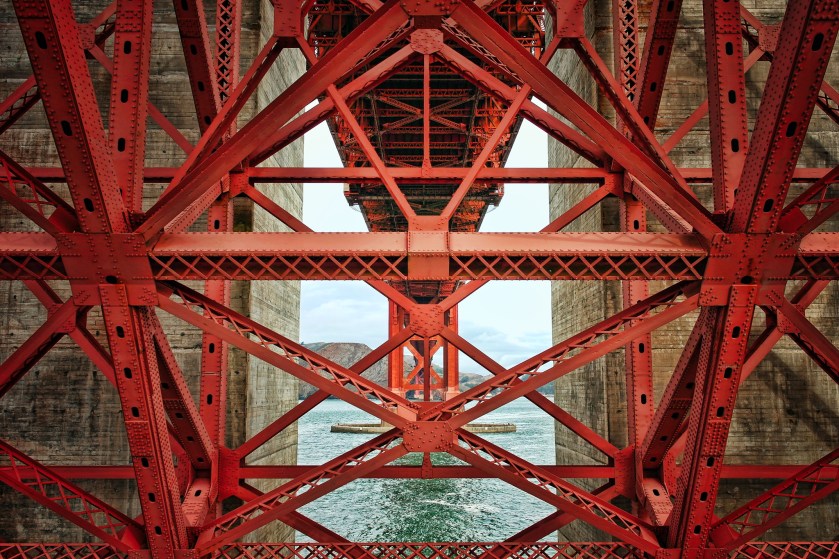
Upward view through the geometric steel framework beneath the Golden Gate Bridge from Fort Point, showing symmetrical orange-red trusses, concrete support pillars, and San Francisco Bay visible through the structure.
Beneath the Golden Gate Bridge from Fort Point, San Francisco – Architectural Photography 2010. Unique upward perspective capturing the intricate steel framework, geometric patterns, and engineering details of San Francisco’s iconic suspension bridge. View of San Francisco Bay through the International Orange structural beams and trusses.

This striking composition from 2010 captures the underside of San Francisco’s Golden Gate Bridge from Fort Point, revealing an intricate world of geometric patterns and structural elegance that most visitors never encounter. The photograph represents a pivotal moment in Greg Urbano’s photographic journey—an early work that demonstrates his emerging ability to transform industrial architecture into compelling visual poetry.

Shot with a Samsung NX100 at 22mm, the image presents a masterclass in symmetry and depth. The famous International Orange paint transforms the steel framework into a chromatic study, its warm coral-red tones contrasting beautifully against the cool concrete of the bridge’s support piers. Through the latticed structure, fragments of turquoise water and distant mountains create a layered composition that draws the eye through multiple planes of depth.

What distinguishes this photograph is its unconventional perspective. Rather than capturing the Golden Gate Bridge from the typical vantage points—across the bay or from the Marin Headlands—Urbano positions himself directly beneath the structure, looking upward through its architectural skeleton. This choice reveals the bridge not as an icon but as an engineering marvel, a cathedral of steel where form and function merge into unexpected beauty.

The technical execution shows thoughtful consideration of exposure and composition. At ƒ/4.5 and 1/250s, the photographer maintains sharpness throughout the frame while preserving detail in both the shadowed steel and the bright sky beyond. The ISO 100 setting ensures clean image quality, allowing the intricate patterns of rivets, crossbeams, and diagonal bracing to remain crisp and legible. The 22mm focal length provides enough width to capture the structure’s overwhelming scale while maintaining proper perspective control.

The geometric complexity invites prolonged viewing. X-patterns and triangular forms repeat throughout the composition, creating a rhythm that feels almost musical. The vertical piers anchor the image, while the diagonal members create dynamic tension. This interplay between stability and movement, between the monumental and the intricate, gives the photograph its visual power.

Within the context of Urbano’s early photographic development, this image reveals an artist learning to see beyond the obvious. The decision to climb Fort Point, to look upward rather than outward, demonstrates curiosity and willingness to explore unconventional viewpoints. These qualities—the search for fresh perspectives, the appreciation of overlooked details, the ability to find abstraction within reality—would become hallmarks of his mature work.

The photograph also captures a specific moment in technological transition. The Samsung NX100, one of the early mirrorless cameras, represented new possibilities in digital photography. This image proves that vision matters more than equipment—that a photographer’s eye can create compelling work with whatever tools are available.

Ultimately, “Under Golden Gate Bridge, 2010” succeeds because it transforms a familiar landmark into something unfamiliar and wondrous. It asks viewers to reconsider what they think they know, to look more carefully at the structures around them, and to appreciate the unexpected beauty hiding in plain sight. For a photographer still finding his voice, it represents an important early statement: architecture can be abstraction, engineering can be art, and poetry can be found in steel.

See this image on:

500px

Flickr