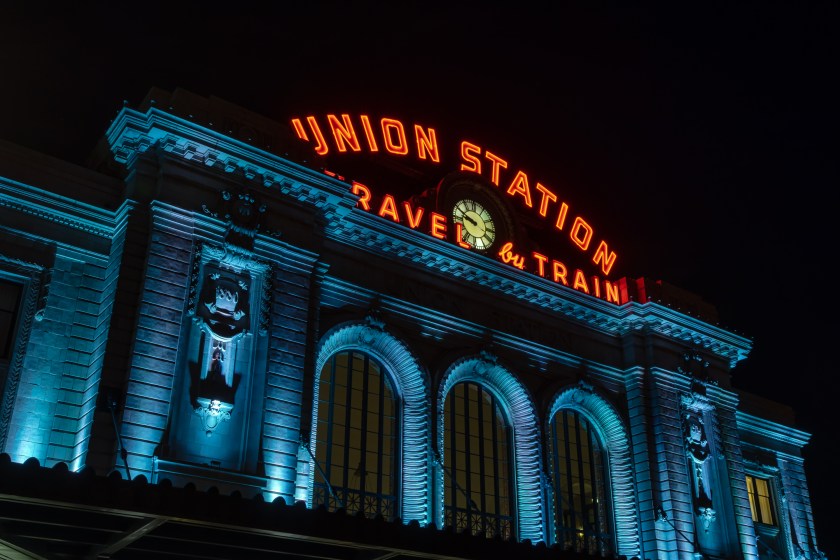
In this nocturnal study of Denver’s Union Station, the photographer captures the transformation that occurs when historic architecture meets contemporary illumination. The image presents the iconic Beaux-Arts facade bathed in electric blue uplighting, while the famous neon signage glows in warm orange against the night sky—a study in complementary contrasts that speaks to both heritage and urban vitality.
The composition demonstrates restraint and classical sensibility. Shot with the Sony A7ii and kit lens, the photographer positions himself at ground level, allowing the building’s ornate cornice and horizontal bands to sweep across the upper portion of the frame. The three arched entrances anchor the lower third, their rhythmic repetition creating visual harmony while the vertical pilasters between them establish structural order. This frontal approach honors the station’s Beaux-Arts symmetry, respecting the intentions of the original 1914 design while documenting its twenty-first-century theatrical presentation.
What distinguishes this photograph is its embrace of artificial light as primary subject matter. The cool cyan wash transforms classical architectural details—the decorative moldings, the sculptural cartouches, the rusticated stonework—into relief elements that appear almost aquatic in their luminosity. This dramatic lighting choice, typically employed during special events or seasonal celebrations, removes the building from everyday documentation and positions it as urban spectacle. The warmth of the neon lettering provides essential counterpoint, its orange glow referencing mid-century Americana and the golden age of rail travel.
The working clock embedded within the signage adds temporal specificity, a reminder that this is a functioning transportation hub rather than mere architectural monument. The small silhouettes of gathered observers at the frame’s base provide crucial human scale, grounding the building’s theatrical presentation within the social realm. Their presence suggests communal gathering, the station serving its historic role as urban meeting point and threshold between destinations.
Within Chapter 3’s exploration of Colorado landscapes and cityscapes, this image represents the photographer’s engagement with Denver’s architectural heritage and its ongoing urban renewal. Union Station, revitalized in recent years as a mixed-use hub, embodies the tension between preservation and progress that defines many American cities. The photographer documents this transformation without editorial comment, allowing the dramatic lighting to speak to both celebration and commodification of historic space.
Technically, the night exposure presents challenges that the photographer navigates successfully. The deep black sky eliminates distracting context, focusing attention entirely on the illuminated facade. The exposure balances the intense neon signage against the softer architectural lighting, maintaining detail in both the brilliant highlights and the deeper blue shadows. The kit lens, often dismissed by photography purists, proves adequate to the task, capturing the scene with sufficient sharpness and minimal distortion.
This photograph pairs effectively with the earlier Denver Public Library study, together presenting divergent approaches to civic architecture. Where the library image emphasized monumental permanence through stark monochrome daylight, Union Station celebrates temporal display through saturated nocturnal color. Both reveal the photographer’s interest in how built environments express civic identity and cultural values.
The image ultimately serves as document, celebration, and subtle meditation on urban transformation—the historic gateway reimagined as luminous beacon in Denver’s evolving downtown landscape.
 Greg Urbano