Refraction and Illumination: A Study in Controlled Light

In Greg Urbano’s entry from “The Road Ahead: Recent Work & Ongoing Exploration,” a single green LED illuminates a glass sphere, creating intricate light patterns. This photograph showcases the artist’s mastery of optical effects and light manipulation. It reflects an ongoing exploration of visual ideas, balancing technical skill with artistic homage.

A glass sphere sits on black acrylic, bending bright green LED lines that cross diagonally, with a clear reflection below against a dark background.
A single green LED light creates intersecting line patterns that refract through a glass sphere and reflect off black acrylic.

In this striking entry from Chapter 6 of Greg Urbano’s Top 100 Journey—titled “The Road Ahead: Recent Work & Ongoing Exploration”—the photographer demonstrates a sophisticated understanding of light manipulation and optical phenomena. Created as part of the 52 Frames community’s Week 38 challenge, which called for images using a single light source, this photograph represents both technical mastery and artistic homage.

The composition centers on a glass sphere resting atop a reflective black acrylic base, positioned against a background of projected linear light patterns. What immediately captivates the viewer is the optical complexity achieved through such seemingly simple elements. The sphere acts as a lens, refracting and inverting the striped pattern behind it, while simultaneously creating a mirror image in the glossy surface below. This doubling effect—one sphere above, one reflected beneath—establishes a visual dialogue between reality and reflection that speaks to photography’s fundamental nature as a medium of light capture.

The photographer’s choice of a Godox TL30 LED wand as his single light source proves particularly astute. Rather than relying on ambient or diffused lighting, he creates a precise, linear pattern that reads as both graphic element and scientific demonstration. The vibrant green illumination pulses across the frame in parallel lines, their luminosity gradating from deep emerald to electric cyan. Where the light passes through the sphere, it bends and concentrates, revealing the optical principles at work while creating areas of intense brilliance that punctuate the geometric order.

This image explicitly acknowledges its lineage. The photographer credits Elizabeth Klepper’s 2023 work from the same community as inspiration—a refreshingly transparent gesture that positions this photograph within a continuum of artistic exchange rather than claiming isolated innovation. Yet this is no mere reproduction. Where Klepper’s original vision provided the conceptual framework, this interpretation carries distinct choices in color temperature, scale, and tonal contrast that mark it as an independent exploration.

The technical execution reveals careful consideration of multiple variables. The exposure balances the intense luminosity of the LED source with the deep blacks of the background and base, maintaining detail across a challenging dynamic range. The focus renders the sphere’s surface with crystalline clarity, allowing viewers to perceive both its transparency and its physical substance simultaneously. The alignment of the linear patterns—maintaining their parallel consistency both in direct view and through the sphere’s distortion—suggests meticulous positioning and multiple test exposures.

Within the context of Chapter 6, this photograph signals a willingness to engage with established visual ideas while pushing toward new territory. The chapter’s subtitle, “Recent Work & Ongoing Exploration,” positions the photographer at a transitional moment, actively investigating techniques and concepts that may inform future directions. This image embodies that investigative spirit—it is simultaneously a study, an exercise, and a finished work worthy of exhibition.

The minimalist aesthetic here contrasts with the more documentary or narrative approaches found in earlier chapters of the Journey. The photographer strips away contextual information, environmental cues, and representational content, focusing instead on pure optical phenomena. Light becomes subject rather than tool. The glass sphere transforms from decorative object to scientific instrument to sculptural form.

What elevates this beyond technical demonstration is its inherent beauty—the mesmerizing quality of those radiating green lines, the perfect symmetry of sphere and reflection, the luminous energy that seems to emanate from the glass itself. It exemplifies how constraint, whether self-imposed or community-mandated, can generate creative solutions that transcend their origins.

Natural Elegance: A Portrait in Copper and Light

Abigail Marchetti, known as Copper Muse, poses at a Denver Models open shoot, showcasing the photographer’s evolving studio portraiture techniques. Utilizing natural light, he captures her striking features and authentic expression, emphasizing color harmony and psychological presence. This portrait marks a significant step in his artistic development, blending classical principles with a modern sensibility.

Studio portrait of a red-haired woman in a black dress posing against a light background with her hands framing her face.
Model Abigail Marchetti, known as Copper Muse, poses during a Denver Models open shoot at Realm Studio in Denver.

This compelling portrait of model Abigail Marchetti exemplifies the photographer’s deepening engagement with studio portraiture and his refined approach to natural light as a primary sculptural tool. Captured during a Denver Models open shoot at Realm Studio, the image represents continued exploration of collaborative creative environments while demonstrating increasingly sophisticated control of the portraitist’s essential elements: light, gesture, color harmony, and psychological presence.

The composition centers on the model’s striking features—vibrant copper-red hair cascading in loose waves, piercing blue-green eyes meeting the camera with direct but unguarded confidence, and pale skin that catches and reflects the soft window light with luminous clarity. Her pose, with one hand gracefully raised to her hair and the other touching her neck, creates natural framing that draws attention to her face while suggesting unaffected spontaneity. The black strapless garment provides bold tonal contrast against both her skin and the pale backdrop, creating visual drama without competing for attention.

What distinguishes this work is the photographer’s masterful exploitation of natural window light. Rather than relying on the multiple strobes and reflectors typical of commercial studio work, he has chosen a more classical approach that recalls portrait painting traditions. The directional quality of the illumination—soft yet defined—models the subject’s features with sculptural precision while maintaining delicate gradations across skin tones. Highlights along the hair reveal its rich, multidimensional copper coloring, transforming what could be merely descriptive documentation into chromatic study.

The technical execution demonstrates growing confidence with the Nikon Z5 system and the versatile 24-120mm lens. The focal length selection—likely in the moderate telephoto range—provides flattering perspective without distortion, while the depth of field keeps the subject sharply defined against the subtly gradated background. The exposure balances the challenge of pale skin and light background without sacrificing detail in either the model’s features or the deeper tones of her garment.

Within the framework of Chapter 6—”The Road Ahead: Recent Work & Ongoing Exploration”—this portrait signals important developments in his artistic trajectory. The open shoot environment, like the previous workshop-based work, indicates willingness to engage with structured collaborative opportunities while bringing his distinct sensibility to bear. Yet where some open shoots yield generic beauty documentation, this image transcends its circumstances through careful attention to classical portraiture principles: the quality of light, the authenticity of expression, the harmony of color and form.

The model’s direct gaze introduces a quality often absent from his landscape and architectural work—reciprocal acknowledgment between photographer and subject. This mutual recognition adds psychological dimension, transforming technical exercise into genuine encounter. The slight asymmetry in her expression—contemplative rather than performative—suggests comfort and trust within the photographic exchange.

The photograph also reveals evolving aesthetic priorities. While maintaining the tonal sensitivity and compositional rigor evident throughout his portfolio, he demonstrates here that minimalism need not preclude richness. The interplay of copper hair, pale skin, black fabric, and soft grey background creates visual complexity through chromatic relationships rather than environmental detail. This represents a distillation of his practice—finding depth in apparent simplicity, discovering complexity in restraint—now applied to the human figure with increasing assurance and grace.

Suspension and Illusion: A Study in Controlled Ephemera

Model Everyn Darling is featured in a significant studio portrait taken during a photography workshop in Denver. This image, characterized by its minimalist setting and controlled lighting, explores themes of aspiration and vulnerability through the metaphor of a translucent balloon. The photographer’s evolving style emphasizes collaborative creativity and visual poetry over mere technical perfection.

Studio portrait of a woman in a black dress holding a translucent balloon against a plain backdrop.
Model Everyn Darling poses with a translucent balloon during a studio photography workshop in Denver, Colorado.

This studio portrait represents a significant departure within the photographer’s evolving practice, marking his exploration of collaborative, workshop-based creation and the controlled artifice of studio environments. Captured during a Creative Experimental Photography Meetup at RAW Studios in Denver, the image demonstrates how structured creative exercises can yield work of surprising conceptual depth when approached with technical precision and compositional awareness.

The photograph centers on model Everyn Darling, positioned within a minimalist studio setting characterized by graduated neutral tones that transition from cool blue-grey to warm cream. This chromatic subtlety provides visual breathing room while maintaining atmospheric presence—a backdrop that supports rather than competes. The subject, dressed in a simple black dress with white collar detail, appears barefoot in a pose of upward contemplation, one arm extended to hold a translucent balloon trailing delicate white ribbons or fabric.

What elevates this image beyond documentation of a workshop exercise is the photographer’s attention to the psychology of gesture and the poetry of the ostensibly simple prop. The balloon—that most ephemeral and-associated of objects—becomes a vehicle for exploring themes of lightness, release, and the tenuous connection between desire and drift. The model’s gaze follows the balloon upward, creating a diagonal compositional line that draws the eye through the frame while suggesting aspiration, longing, or perhaps the acceptance of letting go.

The technical execution reveals disciplined studio craft. Working with his Nikon Z5 and the versatile 24-120mm f/4 lens, the photographer has managed studio lighting with restraint, avoiding the harsh drama often favored in workshop settings. The illumination appears softly directional, modeling the subject’s features and dress while maintaining detail in the translucent balloon. Shadow work on the studio floor provides subtle grounding without becoming graphic or distracting. The slightly elevated perspective and negative space allocation give the subject room to breathe within the frame—a compositional generosity that reinforces the image’s contemplative mood.

Within the context of Chapter 6—”The Road Ahead: Recent Work & Ongoing Exploration”—this photograph signals important developments in his practice. The workshop origin indicates openness to collaborative creative structures and willingness to work within parameters set by others. Yet the result bears his aesthetic signature: careful attention to subtle tonal gradations, preference for psychological ambiguity over narrative certainty, and interest in objects as metaphorical carriers rather than mere props.

The image also represents exploration of human subjects with greater intimacy than much of his earlier landscape and architectural work. The model’s upturned face, though not confronting the camera directly, introduces vulnerability and interiority often absent from environmental documentation. This shift suggests expanding comfort with portraiture and the complex dynamics of photographer-subject collaboration.

The balloon’s deliberate artificiality—clearly held rather than actually floating—adds productive tension. The photograph acknowledges its own construction while inviting viewers to suspend disbelief, mirroring how all photography negotiates between document and fiction. In selecting this image as his best from the series, the photographer reveals evolving criteria for success: not technical perfection alone, but the achievement of visual poetry through careful orchestration of simple elements within controlled conditions.

Reclamation and Ruin: A Study in Agricultural Melancholy

The photograph of an abandoned farmhouse near Fort Collins, Colorado, embodies themes of impermanence and decay. The image balances architectural elements with natural landscapes, showcasing technical sophistication through HDR processing. By highlighting details of deterioration amidst recent human traces, it transforms rural abandonment into a poignant meditation on time and memory.

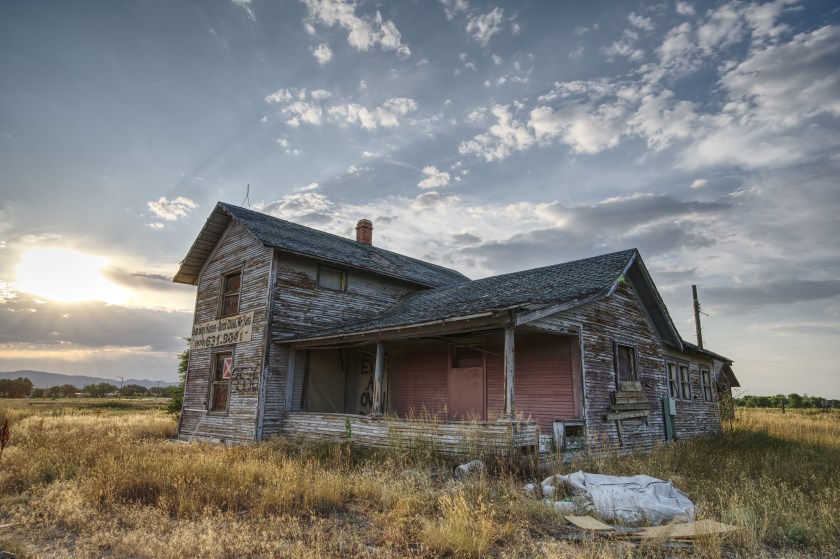
Weathered wooden farmhouse with boarded windows and peeling paint standing in tall grass near Fort Collins, Colorado.
An abandoned wooden farmhouse sits in open prairie near Fort Collins, Colorado.

In this haunting documentation of rural abandonment, the photographer captures a weathered farmhouse on the outskirts of Fort Collins, Colorado—a structure caught in the liminal space between human history and nature’s patient reclamation. The image, selected for Chapter 6 of his Top 100 Journey, exemplifies the ongoing evolution in his practice toward subjects that speak to impermanence, transition, and the quiet dignity of forgotten places.

The compositional strategy reveals a mature understanding of architectural photography merged with landscape sensibility. The two-story structure commands the frame while remaining subordinate to the expansive Colorado sky, which fills nearly half the image with dramatic cloud formations. This deliberate balance prevents the photograph from becoming merely documentary, instead elevating it into meditation on time and decay. The golden hour lighting—captured with precision timing—rakes across the weathered clapboard siding, accentuating every crack, peel, and shadow in the wood grain. This textural emphasis transforms deterioration into visual poetry.

His decision to employ HDR processing demonstrates technical sophistication in service of artistic vision rather than mere spectacle. The extended dynamic range allows simultaneous preservation of detail in the sun-bleached siding and the darker recesses of boarded windows and doorways. The processing maintains naturalistic color while enhancing the amber warmth of dying light against cool blue-grey clouds, creating chromatic tension that mirrors the thematic conflict between persistence and decay.

The overgrown prairie grass in the foreground serves multiple functions within the composition. Practically, it provides textural contrast to the geometric severity of the architecture; symbolically, it represents nature’s inexorable advance. The discarded white fabric or tarp in the lower right corner introduces a note of recent human presence, suggesting that abandonment is an ongoing process rather than a completed historical fact. This detail prevents the image from slipping into nostalgic romanticism.

What distinguishes this work within the context of Chapter 6—titled “The Road Ahead: Recent Work & Ongoing Exploration”—is its synthesis of earlier themes with evolving concerns. The photographer has long demonstrated interest in human traces within landscape, but here the investigation deepens. Rather than simply documenting what remains, he engages with the process of vanishing itself. The boarded windows become blind eyes; the peeling paint functions as aging skin; the sagging roofline suggests exhaustion. The structure possesses almost anthropomorphic vulnerability.

The photograph’s origins as a response to the 52frames weekly challenge reveals another dimension of his practice—the ability to transform assignment-based work into personally meaningful investigation. Many photographers struggle to maintain artistic integrity within the constraints of themed prompts, yet he has consistently used such frameworks as catalysts rather than limitations.

The telephone number still visible on the building’s facade—a commercial ghost—adds poignant specificity. It grounds the abstracted themes of abandonment and time in particular lives, particular businesses, particular failures or departures. This detail resists the tendency toward generic commentary on “the death of rural America” and instead insists on the singular reality of this particular farmhouse, this particular field, this particular evening light.

In positioning this image within his ongoing journey, the photographer signals continued commitment to finding profound resonance in overlooked subjects. The road ahead, it seems, leads deliberately toward what others pass by—not from contrarian impulse, but from genuine recognition that beauty and meaning persist even in, perhaps especially in, the discarded and decaying.

American Beauty: Strawberry Ravecake

The portrait of model Strawberry Ravecake, taken during a Denver workshop, reinterprets film noir and 1940s glamour through contemporary aesthetics, merging historical and modern elements. The striking use of chiaroscuro and vibrant colors challenges traditional conventions, featuring a tattooed model in luxurious settings, creating a dialogue on representation and glamour across eras.

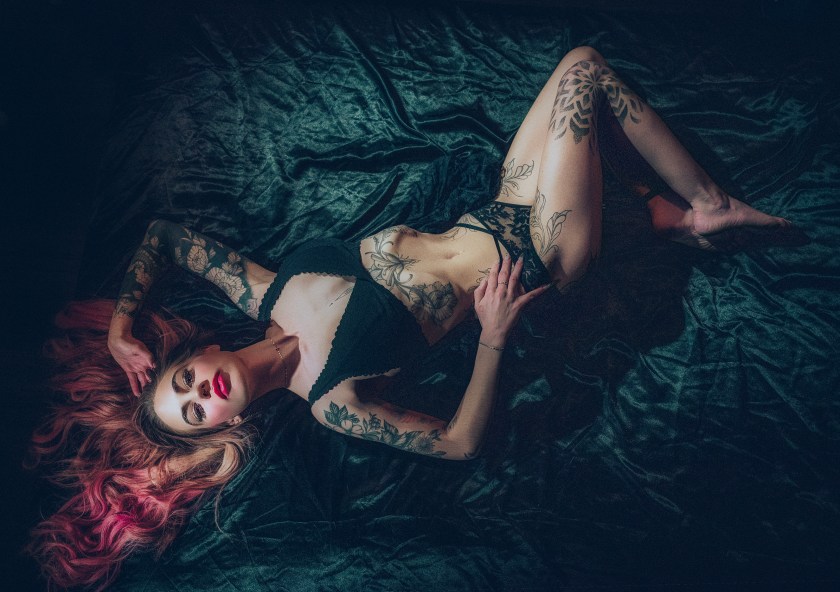
Overhead studio portrait of a tattooed woman reclining on dark fabric, wearing black lingerie under dramatic low-key lighting.
A studio portrait of model Strawberry Ravecake reclining on textured fabric during a themed photography workshop in Denver.

Within Chapter 6’s exploration of recent directions, this portrait represents a deliberate engagement with historical photographic language reimagined through contemporary aesthetics. Created during a workshop at RAW Studios in Denver focused on recreating film noir and 1940s Hollywood glamour, the photographer demonstrates how classical techniques can be subverted and reclaimed through modern sensibilities. The result is an image that exists in productive tension between eras, neither purely nostalgic nor entirely contemporary.

The composition draws immediate lineage to mid-century boudoir photography, yet the execution reveals crucial departures from those conventions. The model—Betty, known professionally as Strawberry Ravecake—reclines against luxurious teal-green velvet that recalls old Hollywood opulence. Her positioning, with head tilted back and limbs arranged in studied repose, references the languorous poses characteristic of 1940s pin-up and glamour photography. However, the extensive floral tattoo work covering her arms, legs, and torso fundamentally transforms the visual narrative. Where golden-age Hollywood demanded unmarked skin as a canvas for projected fantasy, here the body arrives already inscribed with personal history and deliberate aesthetic choices.

The lighting strategy merits particular attention. Deep shadows dominate the frame, with careful modeling that emphasizes dimensional form while maintaining areas of near-total darkness. This chiaroscuro approach—essential to film noir’s visual vocabulary—creates dramatic contrast between illuminated flesh and surrounding void. The photographer employs what appears to be a single key light positioned to camera right, allowing natural falloff to shape the subject rather than filling shadows with secondary sources. This restraint honors noir’s painterly treatment of darkness as an active compositional element rather than merely the absence of light.

Color becomes a strategic departure from strict period authenticity. While classic noir worked exclusively in black and white, the photographer retains the jewel tones of the velvet backdrop and the subject’s vibrant red-to-blonde ombré hair. The black lingerie and bold red lipstick provide chromatic punctuation, creating focal points that guide the viewer’s eye through the composition. This selective use of color acknowledges that contemporary audiences read images differently than their 1940s counterparts; pure monochrome might feel like affectation rather than interpretation.

The workshop context—Portfolio Building for Aspiring Photographers and Models—frames this image as both artistic output and pedagogical artifact. Workshop environments typically emphasize technical mastery and stylistic imitation, yet this photograph transcends mere exercise. The collaborative nature of such sessions, with multiple participants working alongside professional instruction, requires the photographer to synthesize learning in real-time while maintaining artistic vision. That this image earned placement in his Top 100 Journey suggests successful integration of classical technique with personal aesthetic development.

Within Chapter 6’s framework of ongoing exploration, the photograph demonstrates expanded engagement with historical photographic genres. The work reveals an artist comfortable moving between documentary observation, macro intimacy, and now studio-based portraiture. By choosing to engage with noir’s visual language through contemporary bodies and sensibilities, he participates in an ongoing cultural conversation about representation, desire, and the constructed nature of glamour across generations. The velvet wrinkles, the tattoo artistry, and the calculated pose coalesce into an image that respects its influences while asserting its moment.

Ancient Greek Coin, Head of Alexander II Zebina

A macro photograph of a 123 BC Greek coin by Alexander II Zebina captures its historical significance and texture. The artist avoids over-sharpening, choosing selective focus to highlight the coin’s surface. This work raises questions about ownership, memory, and our connection to time, ultimately transforming the coin into a philosophical exploration of history.

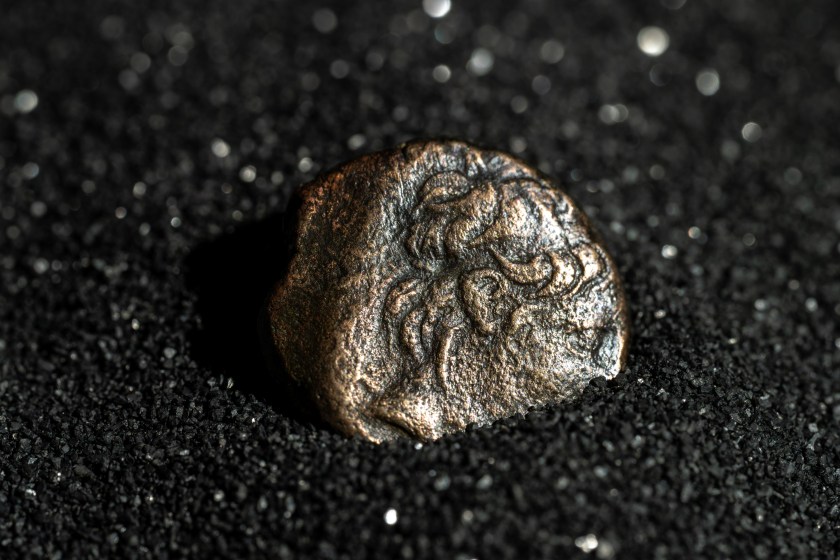
Close-up of a worn ancient Greek coin showing a raised portrait, resting on coarse black granular material.
A macro photograph of an ancient Greek coin with a portrait relief placed on a dark textured surface.

In this macro study from Chapter 6 of his Top 100 Journey, the photographer confronts an artifact that predates the medium of photography by over two millennia. The coin—a bronze piece from 123 BC bearing the portrait of Alexander II Zebina—becomes both subject and collaborator, its weathered surface telling stories that extend far beyond the frame. This single exposure, created for the 52 Frames challenge, demonstrates a mature understanding of how light and composition can resurrect history from oxidized metal.

The technical execution reveals deliberate restraint. Rather than employ focus stacking to render every millimeter sharp, he opts for a single capture that honors the coin’s irregular topography through selective focus. The shallow depth of field becomes a curatorial choice: not everything from antiquity needs to be preserved with clinical precision. Some details fade into soft ambiguity, much as memory itself blurs across centuries. The side lighting—achieved through what appears to be a carefully positioned single source—rakes across the relief, transforming corrosion patterns into a luminous bronze landscape. Highlights catch on the highest points of wear, creating a constellation of golden moments against near-black valleys of shadow.

The substrate selection proves equally thoughtful. Black granular material, possibly sand or volcanic rock, provides textural contrast while introducing delicate bokeh spheres that float in the background like suspended time. This environmental choice feels archaeological, suggesting the coin might have just emerged from excavation rather than from a flea market display case. The photographer resists any impulse toward nostalgic sepia or artificial aging effects; instead, he allows the genuine patina—two thousand years in the making—to provide all the historical gravitas the image requires.

What distinguishes this work within Chapter 6’s framework of ongoing exploration is its meditation on ownership and stewardship. The accompanying note reveals this coin represents “the oldest man-made thing I have ever owned,” yet the photograph itself seems to question that possessive relationship. Can anyone truly own such an object, or are we merely temporary custodians in an impossibly long chain of hands? The macro perspective literalizes this contemplation, bringing the viewer so close that individual crystals of corrosion become visible, each one a marker of time the photographer will never witness.

The portrait of Alexander II Zebina—barely discernible beneath centuries of oxidation—emerges as a ghost in metal, features obscured yet undeniably present. This parallel between photographic and numismatic portraiture feels intentional. Both mediums attempt to freeze time, to preserve likeness against entropy’s relentless work. The photograph succeeds where the coin has partially failed, capturing not just the object but the precise quality of light falling upon it on a specific day in 2025, creating a new historical layer atop the ancient one.

Within the photographer’s evolving practice, this image represents a turn toward material intimacy and temporal reflection. The macro lens becomes a tool for philosophical inquiry rather than mere magnification. By isolating this small artifact against darkness and bringing such focused attention to its corrupted beauty, he creates space for viewers to contemplate their own relationship with history, permanence, and the objects that outlive their makers by millennia.

Kelly

PKelly R. Bienfang’s studio portrait captures the essence of minimalist photography, focusing on the subject against a clean white backdrop. Utilizing controlled lighting and strategic posing, the image showcases the photographer’s skill and adaptability. It highlights the evolving rapport between photographer and subject, emphasizing the importance of genuine collaboration in achieving impactful portraits.

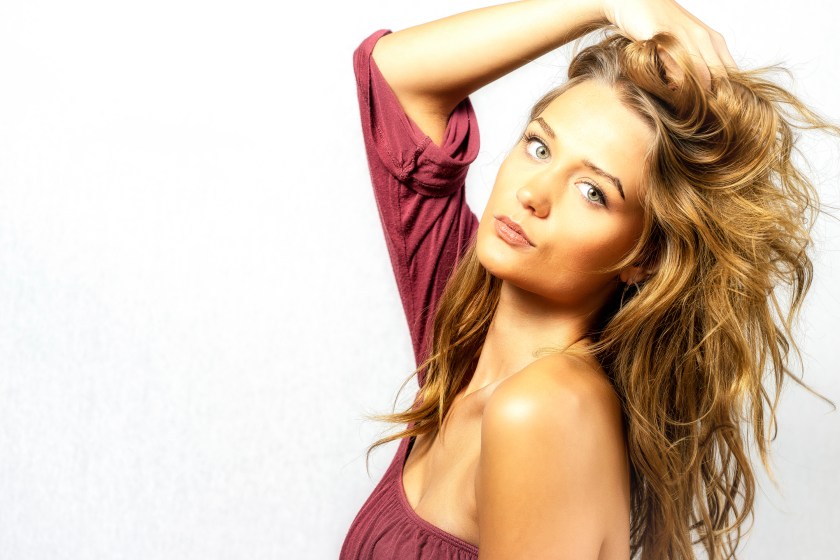
Woman with long light brown hair posing against a white background, one arm raised to her head, wearing a sleeveless top.
PKelly R. Bienfang poses during a studio portrait session in Fort Collins, Colorado.

This portrait from Chapter 4 of Greg Urbano’s Top 100 Journey exemplifies the photographer’s refined approach to studio portraiture, demonstrating how minimalist environments and controlled lighting can distill a subject’s presence to its essential elements. Captured at Old Town Yoga in downtown Fort Collins, Colorado, the image reveals the photographer’s ability to transform functional spaces into effective portrait studios, a skill central to the chapter’s exploration of diverse shooting contexts.

The composition centers on the subject, Kelly, photographed against a pure white backdrop that eliminates all contextual information, focusing attention entirely on her form, expression, and movement. Her pose—arm raised to gather flowing hair, head tilted, gaze directed toward the camera—suggests a moment caught between deliberate positioning and natural gesture. The wind-swept quality of her hair introduces dynamic motion into an otherwise static studio setup, creating visual energy that prevents the portrait from settling into conventional headshot territory.

The photographer’s technical execution demonstrates consistent mastery of the equipment established throughout this chapter. Working with the Sony A7ii and 85mm f/1.8 lens, supplemented by a Godox V1s flash modified through a shoot-through umbrella, he has created illumination that reads as both bright and dimensioned. The lighting wraps evenly across the subject’s features while maintaining sufficient shadow information to model her facial structure and the curves of her shoulders and arms. The high-key approach—white background, luminous skin tones—requires precise exposure control to prevent blown highlights while retaining textural detail in hair and fabric.

Color becomes a critical compositional element in this reduced visual field. The deep burgundy of Kelly’s garment provides the primary chromatic accent against the neutral backdrop and warm skin tones, creating a complementary relationship that anchors the eye. The photographer has allowed the subject’s honey-blonde hair to cascade freely, its varied tones adding subtle complexity to the upper portion of the frame. Post-processing in Luminar 4 has yielded clean, commercial-quality results—polished without appearing artificial, enhanced without sacrificing the authentic quality of skin and texture.

Within the broader context of Chapter 4, this photograph represents the studio portrait in its most distilled form. While other works in this series incorporate environmental elements or natural light scenarios, this image strips away such variables to focus purely on subject, light, and photographer’s vision. The setting at Old Town Yoga—likely chosen for its available space and clean backgrounds rather than thematic connection—underscores the photographer’s adaptability, his capacity to identify and utilize whatever resources a location offers.

The portrait also reflects evolving confidence in direction and collaboration. The pose suggests active guidance rather than passive documentation, indicating the photographer’s growing comfort in shaping rather than merely recording moments. Kelly’s ease before the camera—the natural grace of her gesture, the direct engagement of her gaze—speaks to successful rapport between photographer and subject, that intangible but essential element of portrait work that transcends technical proficiency.

This image stands as evidence of the photographer’s progression toward professional fluency in controlled portrait environments, demonstrating that compelling imagery emerges not from elaborate setups but from clear vision executed with precision.