Hidden Valley Hike: A Study in Atmospheric Depth and Winter Quietude

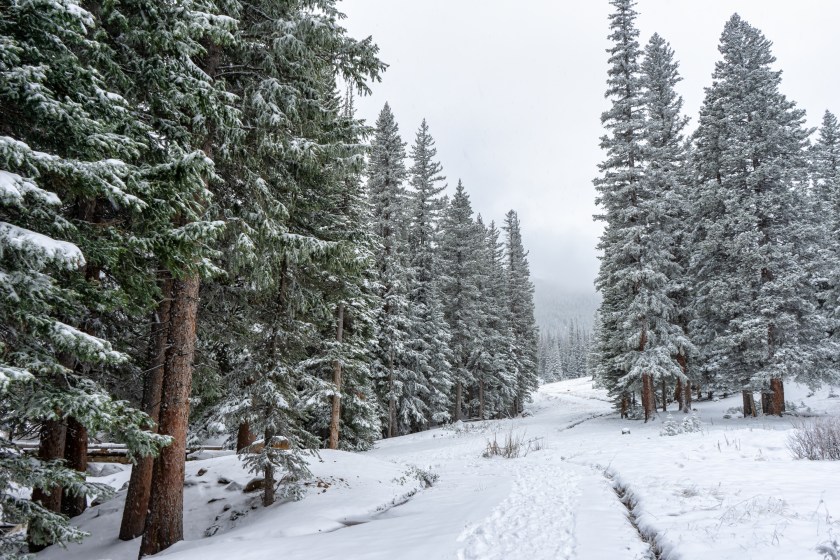
The photograph from Hidden Valley in Rocky Mountain National Park captures a snow-covered trail among dense trees, showcasing Greg Urbano’s skill in monochromatic winter photography. Emphasizing subtlety over grandeur, it conveys solitude and wilderness through careful composition and tonal restraint, highlighting ecological specifics and the beauty of intimate landscapes.

Snow-covered hiking trail winding through evergreen forest at Hidden Valley in Rocky Mountain National Park.
A snowy trail leads through dense evergreen trees at Hidden Valley in Rocky Mountain National Park, Colorado.

Within Chapter 3 of Greg Urbano’s Top 100 Journey—devoted to Colorado Landscapes & Cityscapes—this photograph from Hidden Valley in Rocky Mountain National Park represents a masterful engagement with the challenges of monochromatic winter photography. The image captures a snow-laden trail ascending through dense coniferous forest, where atmospheric conditions have reduced the distant peaks to mere suggestions within a veil of falling snow and fog.

The photographer’s compositional strategy reveals a sophisticated understanding of visual hierarchy. The trail itself functions as both literal and metaphorical pathway, drawing the viewer’s eye from the textured foreground snow through the middle ground’s architectural arrangement of pines and firs, before dissolving into the atmospheric void of the background. This recession creates a palpable sense of depth despite the flattening effect that overcast winter light typically imposes on landscape photography.

What distinguishes this work within Urbano’s broader Colorado portfolio is its restraint. Rather than pursuing the dramatic vistas and saturated alpine glow that characterize much Rocky Mountain photography, he has chosen to document a moment of visual subtlety—a soft, nearly monochromatic palette punctuated only by the warm sienna of exposed tree bark. The decision to work within such a limited tonal range demonstrates confidence in form and composition rather than relying on chromatic spectacle.

The technical execution merits particular attention. The photographer has maintained remarkable detail in the snow-weighted evergreen boughs while preserving the delicate gradation of gray tones that define the misty background. This balance suggests careful exposure management in conditions that would challenge most practitioners—the high reflectivity of fresh snow against dark timber, compounded by active precipitation and low contrast lighting.

From a thematic perspective, this photograph speaks to the contemplative dimension of Urbano’s landscape practice. The absence of human figures—save for the implicit presence suggested by the trail itself—invites meditation on solitude and the experience of wilderness in its less hospitable moments. This is not the Colorado of tourism brochures, but rather an intimate encounter with the state’s winter reality, where beauty reveals itself through subtlety rather than grandeur.

The image also functions as documentation of a specific ecological zone within Rocky Mountain National Park. The mixed conifer forest, dominated by what appear to be Engelmann spruce and subalpine fir, places the photograph within the park’s upper montane and subalpine life zones. The photographer’s attention to these botanical particulars grounds the work in a specific geographic and ecological context, elevating it beyond generic winter scenery.

Within the arc of the Top 100 Journey project, this photograph demonstrates stylistic evolution—a willingness to embrace quieter moments alongside more conventionally dramatic subjects. It suggests that Urbano’s curatorial eye has matured toward valuing atmospheric mood and compositional sophistication over spectacular subject matter alone.

The final consideration is one of timing and patience. Winter photography in Rocky Mountain National Park demands both technical preparation and willingness to work in physically demanding conditions. That this image exists at all speaks to the photographer’s commitment to documenting the full range of Colorado’s landscape character, not merely its most accessible or comfortable manifestations. The result is a work that rewards sustained attention, revealing its carefully calibrated tonal relationships and spatial complexities gradually, much like the trail itself emerging from and dissolving into winter’s embrace.

The Gulf Pier: A Foundation in Light and Structure

Greg Urbano’s “Landscapes in HDR” captures the Gulf Fishing Pier at Fort de Soto Park, reflecting his artistic development in photography. Utilizing a Nikon D7100, he balances composition with HDR techniques, achieving naturalistic vibrancy without over-processing. The image embodies a pivotal moment in skill mastery, exploring the connection between environment and human creation.

HDR landscape photograph of the Gulf Fishing Pier at Fort De Soto Park in Pinellas County, Florida, extending over calm water under a bright sky, taken with a Nikon D7100 at 14mm.
A 2013 HDR landscape photograph of the Gulf Fishing Pier at Fort De Soto Park in Pinellas County, Florida.

In the early stages of any photographer’s journey, there exists a pivotal moment when technical curiosity converges with artistic vision. Greg Urbano’s “Landscapes in HDR” from 2013 captures precisely this convergence—a photograph that speaks to the fundamentals of seeing while revealing the seeds of a maturing artistic voice.

The Gulf Fishing Pier at Fort de Soto Park presents itself as an exercise in classical composition, yet the image transcends mere documentation. Shot with a Nikon D7100 at 14mm, the photographer embraced the distortion inherent in ultra-wide-angle photography, using it not as a limitation but as a tool for emphasis. The pier’s concrete pathway stretches toward the horizon with geometric insistence, its weathered surface textured with salt stains and age—details that anchor the ethereal quality of the surrounding environment.

What distinguishes this work within the context of Chapter 1—Beginnings is the deliberate exploration of HDR processing, a technique that dominated landscape photography in the early 2010s. Rather than falling into the trap of over-processing that plagued much HDR work of this era, Urbano demonstrates restraint. The luminous gradations in the sky—from deep azure to wispy white—retain a naturalistic quality while revealing detail across an impressive tonal range. The turquoise waters of the Gulf of Mexico maintain their vibrancy without crossing into hypersaturation, suggesting an eye already sensitive to the boundaries between enhancement and artifice.

The technical choices reveal a photographer building his fundamental vocabulary. The aperture of ƒ/8.0 ensures critical sharpness from the foreground concrete to the distant structures, while the fast shutter speed of 1/400s freezes the subtle motion of the scene—likely the flutter of distant flags or the movement of the few figures visible along the pier. At ISO 100, the image maintains clarity in its textures, from the horizontal railings that create rhythmic lines to the architectural shelters that punctuate the composition’s middle ground.

What makes this photograph significant in understanding Urbano’s artistic evolution is not its perfection but its purposefulness. The nearly symmetrical composition, the careful attention to the leading lines, the consideration of how architectural elements frame the natural environment—these are the building blocks upon which more complex visual narratives are constructed. The weekly visits to this location mentioned in his notes speak to something essential in photographic development: the practice of returning, of seeing the same subject under different conditions, of learning through repetition.

The landscape itself offers something eternal—the meeting point of human construction and natural expanse. The pier extends confidently into the Gulf, a gesture of connection between land and water, between the photographer’s position and the infinite horizon. In capturing this scene, Urbano was not merely documenting a favorite location but engaging with fundamental questions about how we frame our relationship to place and space.

Within the broader context of “Beginnings,” this image exemplifies the necessary stage of mastering craft before transcending it. The imperfect attempts referenced in the chapter description are not failures but essential experiments. Here, we witness a photographer learning to see in high dynamic range, to compose with geometric precision, and to capture the luminous quality of coastal light—all foundational skills that would inform the more sophisticated work to come.

This is where journeys begin: in the clarity of intention, the discipline of practice, and the recognition that every master was once a student of light.