Kelly: Classical Portraiture in Natural Light

Kelly R. Bienfang’s portrait in Fort Collins’ City Park showcases refined environmental portraiture, merging classic lighting techniques with natural settings. The composition emphasizes psychological presence through thoughtful framing and soft lighting, achieving dimensionality. Using traditional optics and careful post-processing, the image balances contemporary authenticity with technical precision, reinforcing the importance of classical methods in outdoor photography.

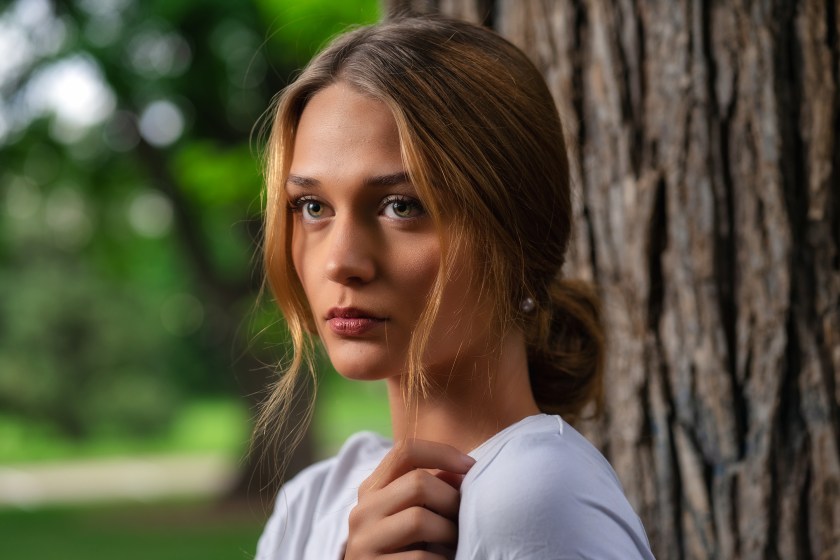
Woman with light brown hair stands beside a tree in a park, looking toward the camera with a soft green background.
Kelly R. Bienfang poses beside a tree in City Park, Fort Collins, Colorado.

This portrait of Kelly exemplifies the photographer’s command of environmental portraiture, demonstrating how classical lighting techniques can be sensitively adapted to outdoor contexts. Created in City Park, Fort Collins, the image represents a refinement of traditional portrait methodology—translating studio principles into naturalistic settings while preserving the intimacy and control typically associated with interior work.

The composition centers on a three-quarter view of the subject positioned against the textured bark of a substantial tree trunk. This anchoring element provides both physical and visual grounding, its vertical mass creating structural balance while its organic texture contrasts productively with the smooth contours of the subject’s face. The decision to place Kelly against this natural backdrop rather than opening the frame to broader park vistas reflects deliberate focus—prioritizing psychological presence over environmental documentation.

The lighting execution reveals sophisticated outdoor flash technique. Employing a single strobe with shoot-through umbrella, the photographer has created illumination that appears to extend rather than contradict the existing ambient light. The soft directional quality—evident in the delicate gradation across the subject’s face and the luminous edge separation along her profile—suggests careful positioning to mimic golden hour sun while maintaining consistent exposure control. This hybrid approach, blending natural and artificial light sources, achieves what purely available light could not: sculptural dimensionality without harsh shadow or unflattering overhead illumination.

The subject’s positioning and expression demonstrate thoughtful directorial collaboration. Kelly’s gaze, angled slightly upward and away from the lens, creates contemplative distance while her hand’s gentle placement at the shoulder introduces subtle gesture without performative emphasis. This combination of turned body and averted eyes establishes a portrait that feels observed rather than confrontational—inviting viewer attention while maintaining the subject’s interior privacy. The styling choice of a simple white garment serves the image’s tonal strategy, providing clean highlight mass that draws focus toward facial features and natural coloring.

Technical choices throughout support this classical approach. The Sony 85mm f/1.8 lens, deployed on the Sony A7II body, offers the compression and shallow depth of field characteristic of traditional portrait optics. The resulting background dissolution—visible in the soft green bokeh representing distant foliage—eliminates visual competition while establishing atmospheric color context. Post-processing in Luminar 4 has enhanced the warm color palette, emphasizing the golden light quality playing across skin tones and hair while maintaining natural saturation levels.

Within Chapter 4’s examination of portrait methodologies, this photograph demonstrates the photographer’s ability to execute formal portraiture outside controlled studio environments. The work shows less interest in contemporary street portrait spontaneity than in translating time-tested studio aesthetics into outdoor practice—a technically demanding approach requiring precise light manipulation and environmental awareness simultaneously.

The image also illustrates evolution in his workshop-informed practice. The confidence evident in both lighting execution and subject direction suggests accumulated knowledge from collaborative learning environments, where traditional portrait techniques are studied and adapted. This photograph represents portraiture rooted in classical principles—emphasizing beauty, technical precision, and dignified subject representation—while acknowledging contemporary preferences for natural settings and authentic expression.

As part of his broader Top 100 Journey documentation, this work affirms the continuing relevance of foundational portrait techniques when executed with skill and sensitivity. It demonstrates how environmental portraiture can achieve the polish and intentionality of studio work without sacrificing the organic qualities that location shooting provides.
Mike Groth: Classical Studio Portraiture and the Language of Formality

Mike Groth’s studio portrait, featured in Chapter 4 of the Top 100 Journey, exemplifies traditional portraiture through controlled lighting and composition. Shot at Old Town Yoga Studio, the image focuses on character and presence, utilizing a classic backdrop and professional techniques. Its formal simplicity highlights the subject’s confidence, making it versatile across various contexts.

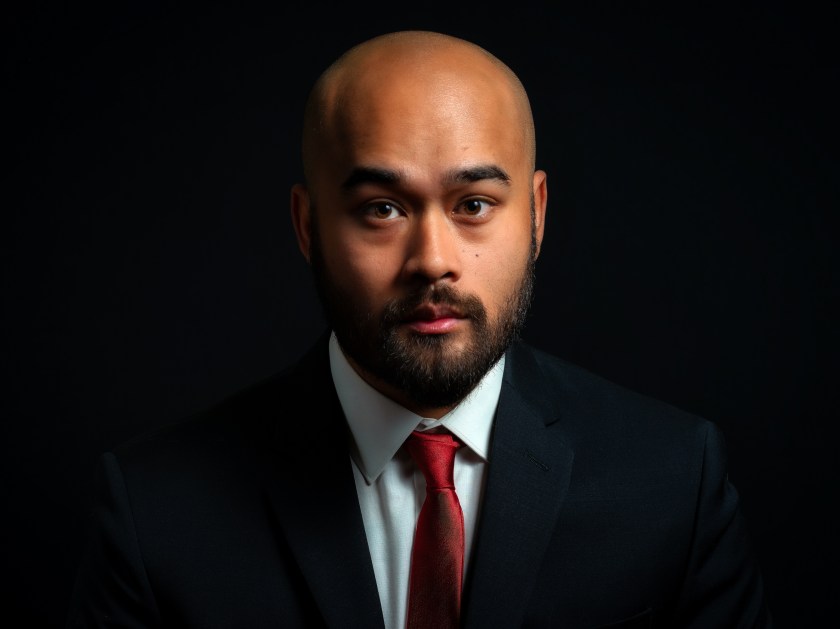
Bald man with a beard wearing a suit and red tie looks directly at the camera against a black background.
Mike Groth is photographed in a studio portrait at Old Town Yoga Studio in Fort Collins, Colorado.

Within Chapter 4 of the photographer’s Top 100 Journey, this portrait of Mike Groth represents a return to the foundational principles of studio portraiture—controlled lighting, deliberate composition, and the timeless formality of traditional headshot aesthetics. Shot at the Old Town Yoga Studio in Fort Collins, Colorado, the image demonstrates the photographer’s facility with classic studio techniques while exploring the psychological dimensions of formal masculine presentation.

The technical execution adheres to established conventions of corporate and editorial portraiture. Utilizing a Sony A7ii with an 85mm f/1.8 lens, the photographer has positioned his subject against a pure black backdrop, eliminating all environmental context to focus entirely on character and presence. A Godox V1s flash paired with a shoot-through umbrella provides the primary illumination—a traditional modifier choice that produces soft, diffused light with gentle shadow gradation across the subject’s features. This approach creates dimensional modeling without the harsh contrast of direct flash, revealing the contours of the face while maintaining a polished, professional quality.

The composition centers the subject in a classical three-quarter view, shoulders angled slightly to create visual interest while the face turns toward the camera. This positioning—neither fully frontal nor profile—has been a cornerstone of portraiture since the Renaissance, offering both dimensionality and direct engagement. The subject’s formal attire—dark suit, white shirt, burgundy tie—reinforces the traditional corporate aesthetic, while his neutral expression and direct gaze suggest confidence tempered with approachability.

What distinguishes this work within the photographer’s broader practice is its embrace of restraint. Where other images in Chapter 4 explore environmental integration and spontaneous moments, this portrait strips away context to examine how lighting, posture, and expression alone can convey character. The black void backdrop functions not merely as a neutral background but as an active element, creating psychological weight and directing all attention to the subtle details: the catch lights in the eyes, the texture of facial hair, the precise fall of shadow along the jawline.

The post-processing in Luminar 4 maintains the studio’s carefully controlled atmosphere. Skin tones are rendered with natural warmth while preserving texture and detail. The lighting reveals itself as directional yet forgiving, highlighting the subject’s facial structure without creating unflattering shadows. This balance between revelation and flattery characterizes effective professional portraiture—honest without being harsh, polished without appearing artificial.

Within the context of Chapter 4’s mission to document studio, outdoor, and workshop methodologies, this image anchors the studio component with particular authority. It demonstrates that contemporary portrait photography need not abandon classical techniques in pursuit of innovation. The photographer’s choice to work within established conventions reflects an understanding that certain approaches endure precisely because they succeed in their essential task: revealing the subject’s presence and character with clarity and dignity.

The formal simplicity of this portrait allows it to function across multiple contexts—editorial, corporate, archival. This versatility speaks to the photographer’s understanding of portraiture not merely as artistic expression but as functional communication. As part of the Top 100 Journey, the image represents a technical benchmark, showcasing the fundamental competencies upon which more experimental work can build. It is portraiture in its most distilled form: light, subject, and the photographer’s ability to orchestrate their interaction with precision and purpose.