The Studio as Theater: Classical Portraiture in Contemporary Practice

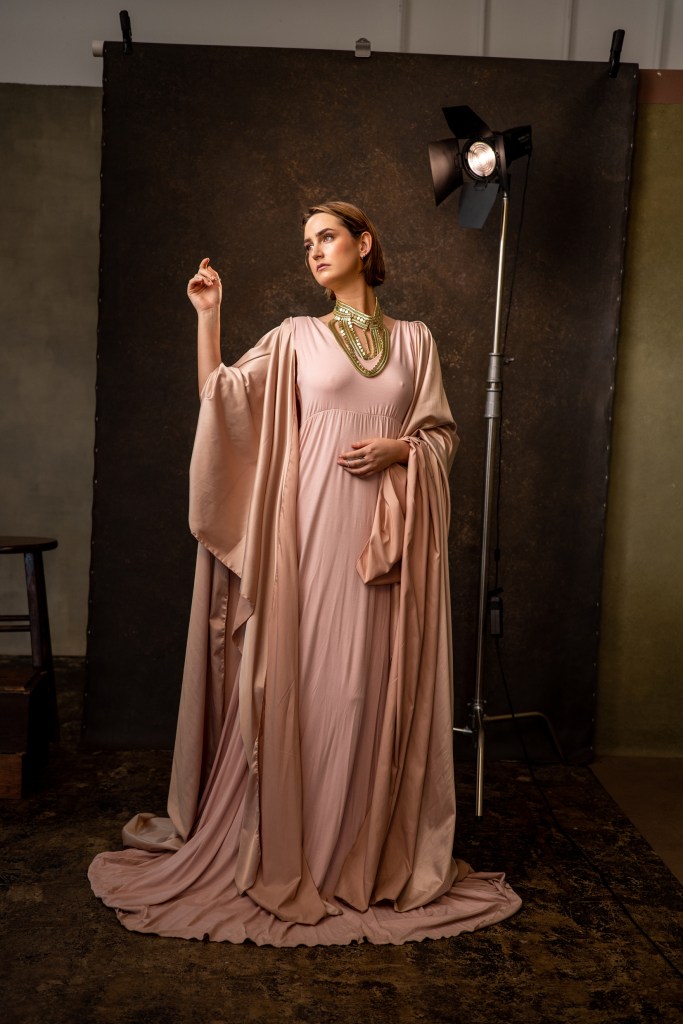
Jessica Lynn’s studio portrait showcases a fusion of classical portraiture and contemporary technique, created during a workshop at Atelier Alchimia. The photograph illustrates the artist’s growth through collaboration, using refined lighting to enhance the subject’s regal appearance. This work embodies artistic evolution, blending tradition with innovation while emphasizing continuous learning.

Studio portrait of Jessica Lynn standing in a flowing blush-colored gown, posed in front of a dark backdrop with a studio light visible behind her.
Jessica Lynn (QueenJess Rising) photographed in a studio setting during a workshop at Atelier Alchimia in Westminster, Colorado.

This studio portrait from Chapter 6 of the photographer’s Top 100 Journey represents a deliberate engagement with the formal traditions of classical portraiture, reimagined through contemporary technical means. Created during a workshop at Atelier Alchimia in Westminster, Colorado, the image demonstrates how collaborative learning environments can yield work of considerable aesthetic merit while advancing the artist’s technical vocabulary.

The subject, Jessica Lynn, is presented in a flowing blush-toned gown with dramatic bell sleeves that cascade to the floor, creating a silhouette reminiscent of Renaissance or Pre-Raphaelite painting. An ornate collar necklace in gold and green adds a regal quality that justifies the image’s title. The photographer has positioned her in a classical contrapposto-inspired stance—weight on one leg, torso gently twisted, one hand raised in a gesture of contemplation or perhaps benediction. This pose, combined with the upward gaze and theatrical lighting, evokes both historical portraiture and contemporary fashion photography’s ongoing dialogue with art history.

The technical execution reveals careful attention to studio craft. A single key light with barn doors, visible in the frame’s right edge, provides directional illumination that sculpts the subject’s features and creates tonal gradation across the fabric’s folds. The mottled canvas backdrop transitions from warm browns to darker tones, providing depth without competing for attention. The lighting setup, developed collaboratively with studio owner Jonny Edwards, demonstrates the photographer’s increasing comfort with controlled environments—a marked evolution from earlier work in the series that frequently engaged with natural light and outdoor settings.

What makes this image particularly relevant to “The Road Ahead: Recent Work & Ongoing Exploration” is its frank acknowledgment of artistic development through structured learning. Shot during a workshop led by Eric Brown, the photograph embodies a philosophy of continuous growth and technical refinement. Rather than presenting only work created in solitary practice, the photographer includes images born from educational contexts, recognizing that mastery often emerges through collaboration and mentorship.

The choice to work with studio lighting represents an expansion of technical range. The careful balance of exposure—maintaining detail in both the luminous fabric and the darker background—suggests growing confidence with artificial light sources. The warm color palette creates cohesion between subject, costume, and environment, while the visible studio elements (backdrop clamps, light stand) provide documentary transparency about the image’s construction.

Within the broader arc of the Top 100 Journey, this portrait signals a willingness to explore different photographic modes. Where earlier chapters emphasized environmental and location work, this studio piece demonstrates versatility and an interest in controlled aesthetic experiences. The theatrical quality—the visible apparatus of image-making—invites viewers into the creative process rather than presenting a seamless illusion.

The photograph succeeds both as a study in classical beauty and as evidence of artistic evolution. It captures a moment of learning translated into accomplished execution, showing that the road ahead need not abandon traditional craft in pursuit of innovation. Instead, it suggests that mastery comes through accumulation—building new skills atop established foundations, always remaining open to guidance, collaboration, and the timeless appeal of light falling gracefully upon fabric and form.
American Beauty: Strawberry Ravecake

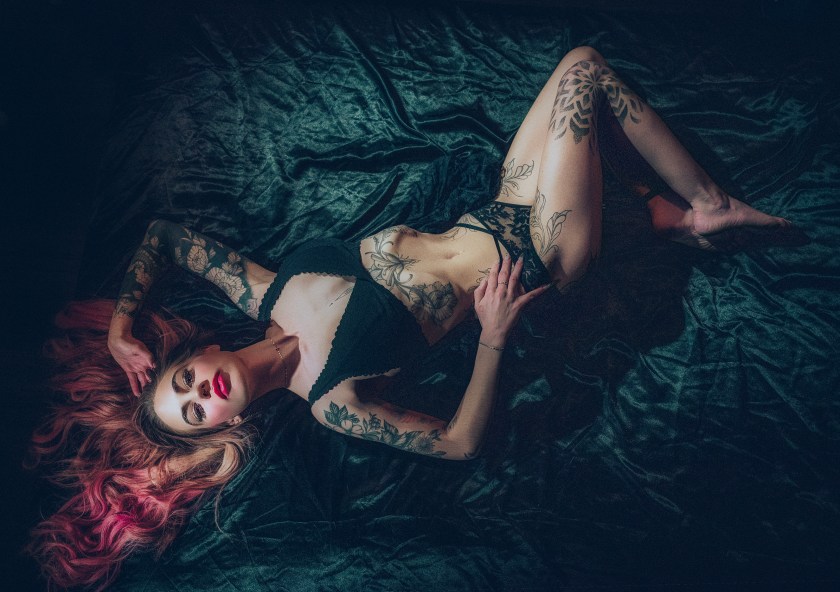
The portrait of model Strawberry Ravecake, taken during a Denver workshop, reinterprets film noir and 1940s glamour through contemporary aesthetics, merging historical and modern elements. The striking use of chiaroscuro and vibrant colors challenges traditional conventions, featuring a tattooed model in luxurious settings, creating a dialogue on representation and glamour across eras.

Overhead studio portrait of a tattooed woman reclining on dark fabric, wearing black lingerie under dramatic low-key lighting.
A studio portrait of model Strawberry Ravecake reclining on textured fabric during a themed photography workshop in Denver.

Within Chapter 6’s exploration of recent directions, this portrait represents a deliberate engagement with historical photographic language reimagined through contemporary aesthetics. Created during a workshop at RAW Studios in Denver focused on recreating film noir and 1940s Hollywood glamour, the photographer demonstrates how classical techniques can be subverted and reclaimed through modern sensibilities. The result is an image that exists in productive tension between eras, neither purely nostalgic nor entirely contemporary.

The composition draws immediate lineage to mid-century boudoir photography, yet the execution reveals crucial departures from those conventions. The model—Betty, known professionally as Strawberry Ravecake—reclines against luxurious teal-green velvet that recalls old Hollywood opulence. Her positioning, with head tilted back and limbs arranged in studied repose, references the languorous poses characteristic of 1940s pin-up and glamour photography. However, the extensive floral tattoo work covering her arms, legs, and torso fundamentally transforms the visual narrative. Where golden-age Hollywood demanded unmarked skin as a canvas for projected fantasy, here the body arrives already inscribed with personal history and deliberate aesthetic choices.

The lighting strategy merits particular attention. Deep shadows dominate the frame, with careful modeling that emphasizes dimensional form while maintaining areas of near-total darkness. This chiaroscuro approach—essential to film noir’s visual vocabulary—creates dramatic contrast between illuminated flesh and surrounding void. The photographer employs what appears to be a single key light positioned to camera right, allowing natural falloff to shape the subject rather than filling shadows with secondary sources. This restraint honors noir’s painterly treatment of darkness as an active compositional element rather than merely the absence of light.

Color becomes a strategic departure from strict period authenticity. While classic noir worked exclusively in black and white, the photographer retains the jewel tones of the velvet backdrop and the subject’s vibrant red-to-blonde ombré hair. The black lingerie and bold red lipstick provide chromatic punctuation, creating focal points that guide the viewer’s eye through the composition. This selective use of color acknowledges that contemporary audiences read images differently than their 1940s counterparts; pure monochrome might feel like affectation rather than interpretation.

The workshop context—Portfolio Building for Aspiring Photographers and Models—frames this image as both artistic output and pedagogical artifact. Workshop environments typically emphasize technical mastery and stylistic imitation, yet this photograph transcends mere exercise. The collaborative nature of such sessions, with multiple participants working alongside professional instruction, requires the photographer to synthesize learning in real-time while maintaining artistic vision. That this image earned placement in his Top 100 Journey suggests successful integration of classical technique with personal aesthetic development.

Within Chapter 6’s framework of ongoing exploration, the photograph demonstrates expanded engagement with historical photographic genres. The work reveals an artist comfortable moving between documentary observation, macro intimacy, and now studio-based portraiture. By choosing to engage with noir’s visual language through contemporary bodies and sensibilities, he participates in an ongoing cultural conversation about representation, desire, and the constructed nature of glamour across generations. The velvet wrinkles, the tattoo artistry, and the calculated pose coalesce into an image that respects its influences while asserting its moment.

Pears: A Chromatic Triptych in Measured Light

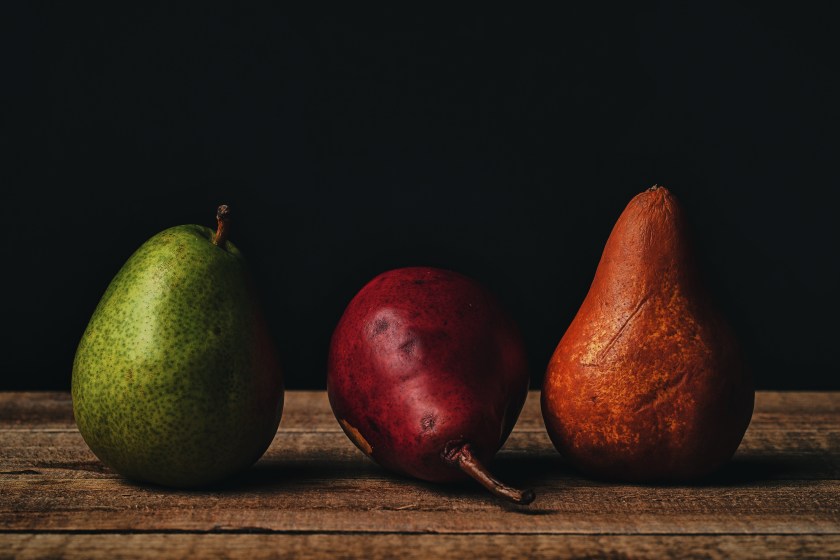
A still life photograph features three pears, highlighting the photographer’s evolving technique in transforming everyday produce into subjects for aesthetic contemplation. Using controlled lighting and a focused composition, the work emphasizes color variation and organic authenticity. This piece bridges classic and contemporary styles, encouraging viewers to appreciate the beauty in simplicity.

Tabletop still life of three pears arranged side by side on a wooden surface against a dark background.
A tabletop still life of three pears arranged on a wooden surface and lit against a dark background.

This composition of three pears exemplifies the photographer’s evolving approach to still life, transforming quotidian supermarket produce into subjects worthy of sustained aesthetic contemplation. Arranged in strict linear progression across weathered wood, the trio presents a study in chromatic variation and volumetric form that speaks to both classical still life traditions and contemporary minimalist sensibilities.

The technical framework mirrors the controlled approach evident throughout this body of work: a single Godox V1s strobe modified by softbox and grid, captured with a Sony A7ii paired with an 85mm f/1.8 lens. This choice of focal length proves particularly significant. Unlike the wider perspectives often employed in tabletop work, the 85mm compression subtly flattens spatial relationships while maintaining separation between subjects, creating a stage-like presentation where each pear occupies its designated position with theatrical clarity.

What distinguishes this image within the chapter’s trajectory is its bold embrace of color as primary subject matter. Where the earlier onion and garlic study operated within a narrow tonal range of earth and amber, here the photographer orchestrates a chromatic progression—verdant green, deep crimson, oxidized copper—that reads almost as a color theory exercise. Yet the natural imperfections of each fruit prevent the composition from becoming merely schematic. Surface blemishes, stem variations, and subtle textural differences assert the subjects’ organic authenticity.

The lighting strategy reveals sophisticated control over shadow placement and tonal gradation. The grid attachment concentrates illumination on the subjects while allowing the background to fall into near-absolute blackness, a technique borrowed from Old Master painting that isolates forms in dramatic relief. Light wraps around each pear’s curved surface with mathematical precision, creating highlight-to-shadow transitions that define volume without resorting to harsh contrast. The wooden platform receives just enough illumination to establish spatial grounding, its grain and weathering providing textural counterpoint to the fruits’ smooth skins.

Compositional decisions demonstrate a rigorous formal intelligence. The three pears, though similar in scale, exhibit distinct silhouettes—the green pear’s upright verticality, the red pear’s compressed roundness, the copper pear’s elongated diagonal lean. This variation within repetition creates visual rhythm while avoiding monotony. The spacing between subjects appears carefully calibrated, neither crowding nor isolating, allowing each fruit to maintain individual presence while contributing to the unified whole.

Post-processing through color grading has intensified chromatic saturation while preserving naturalistic tonality. The resulting palette suggests both heightened reality and painterly intention—colors feel amplified yet believable, enhanced rather than fabricated. This balance between documentation and interpretation positions the work at a productive intersection of photographic traditions.

Within the chapter’s arc from classic to experimental approaches, this image occupies transitional territory. Its formal rigor and single-light methodology align with classical practice, yet the chromatic boldness and almost Pop Art sensibility of three isolated, colored forms hint at more conceptual concerns. The photograph demonstrates that experimentation can emerge from treating simple subjects with exacting attention rather than through technical complexity alone.

The work ultimately asks viewers to reconsider the aesthetic potential residing in everyday objects, a question central to still life practice across centuries. By isolating these supermarket pears in dramatic light and formal precision, the photographer transforms the ordinary into an opportunity for visual meditation on color, form, and the enduring power of careful observation.