Long Exposure Dillon Reservoir: A Study in Temporal Meditation

The photograph from Dillon Reservoir near Silverthorne, Colorado, features a dock leading into tranquil waters, showcasing the photographer’s technical skill and evolving artistic vision. Utilizing long exposure, the image captures a balance of nature and human infrastructure, encouraging contemplation on time, landscape, and accessibility, while inviting viewers to engage further with their surroundings.

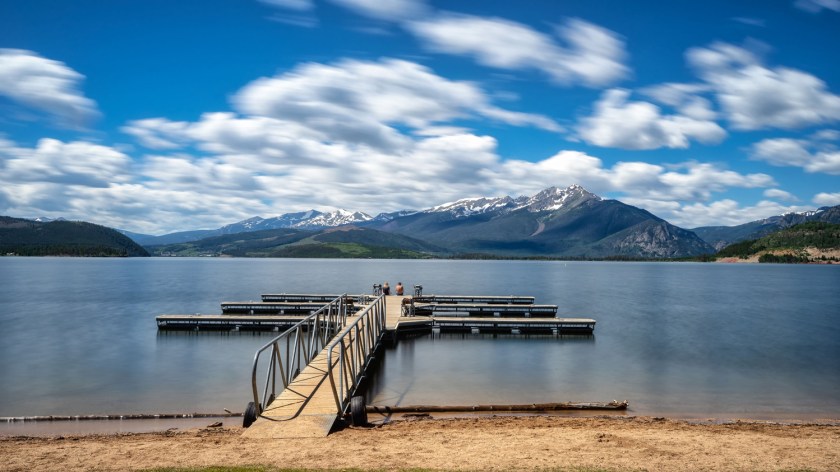
Long exposure view of a dock extending into Dillon Reservoir with mountains and blurred clouds in the background.
A dock extends into Dillon Reservoir near Silverthorne, Colorado, with mountains rising beyond the water.

In this carefully composed study from Dillon Reservoir, the photographer employs extended exposure to transform a commonplace mountain scene into something approaching the transcendent. The image stands as a compelling entry within Chapter 3 of his Top 100 Journey, demonstrating a technical maturity and conceptual clarity that marks his evolving engagement with Colorado’s diverse landscapes.

The composition centers on a weathered dock extending into the reservoir’s calm waters, its wooden walkway and metal railings leading the viewer’s eye toward distant figures positioned at the structure’s terminus. By utilizing a 10-stop neutral density filter with his Sony A7II, the photographer has rendered the water as a glassy, almost ethereal surface—its texture smoothed into gradations of subtle color that suggest movement while paradoxically conveying absolute stillness. This temporal compression transforms fleeting moments into something more permanent, inviting contemplation of how we perceive and record the passage of time.

The technical execution reveals a photographer comfortable with his equipment’s capabilities and limitations. Working with the camera’s kit lens, he has extracted remarkable clarity across the frame, from the sandy foreground through the architectural elements of the dock to the snow-capped peaks beyond. The slight motion blur in the clouds—streaked horizontally across an impeccable blue sky—provides visual rhythm and suggests the duration of the exposure without overwhelming the image’s serene character.

What distinguishes this photograph within the Colorado landscapes chapter is its successful marriage of the state’s iconic mountain scenery with human infrastructure. Rather than presenting wilderness in isolation, the image acknowledges recreational use and accessibility, grounding the sublime natural setting in contemporary experience. The dock becomes a metaphor for our relationship with landscape—a point of interface, an invitation to venture further, a structure that both facilitates and frames our encounter with nature.

Compositionally, the photographer demonstrates sophisticated understanding of visual weight and balance. The curved railing in the immediate foreground creates dynamic entry into the frame, while the horizontal platforms and vertical posts establish geometric order against the organic forms of mountains and clouds. The small human figures at the dock’s end provide crucial scale, reminding viewers of the landscape’s monumentality while suggesting contemplative communion with place.

The color palette rewards close examination. Warm sandy tones in the foreground transition to the cool grays and blues of water and sky, punctuated by the brilliant whites of snow and cloud. This chromatic progression creates depth while maintaining overall tonal harmony. The long exposure has also produced subtle color shifts in the water, where reflected sky and submerged earth combine into something neither purely blue nor brown but somewhere beautifully between.

Within the broader context of his Top 100 Journey, this image represents a photographer increasingly confident in his technical command and artistic vision. The decision to work near Silverthorne—accessible from Interstate 70 rather than requiring backcountry expedition—suggests a mature understanding that compelling photographs need not emerge solely from remote locations. Instead, seeing becomes the essential act, recognizing potential in familiar places and applying technique to reveal what casual observation might miss.

This photograph ultimately asks viewers to pause, to consider how we move through landscape and how landscape moves through time. It is work that respects both craft and subject, offering neither mere technical display nor sentimental postcard but something more considered: a meditation on place, presence, and the strange alchemy of photography itself.
The Zipper: Temporal Geometry in Motion

Greg Urbano’s photograph of the Zipper ride at a Florida carnival uniquely transforms the concept of landscape photography. By capturing swirling light trails during twilight, it emphasizes the intersection of cultural and physical landscapes. The image reveals the dynamic nature of our experiences, illustrating how ephemeral entertainment shapes collective identity in Florida.

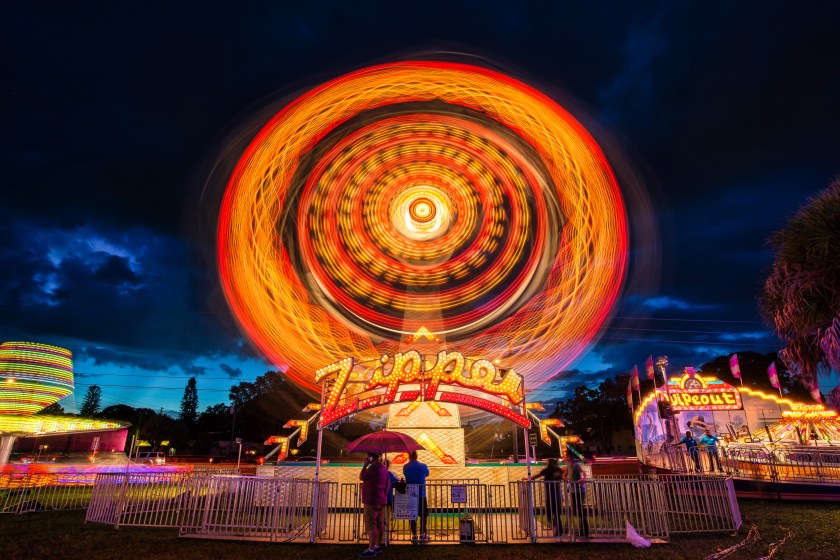
Long exposure photograph of the Zipper carnival ride at night, creating circular light trails in vivid colors with people standing below.
Long exposure night view of the Zipper ride creating swirling light trails at a carnival.

Within Chapter 2 of Greg Urbano’s Top 100 Journey, this carnival ride photograph stands as a compelling exploration of how Florida’s cultural landscape extends beyond its natural and architectural features into the realm of ephemeral entertainment. The image captures the Zipper in full rotation during twilight hours, transforming a traveling carnival attraction into a blazing mandala of light and motion that challenges traditional notions of what constitutes a “landscape.”

The photographer’s technical execution is precise and purposeful. Working with a Nikon D610 at 18mm, he has employed a six-second exposure at f/22 and ISO 100 to record not the ride itself, but rather the luminous trace of its movement through space. This approach fundamentally alters the subject’s visual character—what would typically appear as a stationary mechanical structure becomes instead a dynamic sculptural form composed entirely of light trails. The concentric circles of orange, red, and yellow fire outward from a brilliant white core, creating a hypnotic pattern that suggests both solar imagery and abstract expressionist painting.

The compositional framework demonstrates sophisticated spatial awareness. The ride occupies the central position, its circular motion perfectly framed against a deepening blue sky where storm clouds gather at the horizon. Silhouetted figures stand before the ticket booth in the immediate foreground, their stillness providing human scale and anchoring the viewer’s perspective. These stationary forms create a deliberate counterpoint to the violent spinning above them, emphasizing through contrast the temporal nature of the photographer’s chosen exposure duration.

Environmental context enriches the reading of this work. The characteristic Florida palm trees visible at right, the flat terrain, and the quality of the twilight atmosphere all ground the image firmly within the state’s visual vocabulary. Additional carnival rides glow at the periphery—including what appears to be a carousel and swing ride—establishing this as a comprehensive documentation of Florida’s traveling fair culture, a seasonal tradition that punctuates small-town life across the state.

What makes this photograph particularly significant within the Landscapes & Cityscapes chapter is its conceptual expansion of both terms. The photographer argues implicitly that Florida’s landscape includes not only its physical geography but also its temporal and cultural topography—the fairs, festivals, and itinerant amusements that transform ordinary municipal parks into spaces of collective experience. This is landscape photography that acknowledges human activity not as intrusion but as essential component.

The technical choices support this interpretation. The narrow aperture has rendered the background rides and architectural elements with acceptable sharpness while creating prominent starbursts on individual light points—a decorative effect that paradoxically enhances rather than diminishes the image’s documentary authenticity. The relatively brief six-second exposure has captured sufficient motion to abstract the Zipper into pure pattern while maintaining enough detail in the stationary elements to preserve spatial legibility.

In positioning this work alongside more conventional Florida landscapes within his broader project, the photographer demonstrates an inclusive vision of place-making. Here, the spectacular is found not in natural grandeur or architectural monumentality, but in the democratic pleasure of a county fair at dusk—a quintessentially American scene rendered with technical sophistication and genuine respect for its subject matter.