Natural Elegance: A Portrait in Copper and Light

Abigail Marchetti, known as Copper Muse, poses at a Denver Models open shoot, showcasing the photographer’s evolving studio portraiture techniques. Utilizing natural light, he captures her striking features and authentic expression, emphasizing color harmony and psychological presence. This portrait marks a significant step in his artistic development, blending classical principles with a modern sensibility.

Studio portrait of a red-haired woman in a black dress posing against a light background with her hands framing her face.
Model Abigail Marchetti, known as Copper Muse, poses during a Denver Models open shoot at Realm Studio in Denver.

This compelling portrait of model Abigail Marchetti exemplifies the photographer’s deepening engagement with studio portraiture and his refined approach to natural light as a primary sculptural tool. Captured during a Denver Models open shoot at Realm Studio, the image represents continued exploration of collaborative creative environments while demonstrating increasingly sophisticated control of the portraitist’s essential elements: light, gesture, color harmony, and psychological presence.

The composition centers on the model’s striking features—vibrant copper-red hair cascading in loose waves, piercing blue-green eyes meeting the camera with direct but unguarded confidence, and pale skin that catches and reflects the soft window light with luminous clarity. Her pose, with one hand gracefully raised to her hair and the other touching her neck, creates natural framing that draws attention to her face while suggesting unaffected spontaneity. The black strapless garment provides bold tonal contrast against both her skin and the pale backdrop, creating visual drama without competing for attention.

What distinguishes this work is the photographer’s masterful exploitation of natural window light. Rather than relying on the multiple strobes and reflectors typical of commercial studio work, he has chosen a more classical approach that recalls portrait painting traditions. The directional quality of the illumination—soft yet defined—models the subject’s features with sculptural precision while maintaining delicate gradations across skin tones. Highlights along the hair reveal its rich, multidimensional copper coloring, transforming what could be merely descriptive documentation into chromatic study.

The technical execution demonstrates growing confidence with the Nikon Z5 system and the versatile 24-120mm lens. The focal length selection—likely in the moderate telephoto range—provides flattering perspective without distortion, while the depth of field keeps the subject sharply defined against the subtly gradated background. The exposure balances the challenge of pale skin and light background without sacrificing detail in either the model’s features or the deeper tones of her garment.

Within the framework of Chapter 6—”The Road Ahead: Recent Work & Ongoing Exploration”—this portrait signals important developments in his artistic trajectory. The open shoot environment, like the previous workshop-based work, indicates willingness to engage with structured collaborative opportunities while bringing his distinct sensibility to bear. Yet where some open shoots yield generic beauty documentation, this image transcends its circumstances through careful attention to classical portraiture principles: the quality of light, the authenticity of expression, the harmony of color and form.

The model’s direct gaze introduces a quality often absent from his landscape and architectural work—reciprocal acknowledgment between photographer and subject. This mutual recognition adds psychological dimension, transforming technical exercise into genuine encounter. The slight asymmetry in her expression—contemplative rather than performative—suggests comfort and trust within the photographic exchange.

The photograph also reveals evolving aesthetic priorities. While maintaining the tonal sensitivity and compositional rigor evident throughout his portfolio, he demonstrates here that minimalism need not preclude richness. The interplay of copper hair, pale skin, black fabric, and soft grey background creates visual complexity through chromatic relationships rather than environmental detail. This represents a distillation of his practice—finding depth in apparent simplicity, discovering complexity in restraint—now applied to the human figure with increasing assurance and grace.


Deadpool Lucha Libre: Chromatic Drama in Miniature

The photograph of a Marvel Lucha Libre Funko Pop Deadpool figure exemplifies a blend of commercial and fine art photography. Utilizing dramatic lighting and technical precision, it transforms a mass-produced collectible into a subject of contemplation. The piece reflects the cultural hybridity of its character, bridging traditional still life with contemporary themes.

Studio photograph of a Marvel Lucha Libre Deadpool Funko Pop figure standing on a reflective black surface against a dark background.
A studio still life of a Marvel Lucha Libre Funko Pop Deadpool figure posed on black acrylic.

Within Chapter 5’s exploration of tabletop still life—from classical arrangements to experimental departures—this photograph of the Marvel Lucha Libre Funko Pop! figure demonstrates the photographer’s command of dramatic lighting and his willingness to elevate commercial objects into subjects worthy of sustained contemplation. The piece functions as both technical exercise and cultural commentary, bridging the gap between traditional product photography and fine art still life.

The composition centers on El Chimichanga De La Muerte, the Deadpool variant rendered in the distinctive aesthetic of Mexican lucha libre wrestling. Against an uncompromising black void, the figure emerges through carefully controlled illumination that recalls the chiaroscuro techniques of Dutch Golden Age painting. The photographer has employed a Godox AD100 with gridded softbox to create a focused pool of light that caresses the figure’s surfaces while allowing the background to recede entirely. This technical choice—stark, theatrical, unforgiving—transforms what might have been simple documentation into something approaching portraiture.

The red and gold color palette dominates with painterly intensity. The matte finish of the vinyl catches light selectively, creating subtle gradations across the mask’s sculptural forms. Each stitch line in the figure’s costume becomes a shadow-casting element, adding textural complexity to what is, in reality, molded plastic. The photographer’s choice of the Tamron 35mm f/2.8 lens on his Sony A7II suggests a deliberate approach to depth and perspective—close enough to capture minute details, yet distant enough to maintain the figure’s proportional integrity and comic heroism.

What elevates this work within the chapter’s trajectory is its dialogue between high and low culture. Funko Pop! figures exist as mass-produced collectibles, yet the photographer treats this specimen with the reverence typically reserved for precious antiquities or fine crafts. The shirtless, muscular torso—absurdly rendered in the Funko aesthetic with its characteristic oversized head and simplified body—becomes an exercise in form and volume under his lighting scheme. The reflection on the glossy black surface beneath adds a layer of sophistication, grounding the floating figure in space while doubling its visual presence.

The image represents a contemporary evolution in still life photography where the distinction between commercial and fine art intentionally blurs. By applying gallery-level lighting techniques to a pop culture artifact, the photographer participates in a broader artistic conversation about value, nostalgia, and the objects we choose to collect and immortalize. The lucha libre variant itself carries layers of cultural hybridity—an American comic character filtered through Mexican wrestling tradition, then reimagined as a Japanese-influenced vinyl toy.

The technical execution is nearly flawless. Exposure is carefully balanced to preserve detail in both the deepest reds and the highlighted edges of the mask. The black background shows no distracting gradients or light spill, evidence of precise modifier control and post-processing restraint. This discipline allows the figure to exist in a realm of pure focus, removed from context yet somehow more present because of that isolation.

Within the broader context of Chapter 5’s examination of still life evolution, this photograph demonstrates how experimental approaches need not abandon classical principles. The work honors centuries of still life tradition while embracing decidedly modern subject matter, creating a bridge between photographic eras.

Big Daddy: Layered Depth in Contemporary Tabletop Composition

A focus-stacked image of a Funko Pop BioShock Big Daddy figure highlights the photographer’s skill in elevating a mass-market collectible to art. By mastering focus stacking and lighting techniques, he achieves hyperreal detail and visual analysis, suggesting aesthetic value exists beyond an object’s origins. This work bridges traditional and modern photography, emphasizing form and texture.

Studio photograph of a Funko Pop Big Daddy figure from BioShock, lit against a black background.
A focus-stacked studio image of a Funko Pop Games BioShock Big Daddy figure on black acrylic against a black backdrop.

In this striking tabletop study, the photographer transforms a mass-market collectible into a subject worthy of contemplated observation. The Funko Pop! Games Bioshock 65 figure—depicting the iconic Big Daddy character—emerges from absolute darkness with a presence that transcends its commercial origins. This work exemplifies the photographer’s evolving command of still life technique, demonstrating how contemporary imaging technology can elevate genre photography into something more architecturally precise and visually arresting.

The technical execution reveals a sophisticated understanding of focus stacking methodology. By compositing multiple exposures captured at incrementally adjusted focal planes, he has achieved a depth of field impossible through traditional single-exposure photography. Every riveted seam of the copper-toned diving helmet, each glowing porthole window, and the textured surfaces of the green atmospheric diving suit maintain perfect clarity throughout the frame. This exhaustive sharpness creates an almost hyperreal quality, allowing viewers to examine the figure with a scrutiny typically reserved for museum artifacts rather than vinyl toys.

His lighting strategy demonstrates restraint and intentionality. The stripbox and softbox configuration creates dimensional modeling that accentuates the sculptural qualities of the form. The warm metallic tones of the helmet and boots catch highlights that suggest weight and substance, while the darker green suit recedes appropriately into shadow. The signature yellow portholes glow with an internal luminosity, creating focal points that guide the eye through the composition. Against the black acrylic surface and backdrop, the figure exists in a void that emphasizes form over context—a classic gallery presentation strategy that isolates the subject for pure visual analysis.

Within the framework of Chapter 5’s exploration of tabletop photography from classic to experimental, this image occupies an interesting transitional space. The setup itself—studio lighting, controlled environment, careful composition—adheres to traditional still life conventions established over centuries of studio practice. Yet the technical execution, particularly the focus stacking process completed in Affinity Photo, represents distinctly contemporary capabilities. The photographer bridges historical methodology with digital innovation, creating work that honors tradition while exploiting modern tools.

The choice of subject matter also merits consideration. By photographing a figure from video game culture with the same technical rigor one might apply to antique objects or fine art pieces, he democratizes the still life genre. This approach suggests that aesthetic value exists independent of an object’s pedigree or market position. The Big Daddy, rendered with such meticulous attention, becomes a study in form, light, and texture—qualities inherent to all successful still life work regardless of subject provenance.

The reflection visible on the glossy black surface beneath the figure adds a subtle but important element of depth. This mirroring effect grounds the subject in space while maintaining the minimalist aesthetic. The overall composition reads as both technically accomplished and conceptually considered—a balance not always achieved in enthusiast tabletop work.

As part of his Top 100 Journey, this photograph represents his technical proficiency in a controlled environment, showcasing abilities that extend beyond spontaneous capture into the realm of constructed, considered image-making where patience and precision yield images of remarkable clarity and presence.

Maia del Mazo: Intimate Focus in Environmental Context

Maia del Mazo’s portrait, taken in City Park, Fort Collins, showcases a sophisticated blend of technical skill and authentic presence in outdoor environmental portraiture. The controlled lighting, tight framing, and engaging gaze create intimacy, emphasizing psychological connection. This work reflects the photographer’s evolving style, merging formal excellence with genuine subject interaction.

Woman with short dark hair and facial piercings looks off-camera in a park, with green foliage softly blurred behind her.
Maia del Mazo is photographed in City Park, Fort Collins, Colorado.

This portrait of Maia del Mazo demonstrates the photographer’s evolving approach to environmental portraiture, where technical control and authentic subject presence converge within naturalistic settings. Created in City Park, Fort Collins, the image exemplifies how careful light management can produce studio-quality results while preserving the atmospheric qualities inherent to outdoor locations.

The composition employs a tight framing strategy that prioritizes facial features and direct eye contact over environmental context. While the verdant park setting remains visible through soft bokeh, it functions primarily as chromatic backdrop—its luminous greens providing color temperature contrast against the subject’s warm skin tones and earth-toned clothing. This compositional choice reflects a portrait philosophy centered on psychological connection rather than contextual documentation, using location as supporting element rather than co-protagonist.

The lighting execution reveals refined outdoor flash technique. Employing a single strobe with shoot-through umbrella, the photographer has created illumination that appears both directional and enveloping. The soft light wraps around facial contours with dimensional subtlety, evident in the delicate shadow transitions beneath the cheekbones and jawline. This quality suggests careful modifier positioning—likely placed to camera left, creating gentle modeling while maintaining even exposure across the subject’s face. The approach successfully mimics the flattering characteristics of window light or late-day sun while providing consistent exposure control impossible with ambient illumination alone.

The subject’s direct gaze creates immediate engagement, her slight smile and relaxed demeanor suggesting collaborative rapport rather than performative posing. The styling elements—including visible piercings, layered chokers, and olive-toned garment—construct contemporary identity markers that the photographer neither emphasizes nor downplays, allowing personal expression to coexist naturally with formal portrait structure. This balance between individual authenticity and aesthetic cohesion marks a mature approach to contemporary portraiture.

Technical choices throughout support the image’s intimate character. The Sony 85mm f/1.8 lens, deployed at wide aperture on the Sony A7II, produces the shallow depth of field that isolates the subject while maintaining sharpness across critical focal planes. The resulting background compression creates spatial ambiguity—the viewer understands outdoor context without distraction from precise environmental detail. Post-processing in Luminar 4 has enhanced color separation, particularly emphasizing the complementary relationship between cool background tones and warm subject illumination.

Within Chapter 4’s examination of portrait methodologies, this photograph represents outdoor work informed by studio sensibility. The technical execution—single light source, controlled depth of field, precise subject positioning—demonstrates principles typically associated with interior photography adapted to location constraints. This synthesis suggests workshop-influenced learning, where traditional lighting fundamentals are studied and subsequently applied across varied environments.

The image also reflects broader developments in his portrait practice. Compared to more environmental portraits that incorporate gesture and setting, this work focuses attention inward, using technical precision to facilitate psychological presence. The direct gaze and tight framing create intimacy despite the public park location, demonstrating how formal control can serve rather than diminish authentic connection.

As part of his Top 100 Journey documentation, this portrait affirms the photographer’s technical versatility while revealing his growing interest in portraiture that balances formal excellence with genuine subject engagement. It represents work where technical mastery becomes invisible infrastructure—present in every aspect of execution yet never overshadowing the essential human element at the photograph’s center.

Kelly: Classical Portraiture in Natural Light

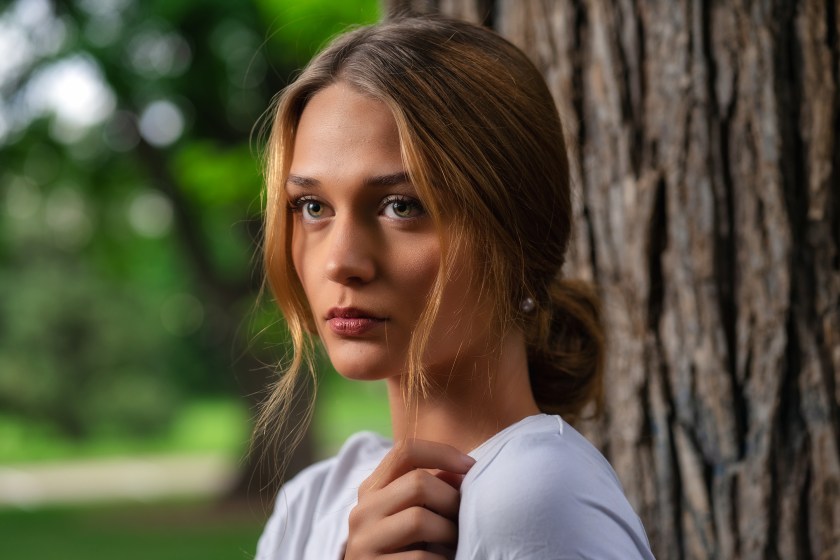
Kelly R. Bienfang’s portrait in Fort Collins’ City Park showcases refined environmental portraiture, merging classic lighting techniques with natural settings. The composition emphasizes psychological presence through thoughtful framing and soft lighting, achieving dimensionality. Using traditional optics and careful post-processing, the image balances contemporary authenticity with technical precision, reinforcing the importance of classical methods in outdoor photography.

Woman with light brown hair stands beside a tree in a park, looking toward the camera with a soft green background.
Kelly R. Bienfang poses beside a tree in City Park, Fort Collins, Colorado.

This portrait of Kelly exemplifies the photographer’s command of environmental portraiture, demonstrating how classical lighting techniques can be sensitively adapted to outdoor contexts. Created in City Park, Fort Collins, the image represents a refinement of traditional portrait methodology—translating studio principles into naturalistic settings while preserving the intimacy and control typically associated with interior work.

The composition centers on a three-quarter view of the subject positioned against the textured bark of a substantial tree trunk. This anchoring element provides both physical and visual grounding, its vertical mass creating structural balance while its organic texture contrasts productively with the smooth contours of the subject’s face. The decision to place Kelly against this natural backdrop rather than opening the frame to broader park vistas reflects deliberate focus—prioritizing psychological presence over environmental documentation.

The lighting execution reveals sophisticated outdoor flash technique. Employing a single strobe with shoot-through umbrella, the photographer has created illumination that appears to extend rather than contradict the existing ambient light. The soft directional quality—evident in the delicate gradation across the subject’s face and the luminous edge separation along her profile—suggests careful positioning to mimic golden hour sun while maintaining consistent exposure control. This hybrid approach, blending natural and artificial light sources, achieves what purely available light could not: sculptural dimensionality without harsh shadow or unflattering overhead illumination.

The subject’s positioning and expression demonstrate thoughtful directorial collaboration. Kelly’s gaze, angled slightly upward and away from the lens, creates contemplative distance while her hand’s gentle placement at the shoulder introduces subtle gesture without performative emphasis. This combination of turned body and averted eyes establishes a portrait that feels observed rather than confrontational—inviting viewer attention while maintaining the subject’s interior privacy. The styling choice of a simple white garment serves the image’s tonal strategy, providing clean highlight mass that draws focus toward facial features and natural coloring.

Technical choices throughout support this classical approach. The Sony 85mm f/1.8 lens, deployed on the Sony A7II body, offers the compression and shallow depth of field characteristic of traditional portrait optics. The resulting background dissolution—visible in the soft green bokeh representing distant foliage—eliminates visual competition while establishing atmospheric color context. Post-processing in Luminar 4 has enhanced the warm color palette, emphasizing the golden light quality playing across skin tones and hair while maintaining natural saturation levels.

Within Chapter 4’s examination of portrait methodologies, this photograph demonstrates the photographer’s ability to execute formal portraiture outside controlled studio environments. The work shows less interest in contemporary street portrait spontaneity than in translating time-tested studio aesthetics into outdoor practice—a technically demanding approach requiring precise light manipulation and environmental awareness simultaneously.

The image also illustrates evolution in his workshop-informed practice. The confidence evident in both lighting execution and subject direction suggests accumulated knowledge from collaborative learning environments, where traditional portrait techniques are studied and adapted. This photograph represents portraiture rooted in classical principles—emphasizing beauty, technical precision, and dignified subject representation—while acknowledging contemporary preferences for natural settings and authentic expression.

As part of his broader Top 100 Journey documentation, this work affirms the continuing relevance of foundational portrait techniques when executed with skill and sensitivity. It demonstrates how environmental portraiture can achieve the polish and intentionality of studio work without sacrificing the organic qualities that location shooting provides.

Maia del Mazo Urban : A Study in Contemporary Youth Portraiture

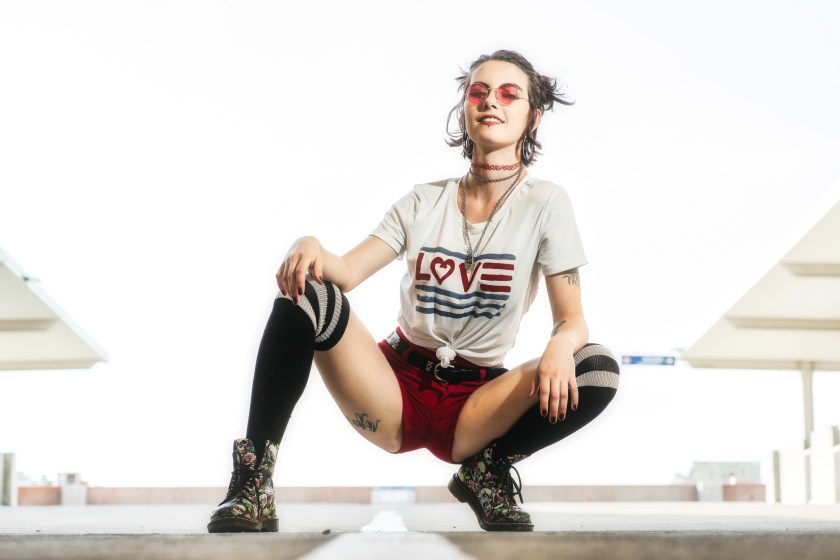
Maia del Mazo’s portrait, captured in Old Town Fort Collins, exemplifies the intersection of contemporary youth culture and environmental portraiture. Utilizing natural light and artificial enhancement, the photographer balances technical precision with spontaneity. The subject’s confident pose and styling reflect a subcultural moment, fostering an authentic connection with the viewer.

Woman wearing red shorts and knee-high socks crouches on a concrete surface in an urban setting with bright sky behind her.
Maia del Mazo poses in an urban location in Old Town Fort Collins, Colorado.

Within Chapter 4 of the photographer’s Top 100 Journey—dedicated to studio, outdoor, and workshop portraiture—this image of Maia del Mazo emerges as a compelling examination of contemporary youth culture and environmental portraiture. Shot in Old Town Fort Collins, Colorado, the photograph demonstrates the artist’s evolving command of natural light augmented by carefully controlled artificial illumination, a technical approach that has become increasingly refined throughout this chapter of his documentary project.

The composition presents the subject in a confident, grounded squat position against a minimalist architectural backdrop. Her styling—vintage band aesthetic meeting modern streetwear, complete with floral combat boots, striped knee socks, and layered chokers—speaks to a specific subcultural moment. The photographer has positioned her centrally within the frame, allowing the clean lines of the urban architecture to recede into soft focus, creating negative space that amplifies the subject’s presence rather than competing with it.

Technically, the image represents a sophisticated balance between available daylight and artificial enhancement. Shot with a Sony A7ii paired with an 85mm f/1.8 lens, the photographer employed a handheld Godox V1s flash without modification—a bold choice that suggests confidence in reading ambient conditions. The direct flash technique produces a subtle fill that lifts shadows without flattening the image’s dimensionality, while the 85mm focal length compresses the background just enough to isolate the figure without creating unnatural bokeh. The slight wind-swept quality of the subject’s hair adds dynamism to what might otherwise read as a static pose.

What distinguishes this work within the chapter’s broader context is its departure from traditional studio control. While maintaining the technical precision associated with formal portraiture, the photographer embraces environmental elements—concrete surfaces, architectural geometry, natural wind movement—that introduce spontaneity into the frame. This hybrid approach reflects an evolution in his practice, moving beyond purely controlled studio environments toward a more flexible methodology that captures authentic personality within structured compositions.

The post-processing in Luminar 4 demonstrates restraint appropriate to the subject matter. Color grading emphasizes warm tones in the subject’s skin and the amber cast of her sunglasses while maintaining the cooler neutrals of the concrete and sky. The processing enhances rather than transforms, supporting the documentary quality inherent in the photographer’s approach to his Top 100 Journey project.

The subject’s body language—relaxed yet assertive, casual yet deliberate—suggests a collaborative relationship between photographer and sitter. This comfort level allows for genuine expression rather than performative posing, a quality that distinguishes effective contemporary portraiture from mere documentation. The direct, knowing gaze above the rose-tinted frames establishes connection with the viewer while maintaining a degree of cool remove characteristic of youth subculture.

As part of the photographer’s long-term Top 100 Journey, this image contributes to an ongoing investigation into portraiture’s capacity to capture both individual personality and broader cultural moments. It represents the workshop and outdoor component of Chapter 4’s mission, demonstrating how environmental factors and technical adaptability can produce work that honors both formal photographic traditions and contemporary visual language. The result is a portrait that feels simultaneously timeless in its compositional confidence and distinctly anchored in its cultural moment.