Through the Looking Glass: A Meditation on Medium and Moment

A glass sphere is used to refract and invert the final print issue of Digital Photographer magazine in a still life composition that explores themes of perception, preservation, and the transition from analog to digital media. The work reflects on the obsolescence of print, intertwining technical prowess with a thoughtful commentary on photography’s evolution.

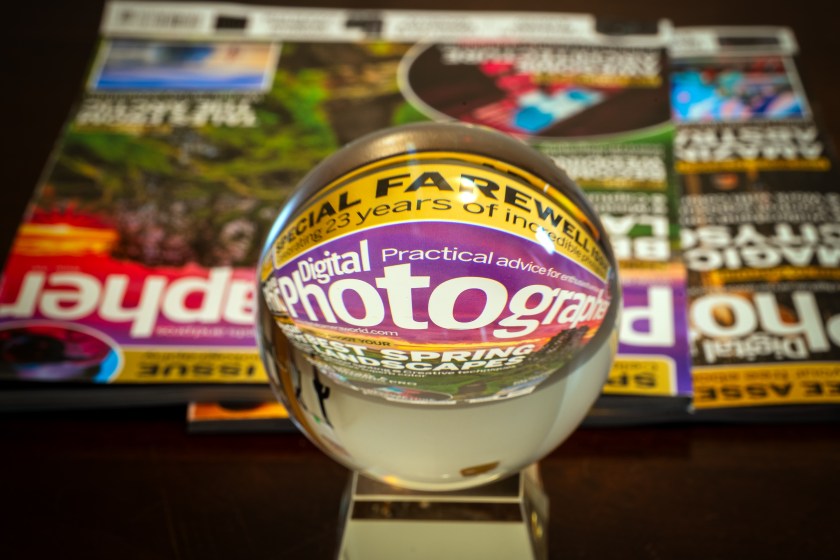
Glass sphere placed over a stack of photography magazines, magnifying and inverting the “Digital Photographer” cover through refraction.
A glass sphere refracts and inverts photography magazines, including the final print issue of Digital Photographer, photographed for the 52 Frames “Through the Looking Glass” challenge.

In this carefully orchestrated still life, the photographer employs a glass sphere as both subject and optical instrument, creating a work that functions simultaneously as technical demonstration and elegiac commentary on the evolution of print media. The composition centers on a crystal orb that inverts and refracts the image of Digital Photographer magazine—specifically, its final print edition—transforming a moment of cultural transition into a study of perception, preservation, and the inevitable passage of analog traditions into digital memory.

The technical execution reveals a photographer comfortable with the complexities of refractive optics. The sphere acts as a lens within the lens, compressing the magazine’s cover into a miniaturized, inverted world that paradoxically sharpens our attention to what might otherwise be overlooked. The purple masthead, readable despite its reversal, anchors the composition with bold color, while the surrounding magazines create a layered backdrop that suggests abundance even as the image mourns scarcity. The decision to flip certain magazines for the “extra credit of refraction” demonstrates a playful engagement with the assignment’s constraints, yet this playfulness does not diminish the work’s underlying melancholy.

What elevates this photograph beyond mere technical exercise is its timing and intentionality. The artist notes he possessed this glass sphere for years before deploying it—a detail that speaks to the patience required in photographic practice, the waiting for subject and tool to find their proper alignment. That this alignment occurred during the week Digital Photographer ceased print publication transforms the image into an unintentional requiem, a visual preservation of a medium announcing its own obsolescence.

Within Chapter 6 of the Top 100 Journey—titled “The Road Ahead: Recent Work & Ongoing Exploration”—this photograph occupies particularly rich territory. The chapter’s title suggests forward momentum, yet this image looks both forward and backward simultaneously. The glass sphere, an ancient optical device, refracts contemporary printed matter about digital photography, creating a temporal layering that mirrors the photographer’s position at a crossroads between mastered techniques and emerging possibilities. The work acknowledges what is being left behind even as it demonstrates facility with the tools of the present.

The composition’s formal qualities reward extended viewing. The shallow depth of field isolates the sphere against the deliberately blurred magazine stack, creating spatial hierarchy while maintaining contextual legibility. The lighting, presumably controlled given the studio-like precision of the setup, wraps around the sphere’s curved surface without harsh reflections, suggesting either diffused natural light or carefully positioned artificial sources. The wooden surface beneath provides warmth and texture, grounding the optical trickery in tangible materiality.

Conceptually, the photograph engages with themes of representation and mediation that recur throughout photographic history. The sphere presents the magazine not as it is, but as refracted, inverted, compressed—much as photography itself presents the world not as direct experience but as mediated image. This self-reflexive quality, combined with the specific poignancy of documenting a publication’s final issue, positions the work within broader conversations about photography’s relationship to preservation, memory, and loss.

As the photographer continues his ongoing exploration, this image suggests an artist increasingly interested in photography that thinks about photography—work that acknowledges the medium’s materiality, history, and transformations while demonstrating technical mastery that never becomes mere showmanship.
Stacked Chrome Muscle: The Architecture of American Power

In a 2014 throwback photo, Greg Urbano captures a chrome muscle car engine at a car show, transforming it into a sculptural testament of American automotive culture. The monochrome composition highlights its intricate details and engineering philosophy, transcending typical automotive photography into fine art, reflecting power and craftsmanship.

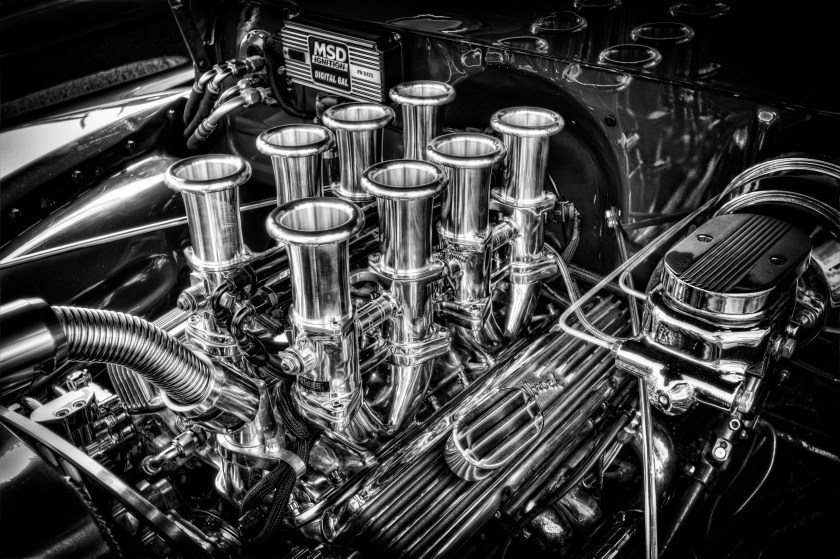
Black‑and‑white close‑up photograph of a chrome muscle car engine with multiple intake stacks, polished components, and detailed mechanical parts, taken with a Nikon D7100 at 24mm.
A 2014 black‑and‑white close‑up of a stacked chrome muscle car engine captured at a car show.

In this striking image from Greg Urbano’s early photographic explorations, the viewer encounters not merely an engine, but a sculptural monument to American automotive culture. Shot at a car show in 2014, this photograph demonstrates how technical documentation can transcend its utilitarian origins to become a meditation on form, texture, and cultural identity.

The composition centers on a magnificent array of individual throttle bodies—eight polished chrome velocity stacks rising like organ pipes from the engine block below. Urbano’s decision to shoot at f/8.0 provides exceptional depth of field, rendering every fluted trumpet in sharp detail while maintaining visual coherence across the crowded mechanical landscape. The MSD Digital 6AL ignition box in the upper left corner grounds the image in specificity, reminding us this is a real machine, not an abstract study.

What elevates this work beyond conventional automotive photography is the photographer’s masterful use of monochrome. The conversion to black and white strips away distraction and reveals the essential geometry of performance engineering. Chrome becomes a study in gradation—from brilliant highlights on the velocity stack lips to the deep blacks of the engine valley below. The ribbed valve covers create rhythmic patterns that echo throughout the frame, establishing a visual cadence that draws the eye deeper into the mechanical complexity.

The lighting deserves particular attention. Working with the ambient conditions of a car show—notoriously challenging for photographers—Urbano has captured specular highlights that accentuate the three-dimensional quality of each component. The reflections dancing across polished surfaces create a sense of movement and life in what is, paradoxically, a static object. One can almost hear the anticipated roar of this engine, feel the vibration of its operation.

From a curatorial perspective, this image belongs firmly within the “Beginnings” chapter of Urbano’s journey. It reveals a photographer discovering his eye, learning to see beyond the obvious. Car shows present a particular challenge: everything is designed to be spectacular, yet the very abundance of visual stimulus can overwhelm. Here, the photographer has exercised editorial judgment, finding a perspective that isolates and celebrates a single element of automotive excess.

The stacked throttle bodies themselves represent a specific philosophy in performance engineering—individual runners for each cylinder, optimized airflow, uncompromising dedication to power over practicality. This photograph captures that ethos perfectly. There is nothing subtle about this engine, and Urbano wisely chooses not to apologize for its maximalism. Instead, he leans into the drama, using his technical choices to amplify the subject’s inherent theatricality.

The 24mm focal length on his Nikon D7100 provides just enough wide-angle perspective to encompass the scene without introducing distortion that would undermine the precision of these machined components. Shot at 1/30th of a second—relatively slow for handheld work—the image’s sharpness suggests careful technique, perhaps braced against the engine bay or shot with controlled breathing.

This photograph documents more than machinery; it captures a particular strain of American automotive culture that values power, craftsmanship, and conspicuous performance. In rendering it so beautifully, Urbano elevates the vernacular tradition of car photography into something approaching fine art—a promising beginning indeed for a photographer learning to find extraordinary subjects in ordinary places.