Tampa Night Skyline: The City as Light Performance

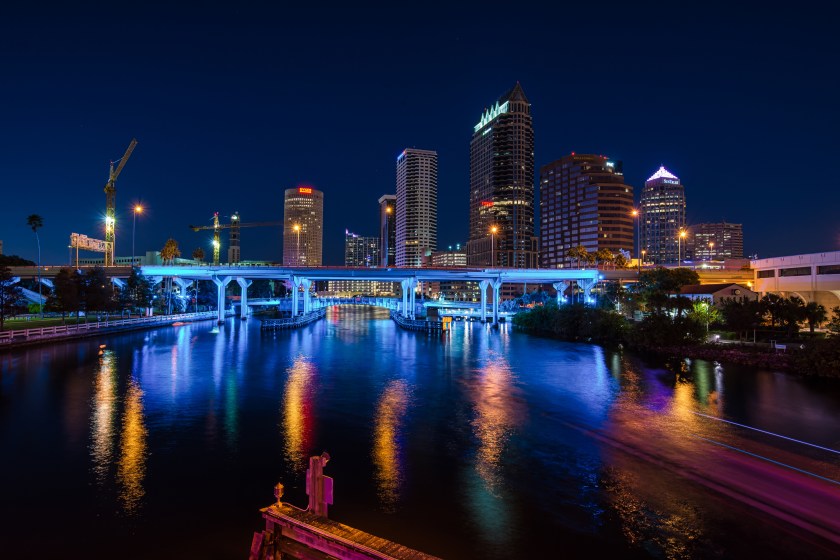
The photograph of Tampa’s skyline from the Platt Street Bridge highlights the vibrant interplay between urban light and architecture at night. With a balanced eight-second exposure, it captures the city’s dynamic illumination, showcasing rich colors reflected in water. The composition balances sleek design and texture, embodying Tampa’s architectural evolution.

Nighttime long exposure photograph of the Tampa, Florida skyline viewed from the Platt Street Bridge over the Hillsborough River.
Long exposure night view of the Tampa skyline from the Platt Street Bridge.

This nocturnal view of Tampa’s downtown district, captured from the Platt Street Bridge, represents a pivotal exploration within Chapter 2—Florida Landscapes & Cityscapes—where the photographer turns his lens toward the performative qualities of urban illumination. Unlike the contemplative stillness of his four-minute dusk exposure, this eight-second capture embraces the vibrancy of the city after dark, revealing Tampa as a stage for artificial light in conversation with architectural form.

The technical approach demonstrates confident command of night photography fundamentals. Shot at 21mm with an aperture of f/10.0, the image achieves comprehensive sharpness while managing the intense point-source lights that define the scene. The eight-second exposure strikes a careful balance: long enough to smooth the water’s surface into a receptive canvas for reflection, yet brief enough to preserve the individual character of each light source without excessive bloom or halation. An ISO of 160 keeps noise minimal while allowing the sensor to capture the full tonal range from the deep navy of the evening sky to the brilliant architectural accent lighting.

The composition is anchored by the dramatically illuminated bridge structure, its cyan LED lighting creating an almost theatrical proscenium that frames the skyline beyond. This choice of vantage point—shooting through the bridge rather than merely of it—adds dimensional complexity, transforming infrastructure into compositional architecture. The repeating vertical supports create rhythm and depth, while the horizontal span provides structural stability to an image otherwise dominated by vertical towers.

What distinguishes this photograph within the photographer’s evolving body of work is its embrace of saturated, polychromatic illumination. The water becomes a liquid prism, fragmenting and multiplying the city’s light signature into vertical streaks of cyan, magenta, amber, and emerald. These reflections possess an almost painterly quality, their chromatic intensity suggesting influence from both contemporary light art and the neon-soaked aesthetics of urban night photography. The contrast between the cool blue bridge lighting and the warmer tones emanating from building facades and street lamps creates visual tension that energizes the entire frame.

The foreground element—a wooden dock structure with visible weathering and industrial hardware—provides crucial textural counterpoint to the sleek glass and steel beyond. This detail grounds the image in physical reality, preventing it from dissolving into pure abstraction despite the transformative effects of artificial light on water. It’s a gesture toward documentary honesty within what might otherwise read as a celebration of spectacle.

Contextually, the inclusion of construction cranes in the left background speaks to Tampa’s ongoing transformation, capturing a specific moment in the city’s architectural timeline. These industrial silhouettes, backlit against the evening sky, add temporal specificity while contributing vertical accents that echo the tower forms they’re constructing.

Within the broader narrative of the Top 100 Journey, this image demonstrates the photographer’s expanding vocabulary for depicting Florida’s urban environments. Where natural landscapes might offer subtlety and organic complexity, cityscapes present their own challenges: managing competing light sources, finding order within density, revealing beauty in the manufactured. His success here lies in recognizing that the contemporary city at night is fundamentally an installation of light—one that reveals itself fully only through the camera’s ability to accumulate and organize photons across time.

Tampa Skyline Long Exposure: A Study in Urban Stillness

This long exposure photograph of Tampa’s skyline captures the city at dusk, highlighting the interplay of light, architecture, and time. With a 241-second exposure, the image transforms the water into a reflective surface, merging urban forms and enhancing their beauty. The composition emphasizes symmetry and color, inviting deeper appreciation of urban landscapes.

Long exposure dusk photograph of the Tampa, Florida skyline with illuminated buildings and reflections on the Hillsborough River.
Long exposure dusk view of the Tampa skyline with river reflections.

Within the framework of Chapter 2—Florida Landscapes & Cityscapes—this long exposure photograph of Tampa’s downtown core represents a sophisticated meditation on the intersection of natural light, architectural form, and temporal manipulation. Shot at dusk from across the Hillsborough River, the image captures the city skyline in a state of suspended transition, where the photographer’s technical mastery serves to transform a familiar urban vista into something altogether more contemplative.

The technical specifications reveal deliberate choices that speak to the photographer’s evolving understanding of long exposure craft. An exposure time of 241 seconds—over four minutes—has rendered the water’s surface into a mirror-like plane of silk, creating an almost supernatural calm that contrasts sharply with the structural solidity of the buildings above. This extended duration collapses time, erasing the ephemeral movements of waves and current to reveal something closer to the river’s essential character. The choice of an 18mm focal length at f/8.0 provides expansive depth of field while maintaining critical sharpness across the entire frame, from the foreground water to the distant architectural pinnacles.

The composition demonstrates a rigorous formalism. The horizontal bands of bridge infrastructure bisect the frame at roughly the golden ratio, their purple-lit supports creating rhythmic vertical elements that guide the eye through the middle ground. The skyline itself presents as a study in geometric variation: cylindrical towers, angular glass facades, and the distinctive peaked crown of the tallest structure each catch and reflect the fading daylight in subtly different ways. The photographer has positioned himself to capture not merely the buildings themselves, but their perfect inversions in the still water below, creating a symmetry that doubles the visual information while emphasizing the transformative effect of his chosen technique.

Color plays a crucial role in the image’s success. The graduated sky transitions from warm peachy tones at the horizon to deepening blue overhead, providing a naturalistic backdrop that throws the artificial illumination into relief. The purple accent lighting on the bridge structure introduces an unexpected chromatic note, while the warm reflections—amber, gold, and rose—animate the lower half of the frame with points of concentrated light. This interplay between cool atmospheric tones and warm architectural lighting creates visual tension that keeps the eye engaged despite the overall compositional stillness.

The small electronic device visible in the immediate foreground—likely the camera’s intervalometer—serves as an unintentional but effective scale reference, grounding the viewer’s perspective and subtly acknowledging the technical apparatus required to achieve such results. It’s a moment of transparency that connects the finished image back to its means of production.

Within the broader arc of the Top 100 Journey project, this Tampa skyline represents the photographer’s deepening engagement with Florida’s urban environments as subjects worthy of the same sustained attention he brings to natural landscapes. The long exposure technique, applied here to a cityscape, reveals patterns and qualities invisible to ordinary perception—the fundamental architecture of light, the liquidity of solid water, the strange beauty of modern cities seen through the lens of time. It’s work that asks viewers to reconsider what they think they know about familiar places, finding in them unexpected dimensions of visual poetry.