Shan Light: Choreographing Time and Illumination

Shannon Quinn’s photograph, taken at Void Studios, symbolizes the photographer’s exploration of long-exposure light painting in collaboration with a dancer. The composition highlights a figure in black, illuminated by vibrant light trails, merging technical skill with performance. This work exemplifies an ongoing artistic journey, emphasizing collaboration and the evolution of creative expression.

Studio portrait of go-go dancer Shannon Quinn wearing a blue wig and dark outfit, surrounded by curved orange light trails created through long-exposure light painting.
Shannon Quinn (ShanOSteel) photographed at Void Studios Denver during a collaborative light painting and long-exposure studio session.

In this striking image from Chapter 6 of Greg Urbano’s Top 100 Journey—titled “The Road Ahead: Recent Work & Ongoing Exploration”—the photographer ventures into territory that merges technical experimentation with performative energy. Shot at Void Studios in Denver during a collaborative session with dancer Shannon Quinn, the photograph represents a deliberate pivot toward long-exposure light painting, a technique the photographer had not previously explored in a controlled studio environment.

The composition centers on a figure clad in black with a blue-toned wig, positioned against a muted backdrop while wielding LED wands that trace vivid arcs of orange and yellow light through space. The long exposure—achieved through rear curtain sync flash combined with continuous LED sources—captures both the frozen stillness of the subject and the kinetic energy of movement, creating a visual paradox that challenges our perception of time. The metallic sheen of the vest catches ambient light, adding textural contrast to the otherwise shadow-heavy figure, while knee-high boots ground the composition in the physical realm even as the light trails suggest something ethereal.

What distinguishes this work within the photographer’s evolving practice is its collaborative foundation. Unlike many studio portraits that position the photographer as sole author, this image emerges from a dialogue between creator and performer. Quinn’s background as a go-go dancer informs the dynamic posture and confident spatial awareness visible in the frame. The choreography of light becomes inseparable from the choreography of the body, suggesting that technical mastery alone cannot produce such results—it requires a willing, skilled collaborator who understands how to perform for extended exposures.

The technical apparatus employed here—a Nikon Z7ii paired with Godox TL30 LED wands and an AD100 strobe—speaks to a hybrid approach that balances ambient light sculpting with decisive flash illumination. Rear curtain sync ensures that the sharpest rendering of the subject occurs at the end of the exposure, allowing motion blur and light trails to accumulate before the final moment of clarity. This reversal of typical flash timing creates a sense of forward momentum, as though the figure is moving into her frozen state rather than away from it.

Within the context of Chapter 6, this photograph embodies the spirit of its subtitle: ongoing exploration. The photographer’s willingness to attempt unfamiliar techniques in a new setting demonstrates an artistic practice that refuses stagnation. Rather than retreating to established strengths, the work here shows someone leaning into uncertainty, using collaboration as a catalyst for discovery.

The color palette—dominated by warm oranges against cool blues and deep blacks—creates a retro-futuristic aesthetic that recalls both 1980s cyberpunk imagery and contemporary LED performance art. Yet the image avoids pastiche. Instead, it synthesizes influences into something distinctly contemporary, a visual language appropriate for documenting this moment in the photographer’s trajectory.

As part of a curated selection representing his strongest work, this image signals not arrival but continuation. It captures the photographer mid-journey, experimenting with new tools and partnerships, documenting not just a subject but a process of becoming. The road ahead, as the chapter title suggests, remains open—and this photograph marks one compelling point along that route.
Light Paint Glass Vase: Minimalism and the Democratization of Photographic Practice

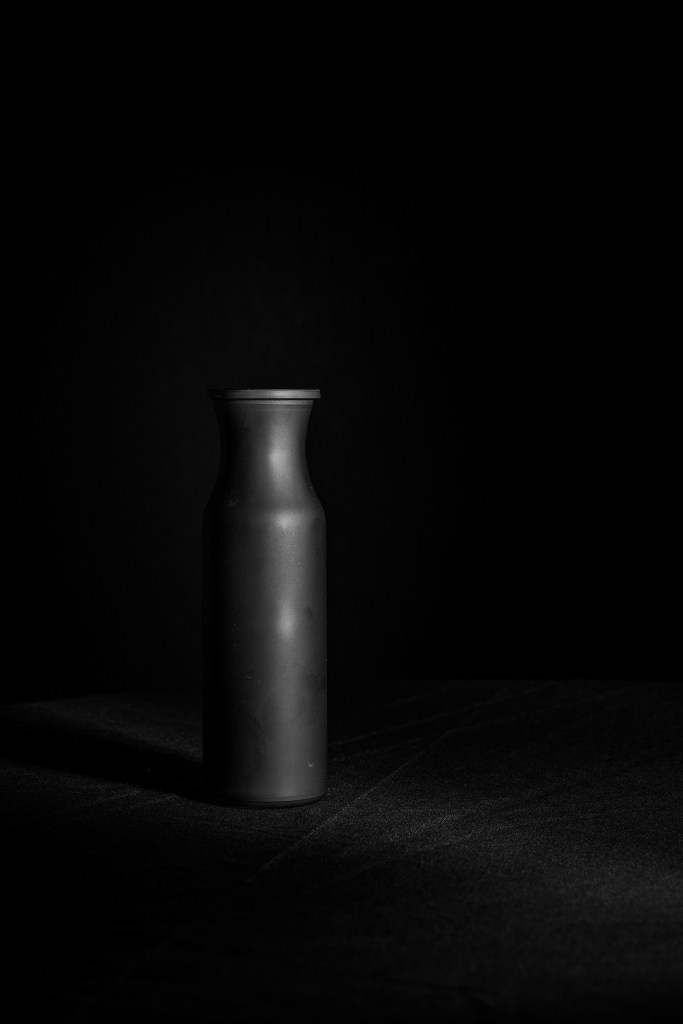
A minimalist black-and-white photograph of a glass vase showcases how simple materials can produce sophisticated visual art. Created for a structured challenge, the work emphasizes classical minimalist principles, focusing on light, form, and composition. It highlights the idea that accessible techniques can achieve impactful results through exploration and experimentation.

Black-and-white photograph of a single glass vase standing on a dark fabric surface, illuminated against a black background with subtle light-painted highlights.
A minimalist black-and-white study of a glass vase, photographed using light painting on a dark tabletop and background.

In this austere still life, the photographer demonstrates how constraint and accessibility can yield sophisticated visual results. Created for Week 46 of a structured challenge focused on black and white minimalism, the image features a green glass vase—rendered in monochrome—isolated against absolute darkness. The work’s genesis from dollar store materials and basic light painting techniques belies its formal accomplishment, positioning it as a compelling statement within Chapter 6’s exploration of ongoing practice and future directions.

The composition adheres to classical minimalist principles: a singular subject, centered and vertical, emerges from void. The vase’s elegant silhouette—narrow at neck and base, gently swelling through its body—receives careful illumination from a handheld flashlight, creating a gradient of tones that model the form with sculptural precision. The photographer’s light painting technique reveals selective control; highlights trace the vessel’s curve while allowing shadow to claim significant portions of the surface, suggesting volume through implication rather than complete revelation.

What distinguishes this work within the photographer’s broader trajectory is its embrace of democratic materials and process. By explicitly acknowledging the humble origins of both subject and lighting instrument, he advances a philosophy that technical sophistication need not depend on expensive equipment. This approach resonates with Chapter 6’s theme of exploration—suggesting that the road ahead involves continual experimentation with accessible means rather than escalating technical complexity.

The monochromatic treatment transforms what was originally a green glass vessel into a study of pure form and tonality. This chromatic reduction focuses attention on the interplay between light and surface, on the subtle texture variations across the vase’s body, and on the relationship between object and ground. The black tablecloth and background merge into a unified void, creating the impression that the vase floats in undefined space—a strategy borrowed from commercial and fine art photography traditions alike.

The image’s participation in a weekly challenge framework—Week 46 addressing black and white minimalism—situates the photographer’s practice within contemporary photography’s social and educational structures. Unlike the isolated studio practice of previous generations, his work emerges from dialogue with prompts, themes, and presumably a community of practitioners engaging similar constraints. This context enriches the reading of Chapter 6; the road ahead is both solitary and communal, shaped by individual vision and collective participation.

Post-processing in Adobe Camera Raw represents the final transformative stage, where the captured light painting receives refinement and intentional tonal mapping. The deep blacks exhibit rich density without blocking detail entirely, while the highlights maintain luminosity without burning out—evidence of considered digital darkroom practice.

Within the Top 100 Journey, this photograph stands as testament to fundamental photographic principles: light, form, composition, and tone. Its apparent simplicity masks deliberate choices regarding placement, illumination duration and direction, and subsequent processing decisions. The vase becomes more than household object; it transforms into a vehicle for exploring how light describes volume, how darkness defines presence, and how minimal means can generate maximal visual impact.

In embracing both constraint and accessibility, the photographer charts a sustainable path forward—one where ongoing exploration need not await perfect conditions or specialized equipment, but can unfold through disciplined attention to essential elements.

Shannon Quinn Creative Red Mesh 01: Portraiture as Transformation

The portrait of model Shannon Quinn, captured with red mesh fabric, highlights the photographer’s creative departure during a commissioned headshot session in Denver. This image explores themes of identity and concealment, merging fashion and classical techniques. It reflects a sophisticated understanding of light and invites viewers to contemplate the complexities of photographic representation.

Studio portrait of model Shannon Quinn standing against a dark background, partially draped in red mesh fabric with hands raised and visible through the translucent material.
Model Shannon Quinn photographed in a studio portrait using red mesh during a creative headshot session in Denver, Colorado.

Within the context of a commissioned headshot session, the photographer discovered an opportunity for creative departure—a moment when commercial purpose yielded to artistic exploration. This photograph, featuring model Shannon Quinn enveloped in crimson mesh fabric, exemplifies his ability to recognize and pursue unexpected visual possibilities within structured professional environments. The resulting image transcends its utilitarian origins, offering instead a meditation on identity, concealment, and the transformative potential of portraiture.

The composition centers on the subject’s steady, outward gaze, her expression poised between vulnerability and defiance. She holds the translucent red fabric above her head with both hands, creating a canopy that simultaneously reveals and obscures. This gesture—part unveiling, part self-protection—establishes a compelling psychological tension. The mesh filters light across her features while maintaining visual clarity, creating a liminal space where the subject exists between states: seen yet veiled, present yet ethereal, contemporary yet somehow timeless.

The photographer’s handling of light demonstrates technical sophistication and restraint. Working against a dark, neutral background, he allows the ambient illumination to bathe the subject’s face in warm tones that harmonize with the red mesh. The fabric itself becomes an active participant in the lighting scheme, casting subtle patterns and chromatic shifts across her skin and clothing. Her black attire—a textured top with bow detail—provides essential contrast, anchoring the composition while allowing the red fabric to command attention without overwhelming the frame.

What distinguishes this work is its navigation of multiple photographic traditions simultaneously. Elements of fashion photography appear in the subject’s confident pose and styled presentation, while the dramatic use of fabric recalls classical painting techniques where drapery conveys narrative and emotional weight. The dark background and controlled studio lighting situate the image within portraiture’s formal conventions, yet the unconventional use of the mesh material disrupts these expectations, injecting contemporary conceptual sensibility into an otherwise traditional setup.

Positioned within Chapter 6 of his Top 100 Journey—”The Road Ahead: Recent Work & Ongoing Exploration”—this photograph signals the artist’s ongoing investigation into portraiture’s evolving possibilities. The chapter’s emphasis on recent work and exploration finds perfect expression here: a commissioned session becomes a laboratory for creative experimentation, demonstrating that artistic vision need not be confined to personal projects alone. Professional practice and artistic development exist not as separate domains but as mutually enriching pursuits.

The red mesh functions as both literal and metaphorical element—a physical barrier that paradoxically enhances rather than diminishes our connection to the subject. This duality speaks to fundamental questions about photographic representation itself: what do we truly see when we look at a portrait? How do layers of interpretation, context, and visual mediation shape our understanding of another person’s presence?

In Shannon Quinn’s direct gaze, there exists a knowing quality, an awareness of the camera’s scrutiny and the complex transaction occurring between subject, photographer, and eventual viewer. This consciousness elevates the image beyond mere technical accomplishment, transforming it into a collaborative exploration of visibility, identity, and the porous boundaries between commercial and fine art photography. It stands as evidence of his commitment to finding artistic merit wherever circumstances allow, refusing to separate professional obligation from creative possibility.

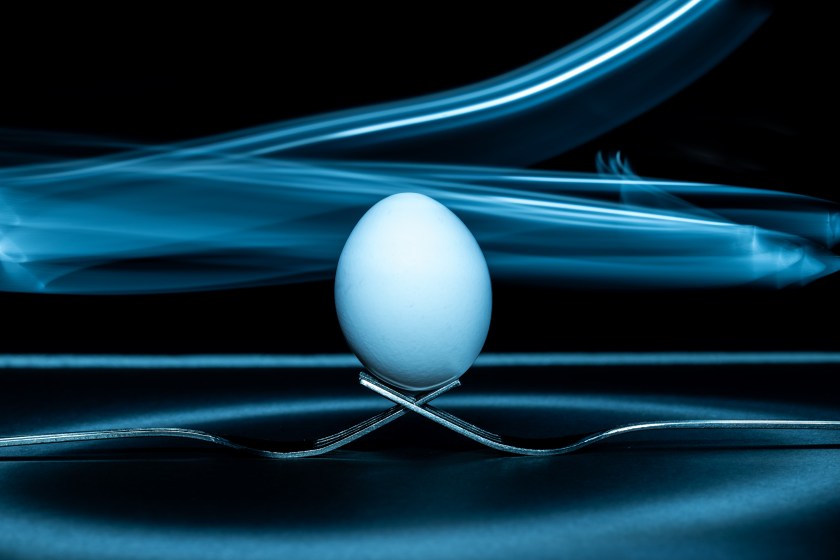
Light Paint Egg: Precision and Wonder in Contemporary Still Life

The photograph “Light Paint Egg” showcases a white egg balanced on crossed forks, illuminated through light painting techniques. This work exemplifies the artist’s blend of traditional and contemporary methods, capturing a balance between stasis and motion. It represents an innovative departure in still life, emphasizing creativity and technical mastery despite simple materials.

White egg balanced upright on crossed metal forks, photographed against a dark background with blue light trails created through light painting.
A white egg balanced on crossed forks, photographed using light painting techniques for the 52 Frames Week 11 “Egg” challenge.

In this meticulously crafted photograph, the artist demonstrates a masterful command of light painting technique, transforming an ordinary subject into an object of contemplation. The egg, positioned at the composition’s center, becomes a luminous focal point—its pale, almost ethereal surface contrasting dramatically against the deep black void that surrounds it. This is not merely documentation of an object, but rather an exploration of form, light, and the delicate balance between the tangible and the abstract.

The technical execution reveals a photographer working at the intersection of traditional still life aesthetics and contemporary experimental methods. Inspired by demonstrations from the lighting equipment company Adaptalux, he pursued this vision independently, relying on his own resourcefulness and understanding of photographic principles rather than specialized gear. This approach speaks to a fundamental confidence in craft—the knowledge that compelling imagery emerges not from equipment alone, but from vision and technical literacy working in concert.

The light trails that sweep through the frame possess an almost calligraphic quality, their cool blue tones suggesting both movement and stillness simultaneously. These luminous threads create a complex spatial environment, establishing depth and dimensionality around the egg while reinforcing its solidity and sculptural presence. The waves beneath appear to cradle the subject, while the diagonal streaks above suggest trajectory, momentum, perhaps even flight. There exists here a visual tension between stasis and motion, weight and weightlessness—themes that resonate throughout his broader body of work.

Positioned within Chapter 6 of his Top 100 Journey—”The Road Ahead: Recent Work & Ongoing Exploration”—this photograph exemplifies the artist’s willingness to embrace technical challenges and aesthetic risks. The chapter’s title suggests forward movement, continued evolution, and the photographer’s commitment to expanding his visual vocabulary. Indeed, this image represents a departure from more conventional approaches to still life, demonstrating how constraints—in this case, a weekly theme challenge—can catalyze creative innovation.

The composition adheres to classical principles while subverting expectations. The egg, that most ancient and universal of symbols, is elevated beyond its associations with fragility and potential. Here it becomes something simultaneously organic and otherworldly, as though suspended in a dimension where the laws of physics bend to artistic intention. The photographer’s choice to work with long exposure and moving light sources transforms the medium itself into a drawing tool, blurring the boundaries between photography, painting, and performance.

What distinguishes this work within his oeuvre is its synthesis of technical precision and poetic sensibility. The execution required careful planning—controlling exposure duration, choreographing light movement, managing ambient contamination—yet the final image transcends its methodology. It invites meditation on form, on the nature of photographic representation, and on how familiar objects can be estranged and renewed through careful observation and technical intervention.

As part of his ongoing exploration documented in the Top 100 Journey project, “Light Paint Egg” signals a photographer unafraid to experiment, to respond to creative prompts with rigor and imagination, and to push the boundaries of his practice. It stands as evidence that profound imagery can emerge from simple materials when vision, patience, and technical mastery converge.

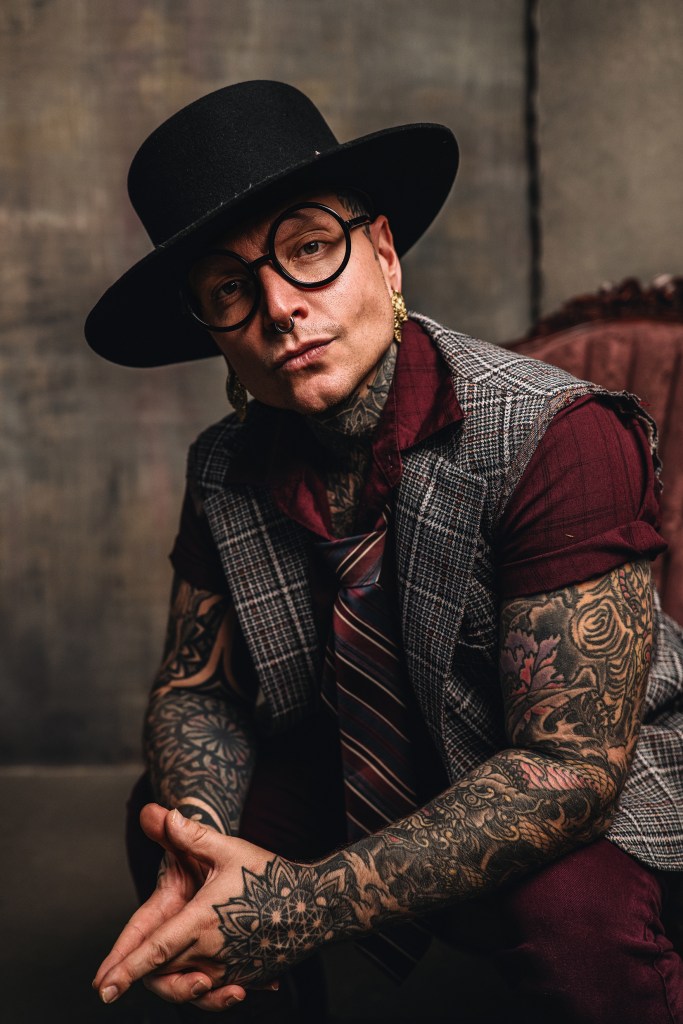
Jonny Edward — Portrait

In this sixth chapter of the visual odyssey, Jonny Edward’s portrait embodies the blend of environment and identity, created in his studio, Atelier Alchimia. The image emphasizes texture and iconography, showcasing a stylistic marriage between traditional garments and modern tattoos. It marks a pivot to evocative, symbolic portraiture, exploring the philosophy of aesthetic existence.

Portrait of a person wearing a black hat and round glasses, seated indoors with tattooed arms, dressed in a vest, shirt, and tie against a textured studio backdrop.
Portrait of Jonny Edward photographed seated in his studio, wearing a hat, glasses, and layered clothing, with tattoos visible on both arms.

In the sixth chapter of this ongoing visual odyssey, the photographer explores the intersection of environment and identity, moving beyond the mere capture of a likeness to conduct a sophisticated study of texture and personal iconography. This portrait of Jonny Edward, captured within the subject’s own creative sanctuary, Atelier Alchimia, serves as a cornerstone of the “Recent Work & Ongoing Exploration” phase. It represents a pivot toward a more layered, atmospheric approach to portraiture, where the subject and the space they inhabit become indistinguishable components of a singular narrative.

The composition is a masterclass in the management of complex visual information. The subject is positioned with a calculated stillness, his gaze direct and piercing through circular frames that provide a geometric anchor for the viewer. There is a profound intentionality in the styling: the marriage of classic haberdashery—a wide-brimmed felt hat, a patterned cravat, and a structured waistcoat—against the modern, intricate cartography of extensive tattoo work. The photographer skillfully navigates these disparate elements, ensuring that the elaborate patterns of the skin and the plaid of the vest complement rather than compete with one another.

Technically, the image excels in its tonal range and tactile quality. The lighting is deliberate, casting a soft yet directional glow that carves out the contours of the subject’s face and highlights the physical relief of the ink on his forearms. There is a tangible weight to the textures presented: the coarseness of the waistcoat’s weave, the smoothness of the felt hat, and the weathered patina of the background wall. This background, reminiscent of a Renaissance fresco in its muted, distressed tones, provides a timeless quality that lifts the portrait out of a specific era and into a more permanent, artistic realm.

As a significant entry in the “Top 100 Journey,” this work illustrates the photographer’s evolving mastery of the “creative workshop” environment. By collaborating within a space designed for artistic alchemy, he has successfully distilled the essence of a fellow creator. The image functions as a dialogue between two artists—one in front of the lens and one behind it—resulting in a portrait that feels less like an observation and more like an excavation.

In the context of Chapter 6: The Road Ahead, this photograph signals a refined direction. It moves away from traditional, literal portraiture toward a more symbolic and evocative methodology. The hands, clasped in a gesture of quiet strength, draw the eye to the lower third of the frame, grounding the composition and reinforcing the sense of grounded presence. It is an exploration of the “modern alchemist,” capturing a figure who is both a product of and a contributor to the creative landscape of Colorado. This portrait does not merely record a face; it documents a philosophy of aesthetic existence, marking a high point in the photographer’s continued pursuit of visual excellence.

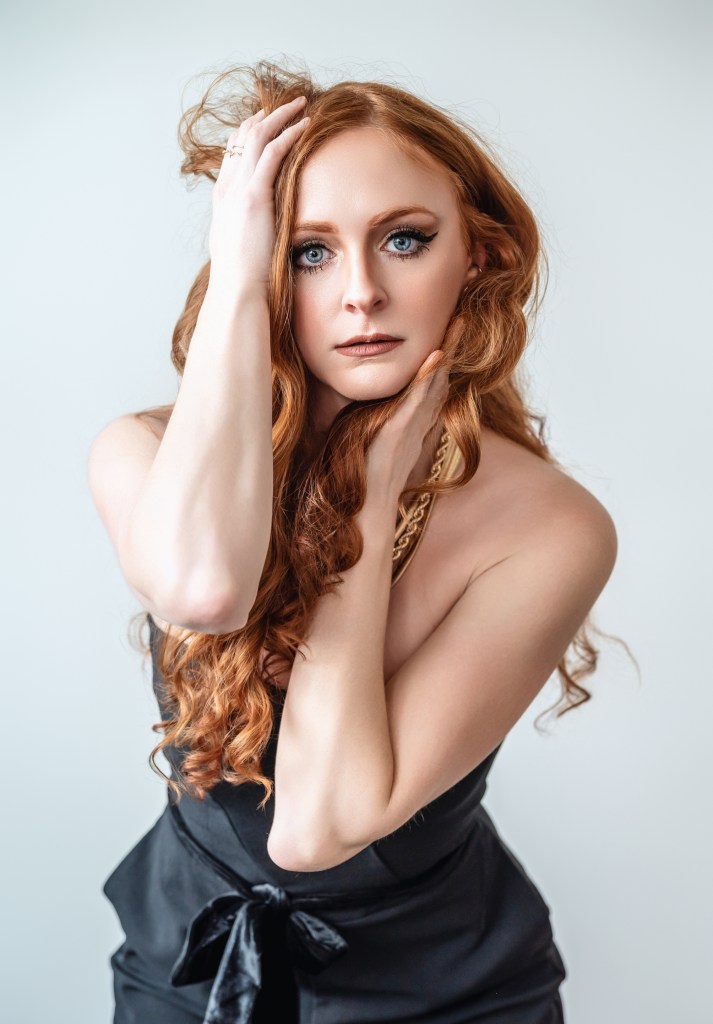
Natural Elegance: A Portrait in Copper and Light

Abigail Marchetti, known as Copper Muse, poses at a Denver Models open shoot, showcasing the photographer’s evolving studio portraiture techniques. Utilizing natural light, he captures her striking features and authentic expression, emphasizing color harmony and psychological presence. This portrait marks a significant step in his artistic development, blending classical principles with a modern sensibility.

Studio portrait of a red-haired woman in a black dress posing against a light background with her hands framing her face.
Model Abigail Marchetti, known as Copper Muse, poses during a Denver Models open shoot at Realm Studio in Denver.

This compelling portrait of model Abigail Marchetti exemplifies the photographer’s deepening engagement with studio portraiture and his refined approach to natural light as a primary sculptural tool. Captured during a Denver Models open shoot at Realm Studio, the image represents continued exploration of collaborative creative environments while demonstrating increasingly sophisticated control of the portraitist’s essential elements: light, gesture, color harmony, and psychological presence.

The composition centers on the model’s striking features—vibrant copper-red hair cascading in loose waves, piercing blue-green eyes meeting the camera with direct but unguarded confidence, and pale skin that catches and reflects the soft window light with luminous clarity. Her pose, with one hand gracefully raised to her hair and the other touching her neck, creates natural framing that draws attention to her face while suggesting unaffected spontaneity. The black strapless garment provides bold tonal contrast against both her skin and the pale backdrop, creating visual drama without competing for attention.

What distinguishes this work is the photographer’s masterful exploitation of natural window light. Rather than relying on the multiple strobes and reflectors typical of commercial studio work, he has chosen a more classical approach that recalls portrait painting traditions. The directional quality of the illumination—soft yet defined—models the subject’s features with sculptural precision while maintaining delicate gradations across skin tones. Highlights along the hair reveal its rich, multidimensional copper coloring, transforming what could be merely descriptive documentation into chromatic study.

The technical execution demonstrates growing confidence with the Nikon Z5 system and the versatile 24-120mm lens. The focal length selection—likely in the moderate telephoto range—provides flattering perspective without distortion, while the depth of field keeps the subject sharply defined against the subtly gradated background. The exposure balances the challenge of pale skin and light background without sacrificing detail in either the model’s features or the deeper tones of her garment.

Within the framework of Chapter 6—”The Road Ahead: Recent Work & Ongoing Exploration”—this portrait signals important developments in his artistic trajectory. The open shoot environment, like the previous workshop-based work, indicates willingness to engage with structured collaborative opportunities while bringing his distinct sensibility to bear. Yet where some open shoots yield generic beauty documentation, this image transcends its circumstances through careful attention to classical portraiture principles: the quality of light, the authenticity of expression, the harmony of color and form.

The model’s direct gaze introduces a quality often absent from his landscape and architectural work—reciprocal acknowledgment between photographer and subject. This mutual recognition adds psychological dimension, transforming technical exercise into genuine encounter. The slight asymmetry in her expression—contemplative rather than performative—suggests comfort and trust within the photographic exchange.

The photograph also reveals evolving aesthetic priorities. While maintaining the tonal sensitivity and compositional rigor evident throughout his portfolio, he demonstrates here that minimalism need not preclude richness. The interplay of copper hair, pale skin, black fabric, and soft grey background creates visual complexity through chromatic relationships rather than environmental detail. This represents a distillation of his practice—finding depth in apparent simplicity, discovering complexity in restraint—now applied to the human figure with increasing assurance and grace.

Suspension and Illusion: A Study in Controlled Ephemera

Model Everyn Darling is featured in a significant studio portrait taken during a photography workshop in Denver. This image, characterized by its minimalist setting and controlled lighting, explores themes of aspiration and vulnerability through the metaphor of a translucent balloon. The photographer’s evolving style emphasizes collaborative creativity and visual poetry over mere technical perfection.

Studio portrait of a woman in a black dress holding a translucent balloon against a plain backdrop.
Model Everyn Darling poses with a translucent balloon during a studio photography workshop in Denver, Colorado.

This studio portrait represents a significant departure within the photographer’s evolving practice, marking his exploration of collaborative, workshop-based creation and the controlled artifice of studio environments. Captured during a Creative Experimental Photography Meetup at RAW Studios in Denver, the image demonstrates how structured creative exercises can yield work of surprising conceptual depth when approached with technical precision and compositional awareness.

The photograph centers on model Everyn Darling, positioned within a minimalist studio setting characterized by graduated neutral tones that transition from cool blue-grey to warm cream. This chromatic subtlety provides visual breathing room while maintaining atmospheric presence—a backdrop that supports rather than competes. The subject, dressed in a simple black dress with white collar detail, appears barefoot in a pose of upward contemplation, one arm extended to hold a translucent balloon trailing delicate white ribbons or fabric.

What elevates this image beyond documentation of a workshop exercise is the photographer’s attention to the psychology of gesture and the poetry of the ostensibly simple prop. The balloon—that most ephemeral and-associated of objects—becomes a vehicle for exploring themes of lightness, release, and the tenuous connection between desire and drift. The model’s gaze follows the balloon upward, creating a diagonal compositional line that draws the eye through the frame while suggesting aspiration, longing, or perhaps the acceptance of letting go.

The technical execution reveals disciplined studio craft. Working with his Nikon Z5 and the versatile 24-120mm f/4 lens, the photographer has managed studio lighting with restraint, avoiding the harsh drama often favored in workshop settings. The illumination appears softly directional, modeling the subject’s features and dress while maintaining detail in the translucent balloon. Shadow work on the studio floor provides subtle grounding without becoming graphic or distracting. The slightly elevated perspective and negative space allocation give the subject room to breathe within the frame—a compositional generosity that reinforces the image’s contemplative mood.

Within the context of Chapter 6—”The Road Ahead: Recent Work & Ongoing Exploration”—this photograph signals important developments in his practice. The workshop origin indicates openness to collaborative creative structures and willingness to work within parameters set by others. Yet the result bears his aesthetic signature: careful attention to subtle tonal gradations, preference for psychological ambiguity over narrative certainty, and interest in objects as metaphorical carriers rather than mere props.

The image also represents exploration of human subjects with greater intimacy than much of his earlier landscape and architectural work. The model’s upturned face, though not confronting the camera directly, introduces vulnerability and interiority often absent from environmental documentation. This shift suggests expanding comfort with portraiture and the complex dynamics of photographer-subject collaboration.

The balloon’s deliberate artificiality—clearly held rather than actually floating—adds productive tension. The photograph acknowledges its own construction while inviting viewers to suspend disbelief, mirroring how all photography negotiates between document and fiction. In selecting this image as his best from the series, the photographer reveals evolving criteria for success: not technical perfection alone, but the achievement of visual poetry through careful orchestration of simple elements within controlled conditions.