Tampa Skyline Long Exposure: A Study in Urban Stillness

This long exposure photograph of Tampa’s skyline captures the city at dusk, highlighting the interplay of light, architecture, and time. With a 241-second exposure, the image transforms the water into a reflective surface, merging urban forms and enhancing their beauty. The composition emphasizes symmetry and color, inviting deeper appreciation of urban landscapes.

Long exposure dusk photograph of the Tampa, Florida skyline with illuminated buildings and reflections on the Hillsborough River.
Long exposure dusk view of the Tampa skyline with river reflections.

Within the framework of Chapter 2—Florida Landscapes & Cityscapes—this long exposure photograph of Tampa’s downtown core represents a sophisticated meditation on the intersection of natural light, architectural form, and temporal manipulation. Shot at dusk from across the Hillsborough River, the image captures the city skyline in a state of suspended transition, where the photographer’s technical mastery serves to transform a familiar urban vista into something altogether more contemplative.

The technical specifications reveal deliberate choices that speak to the photographer’s evolving understanding of long exposure craft. An exposure time of 241 seconds—over four minutes—has rendered the water’s surface into a mirror-like plane of silk, creating an almost supernatural calm that contrasts sharply with the structural solidity of the buildings above. This extended duration collapses time, erasing the ephemeral movements of waves and current to reveal something closer to the river’s essential character. The choice of an 18mm focal length at f/8.0 provides expansive depth of field while maintaining critical sharpness across the entire frame, from the foreground water to the distant architectural pinnacles.

The composition demonstrates a rigorous formalism. The horizontal bands of bridge infrastructure bisect the frame at roughly the golden ratio, their purple-lit supports creating rhythmic vertical elements that guide the eye through the middle ground. The skyline itself presents as a study in geometric variation: cylindrical towers, angular glass facades, and the distinctive peaked crown of the tallest structure each catch and reflect the fading daylight in subtly different ways. The photographer has positioned himself to capture not merely the buildings themselves, but their perfect inversions in the still water below, creating a symmetry that doubles the visual information while emphasizing the transformative effect of his chosen technique.

Color plays a crucial role in the image’s success. The graduated sky transitions from warm peachy tones at the horizon to deepening blue overhead, providing a naturalistic backdrop that throws the artificial illumination into relief. The purple accent lighting on the bridge structure introduces an unexpected chromatic note, while the warm reflections—amber, gold, and rose—animate the lower half of the frame with points of concentrated light. This interplay between cool atmospheric tones and warm architectural lighting creates visual tension that keeps the eye engaged despite the overall compositional stillness.

The small electronic device visible in the immediate foreground—likely the camera’s intervalometer—serves as an unintentional but effective scale reference, grounding the viewer’s perspective and subtly acknowledging the technical apparatus required to achieve such results. It’s a moment of transparency that connects the finished image back to its means of production.

Within the broader arc of the Top 100 Journey project, this Tampa skyline represents the photographer’s deepening engagement with Florida’s urban environments as subjects worthy of the same sustained attention he brings to natural landscapes. The long exposure technique, applied here to a cityscape, reveals patterns and qualities invisible to ordinary perception—the fundamental architecture of light, the liquidity of solid water, the strange beauty of modern cities seen through the lens of time. It’s work that asks viewers to reconsider what they think they know about familiar places, finding in them unexpected dimensions of visual poetry.
Coney Island Grill, 2011

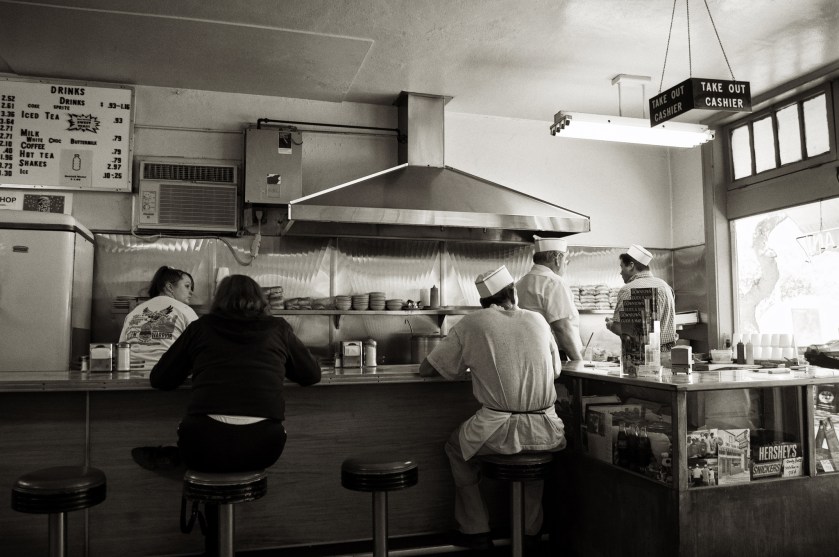
Greg Urbano’s 2011 photograph of Coney Island Grill in St. Petersburg, Florida, captures the intersection of nostalgia and contemporary life. Through careful composition and lighting, Urbano highlights the diner as a communal space. The image preserves a sense of belonging while acknowledging economic pressures facing such establishments, transforming it into a documentary elegy.

Black and white interior photograph of Coney Island Grill diner in St. Petersburg, Florida, showing customers at counter with chrome stools, cooks in white uniforms behind the counter, vintage menu board, and classic diner lighting and fixtures.
The timeless charm of Coney Island Grill in downtown St. Petersburg, Florida, 2011. This black and white photograph captures the authentic American diner experience with counter service, vintage stools, and white-uniformed cooks serving up classic hot dogs and nostalgia in this beloved St. Pete institution.

In the monochromatic stillness of this 2011 photograph, Greg Urbano captures the Coney Island Grill in downtown St. Petersburg, Florida, not as a restaurant, but as a theater of American nostalgia. The image presents a classic counter-service establishment frozen in a moment that feels simultaneously contemporary and timeless, a quality that speaks to the enduring nature of these communal spaces in American culture.

The composition demonstrates Urbano’s understanding of documentary photography’s essential paradox: how to frame the ordinary in ways that reveal its extraordinary nature. Shot with a Pentax K-x at 18mm, the wide-angle perspective encompasses the full breadth of the counter scene while maintaining intimate proximity to the subjects. The technical choices—f/5.6 at 1/40s, ISO 400—suggest available light work, resulting in the soft, natural illumination that bathes the scene in an almost ethereal quality despite the grittiness of the setting.

What commands attention is the photographer’s positioning. Urbano places the viewer among the patrons, seated at the counter alongside two customers whose backs form the photograph’s foreground. This deliberate framing creates layers of engagement: we observe not just the space, but the act of inhabiting it. The diner on the left, in a dark jacket, and the chef in white with his distinctive paper hat become characters in a narrative about place and belonging.

The tonal range of the black and white rendering amplifies the scene’s nostalgic register. Notice how the overhead hood reflects light downward onto the work surface, creating a stage-like illumination for the kitchen staff. The ribbed metal backdrop, the orderly rows of plates, the utilitarian equipment—all these elements speak to efficiency and tradition. Yet Urbano avoids romanticizing the space. The air conditioning unit, the fluorescent fixtures, the practical signage directing customers to the “TAKE OUT CASHIER”—these details ground the image in working-class reality.

The drinks menu board, visible in the upper left corner, provides cultural specificity. Iced tea, milk, hot chocolate, shakes—this is comfort food territory, unpretentious and familiar. The pricing, the handwritten additions, the weathered appearance of the signage all contribute to the sense that this establishment has served its community for years, possibly decades.

Within the context of Urbano’s Top 100 Journey, this photograph functions as documentary evidence of endangered spaces. Classic diners and grills face mounting economic pressures, often displaced by chains or upscale development. By photographing the Coney Island Grill with such careful attention to atmosphere and human presence, Urbano creates both record and elegy. The image honors the social function of these establishments—as gathering places, as democratic spaces where counter seats make everyone equal, where the transaction between server and served maintains its human dimension.

The geometry of the composition reinforces this democratic spirit. The long horizontal line of the counter, repeated in the overhead hood and service shelf, creates stability and continuity. The figures, distributed across the frame, suggest community without crowding. Even in stillness, the photograph conveys the rhythm of daily life, the quiet choreography of ordering, preparing, and serving food.

This is photography that understands place as palimpsest—layers of time, use, and memory inscribed in a single frame.

See this image on:

500px

Flickr

Alioto’s on Fisherman’s Wharf: A Study in Nocturnal Americana

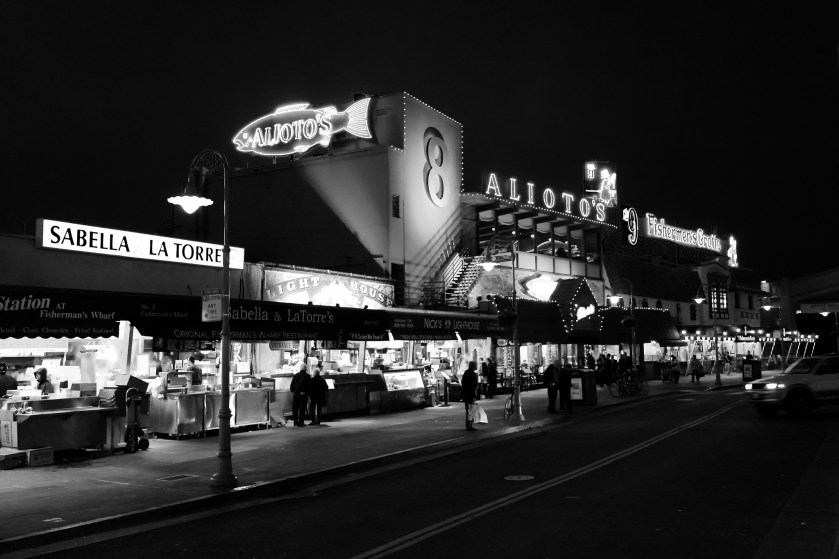
Greg Urbano’s 2010 black and white photograph of Alioto’s restaurant in San Francisco is a significant early work, capturing the intersection of technical skill and artistic vision. It explores familiar scenes through a developing photographic perspective, revealing how ordinary moments can become extraordinary. The image emphasizes light, structure, and context, marking a pivotal discovery in Urbano’s artistic journey.

Black and white night photograph of Alioto's #8 restaurant with illuminated neon signs and marquee lights on Fisherman's Wharf in San Francisco. Food vendor stalls including Sabella LaTorre line the boardwalk in the foreground, with pedestrians visible under vintage street lamps.
Alioto’s Restaurant at Fisherman’s Wharf, San Francisco – Night Photography 2010. Iconic neon signs and vintage architecture illuminate this historic seafood destination on San Francisco’s waterfront. Black and white travel photography capturing the timeless charm of Fisherman’s Wharf restaurants and food stalls.

Alioto’s on Fisherman’s Wharf: A Study in Nocturnal Americana

Greg Urbano’s 2010 photograph of Alioto’s restaurant on Fisherman’s Wharf stands as a pivotal work from Chapter One of his Top 100 Journey—a collection dedicated to early beginnings and the formative images that taught him how to see. This photograph represents more than just a vacation snapshot; it captures the moment when technical skill and artistic vision began to converge.

This image works on multiple levels simultaneously. On the surface, it presents a straightforward night photograph of a famous San Francisco landmark. But closer examination reveals a developing understanding of tonal relationships and compositional balance. The black and white treatment isn’t merely aesthetic—it’s revelatory. By stripping away color, the photographer forces viewers to see the architecture of light itself. The neon signs become sculptural elements, the illuminated storefronts transform into glowing boxes of human activity, and the darkness above presses down with an almost palpable weight.

What makes this photograph particularly significant as an early work is its democratic vision. He doesn’t attempt to elevate Alioto’s to fine art by isolating it or abstracting it beyond recognition. Instead, he presents the entire commercial ecosystem: the neighboring Sabella LaTorre sign, the smaller vendor stalls with their utilitarian lighting, the people moving through the frame as gentle blurs. This is tourism and commerce as theater, captured without cynicism or sentimentality—a mature perspective for someone still discovering their photographic voice.

The technical execution demonstrates the learning curve inherent in Chapter One. Shot with a Samsung NX100—not a professional camera by any measure—this image proves that vision was developing faster than equipment acquisition. The exposure is carefully controlled, holding detail in both the bright signage and the darker architectural elements. The vantage point shows deliberate thought: low enough to emphasize the vertical drama of the building, yet far enough back to include context. That giant illuminated fish and the number “8” become almost sculptural forms against the night sky.

As an early capture, this photograph reveals an artist already grasping something fundamental: great photographs often lie not in exotic locations but in how we see the familiar. Fisherman’s Wharf has been photographed millions of times, yet this image feels both specific and universal. It could only be this place, yet it speaks to every similar waterfront tourist district in America. This understanding—that the ordinary can become extraordinary through careful observation—marks a crucial lesson in any photographer’s development.

The inclusion of this work in the Top 100 Journey reflects its role as a foundational piece. It’s not about perfection; it’s about the spark of discovery. The photograph represents a moment when the camera revealed something the artist was only beginning to articulate—an ability to see light as structure, to recognize the poetry in commercial spaces, to trust in straightforward documentation over manipulation.

The photograph has aged beautifully, which speaks to the instincts already present in these early days. In an era of digital saturation and Instagram filters, there’s something refreshing about this honest image. It doesn’t try too hard. It simply observes, with emerging intelligence and care.

When displayed as part of Chapter One: Beginnings, this image invites viewers to consider the photographer’s journey. It rewards examination not just for its formal qualities—the geometry, the light, the tonal range—but for what it represents: a lesson learned, a moment of clarity, a step toward understanding how to translate vision into image. This is where the journey truly began.

See larger sizes of the image on these sites:

Flickr

500px