Light Paint Glass Vase: Minimalism and the Democratization of Photographic Practice

A minimalist black-and-white photograph of a glass vase showcases how simple materials can produce sophisticated visual art. Created for a structured challenge, the work emphasizes classical minimalist principles, focusing on light, form, and composition. It highlights the idea that accessible techniques can achieve impactful results through exploration and experimentation.

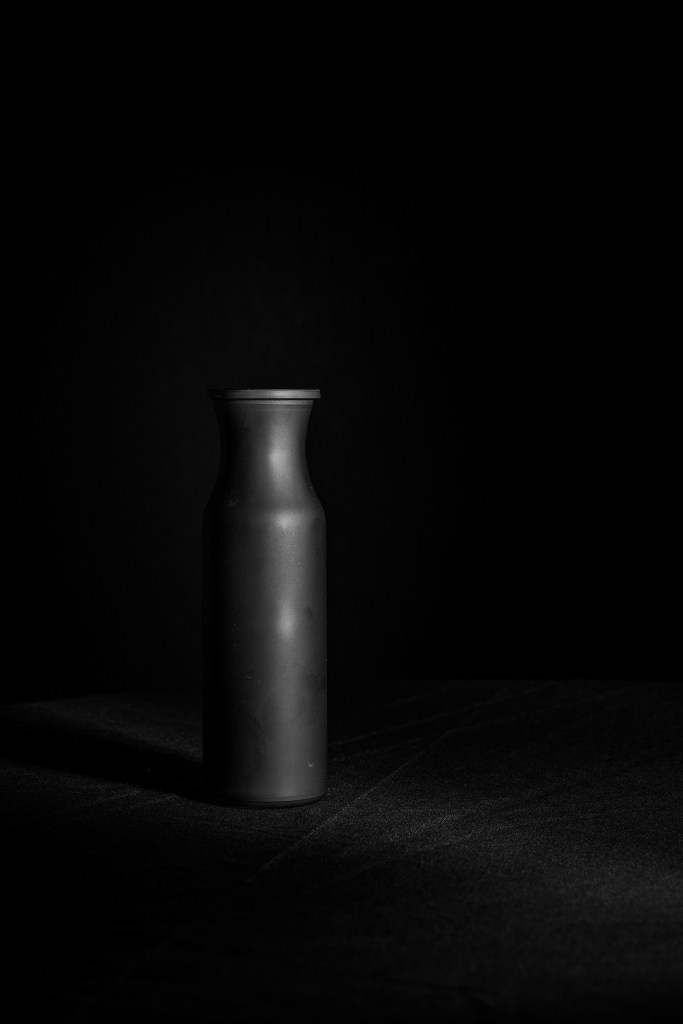
Black-and-white photograph of a single glass vase standing on a dark fabric surface, illuminated against a black background with subtle light-painted highlights.
A minimalist black-and-white study of a glass vase, photographed using light painting on a dark tabletop and background.

In this austere still life, the photographer demonstrates how constraint and accessibility can yield sophisticated visual results. Created for Week 46 of a structured challenge focused on black and white minimalism, the image features a green glass vase—rendered in monochrome—isolated against absolute darkness. The work’s genesis from dollar store materials and basic light painting techniques belies its formal accomplishment, positioning it as a compelling statement within Chapter 6’s exploration of ongoing practice and future directions.

The composition adheres to classical minimalist principles: a singular subject, centered and vertical, emerges from void. The vase’s elegant silhouette—narrow at neck and base, gently swelling through its body—receives careful illumination from a handheld flashlight, creating a gradient of tones that model the form with sculptural precision. The photographer’s light painting technique reveals selective control; highlights trace the vessel’s curve while allowing shadow to claim significant portions of the surface, suggesting volume through implication rather than complete revelation.

What distinguishes this work within the photographer’s broader trajectory is its embrace of democratic materials and process. By explicitly acknowledging the humble origins of both subject and lighting instrument, he advances a philosophy that technical sophistication need not depend on expensive equipment. This approach resonates with Chapter 6’s theme of exploration—suggesting that the road ahead involves continual experimentation with accessible means rather than escalating technical complexity.

The monochromatic treatment transforms what was originally a green glass vessel into a study of pure form and tonality. This chromatic reduction focuses attention on the interplay between light and surface, on the subtle texture variations across the vase’s body, and on the relationship between object and ground. The black tablecloth and background merge into a unified void, creating the impression that the vase floats in undefined space—a strategy borrowed from commercial and fine art photography traditions alike.

The image’s participation in a weekly challenge framework—Week 46 addressing black and white minimalism—situates the photographer’s practice within contemporary photography’s social and educational structures. Unlike the isolated studio practice of previous generations, his work emerges from dialogue with prompts, themes, and presumably a community of practitioners engaging similar constraints. This context enriches the reading of Chapter 6; the road ahead is both solitary and communal, shaped by individual vision and collective participation.

Post-processing in Adobe Camera Raw represents the final transformative stage, where the captured light painting receives refinement and intentional tonal mapping. The deep blacks exhibit rich density without blocking detail entirely, while the highlights maintain luminosity without burning out—evidence of considered digital darkroom practice.

Within the Top 100 Journey, this photograph stands as testament to fundamental photographic principles: light, form, composition, and tone. Its apparent simplicity masks deliberate choices regarding placement, illumination duration and direction, and subsequent processing decisions. The vase becomes more than household object; it transforms into a vehicle for exploring how light describes volume, how darkness defines presence, and how minimal means can generate maximal visual impact.

In embracing both constraint and accessibility, the photographer charts a sustainable path forward—one where ongoing exploration need not await perfect conditions or specialized equipment, but can unfold through disciplined attention to essential elements.
Tomatos

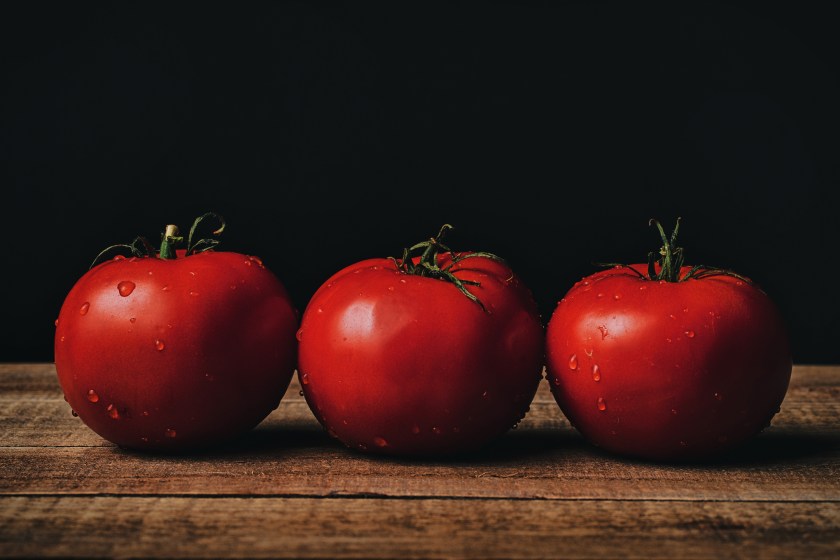
This photographic composition showcases three tomatoes on a textured wooden surface against a dark background, illustrating the themes of light and form in still life art. Using controlled lighting to create a dramatic chiaroscuro effect, the photographer emphasizes the tomatoes’ beauty, merging classical traditions with contemporary techniques.

Tabletop still life of three ripe tomatoes with water droplets on a wooden surface against a dark background.
A tabletop still life of three tomatoes arranged on a wooden surface and lit against a dark background.

In this deceptively simple composition, the photographer demonstrates how the most humble subjects—three tomatoes from a supermarket produce section—can become vehicles for exploring light, form, and the enduring traditions of still life photography. The work sits comfortably within the classical end of Chapter 5’s spectrum, channeling centuries of artistic precedent while employing decidedly contemporary tools and techniques.

The arrangement recalls Dutch Golden Age vanitas paintings, where ordinary kitchen staples were elevated to subjects of profound contemplation. Here, three ripe tomatoes rest upon a weathered wooden surface, their placement casual yet deliberate. The varying positions of their stems—pointing in different directions like botanical compasses—introduce subtle asymmetry that prevents the composition from becoming static. Water droplets cling to the glossy red skin, suggesting recent washing and adding points of light that animate the surface.

His lighting strategy proves crucial to the image’s success. Working with a single Godox V1s flash modified by a softbox and grid, he achieves remarkable control over illumination. The grid attachment narrows the light spread, creating focused illumination that emphasizes the tomatoes while allowing the background to fall into deep, theatrical darkness. This chiaroscuro effect—the dramatic interplay of light and shadow—lends gravitas to subjects that might otherwise seem merely documentary.

The wooden surface provides essential contextual grounding. Its rough texture and visible grain contrast beautifully with the smooth, taut skin of the tomatoes, creating a dialogue between refined organic form and rustic materiality. The warm tones of the aged wood complement the rich reds of the fruit, establishing a harmonious yet varied color palette that feels both earthy and sophisticated.

His post-processing approach through Skylum Luminar 4, utilizing a color LUT (Look-Up Table), demonstrates an efficient workflow that enhances rather than overwhelms the captured image. The color grading deepens the reds toward burgundy in the shadows while maintaining natural highlights, creating dimensionality that draws the eye around each form. This restrained digital intervention respects the photographic integrity of the scene while amplifying its visual impact.

Within the broader trajectory of his still life work, this image represents a return to fundamentals—a meditation on how controlled lighting and thoughtful composition can transform the everyday into the examined. Where other works in this chapter might push toward experimental territories, this photograph anchors itself in proven traditions, demonstrating that innovation need not always mean departure from established visual language.

The Sony A7ii captures these elements with clarity and subtle tonal gradation, rendering the tomatoes with sufficient detail to appreciate their imperfect spherical forms, the slight variations in color saturation, and the delicate green stems that signal recent harvest. These details matter; they prevent the image from becoming abstract or overly stylized, maintaining its connection to the tangible world.

Ultimately, this work succeeds through its quiet confidence. The photographer understands that compelling still life photography requires neither exotic subjects nor complex staging—only patient observation, technical competence, and an appreciation for how light reveals the inherent beauty in forms we too often overlook. These grocery store tomatoes, frozen in this particular moment of light and shadow, become worthy of sustained attention.

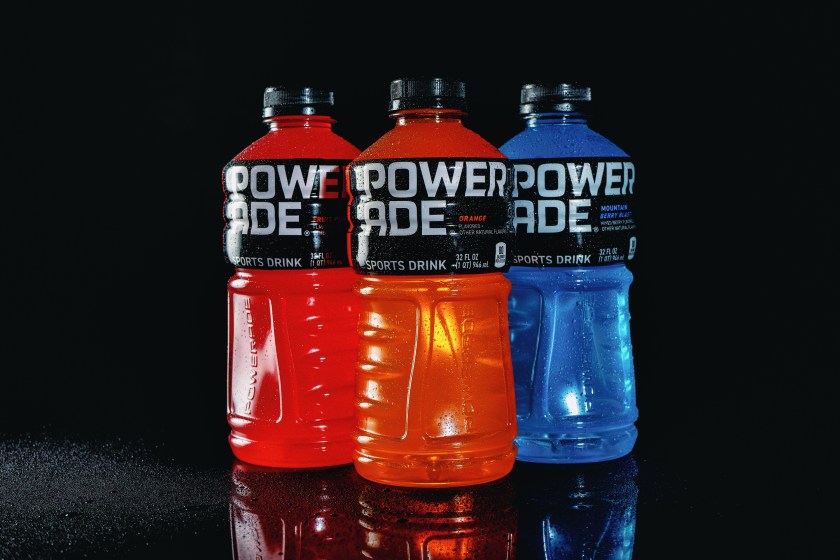
Powerade Sports Drink

The photographer’s still life study of three Powerade bottles transcends typical commercial product photography through technical mastery and thoughtful lighting. Using a classic triangular arrangement against a dark background, he elevates mundane objects into gallery-worthy art, emphasizing color and light. This work reflects his evolving confidence and duality in art and commerce.

Studio still life of three Powerade sports drink bottles in red, orange, and blue on a reflective black surface.
A studio still life of three Powerade sports drink bottles arranged on a reflective surface against a dark background.

The photographer’s exploration of commercial product photography takes an unexpectedly sophisticated turn in this meticulously composed study of three Powerade bottles. Working within the constraints of a domestic setting—his living room transformed into an improvised studio—he demonstrates how technical mastery and thoughtful lighting can elevate mundane consumer objects into subjects worthy of gallery consideration.

The composition employs a classical triangular arrangement, with the three bottles positioned against a stark black background that eliminates all contextual distraction. This deliberate void forces the viewer’s attention entirely onto the subjects themselves: the vivid red and orange bottles flanking a brilliant blue variant. The color palette recalls the saturated hues of contemporary advertising photography, yet the treatment here transcends mere product documentation. Each bottle catches and refracts light differently, creating internal luminosity that transforms the beverages into glowing, jewel-like objects.

His technical approach reveals significant evolution in his still life practice. Utilizing a Sony A7ii with a kit lens, softbox, and flash, he crafts lighting that achieves both commercial polish and artistic dimensionality. The softbox provides diffused illumination that wraps around the bottles’ curved surfaces, while strategic flash placement creates the distinctive highlights and reflections visible across each container. The condensation beading on the plastic surfaces adds textural authenticity, suggesting these are not pristine studio props but objects intercepted in their natural state—cold, recently removed from refrigeration, existing in that liminal moment between commercial packaging and consumption.

The post-processing workflow—Adobe Camera Raw within Photoshop 2018, enhanced with Nik/DXO Viveza—amplifies the inherent drama of the scene. The blacks deepen to an almost velvety darkness, while the colors intensify without crossing into oversaturation. This balance proves crucial: the image maintains photographic credibility while achieving the heightened reality that characterizes effective still life work.

Within the broader context of Chapter 5’s exploration from classic to experimental tabletop photography, this image occupies an interesting middle ground. It adheres to established commercial photography conventions—the product-forward composition, the dramatic lighting, the emphasis on color and form—yet subverts them through its gallery presentation context. Removed from their intended commercial environment and reframed as objects of aesthetic contemplation, these sports drinks become something more: symbols of contemporary consumer culture, studies in color theory and light behavior, or perhaps meditations on how photography itself mediates our relationship with everyday objects.

The work also demonstrates his growing confidence in minimal staging. Rather than elaborate props or complex narratives, he allows the bottles themselves to carry the visual weight of the image. The slight rotation of each container, the variation in liquid levels, the casual yet deliberate spacing—these subtle decisions reveal an artist increasingly comfortable trusting in restraint.

This photograph ultimately succeeds because it occupies dual territories: it could function effectively as commercial product photography while simultaneously inviting the slower, more contemplative viewing that gallery work demands. This duality, this ability to straddle commercial and fine art sensibilities, marks a significant development in his still life practice and suggests promising directions for future experimentation.

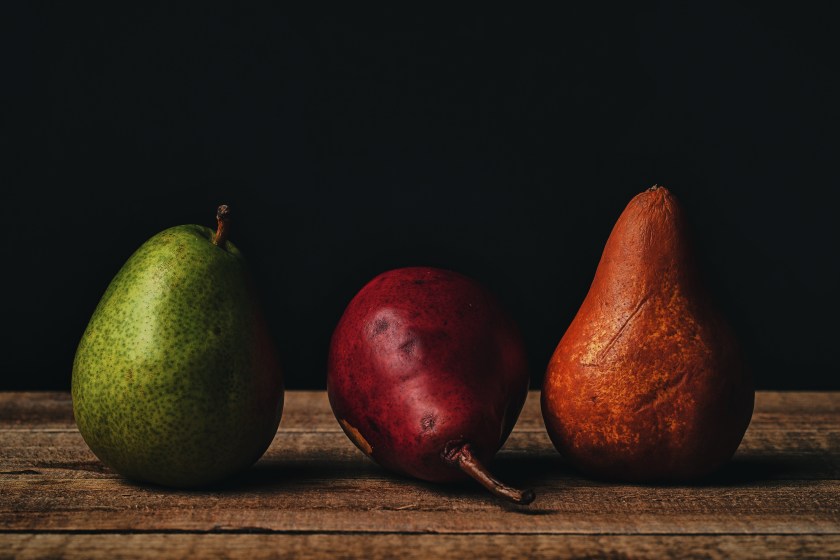
Pears: A Chromatic Triptych in Measured Light

A still life photograph features three pears, highlighting the photographer’s evolving technique in transforming everyday produce into subjects for aesthetic contemplation. Using controlled lighting and a focused composition, the work emphasizes color variation and organic authenticity. This piece bridges classic and contemporary styles, encouraging viewers to appreciate the beauty in simplicity.

Tabletop still life of three pears arranged side by side on a wooden surface against a dark background.
A tabletop still life of three pears arranged on a wooden surface and lit against a dark background.

This composition of three pears exemplifies the photographer’s evolving approach to still life, transforming quotidian supermarket produce into subjects worthy of sustained aesthetic contemplation. Arranged in strict linear progression across weathered wood, the trio presents a study in chromatic variation and volumetric form that speaks to both classical still life traditions and contemporary minimalist sensibilities.

The technical framework mirrors the controlled approach evident throughout this body of work: a single Godox V1s strobe modified by softbox and grid, captured with a Sony A7ii paired with an 85mm f/1.8 lens. This choice of focal length proves particularly significant. Unlike the wider perspectives often employed in tabletop work, the 85mm compression subtly flattens spatial relationships while maintaining separation between subjects, creating a stage-like presentation where each pear occupies its designated position with theatrical clarity.

What distinguishes this image within the chapter’s trajectory is its bold embrace of color as primary subject matter. Where the earlier onion and garlic study operated within a narrow tonal range of earth and amber, here the photographer orchestrates a chromatic progression—verdant green, deep crimson, oxidized copper—that reads almost as a color theory exercise. Yet the natural imperfections of each fruit prevent the composition from becoming merely schematic. Surface blemishes, stem variations, and subtle textural differences assert the subjects’ organic authenticity.

The lighting strategy reveals sophisticated control over shadow placement and tonal gradation. The grid attachment concentrates illumination on the subjects while allowing the background to fall into near-absolute blackness, a technique borrowed from Old Master painting that isolates forms in dramatic relief. Light wraps around each pear’s curved surface with mathematical precision, creating highlight-to-shadow transitions that define volume without resorting to harsh contrast. The wooden platform receives just enough illumination to establish spatial grounding, its grain and weathering providing textural counterpoint to the fruits’ smooth skins.

Compositional decisions demonstrate a rigorous formal intelligence. The three pears, though similar in scale, exhibit distinct silhouettes—the green pear’s upright verticality, the red pear’s compressed roundness, the copper pear’s elongated diagonal lean. This variation within repetition creates visual rhythm while avoiding monotony. The spacing between subjects appears carefully calibrated, neither crowding nor isolating, allowing each fruit to maintain individual presence while contributing to the unified whole.

Post-processing through color grading has intensified chromatic saturation while preserving naturalistic tonality. The resulting palette suggests both heightened reality and painterly intention—colors feel amplified yet believable, enhanced rather than fabricated. This balance between documentation and interpretation positions the work at a productive intersection of photographic traditions.

Within the chapter’s arc from classic to experimental approaches, this image occupies transitional territory. Its formal rigor and single-light methodology align with classical practice, yet the chromatic boldness and almost Pop Art sensibility of three isolated, colored forms hint at more conceptual concerns. The photograph demonstrates that experimentation can emerge from treating simple subjects with exacting attention rather than through technical complexity alone.

The work ultimately asks viewers to reconsider the aesthetic potential residing in everyday objects, a question central to still life practice across centuries. By isolating these supermarket pears in dramatic light and formal precision, the photographer transforms the ordinary into an opportunity for visual meditation on color, form, and the enduring power of careful observation.

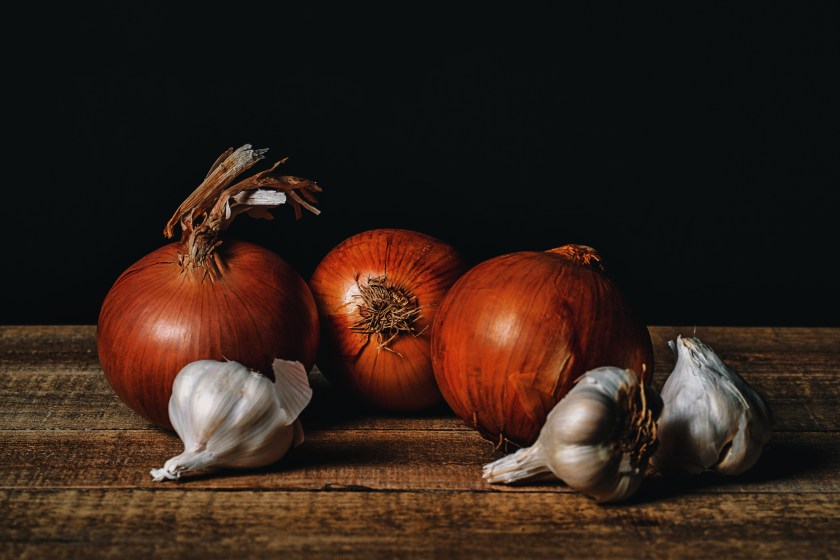
Onions and Garlic: A Study in Chiaroscuro and Culinary Stillness

The photograph captures a still life of onions and garlic on a wooden surface, showcasing classical principles through contemporary techniques. The controlled lighting and asymmetrical balance create depth, while post-processing enhances tonal richness. This artwork engages with historical traditions, revealing how ordinary subjects can convey significant meaning through careful observation and technical precision.

Tabletop still life of whole onions and garlic bulbs arranged on a wooden surface against a dark background.
A tabletop still life of onions and garlic arranged on a wooden surface and lit against a dark background.

In this deliberate composition, the photographer demonstrates a mastery of classical still life principles while working within the constraints of contemporary digital tools. The image presents three bronze-skinned onions accompanied by two heads of garlic, arranged on weathered wood against an impenetrable black void—a setup that immediately recalls the Dutch and Spanish still life traditions of the 17th century, where humble kitchen subjects were elevated to objects of contemplation.

The technical execution reveals a sophisticated understanding of light modulation. Working with a single modified light source—a Godox V1s paired with a softbox and grid—the photographer has created a tightly controlled illumination that wraps around the subjects’ curved surfaces while maintaining crisp shadow definition. The grid attachment proves essential here, preventing light spill into the background and preserving the dramatic contrast that gives the image its gravitas. This economy of means, using just one light to achieve such dimensional modeling, speaks to both practical skill and aesthetic intentionality.

What distinguishes this work within Chapter 5’s progression from classic to experimental tabletop photography is its conscious dialogue with art historical precedent. The photographer acknowledges drawing inspiration from a tutorial source, yet the resulting image transcends mere technical exercise. The onions’ papery skins catch light with a luminosity that suggests both fragility and age, their dried stalks creating gestural elements that break the otherwise spherical regularity. The garlic bulbs, positioned in the lower quadrant, provide tonal counterpoint—their pearl-white surfaces reflecting light with greater intensity than the warmer onions above.

The compositional arrangement follows classical principles of asymmetrical balance. The three onions occupy distinct spatial planes, their positioning creating depth through overlapping forms and subtle scale variation. The leftmost onion’s dramatic upward-reaching stem introduces vertical energy, while the garlic anchors the composition’s base. This triangular organization guides the viewer’s eye through the frame in a measured, contemplative rhythm appropriate to the subject matter.

Post-processing choices, implemented through color grading in Luminar 4, enhance the image’s tonal richness without sacrificing naturalism. The warm amber-to-sienna palette suggests candlelight or late afternoon sun, though the lighting setup confirms neither. This ambiguity of light source contributes to the image’s timeless quality—it could as easily have been captured in a 17th-century Dutch kitchen as in a contemporary studio.

The weathered wooden surface provides crucial textural contrast to the subjects’ organic forms. Its rough grain and worn patina introduce narrative suggestions of use and time, transforming a simple backdrop into an active compositional element. The wood’s horizontal planking creates subtle linear structure beneath the curved biological forms above.

Within the broader context of this chapter’s exploration, this photograph occupies the “classic” end of the spectrum—demonstrating that traditional approaches retain their power when executed with technical precision and compositional intelligence. The work proves that experimentation need not always mean formal rupture; sometimes it involves mining established vocabularies with fresh attention. Here, the photographer engages in a centuries-old conversation about how light reveals form, how arrangement creates meaning, and how the ordinary, when carefully observed, achieves a quiet monumentality that rewards sustained viewing.