Nocturnal Geometry: The Dalí Museum, St. Petersburg

This photograph captures the illuminated Dalí Museum in St. Petersburg, Florida, showcasing the contrast between its geodesic structure and concrete form during twilight. The image highlights Florida’s cultural evolution through art, exemplifying a balanced compositional approach that emphasizes architectural integrity and the atmosphere, marking a sophisticated chapter in the photographer’s journey.

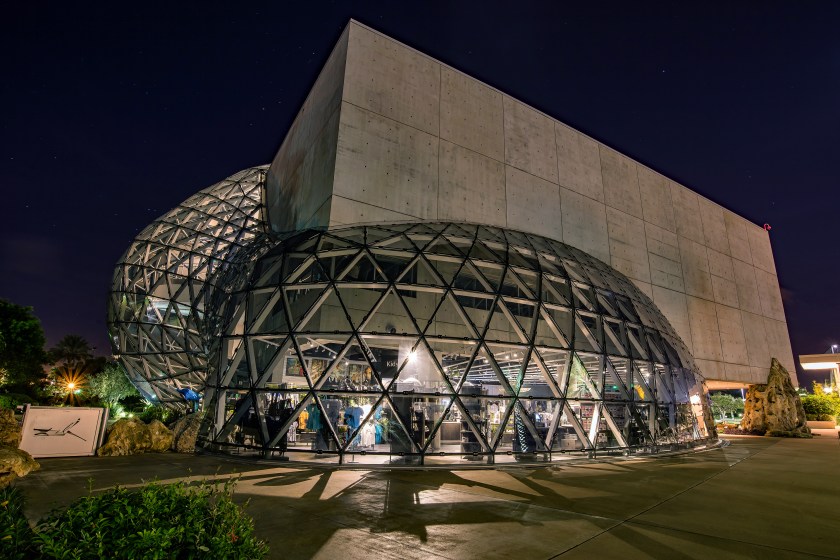
Nighttime long exposure photograph of the Dali Museum in St. Petersburg, Florida, showing its illuminated geodesic glass structure and concrete facade.
Nighttime long exposure view of the Dali Museum’s illuminated glass structure in St. Petersburg, Florida.

Within Chapter 2 of this photographic journey through Florida’s landscapes and cityscapes, this nighttime study of the Dalí Museum in St. Petersburg stands as a meditation on architectural dialogue—the convergence of structural rationality and organic form captured in the quietude of evening hours.

The photographer has positioned himself to emphasize the museum’s defining architectural gesture: the dramatic geodesic structure that emerges from the building’s otherwise austere concrete mass. Shot at 18mm, the wide-angle perspective accentuates the spherical dome’s imposing presence while maintaining the monumental quality of the adjoining concrete volume. This compositional choice creates a visual tension between geometric order and sculptural fluidity, perhaps an intentional echo of Dalí’s own artistic preoccupations with rigidity and metamorphosis.

Technical execution here demonstrates considerable deliberation. The 30-second exposure at f/11 has transformed the museum’s interior lighting into a warm, inviting glow that radiates through the triangulated framework, effectively rendering the geodesic dome as a luminous lantern against the deep blue-black sky. At ISO 250, the photographer has preserved tonal integrity in the shadows while avoiding the noise that might compromise the concrete’s textural detail—those subtle gradations and panel divisions that speak to the building’s material honesty.

The time of day proves critical to the image’s success. Shot during the transitional moment when civil twilight yields to night, enough ambient light remains in the sky to differentiate it from pure black, providing context and atmospheric depth. The surrounding landscaping, illuminated by strategic ground lighting, frames the architectural subject without competing for attention. The wet pavement in the foreground introduces specular highlights that guide the viewer’s eye toward the main structure while adding a layer of urban authenticity.

What distinguishes this photograph within the broader chapter is its representation of Florida’s cultural infrastructure rather than its natural or purely urban environment. While other images in this collection might emphasize the state’s coastal vistas or metropolitan skylines, this work acknowledges Florida’s role as a destination for arts and culture. The Dalí Museum, with its contemporary architectural interpretation housing works of surrealist mastery, becomes a symbol of Florida’s evolution beyond tourism clichés.

The photographer’s technical approach—the choice of a full-frame Nikon D610 paired with an 18-35mm lens—suggests a commitment to capturing architectural subjects with minimal distortion while maintaining portability for location work. The f/11 aperture provides sufficient depth of field to render sharp detail from the foreground plantings through to the building’s illuminated upper reaches, while the extended exposure time smooths any transient elements, creating a sense of permanence and contemplation.

In the context of the Top 100 Journey project, this image represents a maturation in the photographer’s documentation of Florida’s built environment. There is restraint here—a willingness to let the architecture speak through careful observation rather than dramatic intervention. The composition honors both the building’s geometry and its setting, creating a document that functions simultaneously as architectural photography and as a portrait of place, capturing a specific moment in Florida’s ongoing cultural narrative.
Night at the Marina: A Study in Urban Reflection

The photograph from Greg Urbano’s Top 100 Journey captures St. Petersburg’s Municipal Marina at night, showcasing a dialogue of architecture, water, and light. Through a long exposure, the image blends city and reflection, revealing duality in urban nature. Urbano’s technical choices highlight Florida’s beauty within its metropolitan context.

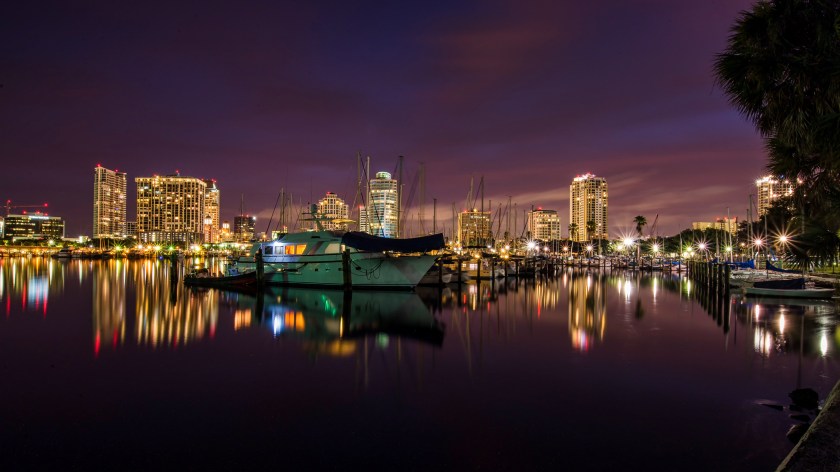
Nighttime long exposure photograph of the St. Petersburg, Florida skyline viewed from the Municipal Marina, with boats and colorful reflections on calm water.
Long exposure nighttime view of the St. Petersburg skyline from the Municipal Marina.

In this striking nocturnal composition from Chapter 2 of Greg Urbano’s Top 100 Journey, the photographer transforms St. Petersburg’s Municipal Marina into a stage where architecture, water, and light perform an intricate dialogue. Shot with a Nikon D610 at the wide end of an 18-35mm lens, the image demonstrates his evolving command of the Florida landscape—this time rendered not through the state’s iconic natural vistas, but through the geometry and luminescence of its urban waterfront.

The technical approach reveals deliberate choices that serve the image’s contemplative mood. A 150-second exposure at f/20 has allowed the photographer to capture not merely a moment but an accumulation of light and stillness. The water becomes a flawless mirror, its surface so calm that the distinction between city and reflection dissolves into symmetry. This extended duration smooths away any transient ripples, creating an almost surreal doubling effect where the marina’s vessels and the downtown skyline exist in perfect vertical equilibrium.

The color palette is equally considered. The twilight sky transitions from deep violet to warm amber along the horizon, providing a graduated backdrop that never competes with the main subject. The buildings’ golden illumination—ranging from honey tones to brilliant white—creates rhythmic vertical accents across the frame, while the marina lights introduce unexpected splashes of emerald and ruby that punctuate the composition with chromatic variety. These colored reflections stretch and shimmer in the foreground water, adding texture to what might otherwise be an overly static scene.

Compositionally, the photographer has positioned himself to maximize the reflection’s impact while maintaining architectural legibility. The yacht in the immediate foreground serves as an anchor point, its substantial form providing scale and depth to the scene. The vessel’s subtle green illumination connects it visually to the reflected lights while distinguishing it from the darker water surrounding it. Behind, the forest of masts creates a delicate counterpoint to the solid mass of the high-rises, introducing organic irregularity into an otherwise geometric composition.

What distinguishes this work within the Florida Landscapes & Cityscapes chapter is its meditation on duality—the way human development interacts with the natural world, specifically water’s capacity to both accept and transform urban light. The photographer has found in St. Petersburg’s marina a location where Florida’s maritime character persists even within its metropolitan context. The palm fronds visible at the frame’s edge remind viewers of the subtropical environment, preventing the scene from becoming generically urban.

The technical execution supports this conceptual balance. The ISO 160 setting has preserved clean shadows and prevented noise in the darker areas, while the narrow aperture has rendered sharpness from the foreground yacht to the distant towers. The starburst effects visible on some light sources—a result of the f/20 aperture—add a subtle decorative element without overwhelming the image’s naturalistic foundation.

Within his broader body of work exploring Florida’s diverse landscapes, this photograph represents an important expansion of scope. Here, the photographer demonstrates that the state’s visual poetry exists not only in its Everglades, beaches, and wetlands, but also in the moments when its cities pause and reflect—literally and figuratively—upon themselves. The result is an image that honors both the constructed and the elemental, capturing a Florida that is simultaneously modern and timeless.

Electric Sublime: Atmospheric Drama Over Tampa Bay

The image of a lightning strike over Tampa Bay, captured from Vinoy Park, showcases the photographer’s skill in storm photography. Using a Nikon D610, the thirty-second exposure reveals a dramatic interplay of colors and natural forces. This work highlights Florida’s weather patterns, merging urban and natural landscapes in a powerful visual narrative.

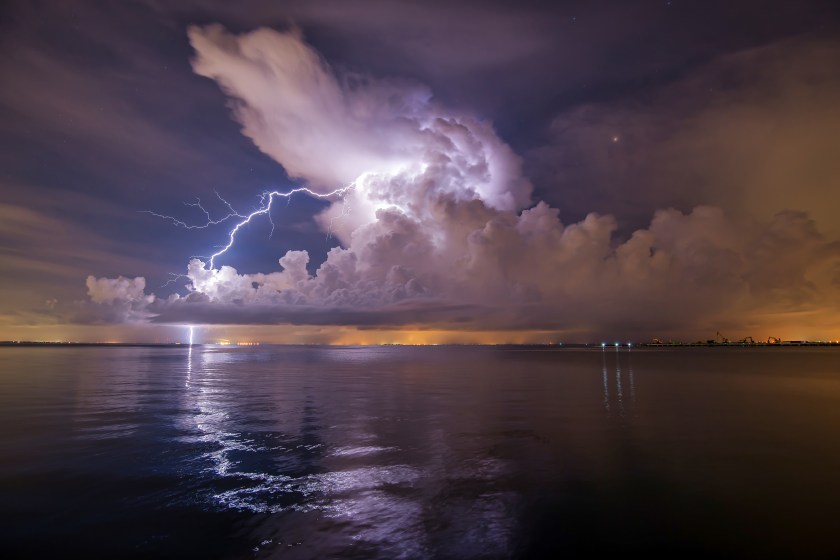
Long exposure photograph of lightning illuminating clouds over Tampa Bay, viewed from Vinoy Park in St. Petersburg, Florida.
Long exposure lightning strike over Tampa Bay from Vinoy Park.

Among the most technically demanding and visually arresting images in Chapter 2 of the photographer’s Top 100 Journey, this capture of a lightning strike over Tampa Bay represents a masterful convergence of patience, preparation, and meteorological fortune. Photographed from Vinoy Park in St. Petersburg, the image transforms a transient weather event into a sustained meditation on nature’s raw power and the atmospheric spectacle that defines Florida’s subtropical climate.

The composition presents a study in horizontal stratification—water, distant shoreline, and sky arranged in classical landscape proportions, yet animated by the extraordinary electrical discharge that commands the frame’s center. A single lightning bolt descends vertically through towering cumulonimbus clouds, creating a luminous column that connects the charged atmosphere to the bay’s surface. The strike illuminates the cloud structure from within, revealing billowing formations in shades of pearl, lavender, and steel blue against a gradient sky that transitions from deep indigo to warm amber.

Technical execution reflects the specialized demands of storm photography. Working with a Nikon D610 at the wide end of an 18-35mm lens, the photographer selected an 18mm focal length to encompass both the expansive cloud system and the reflective water below. The thirty-second exposure at f/5.6 and ISO 400 represents a calculated approach to lightning capture—a long enough duration to increase the probability of recording a strike within the frame, yet controlled enough to prevent overexposure of ambient light sources visible along the distant horizon. This extended shutter speed also smooths the bay’s surface into a mirror-like plane, its subtle texture suggesting gentle motion while maintaining enough definition to anchor the composition.

The color palette distinguishes this work within the chapter’s broader collection. Where the architectural study of Signature Place employed monochrome austerity, this image embraces the full chromatic range of atmospheric phenomena. The storm cell’s cool blues and purples contrast with the warm ochre glow infiltrating from the right edge of the frame—likely light pollution from Tampa’s urban corridor or residual sunset illumination scattered through distant clouds. This interplay of cool and warm tones creates visual tension that enhances the image’s dramatic impact without resorting to artificial enhancement.

Within Chapter 2’s exploration of Florida Landscapes & Cityscapes, this photograph occupies essential territory. Florida’s identity remains inextricably linked to its volatile weather patterns—the daily thunderstorm cycles of summer, the atmospheric electricity that makes the state the lightning capital of North America. By documenting this phenomenon, the photographer engages with environmental storytelling that moves beyond picturesque representation toward a more complete portrait of place.

The work also demonstrates sophisticated understanding of the sublime in contemporary landscape photography. The tradition of depicting nature’s awesome power—from nineteenth-century Romantic painters to mid-century photographers like Ansel Adams capturing Sierra storms—finds fresh expression here. The lightning strike serves as both subject and metaphor: a literal discharge of atmospheric energy and a symbolic representation of nature’s capacity to humble human observers.

Viewed alongside the chapter’s urban architectural studies, this image provides necessary balance. Together, these photographs suggest a photographer equally attentive to built and natural environments, capable of finding visual poetry in glass towers and electrical storms alike. Such range indicates a mature artistic vision—one that recognizes Florida’s complexity as both a site of intensive human development and a landscape still subject to forces beyond human control.

Vertical Ascension: Modernist Form in Downtown St. Petersburg

The black and white photograph of the Signature Place high-rise in St. Petersburg captures its architectural monumentality through a minimalist lens. Stripping color emphasizes form and texture, while a dynamic composition highlights urban development. The work reflects the photographer’s evolving vision, merging documentary and artistic interpretation within contemporary architectural photography.

Black and white low‑angle photograph of the Signature Place condominium tower in downtown St. Petersburg, Florida, showing strong geometric lines and modern architecture.
Black and white architectural study of the Signature Place high‑rise in downtown St. Petersburg.

In this striking image from Chapter 2 of the photographer’s Top 100 Journey, the Signature Place Condominium tower emerges as a study in architectural monumentality and photographic restraint. Shot in downtown St. Petersburg, Florida, the photograph transforms a contemporary residential structure into something both documentary and abstract—a meditation on verticality, light, and the geometric language of modern urban development.

The decision to render this scene in black and white proves essential to the image’s success. By stripping away color, the photographer directs attention to the fundamental elements of architectural photography: form, texture, and tonal gradation. The building’s repetitive window pattern creates a rhythmic grid that draws the eye upward, while the dramatic contrast between the illuminated facade and the darkening sky suggests a specific moment of transition—likely the golden hour, when natural light rakes across surfaces to reveal dimension and depth.

Technical execution demonstrates thoughtful consideration of both optics and exposure. Working at 35mm on an 18-35mm lens mounted to a full-frame Nikon D610, he selected a narrow aperture of f/18 to maximize depth of field and ensure crisp detail throughout the frame. The resulting sharpness allows the viewer to appreciate the building’s material qualities—the interplay of glass, concrete, and steel that defines contemporary high-rise construction. A shutter speed of 1/8 second at ISO 100 suggests the use of a tripod, essential for maintaining clarity at this exposure length while preserving clean shadow detail.

The composition employs a low vantage point that accentuates the tower’s dramatic thrust skyward. This perspective, common in architectural photography but executed here with particular effectiveness, creates a sense of imposing scale while maintaining architectural integrity. The building’s angular crown punctures the upper portion of the frame, while a lower podium structure grounds the composition and provides contextual anchoring in the urban landscape.

Within the broader framework of Chapter 2—Florida Landscapes & Cityscapes—this photograph represents an important counterpoint to the state’s more commonly photographed natural environments. Rather than beaches, wetlands, or subtropical flora, the photographer turns his lens toward Florida’s built environment, acknowledging the contemporary reality of rapid urban development along the Gulf Coast. St. Petersburg’s downtown skyline, transformed dramatically over recent decades, serves as a compelling subject for examining how modern architecture reshapes regional identity.

The image also speaks to the photographer’s evolving vision throughout the Top 100 Journey. Where other selections might emphasize natural wonder or environmental preservation, this work demonstrates equal comfort with urban subject matter. The modernist aesthetic—clean lines, geometric precision, monochromatic palette—suggests an appreciation for architectural form as a legitimate subject for serious photographic inquiry.

What elevates this photograph beyond mere documentation is its atmospheric quality. The graduated sky, rendered in smooth tones from deep black to luminous gray, provides a canvas against which the building performs. The partially visible vegetation at the frame’s base hints at the subtropical context without overwhelming the primary subject. This careful balance between architectural documentation and artistic interpretation positions the work within a tradition extending from early twentieth-century modernist photography through contemporary fine art practice—a lineage that recognizes buildings not merely as structures to be recorded, but as forms to be interpreted.

Night at the Dali: Architecture as Teacher

In 2013, Greg Urbano’s photography evolved, particularly with architecture and HDR techniques. His night photograph of the Dalí Museum in St. Petersburg showcases his technical growth and artistic maturity. Through careful exposure settings and HDR processing, he captures dramatic contrasts, reflecting his continuous exploration and adaptability in night photography.

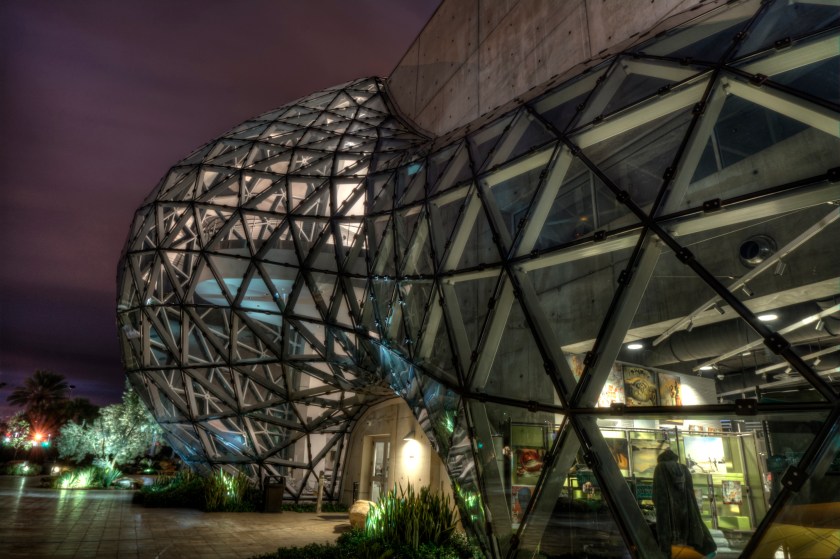
HDR nighttime photograph of the Dali Museum in St. Petersburg, Florida, showing its illuminated geodesic glass facade and surrounding landscaping, taken with a Nikon D7100 at 14mm.
A 2013 HDR nighttime photograph of the Dali Museum’s geodesic glass structure in St. Petersburg, Florida.

In this 2013 photograph of St. Petersburg’s Dalí Museum, Greg Urbano captures far more than an architectural landmark—he documents a photographer in the act of discovery, using his camera to decode the visual language of light, structure, and time. The image stands as a testament to what the Chapter 1 — Beginnings theme celebrates: the transformative power of experimentation and the artistic maturity that emerges from technical curiosity.

The composition immediately announces ambition. Shot with a 14mm ultra-wide lens, the perspective tilts upward to embrace the museum’s extraordinary geodesic glass bubble, that surrealist flourish erupting from an otherwise rectilinear concrete structure. The ultra-wide focal length creates dramatic spatial distortion—the glass sphere appears to swell toward the viewer while the building’s mass recedes at impossible angles. This is deliberate visual exaggeration, the photographer using optical characteristics as expressive tools rather than merely recording what stands before him.

Urbano’s fifteen-second exposure at ƒ/11 reveals careful consideration of night photography’s particular demands. The narrow aperture ensures front-to-back sharpness across the complex geometric planes, while the extended shutter speed gathers sufficient light to render both the illuminated interior spaces and the textured concrete exterior. At ISO 250, he maintained image quality while managing the sensor’s heat buildup during long exposures—a technical balancing act that night photography ruthlessly exposes when miscalculated.

The HDR processing, which Urbano identifies as a focus of his 2013 work, serves the subject’s inherent drama without overwhelming it. High Dynamic Range imaging compresses the vast tonal range between the glowing glass panels and the deep purple-gray twilight sky into a single viewable image. Here, the technique preserves detail in both the brightest interior lights and the shadowed architectural framework—the black steel triangles that form the geodesic pattern remain visible and textured rather than silhouetted into flat darkness.

What distinguishes this image within the Beginnings chapter is its transparency about process. The HDR treatment shows characteristic traces of learning—slight luminous halos around high-contrast edges, enhanced local contrast that gives surfaces an almost tactile presence, color saturation pushed just beyond naturalism. These are not flaws but evidence of active experimentation, a photographer testing the boundaries of technique to understand where effectiveness ends and excess begins.

The photograph’s context enriches its meaning considerably. This museum stood a brief walk from the photographer’s residence, close enough for repeated visits, for returning under different conditions, for the kind of sustained engagement that transforms casual documentation into genuine study. This proximity allowed Urbano to approach the subject with evolving sophistication, each attempt building on lessons from the previous one.

The wet pavement in the foreground adds an unexpected grace note—evidence of recent rain creating reflective surfaces that double the architectural lighting, adding visual complexity without cluttering the composition. Whether intentional or opportunistic, this detail demonstrates the photographer’s developing awareness of how environmental conditions can enhance rather than merely complicate a scene.

Viewed within the arc of artistic development, this photograph captures a crucial transition point: technical capability catching up with visual ambition, the gap between conception and execution narrowing with each frame. It is the work of a photographer actively becoming, embracing complexity as the necessary path toward mastery.