Anne-Elise

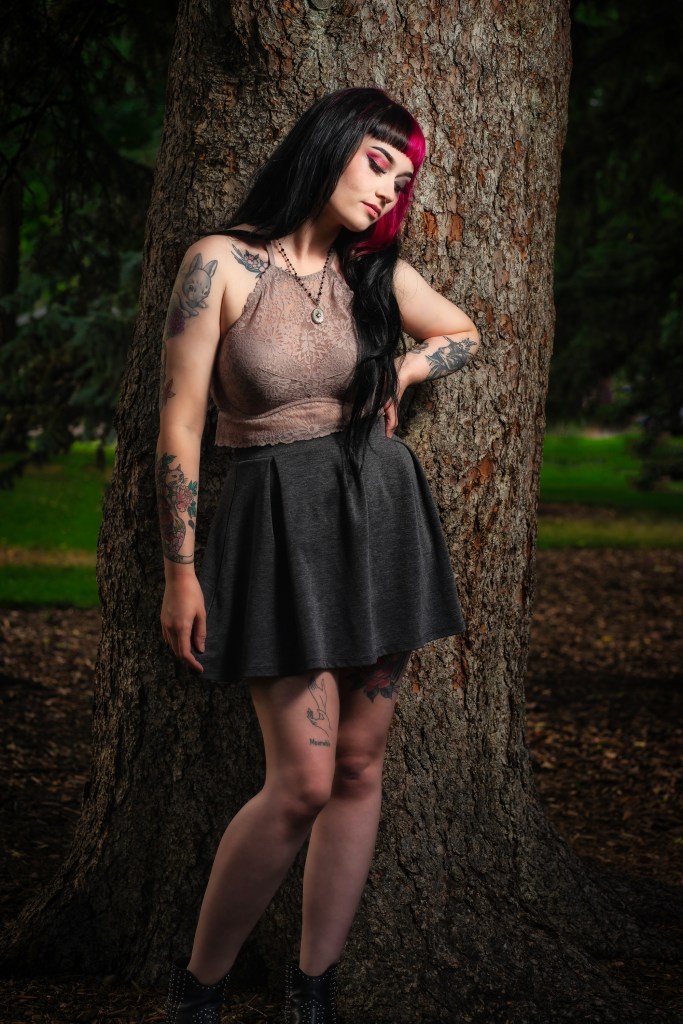
The portrait of Anne-Elise Chapman in City Park, Fort Collins, highlights the photographer’s skill in blending environmental portraiture with studio techniques. Utilizing careful lighting and composition, the image captures contrasts between natural and contemporary elements. The strategic use of color and texture enriches the narrative, showcasing technical excellence and artistic vision.

Woman with long dark hair and visible tattoos leaning against a large tree in a park, eyes closed, wearing a sleeveless top and skirt.
Anne-Elise Chapman stands against a tree in City Park, Fort Collins, Colorado.

This portrait exemplifies the photographer’s nuanced approach to environmental portraiture, where natural settings are transformed into outdoor studios through strategic lighting and compositional choices. Photographed in City Park, Fort Collins, the image presents the subject leaning against the textured bark of a mature tree, her contemplative pose and distinctive styling creating a study in contrasts between the organic and the contemporary, the natural and the cultivated.

The technical foundation reveals a methodical approach to outdoor flash photography. Working with a Sony A7ii and the respected 85mm f/1.8 lens—a classic portrait focal length that provides flattering perspective and subject isolation—the photographer employed a Godox V1s flash modified with a shoot-through umbrella. This diffusion choice proves critical to the image’s success. The softened light wraps around the subject’s features and form, preventing the harsh shadows that plague poorly executed outdoor flash work while maintaining directionality that provides dimension and depth. The lighting appears to originate from camera left, creating subtle modeling across the face and body that complements rather than competes with the ambient forest light.

The compositional structure demonstrates careful consideration of both subject and environment. The tree trunk functions as more than backdrop; it becomes an active element in the visual narrative, its rough, organic texture providing counterpoint to the smooth skin and fabric surfaces. The subject’s positioning—slightly offset from center, body angled, one hand resting naturally against the bark—creates a relaxed asymmetry that invites extended viewing. The visible tattoos become graphic elements within the composition, their dark forms echoing the patterns in the tree bark and adding layers of personal narrative to the environmental context.

Color relationships within the frame merit attention. The earthy tones of the subject’s outfit—muted rose and deep charcoal—harmonize with the brown and gray palette of the bark while maintaining sufficient contrast to ensure separation. The vivid magenta accent in the hair provides a calculated color note that draws the eye upward to the face, where the complementary makeup palette reinforces this focal point. The defocused green background, rendered as soft bokeh by the 85mm lens at apparent wide aperture, provides color balance without competing for attention.

Within Chapter 4’s exploration of portrait methodologies, this photograph demonstrates the photographer’s ability to translate studio lighting principles into outdoor contexts. The controlled light quality typically associated with indoor work here interacts with natural ambient illumination, creating a hybrid aesthetic that benefits from both approaches. The umbrella modification prevents the artificial quality that often characterizes outdoor flash photography, instead producing a luminosity that feels organic to the wooded setting while maintaining the precise control necessary for professional portraiture.

The post-processing in Luminar 4 enhances the image’s tonal sophistication without sacrificing naturalism. Skin tones remain truthful, the detail in both highlights and shadows suggests careful attention to dynamic range, and the overall color grading supports the slightly cinematic quality of the final image. There’s a refinement present that indicates maturity in the photographer’s workflow—the recognition that technical excellence serves artistic vision rather than existing as an end unto itself.

This portrait represents a convergence of skills developed across multiple photographic disciplines: the lighting control of studio work, the adaptability required for location shooting, and the interpersonal dynamics essential to capturing authentic moments within directed sessions.
Mike Groth: Classical Studio Portraiture and the Language of Formality

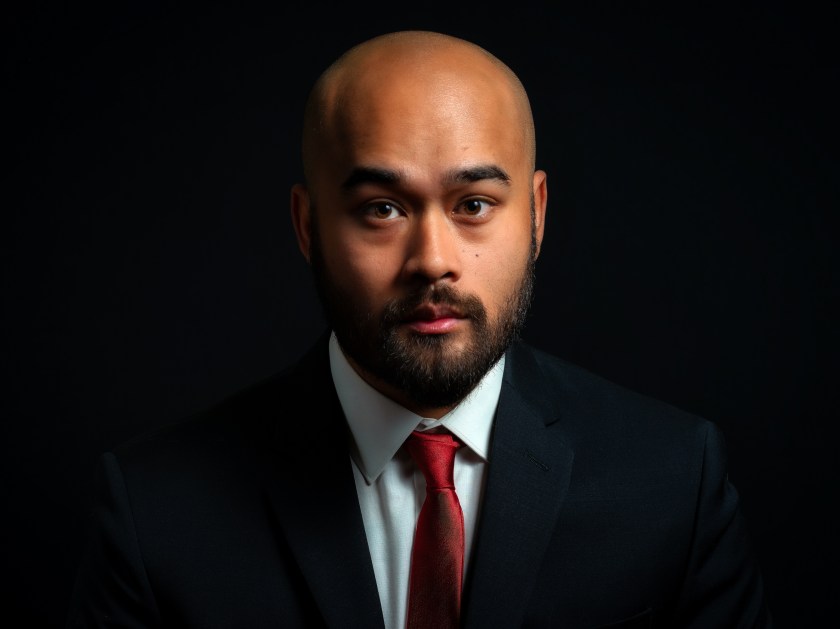
Mike Groth’s studio portrait, featured in Chapter 4 of the Top 100 Journey, exemplifies traditional portraiture through controlled lighting and composition. Shot at Old Town Yoga Studio, the image focuses on character and presence, utilizing a classic backdrop and professional techniques. Its formal simplicity highlights the subject’s confidence, making it versatile across various contexts.

Bald man with a beard wearing a suit and red tie looks directly at the camera against a black background.
Mike Groth is photographed in a studio portrait at Old Town Yoga Studio in Fort Collins, Colorado.

Within Chapter 4 of the photographer’s Top 100 Journey, this portrait of Mike Groth represents a return to the foundational principles of studio portraiture—controlled lighting, deliberate composition, and the timeless formality of traditional headshot aesthetics. Shot at the Old Town Yoga Studio in Fort Collins, Colorado, the image demonstrates the photographer’s facility with classic studio techniques while exploring the psychological dimensions of formal masculine presentation.

The technical execution adheres to established conventions of corporate and editorial portraiture. Utilizing a Sony A7ii with an 85mm f/1.8 lens, the photographer has positioned his subject against a pure black backdrop, eliminating all environmental context to focus entirely on character and presence. A Godox V1s flash paired with a shoot-through umbrella provides the primary illumination—a traditional modifier choice that produces soft, diffused light with gentle shadow gradation across the subject’s features. This approach creates dimensional modeling without the harsh contrast of direct flash, revealing the contours of the face while maintaining a polished, professional quality.

The composition centers the subject in a classical three-quarter view, shoulders angled slightly to create visual interest while the face turns toward the camera. This positioning—neither fully frontal nor profile—has been a cornerstone of portraiture since the Renaissance, offering both dimensionality and direct engagement. The subject’s formal attire—dark suit, white shirt, burgundy tie—reinforces the traditional corporate aesthetic, while his neutral expression and direct gaze suggest confidence tempered with approachability.

What distinguishes this work within the photographer’s broader practice is its embrace of restraint. Where other images in Chapter 4 explore environmental integration and spontaneous moments, this portrait strips away context to examine how lighting, posture, and expression alone can convey character. The black void backdrop functions not merely as a neutral background but as an active element, creating psychological weight and directing all attention to the subtle details: the catch lights in the eyes, the texture of facial hair, the precise fall of shadow along the jawline.

The post-processing in Luminar 4 maintains the studio’s carefully controlled atmosphere. Skin tones are rendered with natural warmth while preserving texture and detail. The lighting reveals itself as directional yet forgiving, highlighting the subject’s facial structure without creating unflattering shadows. This balance between revelation and flattery characterizes effective professional portraiture—honest without being harsh, polished without appearing artificial.

Within the context of Chapter 4’s mission to document studio, outdoor, and workshop methodologies, this image anchors the studio component with particular authority. It demonstrates that contemporary portrait photography need not abandon classical techniques in pursuit of innovation. The photographer’s choice to work within established conventions reflects an understanding that certain approaches endure precisely because they succeed in their essential task: revealing the subject’s presence and character with clarity and dignity.

The formal simplicity of this portrait allows it to function across multiple contexts—editorial, corporate, archival. This versatility speaks to the photographer’s understanding of portraiture not merely as artistic expression but as functional communication. As part of the Top 100 Journey, the image represents a technical benchmark, showcasing the fundamental competencies upon which more experimental work can build. It is portraiture in its most distilled form: light, subject, and the photographer’s ability to orchestrate their interaction with precision and purpose.

Hidden Valley Hike: A Study in Atmospheric Depth and Winter Quietude

The photograph from Hidden Valley in Rocky Mountain National Park captures a snow-covered trail among dense trees, showcasing Greg Urbano’s skill in monochromatic winter photography. Emphasizing subtlety over grandeur, it conveys solitude and wilderness through careful composition and tonal restraint, highlighting ecological specifics and the beauty of intimate landscapes.

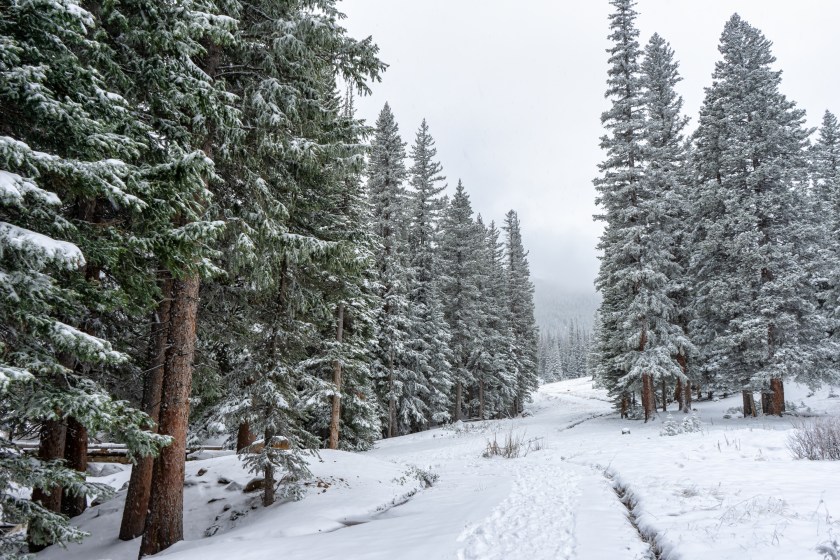
Snow-covered hiking trail winding through evergreen forest at Hidden Valley in Rocky Mountain National Park.
A snowy trail leads through dense evergreen trees at Hidden Valley in Rocky Mountain National Park, Colorado.

Within Chapter 3 of Greg Urbano’s Top 100 Journey—devoted to Colorado Landscapes & Cityscapes—this photograph from Hidden Valley in Rocky Mountain National Park represents a masterful engagement with the challenges of monochromatic winter photography. The image captures a snow-laden trail ascending through dense coniferous forest, where atmospheric conditions have reduced the distant peaks to mere suggestions within a veil of falling snow and fog.

The photographer’s compositional strategy reveals a sophisticated understanding of visual hierarchy. The trail itself functions as both literal and metaphorical pathway, drawing the viewer’s eye from the textured foreground snow through the middle ground’s architectural arrangement of pines and firs, before dissolving into the atmospheric void of the background. This recession creates a palpable sense of depth despite the flattening effect that overcast winter light typically imposes on landscape photography.

What distinguishes this work within Urbano’s broader Colorado portfolio is its restraint. Rather than pursuing the dramatic vistas and saturated alpine glow that characterize much Rocky Mountain photography, he has chosen to document a moment of visual subtlety—a soft, nearly monochromatic palette punctuated only by the warm sienna of exposed tree bark. The decision to work within such a limited tonal range demonstrates confidence in form and composition rather than relying on chromatic spectacle.

The technical execution merits particular attention. The photographer has maintained remarkable detail in the snow-weighted evergreen boughs while preserving the delicate gradation of gray tones that define the misty background. This balance suggests careful exposure management in conditions that would challenge most practitioners—the high reflectivity of fresh snow against dark timber, compounded by active precipitation and low contrast lighting.

From a thematic perspective, this photograph speaks to the contemplative dimension of Urbano’s landscape practice. The absence of human figures—save for the implicit presence suggested by the trail itself—invites meditation on solitude and the experience of wilderness in its less hospitable moments. This is not the Colorado of tourism brochures, but rather an intimate encounter with the state’s winter reality, where beauty reveals itself through subtlety rather than grandeur.

The image also functions as documentation of a specific ecological zone within Rocky Mountain National Park. The mixed conifer forest, dominated by what appear to be Engelmann spruce and subalpine fir, places the photograph within the park’s upper montane and subalpine life zones. The photographer’s attention to these botanical particulars grounds the work in a specific geographic and ecological context, elevating it beyond generic winter scenery.

Within the arc of the Top 100 Journey project, this photograph demonstrates stylistic evolution—a willingness to embrace quieter moments alongside more conventionally dramatic subjects. It suggests that Urbano’s curatorial eye has matured toward valuing atmospheric mood and compositional sophistication over spectacular subject matter alone.

The final consideration is one of timing and patience. Winter photography in Rocky Mountain National Park demands both technical preparation and willingness to work in physically demanding conditions. That this image exists at all speaks to the photographer’s commitment to documenting the full range of Colorado’s landscape character, not merely its most accessible or comfortable manifestations. The result is a work that rewards sustained attention, revealing its carefully calibrated tonal relationships and spatial complexities gradually, much like the trail itself emerging from and dissolving into winter’s embrace.