Redington Long Pier Sunset

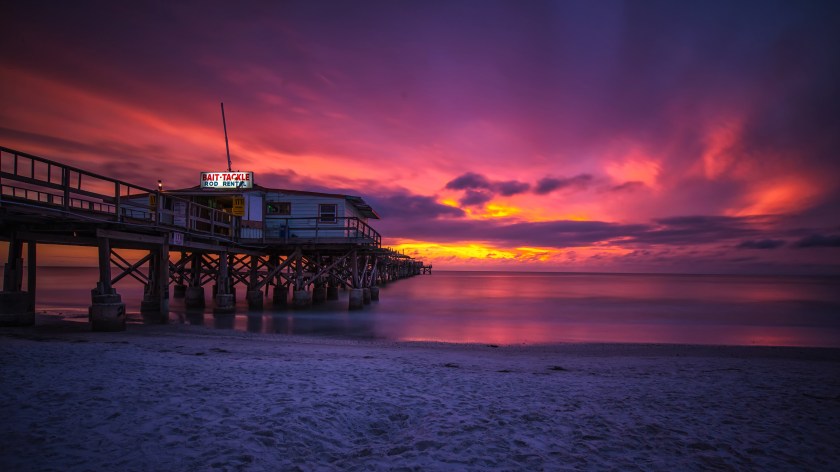
The photograph of Redington Long Pier at sunset highlights the interplay between Florida’s coastal architecture and natural beauty. Captured with a long exposure technique, it merges structure and color, showcasing the significance of humble elements like a bait shop sign. This image advocates for a broader definition of landscape photography, embracing authenticity over idealization.

Long exposure photograph of the Redington Long Pier on Redington Beach, Florida, taken after sunset with vivid sky colors and calm reflective water.
Long exposure sunset view of the Redington Long Pier on Redington Beach.

The photographer’s approach to Florida’s coastal architecture reveals itself most compellingly in this extended exposure from Redington Beach, where a humble fishing pier becomes a study in structural grace against an incandescent sky. Captured on a Nikon D610 with an 18-35mm lens set to its widest focal length, the thirty-second exposure at f/8.0 transforms the Gulf of Mexico into liquid silk, while the pier’s weathered geometry provides essential counterpoint to the sky’s theatrical display.

What distinguishes this image within the Florida Landscapes & Cityscapes chapter is its subtle negotiation between the vernacular and the sublime. The “Bait·Tackle Rod Rental” sign—a modest beacon of commercial utility—anchors the composition with an authenticity that elevates rather than diminishes the scene’s natural grandeur. This juxtaposition speaks to the photographer’s evolving understanding of Florida’s coastal identity, where working piers and rental shacks exist not as intrusions upon beauty but as integral components of it.

The technical execution demonstrates considerable restraint. The eighteen-millimeter perspective captures the pier’s diagonal recession into the frame while maintaining clarity in the structural cross-bracing beneath the deck. The thirty-second exposure, calibrated to ISO 200, achieves that liminal smoothness in the water without sacrificing detail in the sky’s stratified clouds. The photographer has timed his capture for that brief window after sunset when the western horizon blazes with residual light while the zenith deepens toward purple—a moment lasting perhaps ten minutes when the dynamic range compresses just enough for a single exposure to hold both fire and shadow.

Color becomes the image’s primary language. The gradient from molten gold through crimson to violet speaks to the atmospheric conditions particular to Gulf Coast evenings, where humidity and marine air create these saturated transitions. The pier itself, rendered in silhouette, serves as a tonal anchor that prevents the composition from dissolving into pure chromaticism. The photographer’s choice to shoot into this gradient, rather than capturing the pier against a uniformly lit sky, reveals an understanding of how structure and color can modulate one another.

Within the broader trajectory of this chapter, the image represents a maturation of approach. Where earlier Florida work might have privileged either the natural landscape or the built environment, this photograph insists they cannot be separated. The pier extends from beach to horizon as a human gesture toward the infinite, its pilings disappearing into softened water that suggests both permanence and impermanence. The long exposure technique—a methodology that appears repeatedly throughout his landscape work—here serves not merely as technical flourish but as philosophical statement about time’s accumulation within a single frame.

The composition’s formal elegance belies its democratic subject matter. This is not a pristine wilderness or an architectural landmark, but a working-class fishing pier on a stretch of developed coastline. By rendering it with such visual authority, the photographer argues for an expanded definition of landscape photography—one that acknowledges Florida’s actual character rather than retreating to fantasies of unspoiled nature. The sunset may be spectacular, but it is the bait shop sign, glowing like a minor constellation above the water, that makes this image distinctly Floridian, distinctly true

See this image on:

Flickr

500px

The Gateway Image: Passagrille Jetty Silhouette and the Dawn of a Photographic Vision

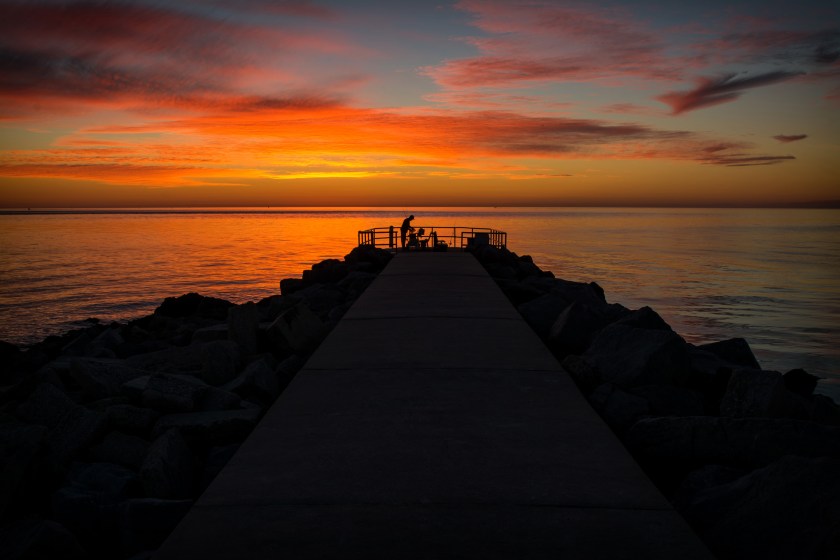
In a 2014 photograph taken at Passagrille Beach, Greg Urbano captures a stunning sunset over the Gulf of Mexico, which inspires his beach photography. Featuring a silhouetted fisherman against an orange sky, the image combines technical skill and emotional depth, symbolizing Urbano’s artistic journey and his evolving relationship with landscape imagery.

Silhouette of a lone fisherman standing on a rock jetty at Passagrille Beach during an orange Gulf of Mexico sunset, photographed with a Nikon D7100 at 24mm.
A 2014 sunset silhouette of a fisherman on the rock jetty at Passagrille Beach, Florida.

In the context of Greg Urbano’s “Beginnings” chapter, this 2014 sunset photograph from Passagrille Beach holds particular significance—not merely as a technically accomplished image, but as a foundational moment that would shape the photographer’s artistic trajectory for years to come. The image captures that precise intersection where technical competence meets emotional resonance, creating what Urbano himself identifies as his “inspiration for years of beach photography.”

The compositional structure reveals a photographer already thinking in strong geometric terms. The jetty’s dark pathway cuts through the frame with striking linearity, creating a powerful visual corridor that draws the viewer’s eye toward the observation platform at the terminus. This use of leading lines demonstrates sophisticated spatial awareness, transforming the rocky breakwater into a narrative device—a journey into the sublime moment captured in the sky above.

What distinguishes this photograph from countless other sunset images is Urbano’s commitment to silhouette as an artistic choice. Shot at ƒ/11 with a relatively slow shutter speed of 1/20 second at ISO 100, the exposure prioritizes the spectacular gradation of color in the sky while allowing the foreground elements to fall into deep shadow. The lone fisherman—barely discernible yet unmistakably present—becomes an everyman figure, a contemplative sentinel witnessing the day’s transition. This human element, reduced to pure form, prevents the image from becoming merely a spectacular sky study; instead, it grounds the natural drama in human experience.

The technical execution warrants examination. Using the Nikon D7100 with a 10-24mm lens at its maximum 24mm focal length, Urbano captures an expansive view that encompasses both the architectural elements of the jetty and the full breadth of the atmospheric display. The cropped sensor’s field of view provides enough width to establish context while maintaining focus on the central narrative. The aperture choice of ƒ/11 ensures sharpness throughout the frame, from the textured rocks in the immediate foreground to the distant horizon where sea meets sky.

The color palette—ranging from deep oranges and burning yellows to subtle purples and grays in the cloud formations—displays nature at its most theatrical. Yet Urbano’s restraint in post-processing (evident in the natural tonal transitions) allows the scene to speak with authenticity rather than hyperbole. This restraint would become a hallmark of his approach, distinguishing his work from the over-saturated aesthetic that dominates much contemporary landscape photography.

Perhaps most revealing is Urbano’s own reflection on this image as inspirational—a north star that guided subsequent explorations. One can trace forward from this moment to understand his ongoing fascination with the Gulf Coast’s theatrical sunsets, his appreciation for human elements within natural landscapes, and his sophisticated use of silhouette as a storytelling device. The photograph represents not an endpoint but a beginning, a discovery of visual vocabulary that would be refined and expanded throughout his career.

In the broader context of the “Beginnings” chapter, this Passagrille jetty image serves as both literal and metaphorical gateway—the concrete walkway leading toward beauty, the artist’s path toward photographic maturity, and the viewer’s invitation into Urbano’s evolving body of work.