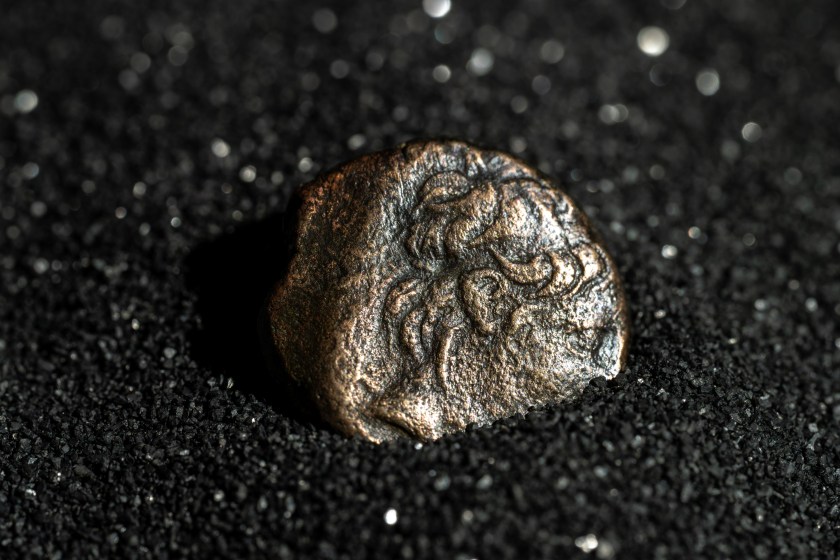
Ancient Greek Coin, Head of Alexander II Zebina

A macro photograph of a 123 BC Greek coin by Alexander II Zebina captures its historical significance and texture. The artist avoids over-sharpening, choosing selective focus to highlight the coin’s surface. This work raises questions about ownership, memory, and our connection to time, ultimately transforming the coin into a philosophical exploration of history.

Close-up of a worn ancient Greek coin showing a raised portrait, resting on coarse black granular material.
A macro photograph of an ancient Greek coin with a portrait relief placed on a dark textured surface.

In this macro study from Chapter 6 of his Top 100 Journey, the photographer confronts an artifact that predates the medium of photography by over two millennia. The coin—a bronze piece from 123 BC bearing the portrait of Alexander II Zebina—becomes both subject and collaborator, its weathered surface telling stories that extend far beyond the frame. This single exposure, created for the 52 Frames challenge, demonstrates a mature understanding of how light and composition can resurrect history from oxidized metal.

The technical execution reveals deliberate restraint. Rather than employ focus stacking to render every millimeter sharp, he opts for a single capture that honors the coin’s irregular topography through selective focus. The shallow depth of field becomes a curatorial choice: not everything from antiquity needs to be preserved with clinical precision. Some details fade into soft ambiguity, much as memory itself blurs across centuries. The side lighting—achieved through what appears to be a carefully positioned single source—rakes across the relief, transforming corrosion patterns into a luminous bronze landscape. Highlights catch on the highest points of wear, creating a constellation of golden moments against near-black valleys of shadow.

The substrate selection proves equally thoughtful. Black granular material, possibly sand or volcanic rock, provides textural contrast while introducing delicate bokeh spheres that float in the background like suspended time. This environmental choice feels archaeological, suggesting the coin might have just emerged from excavation rather than from a flea market display case. The photographer resists any impulse toward nostalgic sepia or artificial aging effects; instead, he allows the genuine patina—two thousand years in the making—to provide all the historical gravitas the image requires.

What distinguishes this work within Chapter 6’s framework of ongoing exploration is its meditation on ownership and stewardship. The accompanying note reveals this coin represents “the oldest man-made thing I have ever owned,” yet the photograph itself seems to question that possessive relationship. Can anyone truly own such an object, or are we merely temporary custodians in an impossibly long chain of hands? The macro perspective literalizes this contemplation, bringing the viewer so close that individual crystals of corrosion become visible, each one a marker of time the photographer will never witness.

The portrait of Alexander II Zebina—barely discernible beneath centuries of oxidation—emerges as a ghost in metal, features obscured yet undeniably present. This parallel between photographic and numismatic portraiture feels intentional. Both mediums attempt to freeze time, to preserve likeness against entropy’s relentless work. The photograph succeeds where the coin has partially failed, capturing not just the object but the precise quality of light falling upon it on a specific day in 2025, creating a new historical layer atop the ancient one.

Within the photographer’s evolving practice, this image represents a turn toward material intimacy and temporal reflection. The macro lens becomes a tool for philosophical inquiry rather than mere magnification. By isolating this small artifact against darkness and bringing such focused attention to its corrupted beauty, he creates space for viewers to contemplate their own relationship with history, permanence, and the objects that outlive their makers by millennia.
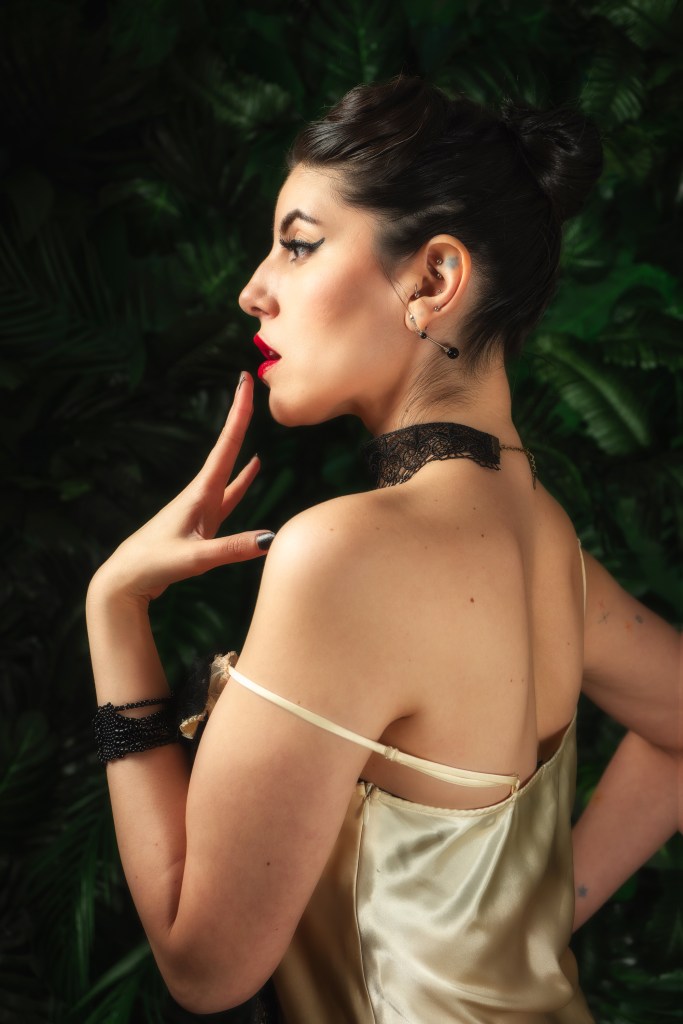
Silhouette and Subversion: A Study in Controlled Drama

The portrait of Savage Van Sage by Greg Urbano in Chapter 4 of Top 100 Journey exemplifies refined environmental portraiture. It captures a blend of vulnerability and confidence through composition, lighting, and setting. The ivy backdrop, along with the model’s pose, invites viewers to engage with the complex narrative, reflecting Urbano’s artistic evolution and technical mastery.

Woman in a satin dress shown in side profile against a dark leafy background, with hair in an updo and red lipstick.
Savage Van Sage poses in profile in a studio portrait with an ivy-covered wall near Denver, Colorado.

Within Chapter 4 of Greg Urbano’s Top 100 Journey—a section devoted to studio portraiture and collaborative workshop explorations—this photograph of model Savage Van Sage stands as a masterclass in theatrical restraint. Shot against an ivy-laden wall at the Headquarters studio near Denver, the image demonstrates the photographer’s evolving command of environmental portraiture, where setting and subject engage in a carefully choreographed dialogue.

The composition reveals sophisticated technical decision-making. Urbano positions his subject in profile, her face turned away from the camera yet fully engaged with the viewer through gesture and posture. The silhouette technique employed here—enhanced through post-processing in Adobe Camera Raw and Luminar 4—creates a striking interplay between illumination and shadow. Light sculpts the model’s features with precision, catching the curve of her jawline, the delicate architecture of her ear adorned with multiple piercings, and the bold contrast of crimson lips against porcelain skin.

What distinguishes this work within the chapter’s broader exploration of portrait photography is its willingness to embrace ambiguity. The model’s bare shoulder and the gossamer straps of her garment suggest vulnerability, yet her pose—hand raised to chin in a gesture of thoughtful poise—projects confidence and self-possession. The black lace choker and wrist accessory introduce elements of vintage glamour and contemporary subculture, positioning the subject at the intersection of multiple aesthetic traditions. This fusion of pin-up sensibility with darker, more enigmatic styling reflects Urbano’s interest in portraits that resist singular interpretation.

The natural ivy backdrop functions as more than mere decoration. Its organic chaos provides textural depth and creates a liminal space—neither entirely studio nor wholly natural environment. This choice aligns with the chapter’s documentation of the photographer’s studio and workshop methodologies, demonstrating how controlled environments can be manipulated to suggest narrative possibilities beyond their physical constraints. The deep greens recede into darkness, focusing attention on the figure while maintaining atmospheric richness.

Technically, the photograph showcases the photographer’s proficiency with studio lighting configurations. The illumination appears to originate from a single, directional source, creating the dramatic side-lighting characteristic of classic portraiture while maintaining sufficient fill to preserve detail in shadow areas. This approach—refined through workshop collaborations and repeated studio sessions—demonstrates a maturation from documentary impulses toward more deliberately constructed imagery.

The inclusion of this photograph in the Top 100 Journey marks a significant moment in Urbano’s artistic development. Where earlier chapters might emphasize spontaneity or environmental documentation, this studio work reveals an artist increasingly comfortable with artifice and construction. The model becomes collaborator rather than subject, her professional experience evident in the precision of her pose and the deliberate theatricality of her presentation.

Ultimately, this portrait succeeds because it understands the power of suggestion over declaration. The viewer receives fragments—a profile, a gesture, a carefully composed environment—and must construct meaning from these elements. It is portrait photography that honors both the technical traditions of studio work and the contemporary expectation that images should provoke rather than simply document. Within Urbano’s evolving practice, it represents a confident synthesis of technical skill and artistic vision.