
Light Paint Glass Vase: Minimalism and the Democratization of Photographic Practice

A minimalist black-and-white photograph of a glass vase showcases how simple materials can produce sophisticated visual art. Created for a structured challenge, the work emphasizes classical minimalist principles, focusing on light, form, and composition. It highlights the idea that accessible techniques can achieve impactful results through exploration and experimentation.

Black-and-white photograph of a single glass vase standing on a dark fabric surface, illuminated against a black background with subtle light-painted highlights.
A minimalist black-and-white study of a glass vase, photographed using light painting on a dark tabletop and background.

In this austere still life, the photographer demonstrates how constraint and accessibility can yield sophisticated visual results. Created for Week 46 of a structured challenge focused on black and white minimalism, the image features a green glass vase—rendered in monochrome—isolated against absolute darkness. The work’s genesis from dollar store materials and basic light painting techniques belies its formal accomplishment, positioning it as a compelling statement within Chapter 6’s exploration of ongoing practice and future directions.

The composition adheres to classical minimalist principles: a singular subject, centered and vertical, emerges from void. The vase’s elegant silhouette—narrow at neck and base, gently swelling through its body—receives careful illumination from a handheld flashlight, creating a gradient of tones that model the form with sculptural precision. The photographer’s light painting technique reveals selective control; highlights trace the vessel’s curve while allowing shadow to claim significant portions of the surface, suggesting volume through implication rather than complete revelation.

What distinguishes this work within the photographer’s broader trajectory is its embrace of democratic materials and process. By explicitly acknowledging the humble origins of both subject and lighting instrument, he advances a philosophy that technical sophistication need not depend on expensive equipment. This approach resonates with Chapter 6’s theme of exploration—suggesting that the road ahead involves continual experimentation with accessible means rather than escalating technical complexity.

The monochromatic treatment transforms what was originally a green glass vessel into a study of pure form and tonality. This chromatic reduction focuses attention on the interplay between light and surface, on the subtle texture variations across the vase’s body, and on the relationship between object and ground. The black tablecloth and background merge into a unified void, creating the impression that the vase floats in undefined space—a strategy borrowed from commercial and fine art photography traditions alike.

The image’s participation in a weekly challenge framework—Week 46 addressing black and white minimalism—situates the photographer’s practice within contemporary photography’s social and educational structures. Unlike the isolated studio practice of previous generations, his work emerges from dialogue with prompts, themes, and presumably a community of practitioners engaging similar constraints. This context enriches the reading of Chapter 6; the road ahead is both solitary and communal, shaped by individual vision and collective participation.

Post-processing in Adobe Camera Raw represents the final transformative stage, where the captured light painting receives refinement and intentional tonal mapping. The deep blacks exhibit rich density without blocking detail entirely, while the highlights maintain luminosity without burning out—evidence of considered digital darkroom practice.

Within the Top 100 Journey, this photograph stands as testament to fundamental photographic principles: light, form, composition, and tone. Its apparent simplicity masks deliberate choices regarding placement, illumination duration and direction, and subsequent processing decisions. The vase becomes more than household object; it transforms into a vehicle for exploring how light describes volume, how darkness defines presence, and how minimal means can generate maximal visual impact.

In embracing both constraint and accessibility, the photographer charts a sustainable path forward—one where ongoing exploration need not await perfect conditions or specialized equipment, but can unfold through disciplined attention to essential elements.

Natural Elegance: A Portrait in Copper and Light

Abigail Marchetti, known as Copper Muse, poses at a Denver Models open shoot, showcasing the photographer’s evolving studio portraiture techniques. Utilizing natural light, he captures her striking features and authentic expression, emphasizing color harmony and psychological presence. This portrait marks a significant step in his artistic development, blending classical principles with a modern sensibility.

Studio portrait of a red-haired woman in a black dress posing against a light background with her hands framing her face.
Model Abigail Marchetti, known as Copper Muse, poses during a Denver Models open shoot at Realm Studio in Denver.

This compelling portrait of model Abigail Marchetti exemplifies the photographer’s deepening engagement with studio portraiture and his refined approach to natural light as a primary sculptural tool. Captured during a Denver Models open shoot at Realm Studio, the image represents continued exploration of collaborative creative environments while demonstrating increasingly sophisticated control of the portraitist’s essential elements: light, gesture, color harmony, and psychological presence.

The composition centers on the model’s striking features—vibrant copper-red hair cascading in loose waves, piercing blue-green eyes meeting the camera with direct but unguarded confidence, and pale skin that catches and reflects the soft window light with luminous clarity. Her pose, with one hand gracefully raised to her hair and the other touching her neck, creates natural framing that draws attention to her face while suggesting unaffected spontaneity. The black strapless garment provides bold tonal contrast against both her skin and the pale backdrop, creating visual drama without competing for attention.

What distinguishes this work is the photographer’s masterful exploitation of natural window light. Rather than relying on the multiple strobes and reflectors typical of commercial studio work, he has chosen a more classical approach that recalls portrait painting traditions. The directional quality of the illumination—soft yet defined—models the subject’s features with sculptural precision while maintaining delicate gradations across skin tones. Highlights along the hair reveal its rich, multidimensional copper coloring, transforming what could be merely descriptive documentation into chromatic study.

The technical execution demonstrates growing confidence with the Nikon Z5 system and the versatile 24-120mm lens. The focal length selection—likely in the moderate telephoto range—provides flattering perspective without distortion, while the depth of field keeps the subject sharply defined against the subtly gradated background. The exposure balances the challenge of pale skin and light background without sacrificing detail in either the model’s features or the deeper tones of her garment.

Within the framework of Chapter 6—”The Road Ahead: Recent Work & Ongoing Exploration”—this portrait signals important developments in his artistic trajectory. The open shoot environment, like the previous workshop-based work, indicates willingness to engage with structured collaborative opportunities while bringing his distinct sensibility to bear. Yet where some open shoots yield generic beauty documentation, this image transcends its circumstances through careful attention to classical portraiture principles: the quality of light, the authenticity of expression, the harmony of color and form.

The model’s direct gaze introduces a quality often absent from his landscape and architectural work—reciprocal acknowledgment between photographer and subject. This mutual recognition adds psychological dimension, transforming technical exercise into genuine encounter. The slight asymmetry in her expression—contemplative rather than performative—suggests comfort and trust within the photographic exchange.

The photograph also reveals evolving aesthetic priorities. While maintaining the tonal sensitivity and compositional rigor evident throughout his portfolio, he demonstrates here that minimalism need not preclude richness. The interplay of copper hair, pale skin, black fabric, and soft grey background creates visual complexity through chromatic relationships rather than environmental detail. This represents a distillation of his practice—finding depth in apparent simplicity, discovering complexity in restraint—now applied to the human figure with increasing assurance and grace.

Metallic Army Men Still Life: The Alchemy of Transformation

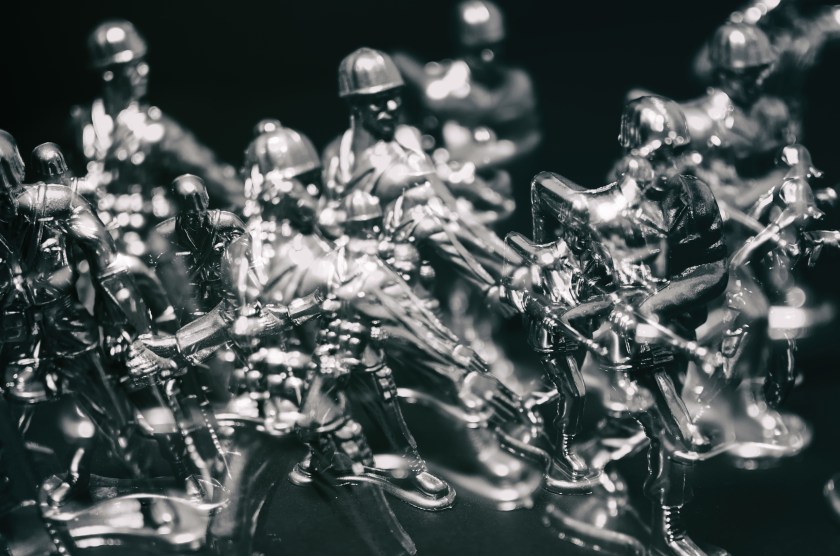
Greg Urbano’s 2014 still life photograph of metallic army men illustrates a crucial moment in his artistic development. Through intentional composition and lighting, he transforms simple toys into evocative symbols of memory and mythology, balancing childhood nostalgia with adult artistry. The photograph reflects Urbano’s conceptual approach and mastery of his medium.

Metallic silver toy army men photographed in dramatic low light against a black background, creating an ethereal tabletop photography scene.
Metallic Army Men Still Life – Purpose-Driven Tabletop Photography (2014)

In the opening chapter of Greg Urbano’s photographic journey, this 2014 still life stands as a pivotal moment—a declaration of intentionality. The image depicts metallic army men frozen mid-action, their silver surfaces catching and scattering light across a void-like background. What began as dollar store plastic toys has been transmuted through spray paint and careful composition into something far more evocative: a meditation on memory, mythology, and the photographer’s emerging visual voice.

The technical execution reveals an artist learning to control his medium with precision. Shot on a Nikon D5100 with a 35mm f/1.8 lens wide open, Urbano exploits the shallow depth of field to create a dreamlike atmosphere. The foreground figures emerge sharp and detailed, their helmets and rifles rendered in crisp focus, while those behind dissolve into soft bokeh. This selective focus mimics the way memory itself operates—certain moments crystalline and vivid, others fading into impressionistic blur. The 1/20 second shutter speed at ISO 100 suggests a carefully controlled tabletop setup, likely using continuous lighting that allowed him to maintain the drama of highlights dancing across metallic surfaces.

What distinguishes this photograph within the “Beginnings” chapter is its purposefulness. Unlike casual snapshots or experimental exercises, this image demonstrates conceptual thinking from inception through execution. The decision to spray paint the figures silver wasn’t merely aesthetic—it stripped these mass-produced symbols of childhood play from their conventional context. No longer green plastic soldiers evoking backyard battles, they become archetypal warriors, their metallic finish suggesting both classical statuary and science fiction. They exist outside time, suspended between the ancient and the futuristic.

The composition itself rewards extended viewing. Urbano arranges the figures in a dynamic diagonal sweep that guides the eye through the frame. There’s a sense of advancing movement, of forces converging, yet the shallow focus and monochromatic treatment create an ethereal quality that contradicts any literal interpretation. These aren’t soldiers storming a beach—they’re specters, memories of conflict rendered as beautiful objects. The black background becomes an infinite space, allowing the figures to float free from any specific context or narrative.

The lighting deserves particular attention. The way highlights trace the contours of each figure—the curve of a helmet, the angle of a raised arm—reveals an understanding of how light sculpts form in photography. Some figures glow almost luminously, while others recede into shadow, creating a tonal range that prevents the silver-on-black palette from becoming monotonous. This careful modulation of light transforms what could have been a simple craft project into a genuine photographic study.

Positioned within Urbano’s broader body of work, this image represents a crucial developmental moment. It demonstrates his willingness to manipulate reality rather than simply document it, to transform found objects into vehicles for artistic expression. The photograph bridges childhood nostalgia and adult artistry, acknowledging the army men’s playful origins while elevating them through photographic treatment.

As a statement of beginnings, this work reveals an artist already thinking beyond the conventional. He wasn’t content to photograph the world as found; instead, he reimagined it, spray paint and camera serving as tools of transformation. The metallic army men become a fitting metaphor for the photographic process itself—ordinary subjects made extraordinary through vision, technique, and intention.