Reclamation and Ruin: A Study in Agricultural Melancholy

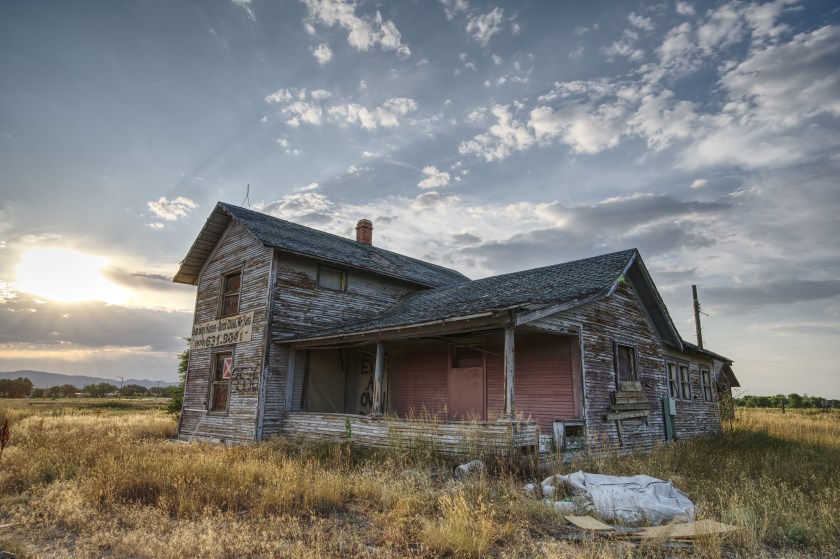
The photograph of an abandoned farmhouse near Fort Collins, Colorado, embodies themes of impermanence and decay. The image balances architectural elements with natural landscapes, showcasing technical sophistication through HDR processing. By highlighting details of deterioration amidst recent human traces, it transforms rural abandonment into a poignant meditation on time and memory.

Weathered wooden farmhouse with boarded windows and peeling paint standing in tall grass near Fort Collins, Colorado.
An abandoned wooden farmhouse sits in open prairie near Fort Collins, Colorado.

In this haunting documentation of rural abandonment, the photographer captures a weathered farmhouse on the outskirts of Fort Collins, Colorado—a structure caught in the liminal space between human history and nature’s patient reclamation. The image, selected for Chapter 6 of his Top 100 Journey, exemplifies the ongoing evolution in his practice toward subjects that speak to impermanence, transition, and the quiet dignity of forgotten places.

The compositional strategy reveals a mature understanding of architectural photography merged with landscape sensibility. The two-story structure commands the frame while remaining subordinate to the expansive Colorado sky, which fills nearly half the image with dramatic cloud formations. This deliberate balance prevents the photograph from becoming merely documentary, instead elevating it into meditation on time and decay. The golden hour lighting—captured with precision timing—rakes across the weathered clapboard siding, accentuating every crack, peel, and shadow in the wood grain. This textural emphasis transforms deterioration into visual poetry.

His decision to employ HDR processing demonstrates technical sophistication in service of artistic vision rather than mere spectacle. The extended dynamic range allows simultaneous preservation of detail in the sun-bleached siding and the darker recesses of boarded windows and doorways. The processing maintains naturalistic color while enhancing the amber warmth of dying light against cool blue-grey clouds, creating chromatic tension that mirrors the thematic conflict between persistence and decay.

The overgrown prairie grass in the foreground serves multiple functions within the composition. Practically, it provides textural contrast to the geometric severity of the architecture; symbolically, it represents nature’s inexorable advance. The discarded white fabric or tarp in the lower right corner introduces a note of recent human presence, suggesting that abandonment is an ongoing process rather than a completed historical fact. This detail prevents the image from slipping into nostalgic romanticism.

What distinguishes this work within the context of Chapter 6—titled “The Road Ahead: Recent Work & Ongoing Exploration”—is its synthesis of earlier themes with evolving concerns. The photographer has long demonstrated interest in human traces within landscape, but here the investigation deepens. Rather than simply documenting what remains, he engages with the process of vanishing itself. The boarded windows become blind eyes; the peeling paint functions as aging skin; the sagging roofline suggests exhaustion. The structure possesses almost anthropomorphic vulnerability.

The photograph’s origins as a response to the 52frames weekly challenge reveals another dimension of his practice—the ability to transform assignment-based work into personally meaningful investigation. Many photographers struggle to maintain artistic integrity within the constraints of themed prompts, yet he has consistently used such frameworks as catalysts rather than limitations.

The telephone number still visible on the building’s facade—a commercial ghost—adds poignant specificity. It grounds the abstracted themes of abandonment and time in particular lives, particular businesses, particular failures or departures. This detail resists the tendency toward generic commentary on “the death of rural America” and instead insists on the singular reality of this particular farmhouse, this particular field, this particular evening light.

In positioning this image within his ongoing journey, the photographer signals continued commitment to finding profound resonance in overlooked subjects. The road ahead, it seems, leads deliberately toward what others pass by—not from contrarian impulse, but from genuine recognition that beauty and meaning persist even in, perhaps especially in, the discarded and decaying.
Briggsdale Scale and Silos: Monuments of Rural Persistence

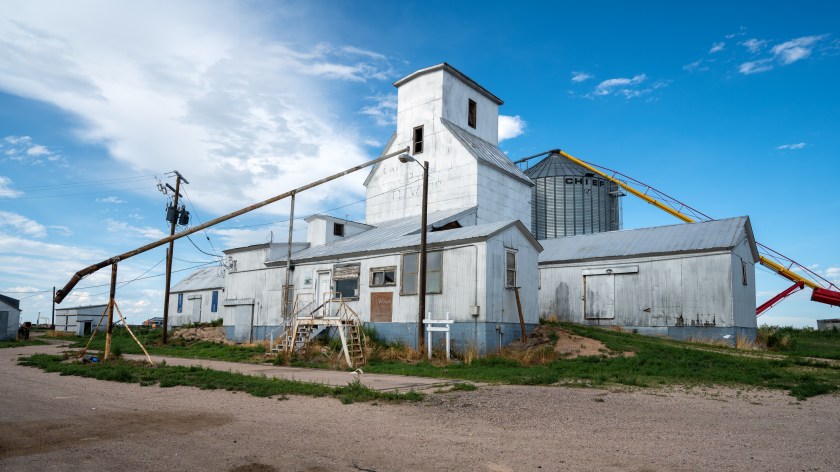
The photograph of the Briggsdale Scale and Silos in eastern Colorado captures the beauty of agricultural remnants under a vast prairie sky. The artist portrays abandonment as transformation rather than decay, highlighting layered complexities and themes of economic change. This work reflects both personal exploration and broader cultural narratives in rural America.

Rural grain elevator complex with white scale house buildings and metal silos under a blue sky in eastern Colorado.
The Briggsdale scale and silos stand along a roadside in rural eastern Colorado.

In this commanding photograph from Chapter 6 of Greg Urbano’s Top 100 Journey, the photographer turns his lens toward the structural remnants of agricultural infrastructure in eastern Colorado. The Briggsdale Scale and Silos stand as weathered sentinels against an expansive prairie sky, their utilitarian forms elevated to subjects of aesthetic contemplation through careful compositional framing and an acute sensitivity to light.

The image presents a study in contrasts—temporal, textural, and tonal. The white-painted grain elevator rises prominently in the frame’s left third, its verticality punctuated by narrow window openings that read as dark voids against the painted surface. Adjacent structures spread horizontally across the composition, their corrugated metal siding bearing the patina of decades exposed to the elements. A modern Chief grain bin introduces a cylindrical geometry, while the skeletal remains of what appears to be an auger system arc across the upper right quadrant, its yellow and red paint providing the only vivid chromatic notes in an otherwise muted palette.

What distinguishes this work within the photographer’s ongoing exploration is its treatment of abandonment not as decay but as transformation. The structures retain their monumental presence even as nature begins its slow reclamation—weeds push through concrete, grass encroaches on gravel pathways, and rust blooms across metal surfaces. The dramatic cloud formation sweeping across the cobalt sky suggests movement and change, while the buildings themselves remain rooted, immovable despite their gradual obsolescence.

The photographer’s technical execution reveals a sophisticated understanding of documentary traditions. Shot in brilliant midday light that might challenge less experienced practitioners, he harnesses the harsh illumination to articulate every surface detail—the vertical seams of the elevator, the weathering patterns on wood siding, the dimensional quality of the corrugated metal. The deep blue sky provides crucial tonal separation, preventing the white structures from dissolving into atmospheric haze while simultaneously emphasizing the vastness of the landscape context.

Within Chapter 6’s framework of “The Road Ahead,” this photograph functions as both retrospective and prospective statement. It acknowledges the photographer’s established interest in vernacular architecture and rural landscapes while suggesting new territories of investigation. The composition’s layered complexity—multiple structures occupying different spatial planes, the interplay of geometric forms, the dialogue between human-made and natural elements—indicates an artist pushing beyond straightforward documentation toward more nuanced visual poetry.

The work also engages broader themes of economic transition and cultural memory embedded in the American rural landscape. These agricultural structures, once vital nodes in the grain production and distribution network, now stand largely dormant, their continued presence a testament to both past prosperity and present uncertainty. The photographer neither romanticizes nor condemns this state of affairs; instead, he presents the scene with clear-eyed attention, allowing viewers to project their own narratives onto these architectural forms.

As part of his long-term Top 100 Journey project, this image demonstrates the photographer’s commitment to sustained engagement with place and subject matter. His repeated travels through eastern Colorado have yielded not mere repetition but deepening insight, as evidenced by this photograph’s confident handling of complex visual elements. It represents the work of an artist whose ongoing exploration continues to reveal new dimensions within familiar territory, finding monumentality in structures others might overlook and poetry in the persistent presence of the seemingly obsolete.