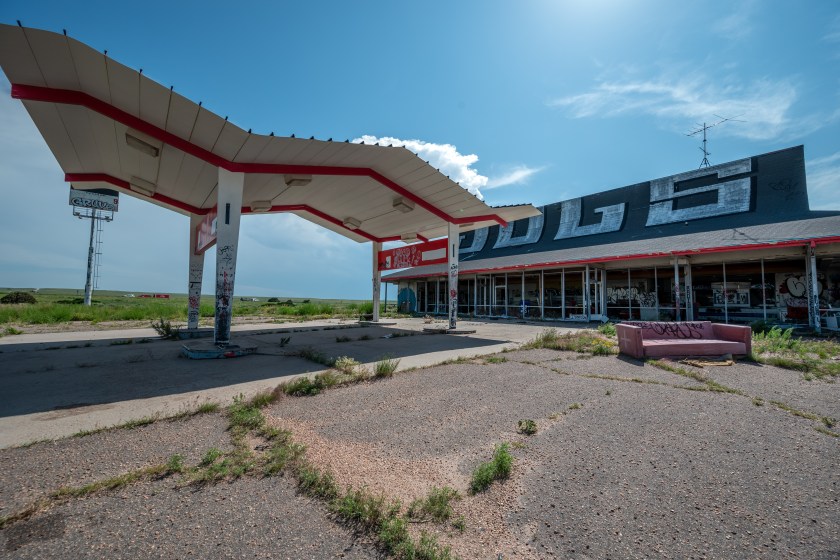
In this documentation of a former Stuckey’s roadside station along Interstate 76 near Sedgwick, Colorado, the photographer captures a distinctly American form of ruin—one born not of catastrophe but of bypass, economic shift, and the relentless evolution of travel infrastructure. The image, positioned within Chapter 6 of his Top 100 Journey, reflects a thematic concern with both literal and metaphorical roads ahead, while simultaneously acknowledging what has been left behind.
The composition employs a wide-angle perspective that emphasizes the structure’s geometric severity against an expansive Colorado sky. The canopy’s angular red-and-white striping draws the eye leftward, while the weathered building facade—bearing faded lettering and graffiti-marked columns—anchors the right side of the frame. Between these elements lies cracked asphalt overtaken by scrub grass, a visual testimony to years of abandonment. The photographer positions himself at a slight distance, allowing the full scope of dereliction to register without sensationalizing the decay.
What distinguishes this work from mere urban exploration photography is its restraint. Rather than fetishizing abandonment or deploying dramatic processing techniques, the photographer presents the scene with documentary clarity. The natural light—diffused through wispy clouds—provides even illumination that reveals texture in the deteriorating surfaces without casting the scene into melodrama. A discarded pink couch in the lower right corner serves as an unexpected punctuation mark, a surreal domestic intrusion into commercial space that hints at the site’s reappropriation by transient visitors.
The Stuckey’s chain represents a specific era of American mobility—mid-century road travel when interstate commerce moved at human speeds and roadside stops functioned as destinations rather than mere interruptions. The photographer’s selection of this subject speaks to an interest in cultural archaeology, in preserving evidence of infrastructures that once defined travel experience but now exist as skeletal reminders of obsolete commercial models.
Within the context of Chapter 6’s “ongoing exploration,” this photograph demonstrates an expansion of the photographer’s subject matter beyond controlled studio environments and collaborative performances. Here, he engages with the built environment as found object, approaching landscape and architecture with the same compositional rigor previously applied to portraiture and experimental lighting. The decision to include this image alongside more technically innovative work suggests an artistic practice concerned with breadth as much as depth—a willingness to move between modes of image-making as the subject demands.
The personal dimension—referenced in the accompanying text through memories of hot dogs and pecan log rolls—remains deliberately absent from the photograph itself. This restraint allows the image to function on multiple levels: as architectural document, as cultural commentary, as landscape study. The photographer trusts the visual evidence to carry meaning without editorial intervention, letting viewers project their own relationships to such spaces.
As part of the Top 100 selection, this photograph confirms that the journey ahead need not always involve technical innovation or conceptual complexity. Sometimes it requires simply bearing witness to what time and economics have rendered irrelevant, preserving in two dimensions what three-dimensional space will not sustain much longer. The road ahead, this image suggests, is also paved with remnants of roads already traveled.
 Greg Urbano