Boulder Falls Long Exposure

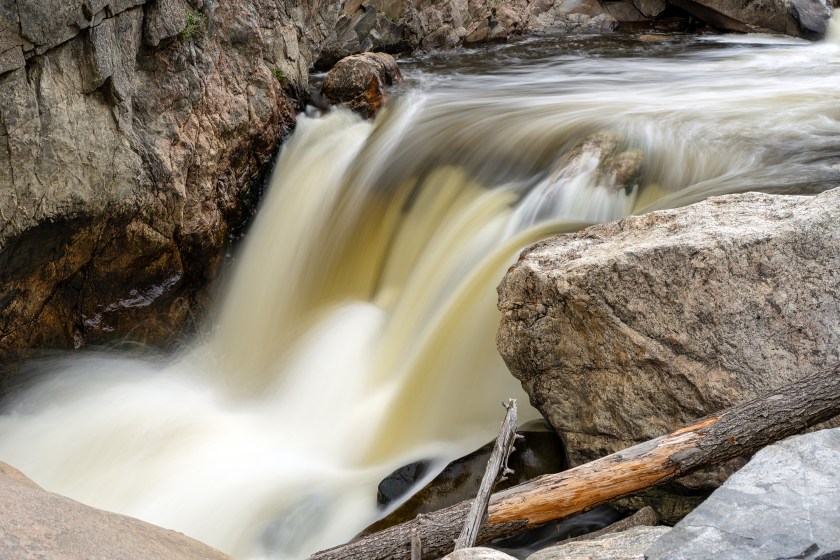
The photograph of Boulder Falls captures the intricate interplay of water and rock in Colorado’s canyon, showcasing the photographer’s mastery of long exposure techniques. Using a Nikon D610, the image balances smooth water motion with structural clarity. This work signifies a matured artistic voice within the broader context of his evolving landscape photography.

Long-exposure view of Boulder Falls flowing over rocks into a shallow pool within a rocky canyon.
Long-exposure photograph of Boulder Falls cascading through a rocky canyon in Colorado.

The photographer’s mastery of long exposure technique reaches full maturity in this commanding portrait of Boulder Falls, where water, stone, and light converge in a composition of remarkable spatial depth and textural complexity. Captured with a Nikon D610 and an 18-35mm f/3.5-4.5 lens at its widest setting of 18mm, the image employs a half-second exposure at ƒ/4.0 and ISO 100 to render cascading water as ethereal veils against the canyon’s ancient geological architecture.

The composition operates on multiple planes, drawing the eye through a carefully orchestrated visual journey. In the immediate foreground, stream-smoothed boulders—some dry and tan, others wet and rust-colored—create a rocky platform that grounds the viewer’s perspective. Water flows around and between these stones in delicate ribbons, their motion captured as soft blur that contrasts with the sharp detail of stationary rock. The middle ground presents the falls itself, a luminous white cascade plunging through a dramatic cleft in the granite amphitheater. Finally, the background reveals towering rock walls in warm earth tones, their fractured surfaces speaking to millennia of geological upheaval, crowned by evergreen forest and a brilliant blue sky.

What distinguishes this work from countless waterfall photographs is the photographer’s sophisticated understanding of how long exposure serves composition rather than merely creating predictable aesthetic effects. The half-second shutter speed proves precisely calibrated—long enough to smooth the water into silken forms while short enough to preserve structural definition in the cascade. The falls maintain sculptural presence rather than dissolving into amorphous white masses. Similarly, the foreground stream retains enough texture and gradation to read as water in motion rather than abstract blur.

The technical choices reveal deliberate control over the medium. The wide 18mm focal length encompasses the entire scene’s grandeur while maintaining exceptional corner-to-corner sharpness, crucial when working with such complex spatial relationships. The ƒ/4.0 aperture balances depth of field considerations—keeping both foreground rocks and distant walls acceptably sharp—with the light reduction necessary for the extended exposure. At ISO 100, the image maintains optimal clarity across its tonal range, from the brightest highlights in the falling water to the shadowed crevices in the surrounding stone.

The inclusion of this photograph in Chapter 3—Colorado Landscapes & Cityscapes—marks a significant development in the photographer’s journey. Where earlier chapters saw him exploring beyond Florida’s boundaries, this chapter formalizes Colorado as a central subject within his practice. The image embodies what might be termed “high country aesthetics”: the interplay of water and granite, the vertical drama of canyon topography, the crystalline light of elevated altitude. These elements recur throughout Rocky Mountain landscape photography, yet the photographer brings fresh eyes to familiar territory through precise craft and compositional intelligence.

Within the broader context of the Top 100 Journey project, “Boulder Falls Long Exposure” represents an artist who has moved beyond technical experimentation toward mature artistic voice. The photograph demonstrates that mastery emerges not from discovering novel techniques but from wielding established ones with intention, subtlety, and unwavering attention to the specific demands of place and moment.

Big Thompson Long Exposure

The photograph of the Big Thompson River showcases a masterful interplay of permanence and fluidity through long exposure techniques. Captured in Colorado, the image emphasizes detail in granite boulders alongside soft, flowing water. It reflects the photographer’s evolving artistic journey, expanding thematic boundaries while presenting a cohesive and naturalistic landscape composition.

Long exposure view of fast-moving water flowing over a rocky drop on the Big Thompson River between granite boulders.
Water flows over a small rocky drop along the Big Thompson River, photographed with a long exposure.

The photographer’s technical mastery converges with natural drama in this commanding study of the Big Thompson River, captured in Colorado’s rugged high country. Shot with a Sony Alpha a7 II paired with the Sony FE 28-70mm f/3.5-5.6 OSS lens at 62mm, the image employs long exposure technique enhanced by neutral density filtration to transform rushing water into ethereal ribbons of motion. At ƒ/9.0 and ISO 50, the exposure settings reveal a deliberate approach to capturing both sharpness in the surrounding geology and the silken blur of flowing water.

What immediately arrests the viewer is the dramatic interplay between permanence and fluidity. Massive granite boulders—textured, ancient, immovable—frame a cascade that appears simultaneously powerful and gossamer-soft. The long exposure technique transforms the torrent into bands of cream and amber, creating visual movement that guides the eye through the composition in sweeping arcs. The golden tint in the water suggests the presence of sediment or tannins, lending warmth to what might otherwise read as a cool mountain scene.

The compositional architecture demonstrates sophisticated understanding of visual weight and balance. A substantial boulder occupies the right foreground, its weathered surface rendered in exquisite detail, while a piece of driftwood creates a diagonal element that adds depth and natural geometry. The left side reveals stratified rock walls, their vertical presence providing counterpoint to the horizontal flow. This triangulation of elements—stone, water, wood—creates a cohesive environmental portrait rather than merely documenting a waterfall.

The inclusion of this image within Chapter 2—Florida Landscapes & Cityscapes—presents an intriguing curatorial question. Clearly captured in Colorado’s Rocky Mountain ecosystem rather than Florida, the photograph signals an expansion in the photographer’s geographical scope and thematic boundaries. This apparent departure from the chapter’s titular focus suggests an evolving artistic journey, one where the photographer moves beyond regional constraints to explore universal themes of landscape and natural process. Perhaps the chapter title reflects the photographer’s home base or primary focus, while individual works demonstrate his widening field of exploration.

The technical execution reveals growing confidence with long exposure photography as a expressive tool. The neutral density filter allows for extended exposure times in daylight conditions, creating that characteristic motion blur while maintaining proper exposure across the frame’s dynamic range. The choice of ƒ/9.0 ensures adequate depth of field to keep both foreground rocks and background elements acceptably sharp, a critical consideration in landscape work where context matters as much as subject.

What elevates this beyond technical exercise is the photographer’s eye for natural composition. The cascade’s S-curve creates inherent grace, while the careful positioning relative to the boulder forms suggests patient observation and deliberate framing. The subdued color palette—grays, tans, muted greens—speaks to naturalistic rendering rather than heightened saturation, allowing texture and form to dominate over chromatic spectacle.

Within the broader trajectory of the Top 100 Journey project, this image represents an artist testing boundaries and methodologies. It demonstrates that landscape photography, when executed with technical precision and compositional awareness, can reveal the sublime within the observable—the eternal dance between stone and water, stillness and motion, captured in a single decisive exposure.