Milky Way Interrupted: The Anthropocene Inscribed in Starlight

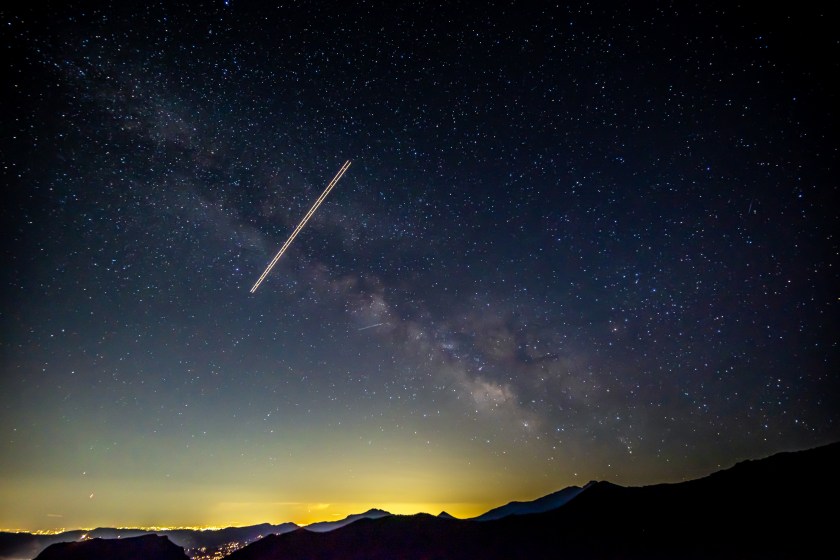
“Milky Way Interrupted,” a photograph by Greg Urbano, captures a unique blend of three realities—the Milky Way, Colorado mountains, and an aircraft’s light trail. This interplay creates tension between the timeless cosmos and modern human impact, emphasizing how even remote landscapes reflect our influence. The image invites varied interpretations while acknowledging evolving wilderness photography’s complexities.

The Milky Way stretches across a star-filled night sky above silhouetted mountain ridges, with a bright aircraft light trail crossing the stars.
The Milky Way appears above the mountains of Rocky Mountain National Park as an aircraft passes through the night sky near Rainbow Curve.

Among the selections comprising Chapter 3 of Greg Urbano’s Top 100 Journey, “Milky Way Interrupted” stands as perhaps the most conceptually layered work—a photograph that captures not one subject but three distinct temporal and spatial realities coexisting within a single frame. Captured from Rainbow Curve in Rocky Mountain National Park, the image presents the galactic core of the Milky Way, the ancient mountain silhouettes of Colorado’s high country, and a striking diagonal light trail that bisects the celestial display with unmistakable human presence.

The composition’s power lies precisely in this interruption. The aircraft’s light trail—rendered as a warm, golden-orange streak through long exposure—cuts diagonally across the frame, creating a dynamic tension between the timeless and the contemporary. While astrophotography typically seeks to eliminate such intrusions, this photographer has embraced the collision, transforming what might be considered a technical flaw into the photograph’s conceptual strength. The work becomes a document of our current moment, when even the most remote wilderness viewing points cannot escape the signatures of human movement across the planet.

Technical execution reveals careful consideration of the challenges inherent to night sky photography. Shot with a Nikon Z5, the image demonstrates the full-frame sensor’s capability to resolve stellar detail while managing the noise characteristics of extended ISO settings. The photographer has successfully balanced multiple exposure considerations: maintaining star sharpness through appropriate shutter speed selection, capturing the subtle gradations of airglow near the horizon, and rendering the mountainous foreground as legible silhouettes rather than featureless black masses.

The color palette deserves particular attention. The frame transitions from deep indigo and blue-black in the upper reaches, through the dusty rose and purple tones of the galactic core, down to the unexpected warmth of light pollution painting the horizon in amber and gold. This terrestrial glow—emanating from Front Range cities invisible beyond the mountains—creates an almost painterly quality along the lower third of the composition. The photograph thus captures three light sources simultaneously: starlight millions of years old, the reflected sunlight from a pressurized aluminum tube at 35,000 feet, and the collective illumination of human civilization diffused through atmosphere and distance.

Within the context of the Colorado Landscapes & Cityscapes chapter, this work occupies a unique position. It represents the photographer’s willingness to document Colorado not as pristine wilderness separate from human influence, but as a landscape inevitably marked by contemporary life. The image acknowledges that wilderness photography in the 21st century must contend with satellite constellations, flight paths, and light pollution—that the “natural” landscape exists now only in relationship to human infrastructure.

The title’s simple declaration—”Interrupted”—functions with appropriate restraint. It states fact without judgment, allowing viewers to bring their own interpretations to the juxtaposition. Some may read the aircraft trail as intrusion, others as a reminder of our species’ brief moment against cosmic timescales. The photographer wisely resists imposing a singular reading, instead presenting the visual evidence and trusting the inherent complexity of the image to generate meaning. This restraint marks a mature approach to landscape photography’s evolving role in documenting our changing relationship with the natural world.
Hidden Valley Hike: A Study in Atmospheric Depth and Winter Quietude

The photograph from Hidden Valley in Rocky Mountain National Park captures a snow-covered trail among dense trees, showcasing Greg Urbano’s skill in monochromatic winter photography. Emphasizing subtlety over grandeur, it conveys solitude and wilderness through careful composition and tonal restraint, highlighting ecological specifics and the beauty of intimate landscapes.

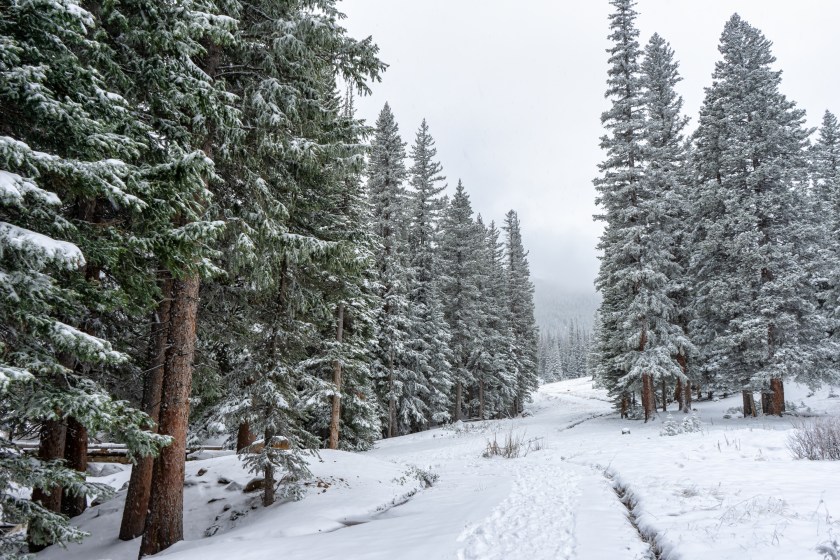
Snow-covered hiking trail winding through evergreen forest at Hidden Valley in Rocky Mountain National Park.
A snowy trail leads through dense evergreen trees at Hidden Valley in Rocky Mountain National Park, Colorado.

Within Chapter 3 of Greg Urbano’s Top 100 Journey—devoted to Colorado Landscapes & Cityscapes—this photograph from Hidden Valley in Rocky Mountain National Park represents a masterful engagement with the challenges of monochromatic winter photography. The image captures a snow-laden trail ascending through dense coniferous forest, where atmospheric conditions have reduced the distant peaks to mere suggestions within a veil of falling snow and fog.

The photographer’s compositional strategy reveals a sophisticated understanding of visual hierarchy. The trail itself functions as both literal and metaphorical pathway, drawing the viewer’s eye from the textured foreground snow through the middle ground’s architectural arrangement of pines and firs, before dissolving into the atmospheric void of the background. This recession creates a palpable sense of depth despite the flattening effect that overcast winter light typically imposes on landscape photography.

What distinguishes this work within Urbano’s broader Colorado portfolio is its restraint. Rather than pursuing the dramatic vistas and saturated alpine glow that characterize much Rocky Mountain photography, he has chosen to document a moment of visual subtlety—a soft, nearly monochromatic palette punctuated only by the warm sienna of exposed tree bark. The decision to work within such a limited tonal range demonstrates confidence in form and composition rather than relying on chromatic spectacle.

The technical execution merits particular attention. The photographer has maintained remarkable detail in the snow-weighted evergreen boughs while preserving the delicate gradation of gray tones that define the misty background. This balance suggests careful exposure management in conditions that would challenge most practitioners—the high reflectivity of fresh snow against dark timber, compounded by active precipitation and low contrast lighting.

From a thematic perspective, this photograph speaks to the contemplative dimension of Urbano’s landscape practice. The absence of human figures—save for the implicit presence suggested by the trail itself—invites meditation on solitude and the experience of wilderness in its less hospitable moments. This is not the Colorado of tourism brochures, but rather an intimate encounter with the state’s winter reality, where beauty reveals itself through subtlety rather than grandeur.

The image also functions as documentation of a specific ecological zone within Rocky Mountain National Park. The mixed conifer forest, dominated by what appear to be Engelmann spruce and subalpine fir, places the photograph within the park’s upper montane and subalpine life zones. The photographer’s attention to these botanical particulars grounds the work in a specific geographic and ecological context, elevating it beyond generic winter scenery.

Within the arc of the Top 100 Journey project, this photograph demonstrates stylistic evolution—a willingness to embrace quieter moments alongside more conventionally dramatic subjects. It suggests that Urbano’s curatorial eye has matured toward valuing atmospheric mood and compositional sophistication over spectacular subject matter alone.

The final consideration is one of timing and patience. Winter photography in Rocky Mountain National Park demands both technical preparation and willingness to work in physically demanding conditions. That this image exists at all speaks to the photographer’s commitment to documenting the full range of Colorado’s landscape character, not merely its most accessible or comfortable manifestations. The result is a work that rewards sustained attention, revealing its carefully calibrated tonal relationships and spatial complexities gradually, much like the trail itself emerging from and dissolving into winter’s embrace.

Hallett Peak: A Study in Motion and Permanence

In a captivating long-exposure photograph of Hallett Peak in Rocky Mountain National Park, the artist merges landscape photography with technical artistry. The image features dynamic cloud streaks, contrasting geological permanence, and rich tonal variations, creating an engaging interplay of time and nature. This work illustrates a mature artistic voice, enhancing familiar landscapes.

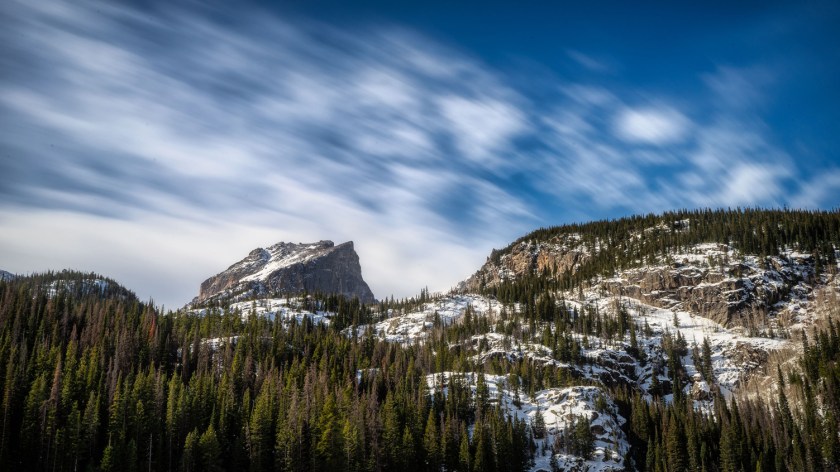
Hallett Peak rises above evergreen forest and snow-dusted slopes beneath streaked clouds in Rocky Mountain National Park.
Hallett Peak towers above forested slopes near Bear Lake in Rocky Mountain National Park, Colorado.

In this striking capture from Rocky Mountain National Park, the photographer demonstrates a sophisticated command of long-exposure technique to transform a familiar Colorado landscape into something both ethereal and architectural. The image of Hallett Peak, taken from the Bear Lake area, exemplifies the technical precision and artistic vision that defines Chapter 3 of his Top 100 Journey project.

The composition is anchored by the geological drama of Hallett Peak itself—that distinctive snow-dusted formation rising with muscular authority against the left portion of the frame. Yet it is the sky that commands immediate attention. Through extended exposure, the photographer has rendered clouds as diagonal streaks of motion, creating dynamic vectors that sweep across the upper two-thirds of the image. This technique transforms the sky from mere backdrop into active participant, suggesting the passage of time within a single frozen moment. The effect is cinematic, almost reminiscent of time-lapse sequences compressed into still photography.

The tonal range demonstrates careful exposure management in challenging high-altitude conditions. Deep blues saturate the upper atmosphere while softer, almost pearl-like whites and grays occupy the middle zones where cloud and sky intermingle. The snow-covered peaks and rock faces provide textural counterpoint—solid, immutable, sharply defined—against the fluid sky. This juxtaposition between the permanent and the transient becomes the photograph’s central artistic statement.

In the foreground, dense stands of evergreens establish both scale and context. The forest appears in rich greens and shadow-dark tones, creating a horizontal band that grounds the viewer’s eye before it ascends to the peaks and sky beyond. These trees serve multiple functions: they frame the composition, they provide Colorado’s signature ecological context, and they emphasize the vertical drama of the mountain forms rising behind them.

What distinguishes this work within the Colorado Landscapes & Cityscapes chapter is its sophisticated balance between documentary and interpretive approaches. While the location remains recognizable to anyone familiar with Rocky Mountain National Park, the artistic treatment elevates the image beyond straightforward landscape photography. The photographer has chosen to emphasize process—geological, meteorological, temporal—over simple representation.

The technical execution reveals careful planning. The long exposure required for cloud streaking demands stable tripod work, precise timing, and likely the use of neutral density filtration to manage the bright mountain light. The sharpness maintained throughout the frame, from foreground forest to distant peak, suggests a narrow aperture and careful focus technique. These are not accidental achievements but rather the results of deliberate craft.

Within the broader context of his Top 100 Journey, this photograph represents a mature artistic voice. It demonstrates that the photographer understands landscape work as more than capturing beautiful places—it involves interpreting those places through technical means that reveal aspects invisible to casual observation. The streaming clouds make visible the wind, the time, the atmospheric dynamics that define mountain environments but typically escape photographic capture.

This image invites extended viewing. Initially, one registers the dramatic sky; subsequently, the eye explores the geological complexity of the peaks, the play of snow and rock, the forest’s quiet density. It is work that rewards attention, revealing the photographer’s ability to transform a well-visited location into something that feels simultaneously familiar and newly seen—a hallmark of accomplished landscape photography.