Refraction and Illumination: A Study in Controlled Light

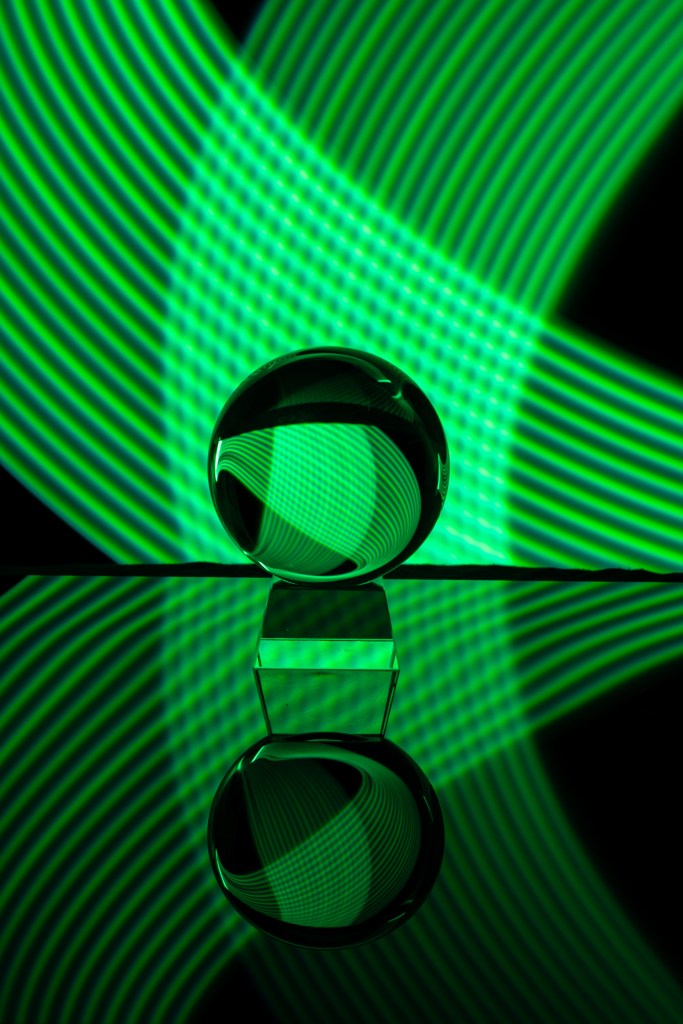
In Greg Urbano’s entry from “The Road Ahead: Recent Work & Ongoing Exploration,” a single green LED illuminates a glass sphere, creating intricate light patterns. This photograph showcases the artist’s mastery of optical effects and light manipulation. It reflects an ongoing exploration of visual ideas, balancing technical skill with artistic homage.

A glass sphere sits on black acrylic, bending bright green LED lines that cross diagonally, with a clear reflection below against a dark background.
A single green LED light creates intersecting line patterns that refract through a glass sphere and reflect off black acrylic.

In this striking entry from Chapter 6 of Greg Urbano’s Top 100 Journey—titled “The Road Ahead: Recent Work & Ongoing Exploration”—the photographer demonstrates a sophisticated understanding of light manipulation and optical phenomena. Created as part of the 52 Frames community’s Week 38 challenge, which called for images using a single light source, this photograph represents both technical mastery and artistic homage.

The composition centers on a glass sphere resting atop a reflective black acrylic base, positioned against a background of projected linear light patterns. What immediately captivates the viewer is the optical complexity achieved through such seemingly simple elements. The sphere acts as a lens, refracting and inverting the striped pattern behind it, while simultaneously creating a mirror image in the glossy surface below. This doubling effect—one sphere above, one reflected beneath—establishes a visual dialogue between reality and reflection that speaks to photography’s fundamental nature as a medium of light capture.

The photographer’s choice of a Godox TL30 LED wand as his single light source proves particularly astute. Rather than relying on ambient or diffused lighting, he creates a precise, linear pattern that reads as both graphic element and scientific demonstration. The vibrant green illumination pulses across the frame in parallel lines, their luminosity gradating from deep emerald to electric cyan. Where the light passes through the sphere, it bends and concentrates, revealing the optical principles at work while creating areas of intense brilliance that punctuate the geometric order.

This image explicitly acknowledges its lineage. The photographer credits Elizabeth Klepper’s 2023 work from the same community as inspiration—a refreshingly transparent gesture that positions this photograph within a continuum of artistic exchange rather than claiming isolated innovation. Yet this is no mere reproduction. Where Klepper’s original vision provided the conceptual framework, this interpretation carries distinct choices in color temperature, scale, and tonal contrast that mark it as an independent exploration.

The technical execution reveals careful consideration of multiple variables. The exposure balances the intense luminosity of the LED source with the deep blacks of the background and base, maintaining detail across a challenging dynamic range. The focus renders the sphere’s surface with crystalline clarity, allowing viewers to perceive both its transparency and its physical substance simultaneously. The alignment of the linear patterns—maintaining their parallel consistency both in direct view and through the sphere’s distortion—suggests meticulous positioning and multiple test exposures.

Within the context of Chapter 6, this photograph signals a willingness to engage with established visual ideas while pushing toward new territory. The chapter’s subtitle, “Recent Work & Ongoing Exploration,” positions the photographer at a transitional moment, actively investigating techniques and concepts that may inform future directions. This image embodies that investigative spirit—it is simultaneously a study, an exercise, and a finished work worthy of exhibition.

The minimalist aesthetic here contrasts with the more documentary or narrative approaches found in earlier chapters of the Journey. The photographer strips away contextual information, environmental cues, and representational content, focusing instead on pure optical phenomena. Light becomes subject rather than tool. The glass sphere transforms from decorative object to scientific instrument to sculptural form.

What elevates this beyond technical demonstration is its inherent beauty—the mesmerizing quality of those radiating green lines, the perfect symmetry of sphere and reflection, the luminous energy that seems to emanate from the glass itself. It exemplifies how constraint, whether self-imposed or community-mandated, can generate creative solutions that transcend their origins.
Powerade Sports Drink

The photographer’s still life study of three Powerade bottles transcends typical commercial product photography through technical mastery and thoughtful lighting. Using a classic triangular arrangement against a dark background, he elevates mundane objects into gallery-worthy art, emphasizing color and light. This work reflects his evolving confidence and duality in art and commerce.

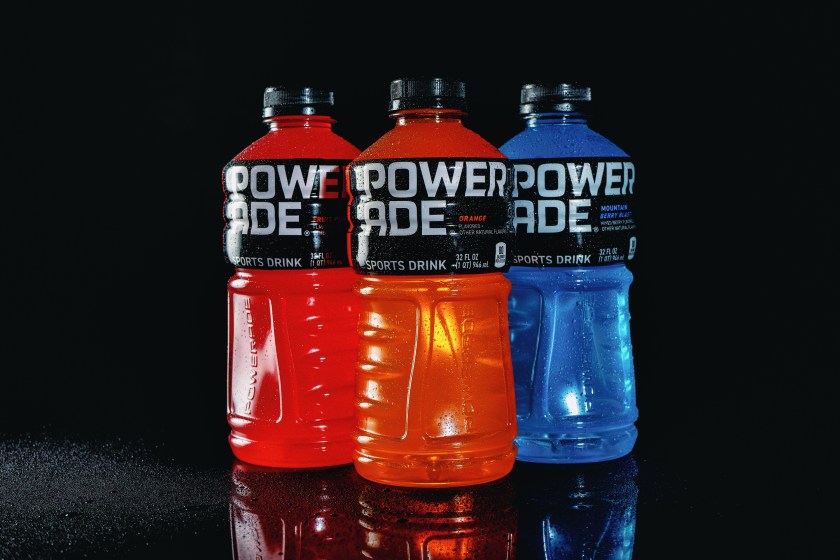
Studio still life of three Powerade sports drink bottles in red, orange, and blue on a reflective black surface.
A studio still life of three Powerade sports drink bottles arranged on a reflective surface against a dark background.

The photographer’s exploration of commercial product photography takes an unexpectedly sophisticated turn in this meticulously composed study of three Powerade bottles. Working within the constraints of a domestic setting—his living room transformed into an improvised studio—he demonstrates how technical mastery and thoughtful lighting can elevate mundane consumer objects into subjects worthy of gallery consideration.

The composition employs a classical triangular arrangement, with the three bottles positioned against a stark black background that eliminates all contextual distraction. This deliberate void forces the viewer’s attention entirely onto the subjects themselves: the vivid red and orange bottles flanking a brilliant blue variant. The color palette recalls the saturated hues of contemporary advertising photography, yet the treatment here transcends mere product documentation. Each bottle catches and refracts light differently, creating internal luminosity that transforms the beverages into glowing, jewel-like objects.

His technical approach reveals significant evolution in his still life practice. Utilizing a Sony A7ii with a kit lens, softbox, and flash, he crafts lighting that achieves both commercial polish and artistic dimensionality. The softbox provides diffused illumination that wraps around the bottles’ curved surfaces, while strategic flash placement creates the distinctive highlights and reflections visible across each container. The condensation beading on the plastic surfaces adds textural authenticity, suggesting these are not pristine studio props but objects intercepted in their natural state—cold, recently removed from refrigeration, existing in that liminal moment between commercial packaging and consumption.

The post-processing workflow—Adobe Camera Raw within Photoshop 2018, enhanced with Nik/DXO Viveza—amplifies the inherent drama of the scene. The blacks deepen to an almost velvety darkness, while the colors intensify without crossing into oversaturation. This balance proves crucial: the image maintains photographic credibility while achieving the heightened reality that characterizes effective still life work.

Within the broader context of Chapter 5’s exploration from classic to experimental tabletop photography, this image occupies an interesting middle ground. It adheres to established commercial photography conventions—the product-forward composition, the dramatic lighting, the emphasis on color and form—yet subverts them through its gallery presentation context. Removed from their intended commercial environment and reframed as objects of aesthetic contemplation, these sports drinks become something more: symbols of contemporary consumer culture, studies in color theory and light behavior, or perhaps meditations on how photography itself mediates our relationship with everyday objects.

The work also demonstrates his growing confidence in minimal staging. Rather than elaborate props or complex narratives, he allows the bottles themselves to carry the visual weight of the image. The slight rotation of each container, the variation in liquid levels, the casual yet deliberate spacing—these subtle decisions reveal an artist increasingly comfortable trusting in restraint.

This photograph ultimately succeeds because it occupies dual territories: it could function effectively as commercial product photography while simultaneously inviting the slower, more contemplative viewing that gallery work demands. This duality, this ability to straddle commercial and fine art sensibilities, marks a significant development in his still life practice and suggests promising directions for future experimentation.

Deadpool Lucha Libre: Chromatic Drama in Miniature

The photograph of a Marvel Lucha Libre Funko Pop Deadpool figure exemplifies a blend of commercial and fine art photography. Utilizing dramatic lighting and technical precision, it transforms a mass-produced collectible into a subject of contemplation. The piece reflects the cultural hybridity of its character, bridging traditional still life with contemporary themes.

Studio photograph of a Marvel Lucha Libre Deadpool Funko Pop figure standing on a reflective black surface against a dark background.
A studio still life of a Marvel Lucha Libre Funko Pop Deadpool figure posed on black acrylic.

Within Chapter 5’s exploration of tabletop still life—from classical arrangements to experimental departures—this photograph of the Marvel Lucha Libre Funko Pop! figure demonstrates the photographer’s command of dramatic lighting and his willingness to elevate commercial objects into subjects worthy of sustained contemplation. The piece functions as both technical exercise and cultural commentary, bridging the gap between traditional product photography and fine art still life.

The composition centers on El Chimichanga De La Muerte, the Deadpool variant rendered in the distinctive aesthetic of Mexican lucha libre wrestling. Against an uncompromising black void, the figure emerges through carefully controlled illumination that recalls the chiaroscuro techniques of Dutch Golden Age painting. The photographer has employed a Godox AD100 with gridded softbox to create a focused pool of light that caresses the figure’s surfaces while allowing the background to recede entirely. This technical choice—stark, theatrical, unforgiving—transforms what might have been simple documentation into something approaching portraiture.

The red and gold color palette dominates with painterly intensity. The matte finish of the vinyl catches light selectively, creating subtle gradations across the mask’s sculptural forms. Each stitch line in the figure’s costume becomes a shadow-casting element, adding textural complexity to what is, in reality, molded plastic. The photographer’s choice of the Tamron 35mm f/2.8 lens on his Sony A7II suggests a deliberate approach to depth and perspective—close enough to capture minute details, yet distant enough to maintain the figure’s proportional integrity and comic heroism.

What elevates this work within the chapter’s trajectory is its dialogue between high and low culture. Funko Pop! figures exist as mass-produced collectibles, yet the photographer treats this specimen with the reverence typically reserved for precious antiquities or fine crafts. The shirtless, muscular torso—absurdly rendered in the Funko aesthetic with its characteristic oversized head and simplified body—becomes an exercise in form and volume under his lighting scheme. The reflection on the glossy black surface beneath adds a layer of sophistication, grounding the floating figure in space while doubling its visual presence.

The image represents a contemporary evolution in still life photography where the distinction between commercial and fine art intentionally blurs. By applying gallery-level lighting techniques to a pop culture artifact, the photographer participates in a broader artistic conversation about value, nostalgia, and the objects we choose to collect and immortalize. The lucha libre variant itself carries layers of cultural hybridity—an American comic character filtered through Mexican wrestling tradition, then reimagined as a Japanese-influenced vinyl toy.

The technical execution is nearly flawless. Exposure is carefully balanced to preserve detail in both the deepest reds and the highlighted edges of the mask. The black background shows no distracting gradients or light spill, evidence of precise modifier control and post-processing restraint. This discipline allows the figure to exist in a realm of pure focus, removed from context yet somehow more present because of that isolation.

Within the broader context of Chapter 5’s examination of still life evolution, this photograph demonstrates how experimental approaches need not abandon classical principles. The work honors centuries of still life tradition while embracing decidedly modern subject matter, creating a bridge between photographic eras.

Stacked Chrome Muscle: The Architecture of American Power

In a 2014 throwback photo, Greg Urbano captures a chrome muscle car engine at a car show, transforming it into a sculptural testament of American automotive culture. The monochrome composition highlights its intricate details and engineering philosophy, transcending typical automotive photography into fine art, reflecting power and craftsmanship.

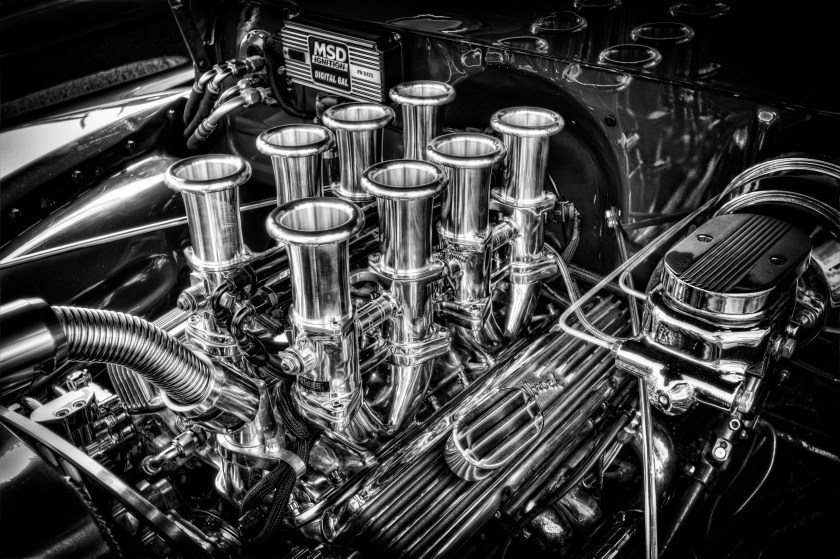
Black‑and‑white close‑up photograph of a chrome muscle car engine with multiple intake stacks, polished components, and detailed mechanical parts, taken with a Nikon D7100 at 24mm.
A 2014 black‑and‑white close‑up of a stacked chrome muscle car engine captured at a car show.

In this striking image from Greg Urbano’s early photographic explorations, the viewer encounters not merely an engine, but a sculptural monument to American automotive culture. Shot at a car show in 2014, this photograph demonstrates how technical documentation can transcend its utilitarian origins to become a meditation on form, texture, and cultural identity.

The composition centers on a magnificent array of individual throttle bodies—eight polished chrome velocity stacks rising like organ pipes from the engine block below. Urbano’s decision to shoot at f/8.0 provides exceptional depth of field, rendering every fluted trumpet in sharp detail while maintaining visual coherence across the crowded mechanical landscape. The MSD Digital 6AL ignition box in the upper left corner grounds the image in specificity, reminding us this is a real machine, not an abstract study.

What elevates this work beyond conventional automotive photography is the photographer’s masterful use of monochrome. The conversion to black and white strips away distraction and reveals the essential geometry of performance engineering. Chrome becomes a study in gradation—from brilliant highlights on the velocity stack lips to the deep blacks of the engine valley below. The ribbed valve covers create rhythmic patterns that echo throughout the frame, establishing a visual cadence that draws the eye deeper into the mechanical complexity.

The lighting deserves particular attention. Working with the ambient conditions of a car show—notoriously challenging for photographers—Urbano has captured specular highlights that accentuate the three-dimensional quality of each component. The reflections dancing across polished surfaces create a sense of movement and life in what is, paradoxically, a static object. One can almost hear the anticipated roar of this engine, feel the vibration of its operation.

From a curatorial perspective, this image belongs firmly within the “Beginnings” chapter of Urbano’s journey. It reveals a photographer discovering his eye, learning to see beyond the obvious. Car shows present a particular challenge: everything is designed to be spectacular, yet the very abundance of visual stimulus can overwhelm. Here, the photographer has exercised editorial judgment, finding a perspective that isolates and celebrates a single element of automotive excess.

The stacked throttle bodies themselves represent a specific philosophy in performance engineering—individual runners for each cylinder, optimized airflow, uncompromising dedication to power over practicality. This photograph captures that ethos perfectly. There is nothing subtle about this engine, and Urbano wisely chooses not to apologize for its maximalism. Instead, he leans into the drama, using his technical choices to amplify the subject’s inherent theatricality.

The 24mm focal length on his Nikon D7100 provides just enough wide-angle perspective to encompass the scene without introducing distortion that would undermine the precision of these machined components. Shot at 1/30th of a second—relatively slow for handheld work—the image’s sharpness suggests careful technique, perhaps braced against the engine bay or shot with controlled breathing.

This photograph documents more than machinery; it captures a particular strain of American automotive culture that values power, craftsmanship, and conspicuous performance. In rendering it so beautifully, Urbano elevates the vernacular tradition of car photography into something approaching fine art—a promising beginning indeed for a photographer learning to find extraordinary subjects in ordinary places.