Night at the Marina: A Study in Urban Reflection

The photograph from Greg Urbano’s Top 100 Journey captures St. Petersburg’s Municipal Marina at night, showcasing a dialogue of architecture, water, and light. Through a long exposure, the image blends city and reflection, revealing duality in urban nature. Urbano’s technical choices highlight Florida’s beauty within its metropolitan context.

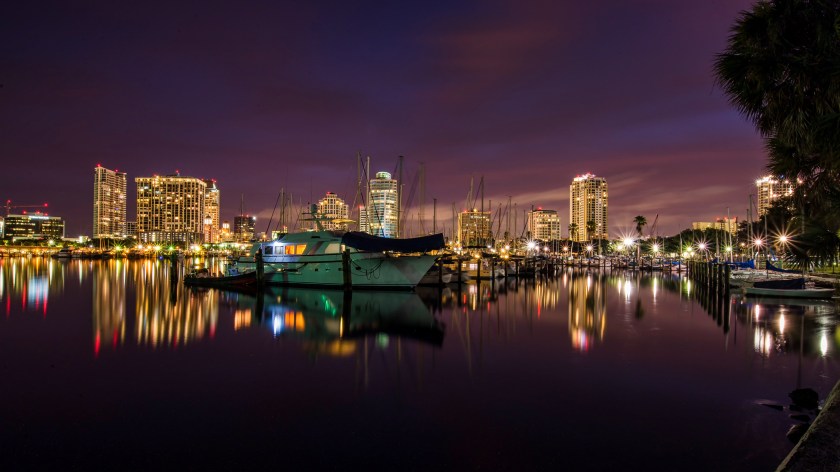
Nighttime long exposure photograph of the St. Petersburg, Florida skyline viewed from the Municipal Marina, with boats and colorful reflections on calm water.
Long exposure nighttime view of the St. Petersburg skyline from the Municipal Marina.

In this striking nocturnal composition from Chapter 2 of Greg Urbano’s Top 100 Journey, the photographer transforms St. Petersburg’s Municipal Marina into a stage where architecture, water, and light perform an intricate dialogue. Shot with a Nikon D610 at the wide end of an 18-35mm lens, the image demonstrates his evolving command of the Florida landscape—this time rendered not through the state’s iconic natural vistas, but through the geometry and luminescence of its urban waterfront.

The technical approach reveals deliberate choices that serve the image’s contemplative mood. A 150-second exposure at f/20 has allowed the photographer to capture not merely a moment but an accumulation of light and stillness. The water becomes a flawless mirror, its surface so calm that the distinction between city and reflection dissolves into symmetry. This extended duration smooths away any transient ripples, creating an almost surreal doubling effect where the marina’s vessels and the downtown skyline exist in perfect vertical equilibrium.

The color palette is equally considered. The twilight sky transitions from deep violet to warm amber along the horizon, providing a graduated backdrop that never competes with the main subject. The buildings’ golden illumination—ranging from honey tones to brilliant white—creates rhythmic vertical accents across the frame, while the marina lights introduce unexpected splashes of emerald and ruby that punctuate the composition with chromatic variety. These colored reflections stretch and shimmer in the foreground water, adding texture to what might otherwise be an overly static scene.

Compositionally, the photographer has positioned himself to maximize the reflection’s impact while maintaining architectural legibility. The yacht in the immediate foreground serves as an anchor point, its substantial form providing scale and depth to the scene. The vessel’s subtle green illumination connects it visually to the reflected lights while distinguishing it from the darker water surrounding it. Behind, the forest of masts creates a delicate counterpoint to the solid mass of the high-rises, introducing organic irregularity into an otherwise geometric composition.

What distinguishes this work within the Florida Landscapes & Cityscapes chapter is its meditation on duality—the way human development interacts with the natural world, specifically water’s capacity to both accept and transform urban light. The photographer has found in St. Petersburg’s marina a location where Florida’s maritime character persists even within its metropolitan context. The palm fronds visible at the frame’s edge remind viewers of the subtropical environment, preventing the scene from becoming generically urban.

The technical execution supports this conceptual balance. The ISO 160 setting has preserved clean shadows and prevented noise in the darker areas, while the narrow aperture has rendered sharpness from the foreground yacht to the distant towers. The starburst effects visible on some light sources—a result of the f/20 aperture—add a subtle decorative element without overwhelming the image’s naturalistic foundation.

Within his broader body of work exploring Florida’s diverse landscapes, this photograph represents an important expansion of scope. Here, the photographer demonstrates that the state’s visual poetry exists not only in its Everglades, beaches, and wetlands, but also in the moments when its cities pause and reflect—literally and figuratively—upon themselves. The result is an image that honors both the constructed and the elemental, capturing a Florida that is simultaneously modern and timeless.
Pier 60 Pink Sunset

In this contemplative study from Chapter 2 of the Top 100 Journey, the photographer demonstrates a sophisticated command of long-exposure technique to capture the liminal hour where day surrenders to night along Florida’s Gulf Coast. Shot at Clearwater Beach, this sixty-second exposure transforms the volatile surf into a glassy, ethereal plane that mirrors the atmospheric drama unfolding above, while Pier 60 extends into the frame with geometric precision against a sky rendered in deep indigos and persistent pink tones.

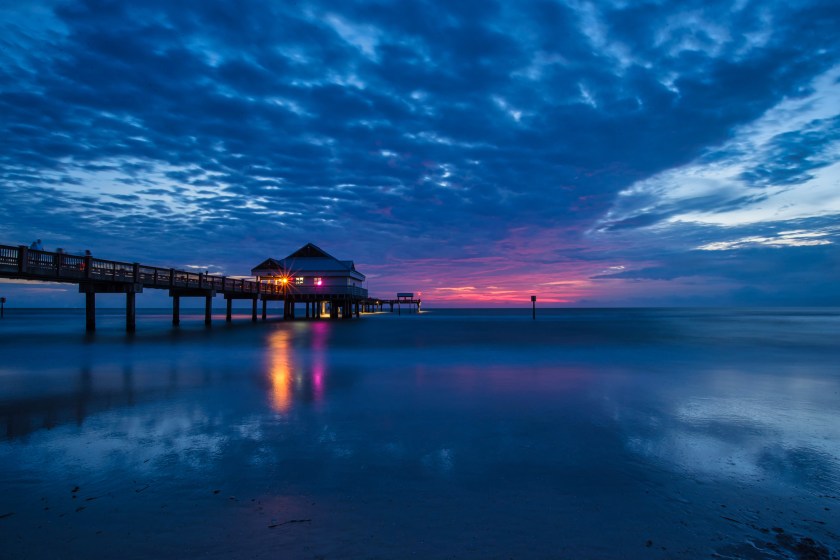
Long exposure photograph of Pier 60 on Clearwater Beach at sunset, with pink and purple sky tones reflecting on calm water.
Long exposure pink sunset at Pier 60 on Clearwater Beach.

In this contemplative study from Chapter 2 of the Top 100 Journey, the photographer demonstrates a sophisticated command of long-exposure technique to capture the liminal hour where day surrenders to night along Florida’s Gulf Coast. Shot at Clearwater Beach, this sixty-second exposure transforms the volatile surf into a glassy, ethereal plane that mirrors the atmospheric drama unfolding above.

The composition centers on Pier 60, an iconic structure that extends into the frame with geometric precision. The photographer has positioned himself to capture the pier in its full dimensionality—the wooden pilings create a rhythmic vertical pattern that draws the eye toward the pavilion structure, where warm sodium lights pierce the deepening blue hour. These artificial punctuations of yellow and magenta provide crucial counterpoints to the natural color palette, preventing the image from dissolving entirely into monochromatic twilight. The long exposure has softened the lights into glowing orbs, their reflections stretching across the wet sand in elongated streaks that echo the horizontal thrust of the pier itself.

The technical execution reveals deliberate choices throughout. At f/22, the photographer has prioritized depth of field and the creation of diffraction spikes around the light sources, adding a subtle stellar quality to the illumination. The ISO 100 setting ensures maximum image quality, while the 18mm focal length—shot on a full-frame Nikon D610 with an 18-35mm lens—provides expansive coverage that encompasses both the architectural subject and the vast atmospheric canvas surrounding it. This wider perspective situates the human-made structure within the broader natural context, a recurring tension in his Florida landscapes.

The sky commands nearly two-thirds of the frame, and rightfully so. The textured cloud formations—rendered in deep indigos and cobalt blues—create a dramatic ceiling that seems to press down upon the horizon line where pink and peach tones persist from the recently set sun. This color gradient, from warm horizon to cool zenith, demonstrates the photographer’s understanding of transitional light and his patience in waiting for the precise moment when competing color temperatures achieve balance.

The wet foreground sand serves multiple compositional functions. Its reflective quality doubles the visual information, creating subtle mirror images of the pier lights, while the barely perceptible texture of the beach—preserved despite the long exposure—grounds the image in physical reality. This detail prevents the photograph from becoming overly abstract, maintaining the delicate equilibrium between documentary observation and interpretive vision.

Within the broader context of Chapter 2—Florida Landscapes & Cityscapes—this image exemplifies the photographer’s evolving relationship with his adopted coastal environment. Where earlier works might emphasize the region’s vibrant daylight character, this photograph engages with Florida’s more contemplative aspects: the quiet moments of transition, the interplay between natural beauty and recreational infrastructure, the way tourism and wilderness coexist along these developed shorelines.

The photograph ultimately succeeds as both technical achievement and aesthetic statement. It captures a specific place at a specific moment while transcending those particulars to evoke the universal experience of standing at the edge of vast water as darkness approaches—a meditation on transience rendered permanent through the camera’s patient eye.

Pilot Boat Pier

This photograph of Fort De Soto Park’s pilot boat pier captures the harmony between utilitarian structures and aesthetics. Utilizing a long exposure, the image highlights light, geometry, and the duality of human activity and nature. The pier becomes more than functional; it represents Florida’s coastal identity, deserving appreciation alongside natural landscapes.

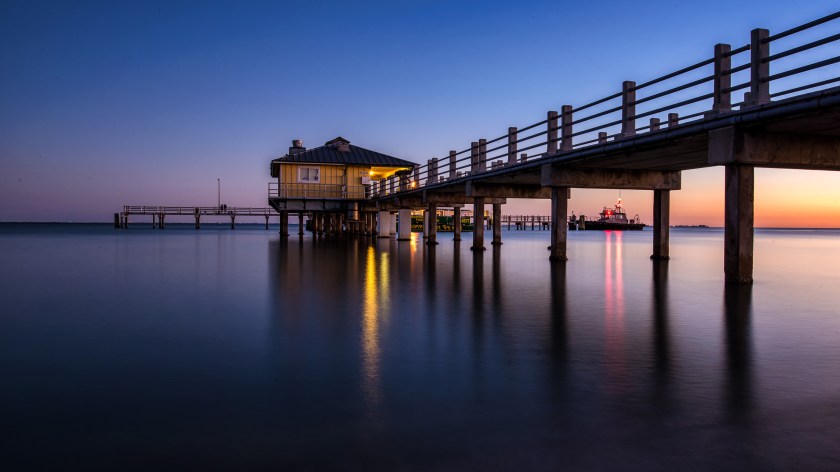
Long exposure twilight photograph of the Bay Pier at Fort De Soto Park in Florida, with a yellow pilot‑boat building illuminated over calm water.
Long exposure twilight view of the pilot boat pier at Fort De Soto Park.

In this carefully orchestrated study of maritime infrastructure at Fort De Soto Park, the photographer demonstrates his capacity to locate poetry within utilitarian structures. The pilot boat pier—a working facility that guides commercial vessels through Tampa Bay’s shipping channels—becomes here a meditation on light, geometry, and the quiet professionalism of coastal operations. Shot during the blue hour with a twenty-five-second exposure at f/16 on a Nikon D610, the image transforms functional architecture into something approaching minimalist sculpture.

The compositional intelligence reveals itself in layers. The pier’s diagonal thrust from left to right creates dynamic movement across the frame, while the elevated structure’s horizontal rails establish rhythmic intervals that lead the eye toward the distant vessel. The photographer has positioned himself to capture the pilings in perfect vertical alignment, their reflections doubling into the glassy water below—a mirror effect achieved through the extended exposure that renders Tampa Bay into polished obsidian. At ISO 100, the twenty-five-millimeter focal length provides sufficient context to establish spatial relationships without sacrificing the intimate scale of the pier house itself.

Light operates as the image’s true subject. The warm interior glow from the pier house casts golden striations across the water, creating a luminous pathway that contrasts with the cool blue-violet gradient dominating the sky. The distant pilot boat, its navigation lights punctuating the horizon in red, provides a crucial narrative element—evidence of the pier’s ongoing purpose even as twilight suspends it in apparent timelessness. This balance between ambient and artificial light, between natural phenomena and human activity, positions the work firmly within the chapter’s exploration of Florida’s developed coastlines.

What distinguishes this image from the photographer’s other coastal studies is its emphasis on infrastructure as architecture. The pier is not merely a platform for viewing nature but an elegant construction worthy of attention in its own right. The horizontal rails, repeating with mechanical precision, create a visual counterpoint to the organic curves of the shoreline visible in the distance. The photographer acknowledges that Florida’s landscape is fundamentally collaborative—nature and human intervention existing in constant dialogue rather than opposition.

The technical execution merits particular attention. The f/16 aperture ensures depth of field sufficient to hold both foreground pilings and horizon vessel in acceptable focus, while the twenty-five-second exposure smooths the water into a reflective plane that doubles the compositional impact of every vertical element. The choice to shoot at this precise moment—when daylight has drained from the western sky but hasn’t yet surrendered to complete darkness—captures that transitional state where artificial lights begin to assert themselves without overwhelming the scene’s natural tonal range.

Within the broader context of the Florida Landscapes & Cityscapes chapter, this photograph represents the photographer’s mature understanding of the state’s coastal identity. Fort De Soto’s pilot boat pier is neither wilderness nor urban environment but something uniquely Floridian—a working maritime facility embedded within a state park, where commerce and recreation, industry and leisure, coexist without apparent conflict. By rendering it with such formal rigor and aesthetic consideration, the photographer argues for expanded recognition of these hybrid spaces as legitimate subjects for contemplation, deserving the same careful attention traditionally reserved for pristine natural vistas.

See this image on:

500px

Flickr

Tampa Panoramic at Night: A Study in Urban Luminescence

The panoramic long exposure photograph of downtown Tampa captures its urban beauty at night from the University of Tampa. This 2014 composition emphasizes artificial light’s role in depicting the cityscape, blending architectural detail and varied illumination. It challenges perceptions of Florida, asserting urban environments as significant alongside natural landscapes, showcasing the photographer’s technical skill and versatility.

Panoramic long exposure composite of downtown Tampa, Florida, photographed at night from across the Hillsborough River, showing illuminated skyscrapers, waterfront reflections, and dramatic clouds.
Panoramic long exposure view of downtown Tampa at night, captured from the UT campus across the Hillsborough River.

In this commanding 2014 panoramic composite, the photographer captures downtown Tampa’s nocturnal identity with technical precision and compositional sophistication. Selected for Chapter 2 of his Top 100 Journey—Florida Landscapes & Cityscapes—the image represents a pivotal moment in his exploration of urban environments, where the built landscape becomes a canvas for light, reflection, and architectural rhythm.

The photograph was executed from the University of Tampa campus, positioned across the Hillsborough River to establish both physical and aesthetic distance from the subject. This vantage point proves strategic: the river functions not merely as foreground but as an active participant in the composition, its surface transforming into a liquid mirror that doubles the visual impact of the skyline. The long exposure technique smooths the water into a reflective plane, allowing the city’s illumination to paint streaks of gold, pink, and violet across the lower third of the frame.

What distinguishes this work within the chapter’s broader narrative is its treatment of artificial light as a defining characteristic of place. While Florida’s natural landscapes—its coastlines, wetlands, and subtropical flora—typically dominate photographic representations of the state, this image asserts the validity of the urban experience as equally worthy of documentation. The photographer approaches Tampa’s skyline not as an intrusion upon nature but as a distinct ecosystem of glass, steel, and light, possessing its own aesthetic logic and visual poetry.

The panoramic format extends the horizontal axis, emphasizing the sprawl and variety of Tampa’s architectural character. Twin residential towers anchor the composition’s center, their construction-phase lighting creating vertical counterpoints to the horizontal sweep of the skyline. To the right, a cylindrical high-rise glows amber, its illuminated facade creating a beacon within the frame. The building adorned with pink-magenta accent lighting introduces chromatic variation, preventing the warm-toned dominance from becoming monotonous. This diversity of illumination—commercial, residential, decorative—reveals the stratified nature of urban nightscapes, where different lighting purposes create unintentional visual harmony.

The technical execution merits attention. Creating a panoramic composite requires not only multiple exposures stitched seamlessly but also consistent exposure values across frames and careful management of the long exposure duration. The photographer balances ambient light with the stronger point sources of building illumination, preventing blown highlights while retaining detail in darker architectural elements. The clouded sky, rendered in motion-blurred copper tones, provides textural contrast to the sharp geometry below.

Within the context of the Top 100 Journey, this image demonstrates the photographer’s versatility in approaching Florida’s varied visual territories. While subsequent work in this chapter may explore the state’s natural drama—storm systems over the Gulf, the crystalline waters of its springs, the atmospheric density of its wetlands—this urban portrait establishes his comfort with diverse subject matter and technical approaches. The photograph argues for Tampa’s inclusion in the visual narrative of Florida, asserting that the state’s identity encompasses both wilderness and metropolitan sophistication.

The image remains a testament to the possibilities inherent in patient observation and technical mastery, transforming a familiar skyline into a study of light, color, and urban form.

Under Naples Pier at Sunset: Architecture Meets the Ethereal

Greg Urbano’s long exposure photograph beneath Naples Pier captures the interplay of human architecture and nature, highlighting time and impermanence. Shot with meticulous technique, the image transforms a familiar locale into a contemplative space where smooth Gulf waters contrast with weathered pilings, emphasizing Florida’s geography and the enduring power of the natural world.

Long exposure photograph taken beneath the Naples Pier in Florida, showing weathered support columns receding into the distance with smooth, blurred water and soft sunset light.
Long exposure view beneath the Naples Pier in Florida, captured with softened water and warm evening light.

In Greg Urbano’s exploration of Florida’s coastal landscapes, this long exposure beneath Naples Pier represents a masterful convergence of structural geometry and natural fluidity. The photograph transforms a familiar tourist destination into something altogether more contemplative—a meditation on time, permanence, and the quiet persistence of natural forces.

The technical execution reveals deliberate artistic choices that elevate the image beyond documentary. Shot at a 30-second exposure with an aperture of ƒ/10, Urbano allows the Gulf waters to smooth into an almost supernatural plane of silk, while the pier’s wooden pilings remain sharply rendered, their weathered surfaces recording years of salt spray and tidal rhythms. The ISO 100 setting preserves exceptional clarity in both the concrete deck overhead and the barnacle-encrusted bases of each column, where marine life has claimed the structure as its own.

What distinguishes this photograph within the Florida Landscapes & Cityscapes chapter is its unique vantage point. Rather than capturing the pier from the beach or along its walkway—the conventional approaches—Urbano positions himself in the liminal space beneath, where human architecture and marine environment intersect. This perspective creates a vanishing point that draws the eye through the repetitive columns, suggesting infinity while simultaneously framing the horizon in measured increments. The composition speaks to Florida’s essential character: a place where human development exists in constant negotiation with water, weather, and an environment that ultimately cannot be controlled.

The color palette captures that transitional moment when day surrenders to evening. Soft blues dominate the frame, punctuated by warmer tones filtering through the gaps between pilings where the setting sun still reaches. The long exposure has rendered a handful of beachgoers as ghostly presences, barely perceptible in the distance—a reminder that even in this serene moment, human activity continues, though made insignificant by the photograph’s emphasis on timelessness over immediacy.

The textural contrasts throughout the frame reward sustained viewing. The smooth, almost liquid sand in the foreground shows subtle patterns from receding water, while the pier pilings display years of weathering—concrete cracking and staining, wooden supports silvered by sun and salt. Most striking are the organic clusters clinging to each column where water regularly submerges them, dark masses of mussels and barnacles that testify to the structure’s dual existence above and below the tideline.

This image exemplifies why Urbano selected Naples Pier for inclusion in his exploration of Florida’s diverse landscapes. The state’s geography is defined by its relationship with water—the Atlantic, the Gulf, the Everglades, countless rivers and springs. Here, that relationship is made architectural, structured, yet the photograph ultimately reveals nature’s quiet supremacy. The pier may impose order with its regular spacing and engineered strength, but the barnacles reclaim it, the water smooths away footprints, and time—made visible through long exposure—reveals the impermanence of even our most solid constructions.

Within the broader context of the Top 100 Journey, this photograph demonstrates Urbano’s ability to find fresh perspectives on familiar subjects, transforming a popular sunset location into a study of geometry, time, and the persistent dialogue between built and natural environments that defines Florida’s coastal identity.

Venice Fishing Pier Sunset: Mastering the Fundamentals of Light

Greg Urbano’s sunset photograph of the Venice Fishing Pier exemplifies the intersection of technical skill and artistic sensibility in landscape photography. Through meticulous use of exposure and composition, Urbano captures a moment where structured permanence meets the fluidity of nature, showcasing balanced tones and dynamic movement in a serene coastal scene.

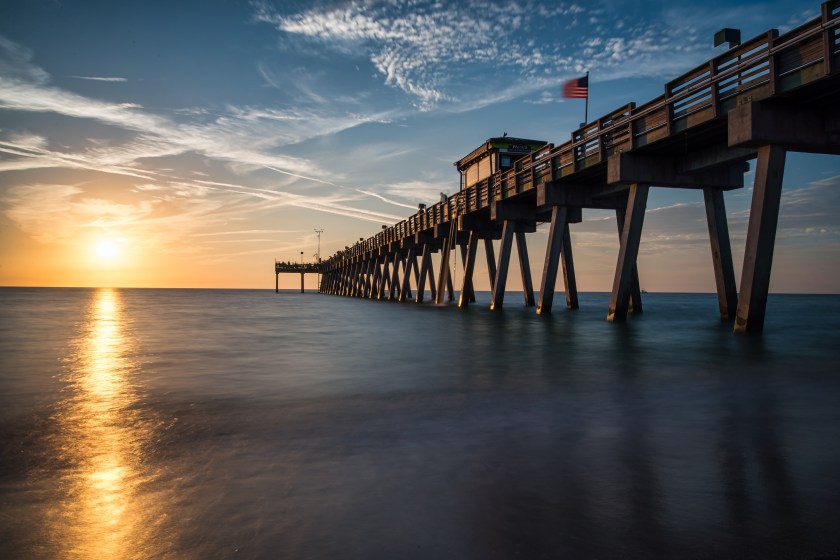
Sunset photograph of the Venice Fishing Pier in Florida, showing the pier extending into the Gulf of Mexico with golden reflections on calm water.
Sunset over the Gulf of Mexico with the Venice Fishing Pier in the background, captured in a long exposure.

Within Greg Urbano’s “Beginnings” chapter, this sunset photograph of the Venice Fishing Pier represents a photographer coming to terms with landscape photography’s essential discipline: the patient orchestration of light, water, and architecture. Shot along Florida’s Gulf Coast, the image demonstrates technical competence married to an emerging aesthetic sensibility—a combination that marks the transition from enthusiast to serious practitioner.

The technical execution reveals deliberate choices that elevate this beyond a simple sunset snapshot. Using a Nikon D610 with an 18-35mm lens set to 28mm, Urbano selected an aperture of f/18 to maximize depth of field, ensuring sharpness from the foreground water to the distant pier structure. The 13-second exposure at ISO 100 transforms the Gulf of Mexico into a silken plane, smoothing the texture of incoming waves into an ethereal blue gradient. This long exposure technique—fundamental to seascape photography—requires both technical knowledge and patience, waiting for the precise moment when light, tide, and atmospheric conditions align.

The composition demonstrates sophisticated spatial awareness. The pier’s diagonal thrust from lower right to upper left creates dynamic movement through the frame, leading the viewer’s eye from the silky foreground water toward the structure’s vanishing point. The rhythmic repetition of pier supports establishes a visual cadence, their angular geometry contrasting beautifully with the organic flow of water and clouds. An American flag atop the pier adds a vertical accent and a touch of patriotic iconography without overwhelming the scene’s natural beauty.

What distinguishes this photograph is Urbano’s treatment of light. The setting sun hovers just above the horizon line, its golden warmth reflected in a shimmering path across the water’s surface. The exposure balances multiple tonal zones expertly: the brilliant sun doesn’t blow out to featureless white, the shadowed pier structure retains detail, and the water holds both luminous highlights and cool, deep blues. This tonal control suggests a photographer who understands exposure compensation and potentially uses graduated neutral density filters or careful post-processing to manage the scene’s extreme dynamic range.

The sky deserves particular attention. Wispy cirrus clouds stretch across the frame in delicate streaks, their feathered patterns creating texture and visual interest in what might otherwise be empty blue space. The interplay between warm sunset tones near the horizon and cooler blues above establishes atmospheric depth, giving the image a sense of vast space and coastal openness.

As a “Beginnings” chapter work, this photograph represents mastery of landscape photography fundamentals. The long exposure technique, the careful attention to composition and leading lines, the patient waiting for optimal light—these are the building blocks upon which more experimental work can later be constructed. There’s confidence here, a photographer who has moved beyond technical uncertainty into intentional image-making.

The Venice Pier becomes more than a documentary subject; it transforms into a meditation on structure and impermanence. The solid, engineered permanence of the pier contrasts with the fluid, ever-changing water—a tension made visible through photographic technique. Urbano captures not just a place, but a moment of perfect equilibrium between human construction and natural forces, all bathed in the transient golden light that photographers chase endlessly along coastlines worldwide.