Shannon Quinn Creative Red Mesh 01: Portraiture as Transformation

The portrait of model Shannon Quinn, captured with red mesh fabric, highlights the photographer’s creative departure during a commissioned headshot session in Denver. This image explores themes of identity and concealment, merging fashion and classical techniques. It reflects a sophisticated understanding of light and invites viewers to contemplate the complexities of photographic representation.

Studio portrait of model Shannon Quinn standing against a dark background, partially draped in red mesh fabric with hands raised and visible through the translucent material.
Model Shannon Quinn photographed in a studio portrait using red mesh during a creative headshot session in Denver, Colorado.

Within the context of a commissioned headshot session, the photographer discovered an opportunity for creative departure—a moment when commercial purpose yielded to artistic exploration. This photograph, featuring model Shannon Quinn enveloped in crimson mesh fabric, exemplifies his ability to recognize and pursue unexpected visual possibilities within structured professional environments. The resulting image transcends its utilitarian origins, offering instead a meditation on identity, concealment, and the transformative potential of portraiture.

The composition centers on the subject’s steady, outward gaze, her expression poised between vulnerability and defiance. She holds the translucent red fabric above her head with both hands, creating a canopy that simultaneously reveals and obscures. This gesture—part unveiling, part self-protection—establishes a compelling psychological tension. The mesh filters light across her features while maintaining visual clarity, creating a liminal space where the subject exists between states: seen yet veiled, present yet ethereal, contemporary yet somehow timeless.

The photographer’s handling of light demonstrates technical sophistication and restraint. Working against a dark, neutral background, he allows the ambient illumination to bathe the subject’s face in warm tones that harmonize with the red mesh. The fabric itself becomes an active participant in the lighting scheme, casting subtle patterns and chromatic shifts across her skin and clothing. Her black attire—a textured top with bow detail—provides essential contrast, anchoring the composition while allowing the red fabric to command attention without overwhelming the frame.

What distinguishes this work is its navigation of multiple photographic traditions simultaneously. Elements of fashion photography appear in the subject’s confident pose and styled presentation, while the dramatic use of fabric recalls classical painting techniques where drapery conveys narrative and emotional weight. The dark background and controlled studio lighting situate the image within portraiture’s formal conventions, yet the unconventional use of the mesh material disrupts these expectations, injecting contemporary conceptual sensibility into an otherwise traditional setup.

Positioned within Chapter 6 of his Top 100 Journey—”The Road Ahead: Recent Work & Ongoing Exploration”—this photograph signals the artist’s ongoing investigation into portraiture’s evolving possibilities. The chapter’s emphasis on recent work and exploration finds perfect expression here: a commissioned session becomes a laboratory for creative experimentation, demonstrating that artistic vision need not be confined to personal projects alone. Professional practice and artistic development exist not as separate domains but as mutually enriching pursuits.

The red mesh functions as both literal and metaphorical element—a physical barrier that paradoxically enhances rather than diminishes our connection to the subject. This duality speaks to fundamental questions about photographic representation itself: what do we truly see when we look at a portrait? How do layers of interpretation, context, and visual mediation shape our understanding of another person’s presence?

In Shannon Quinn’s direct gaze, there exists a knowing quality, an awareness of the camera’s scrutiny and the complex transaction occurring between subject, photographer, and eventual viewer. This consciousness elevates the image beyond mere technical accomplishment, transforming it into a collaborative exploration of visibility, identity, and the porous boundaries between commercial and fine art photography. It stands as evidence of his commitment to finding artistic merit wherever circumstances allow, refusing to separate professional obligation from creative possibility.
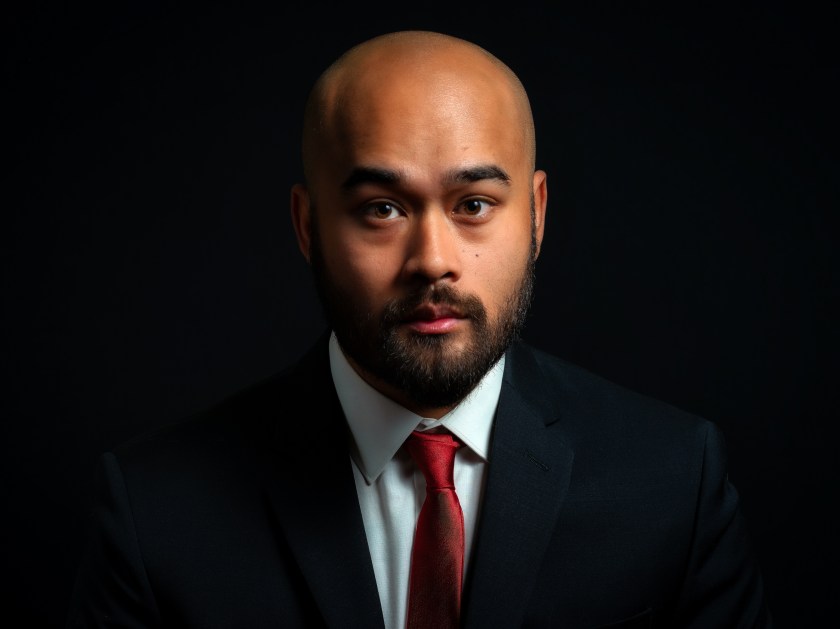
Mike Groth: Classical Studio Portraiture and the Language of Formality

Mike Groth’s studio portrait, featured in Chapter 4 of the Top 100 Journey, exemplifies traditional portraiture through controlled lighting and composition. Shot at Old Town Yoga Studio, the image focuses on character and presence, utilizing a classic backdrop and professional techniques. Its formal simplicity highlights the subject’s confidence, making it versatile across various contexts.

Bald man with a beard wearing a suit and red tie looks directly at the camera against a black background.
Mike Groth is photographed in a studio portrait at Old Town Yoga Studio in Fort Collins, Colorado.

Within Chapter 4 of the photographer’s Top 100 Journey, this portrait of Mike Groth represents a return to the foundational principles of studio portraiture—controlled lighting, deliberate composition, and the timeless formality of traditional headshot aesthetics. Shot at the Old Town Yoga Studio in Fort Collins, Colorado, the image demonstrates the photographer’s facility with classic studio techniques while exploring the psychological dimensions of formal masculine presentation.

The technical execution adheres to established conventions of corporate and editorial portraiture. Utilizing a Sony A7ii with an 85mm f/1.8 lens, the photographer has positioned his subject against a pure black backdrop, eliminating all environmental context to focus entirely on character and presence. A Godox V1s flash paired with a shoot-through umbrella provides the primary illumination—a traditional modifier choice that produces soft, diffused light with gentle shadow gradation across the subject’s features. This approach creates dimensional modeling without the harsh contrast of direct flash, revealing the contours of the face while maintaining a polished, professional quality.

The composition centers the subject in a classical three-quarter view, shoulders angled slightly to create visual interest while the face turns toward the camera. This positioning—neither fully frontal nor profile—has been a cornerstone of portraiture since the Renaissance, offering both dimensionality and direct engagement. The subject’s formal attire—dark suit, white shirt, burgundy tie—reinforces the traditional corporate aesthetic, while his neutral expression and direct gaze suggest confidence tempered with approachability.

What distinguishes this work within the photographer’s broader practice is its embrace of restraint. Where other images in Chapter 4 explore environmental integration and spontaneous moments, this portrait strips away context to examine how lighting, posture, and expression alone can convey character. The black void backdrop functions not merely as a neutral background but as an active element, creating psychological weight and directing all attention to the subtle details: the catch lights in the eyes, the texture of facial hair, the precise fall of shadow along the jawline.

The post-processing in Luminar 4 maintains the studio’s carefully controlled atmosphere. Skin tones are rendered with natural warmth while preserving texture and detail. The lighting reveals itself as directional yet forgiving, highlighting the subject’s facial structure without creating unflattering shadows. This balance between revelation and flattery characterizes effective professional portraiture—honest without being harsh, polished without appearing artificial.

Within the context of Chapter 4’s mission to document studio, outdoor, and workshop methodologies, this image anchors the studio component with particular authority. It demonstrates that contemporary portrait photography need not abandon classical techniques in pursuit of innovation. The photographer’s choice to work within established conventions reflects an understanding that certain approaches endure precisely because they succeed in their essential task: revealing the subject’s presence and character with clarity and dignity.

The formal simplicity of this portrait allows it to function across multiple contexts—editorial, corporate, archival. This versatility speaks to the photographer’s understanding of portraiture not merely as artistic expression but as functional communication. As part of the Top 100 Journey, the image represents a technical benchmark, showcasing the fundamental competencies upon which more experimental work can build. It is portraiture in its most distilled form: light, subject, and the photographer’s ability to orchestrate their interaction with precision and purpose.