Suspended Between Earth and Sky: A Study in Geometric Embrace

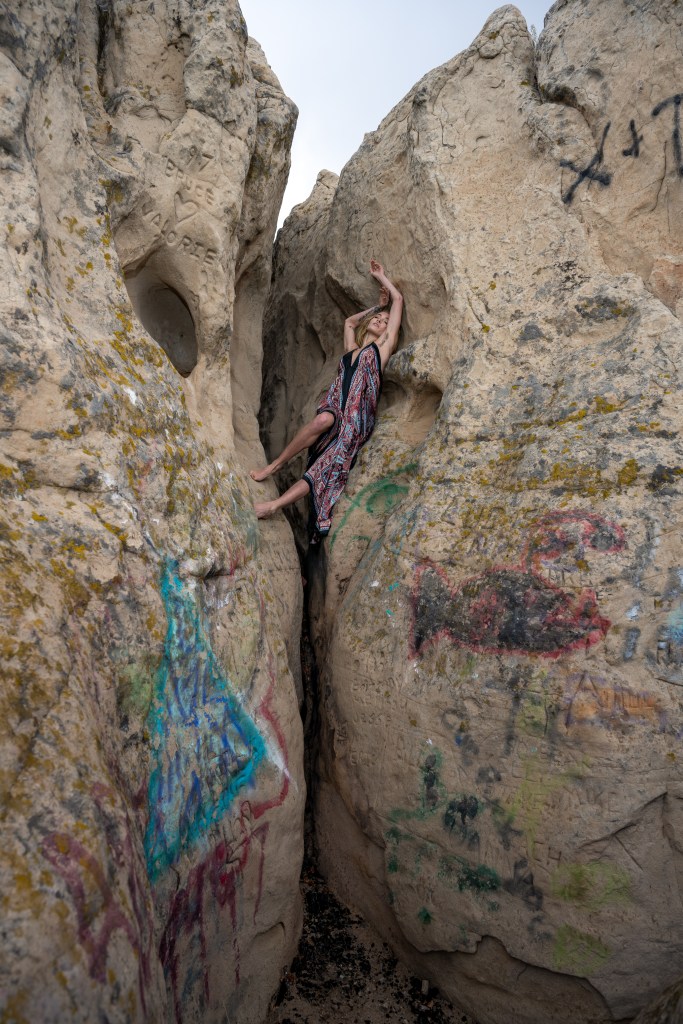
The photograph of Jennie Parks in a sandstone crevice at the Colorado-Wyoming border conveys a powerful interplay between human form and rugged landscape. The composition showcases Parks as both an integral part of the environment and a symbol of human vulnerability, enriched by graffiti that connects ancient rock with contemporary existence.

Model Jennie Parks posed barefoot within a narrow sandstone rock crevice, surrounded by weathered stone walls with graffiti and lichen.
Jennie Parks positioned inside a sandstone crevice at the Natural Fort rock formation on the Colorado–Wyoming border.

In this striking composition from Chapter 6 of the photographer’s Top 100 Journey, the human figure becomes a graceful counterpoint to the harsh geometry of desert stone. Shot at the natural fort rock formation straddling the Colorado-Wyoming border, the image captures model Jennie Parks wedged within a narrow crevasse, her body forming a living bridge between two massive limestone walls that tower overhead.

The photographer demonstrates a sophisticated understanding of environmental portraiture here, positioning his subject not merely within the landscape but as an integral element of its architecture. Parks’s extended pose—one arm reaching upward, legs braced against opposing walls—transforms the human form into a line of tension that mirrors the vertical thrust of the surrounding stone. The patterned fabric of her dress introduces rhythmic visual complexity against the textured, graffiti-marked surfaces of the rock, creating a dialogue between organic movement and geological permanence.

Technically, the composition exploits the natural framing device of the rock formation with considerable skill. The converging walls create strong diagonal lines that draw the eye upward toward the narrow strip of overcast sky, while the low vantage point emphasizes the vertiginous scale of the formation. The photographer has worked with available light to maintain detail in both the shadowed crevasse and the brighter upper reaches, a challenging exposure balance that preserves the dimensional quality of the weathered stone surfaces.

What distinguishes this work within the context of “The Road Ahead: Recent Work & Ongoing Exploration” is its synthesis of earlier themes with new formal rigor. The image continues the photographer’s established interest in the relationship between human vulnerability and natural grandeur, yet demonstrates an evolving sophistication in how that relationship is articulated. Rather than placing the figure as a small element overwhelmed by landscape—a common approach in environmental portraiture—he positions Parks as an active participant in the space’s geometry, neither dominated by nor dominating the scene.

The inclusion of graffiti on the rock faces introduces an unexpected documentary element. These colorful marks of human passage—blue and turquoise abstractions, faded pink tags—situate the timeless geological formation within contemporary reality. Rather than diminishing the image’s aesthetic power, this urban palimpsest enriches the reading: the rock has witnessed countless human gestures, from ancient weathering to modern spray paint to this moment of choreographed grace.

As representative of ongoing exploration, the photograph reveals an artist continuing to refine his visual vocabulary while remaining open to chance encounters and improvisation. The natural fort formation itself suggests the kind of site-responsive work that characterizes mature landscape photography—locations discovered rather than constructed, where the photographer’s role becomes one of recognition and revelation rather than wholesale invention.

In the broader trajectory of the Top 100 Journey, this image marks a moment of confident synthesis. The technical command is assured, the conceptual framework clear, yet there remains an element of spontaneity in how Parks inhabits the narrow space. It is work that looks both backward to established concerns and forward to possibilities yet unrealized—precisely the balance one expects from a chapter titled “The Road Ahead.”
Jonny Edward — Portrait

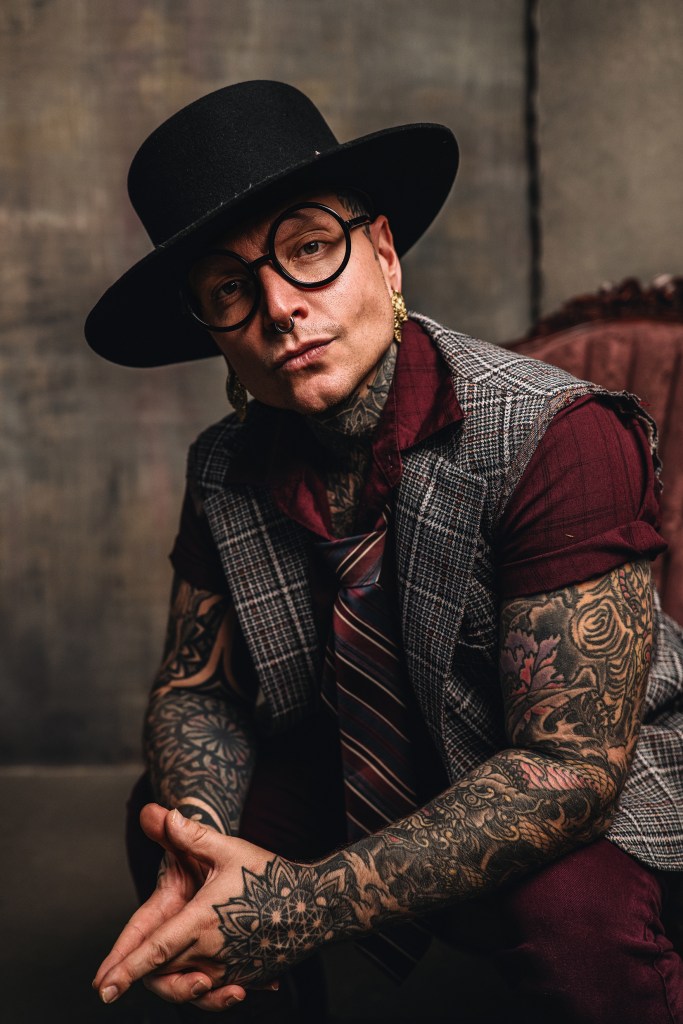
In this sixth chapter of the visual odyssey, Jonny Edward’s portrait embodies the blend of environment and identity, created in his studio, Atelier Alchimia. The image emphasizes texture and iconography, showcasing a stylistic marriage between traditional garments and modern tattoos. It marks a pivot to evocative, symbolic portraiture, exploring the philosophy of aesthetic existence.

Portrait of a person wearing a black hat and round glasses, seated indoors with tattooed arms, dressed in a vest, shirt, and tie against a textured studio backdrop.
Portrait of Jonny Edward photographed seated in his studio, wearing a hat, glasses, and layered clothing, with tattoos visible on both arms.

In the sixth chapter of this ongoing visual odyssey, the photographer explores the intersection of environment and identity, moving beyond the mere capture of a likeness to conduct a sophisticated study of texture and personal iconography. This portrait of Jonny Edward, captured within the subject’s own creative sanctuary, Atelier Alchimia, serves as a cornerstone of the “Recent Work & Ongoing Exploration” phase. It represents a pivot toward a more layered, atmospheric approach to portraiture, where the subject and the space they inhabit become indistinguishable components of a singular narrative.

The composition is a masterclass in the management of complex visual information. The subject is positioned with a calculated stillness, his gaze direct and piercing through circular frames that provide a geometric anchor for the viewer. There is a profound intentionality in the styling: the marriage of classic haberdashery—a wide-brimmed felt hat, a patterned cravat, and a structured waistcoat—against the modern, intricate cartography of extensive tattoo work. The photographer skillfully navigates these disparate elements, ensuring that the elaborate patterns of the skin and the plaid of the vest complement rather than compete with one another.

Technically, the image excels in its tonal range and tactile quality. The lighting is deliberate, casting a soft yet directional glow that carves out the contours of the subject’s face and highlights the physical relief of the ink on his forearms. There is a tangible weight to the textures presented: the coarseness of the waistcoat’s weave, the smoothness of the felt hat, and the weathered patina of the background wall. This background, reminiscent of a Renaissance fresco in its muted, distressed tones, provides a timeless quality that lifts the portrait out of a specific era and into a more permanent, artistic realm.

As a significant entry in the “Top 100 Journey,” this work illustrates the photographer’s evolving mastery of the “creative workshop” environment. By collaborating within a space designed for artistic alchemy, he has successfully distilled the essence of a fellow creator. The image functions as a dialogue between two artists—one in front of the lens and one behind it—resulting in a portrait that feels less like an observation and more like an excavation.

In the context of Chapter 6: The Road Ahead, this photograph signals a refined direction. It moves away from traditional, literal portraiture toward a more symbolic and evocative methodology. The hands, clasped in a gesture of quiet strength, draw the eye to the lower third of the frame, grounding the composition and reinforcing the sense of grounded presence. It is an exploration of the “modern alchemist,” capturing a figure who is both a product of and a contributor to the creative landscape of Colorado. This portrait does not merely record a face; it documents a philosophy of aesthetic existence, marking a high point in the photographer’s continued pursuit of visual excellence.

Natural Elegance: A Portrait in Copper and Light

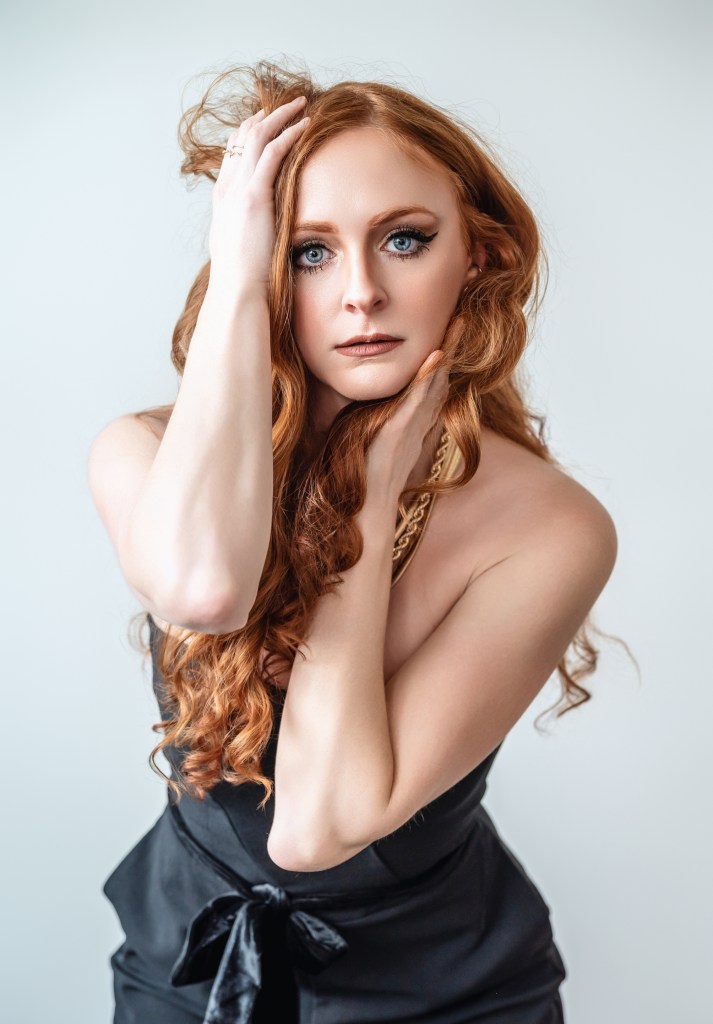
Abigail Marchetti, known as Copper Muse, poses at a Denver Models open shoot, showcasing the photographer’s evolving studio portraiture techniques. Utilizing natural light, he captures her striking features and authentic expression, emphasizing color harmony and psychological presence. This portrait marks a significant step in his artistic development, blending classical principles with a modern sensibility.

Studio portrait of a red-haired woman in a black dress posing against a light background with her hands framing her face.
Model Abigail Marchetti, known as Copper Muse, poses during a Denver Models open shoot at Realm Studio in Denver.

This compelling portrait of model Abigail Marchetti exemplifies the photographer’s deepening engagement with studio portraiture and his refined approach to natural light as a primary sculptural tool. Captured during a Denver Models open shoot at Realm Studio, the image represents continued exploration of collaborative creative environments while demonstrating increasingly sophisticated control of the portraitist’s essential elements: light, gesture, color harmony, and psychological presence.

The composition centers on the model’s striking features—vibrant copper-red hair cascading in loose waves, piercing blue-green eyes meeting the camera with direct but unguarded confidence, and pale skin that catches and reflects the soft window light with luminous clarity. Her pose, with one hand gracefully raised to her hair and the other touching her neck, creates natural framing that draws attention to her face while suggesting unaffected spontaneity. The black strapless garment provides bold tonal contrast against both her skin and the pale backdrop, creating visual drama without competing for attention.

What distinguishes this work is the photographer’s masterful exploitation of natural window light. Rather than relying on the multiple strobes and reflectors typical of commercial studio work, he has chosen a more classical approach that recalls portrait painting traditions. The directional quality of the illumination—soft yet defined—models the subject’s features with sculptural precision while maintaining delicate gradations across skin tones. Highlights along the hair reveal its rich, multidimensional copper coloring, transforming what could be merely descriptive documentation into chromatic study.

The technical execution demonstrates growing confidence with the Nikon Z5 system and the versatile 24-120mm lens. The focal length selection—likely in the moderate telephoto range—provides flattering perspective without distortion, while the depth of field keeps the subject sharply defined against the subtly gradated background. The exposure balances the challenge of pale skin and light background without sacrificing detail in either the model’s features or the deeper tones of her garment.

Within the framework of Chapter 6—”The Road Ahead: Recent Work & Ongoing Exploration”—this portrait signals important developments in his artistic trajectory. The open shoot environment, like the previous workshop-based work, indicates willingness to engage with structured collaborative opportunities while bringing his distinct sensibility to bear. Yet where some open shoots yield generic beauty documentation, this image transcends its circumstances through careful attention to classical portraiture principles: the quality of light, the authenticity of expression, the harmony of color and form.

The model’s direct gaze introduces a quality often absent from his landscape and architectural work—reciprocal acknowledgment between photographer and subject. This mutual recognition adds psychological dimension, transforming technical exercise into genuine encounter. The slight asymmetry in her expression—contemplative rather than performative—suggests comfort and trust within the photographic exchange.

The photograph also reveals evolving aesthetic priorities. While maintaining the tonal sensitivity and compositional rigor evident throughout his portfolio, he demonstrates here that minimalism need not preclude richness. The interplay of copper hair, pale skin, black fabric, and soft grey background creates visual complexity through chromatic relationships rather than environmental detail. This represents a distillation of his practice—finding depth in apparent simplicity, discovering complexity in restraint—now applied to the human figure with increasing assurance and grace.