Suspended Between Earth and Sky: A Study in Geometric Embrace

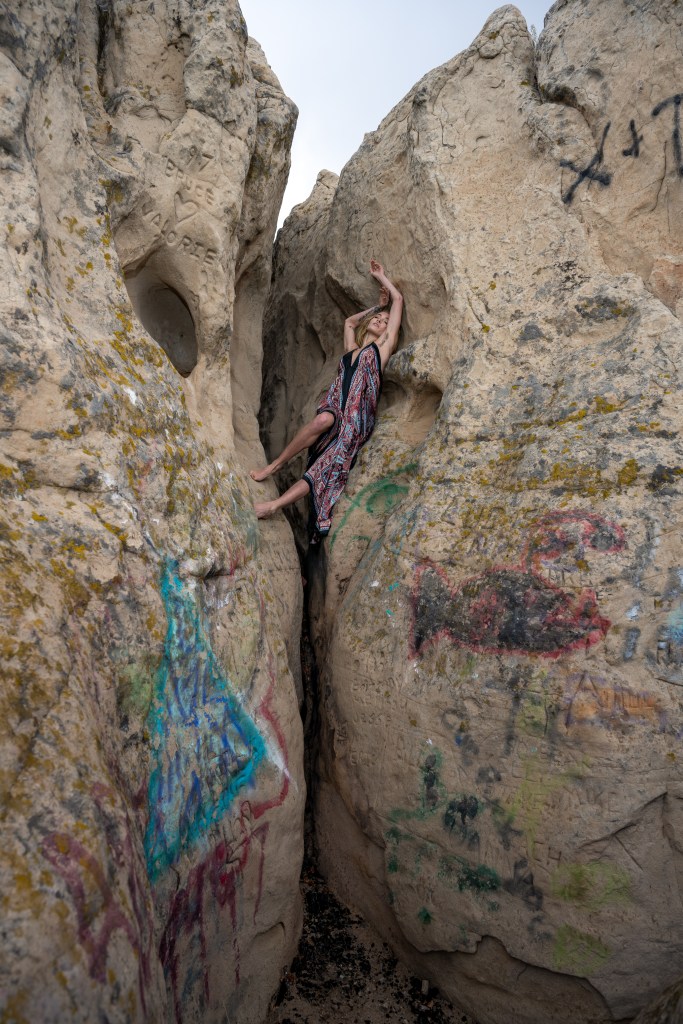
The photograph of Jennie Parks in a sandstone crevice at the Colorado-Wyoming border conveys a powerful interplay between human form and rugged landscape. The composition showcases Parks as both an integral part of the environment and a symbol of human vulnerability, enriched by graffiti that connects ancient rock with contemporary existence.

Model Jennie Parks posed barefoot within a narrow sandstone rock crevice, surrounded by weathered stone walls with graffiti and lichen.
Jennie Parks positioned inside a sandstone crevice at the Natural Fort rock formation on the Colorado–Wyoming border.

In this striking composition from Chapter 6 of the photographer’s Top 100 Journey, the human figure becomes a graceful counterpoint to the harsh geometry of desert stone. Shot at the natural fort rock formation straddling the Colorado-Wyoming border, the image captures model Jennie Parks wedged within a narrow crevasse, her body forming a living bridge between two massive limestone walls that tower overhead.

The photographer demonstrates a sophisticated understanding of environmental portraiture here, positioning his subject not merely within the landscape but as an integral element of its architecture. Parks’s extended pose—one arm reaching upward, legs braced against opposing walls—transforms the human form into a line of tension that mirrors the vertical thrust of the surrounding stone. The patterned fabric of her dress introduces rhythmic visual complexity against the textured, graffiti-marked surfaces of the rock, creating a dialogue between organic movement and geological permanence.

Technically, the composition exploits the natural framing device of the rock formation with considerable skill. The converging walls create strong diagonal lines that draw the eye upward toward the narrow strip of overcast sky, while the low vantage point emphasizes the vertiginous scale of the formation. The photographer has worked with available light to maintain detail in both the shadowed crevasse and the brighter upper reaches, a challenging exposure balance that preserves the dimensional quality of the weathered stone surfaces.

What distinguishes this work within the context of “The Road Ahead: Recent Work & Ongoing Exploration” is its synthesis of earlier themes with new formal rigor. The image continues the photographer’s established interest in the relationship between human vulnerability and natural grandeur, yet demonstrates an evolving sophistication in how that relationship is articulated. Rather than placing the figure as a small element overwhelmed by landscape—a common approach in environmental portraiture—he positions Parks as an active participant in the space’s geometry, neither dominated by nor dominating the scene.

The inclusion of graffiti on the rock faces introduces an unexpected documentary element. These colorful marks of human passage—blue and turquoise abstractions, faded pink tags—situate the timeless geological formation within contemporary reality. Rather than diminishing the image’s aesthetic power, this urban palimpsest enriches the reading: the rock has witnessed countless human gestures, from ancient weathering to modern spray paint to this moment of choreographed grace.

As representative of ongoing exploration, the photograph reveals an artist continuing to refine his visual vocabulary while remaining open to chance encounters and improvisation. The natural fort formation itself suggests the kind of site-responsive work that characterizes mature landscape photography—locations discovered rather than constructed, where the photographer’s role becomes one of recognition and revelation rather than wholesale invention.

In the broader trajectory of the Top 100 Journey, this image marks a moment of confident synthesis. The technical command is assured, the conceptual framework clear, yet there remains an element of spontaneity in how Parks inhabits the narrow space. It is work that looks both backward to established concerns and forward to possibilities yet unrealized—precisely the balance one expects from a chapter titled “The Road Ahead.”
Pilot Boat Pier

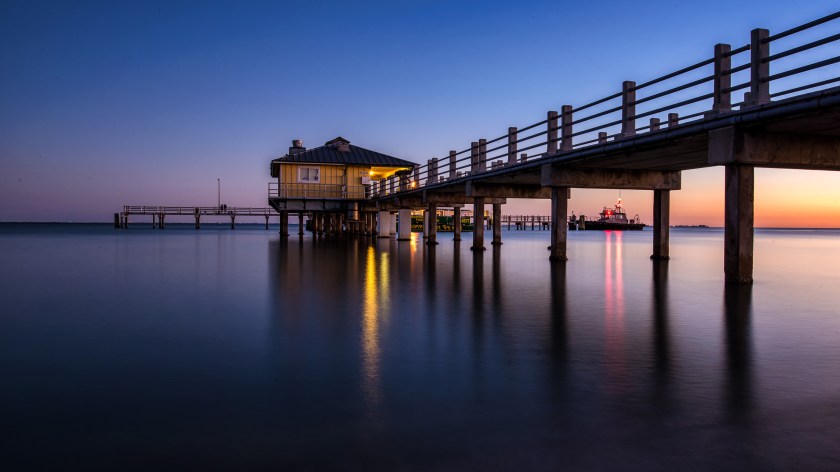
This photograph of Fort De Soto Park’s pilot boat pier captures the harmony between utilitarian structures and aesthetics. Utilizing a long exposure, the image highlights light, geometry, and the duality of human activity and nature. The pier becomes more than functional; it represents Florida’s coastal identity, deserving appreciation alongside natural landscapes.

Long exposure twilight photograph of the Bay Pier at Fort De Soto Park in Florida, with a yellow pilot‑boat building illuminated over calm water.
Long exposure twilight view of the pilot boat pier at Fort De Soto Park.

In this carefully orchestrated study of maritime infrastructure at Fort De Soto Park, the photographer demonstrates his capacity to locate poetry within utilitarian structures. The pilot boat pier—a working facility that guides commercial vessels through Tampa Bay’s shipping channels—becomes here a meditation on light, geometry, and the quiet professionalism of coastal operations. Shot during the blue hour with a twenty-five-second exposure at f/16 on a Nikon D610, the image transforms functional architecture into something approaching minimalist sculpture.

The compositional intelligence reveals itself in layers. The pier’s diagonal thrust from left to right creates dynamic movement across the frame, while the elevated structure’s horizontal rails establish rhythmic intervals that lead the eye toward the distant vessel. The photographer has positioned himself to capture the pilings in perfect vertical alignment, their reflections doubling into the glassy water below—a mirror effect achieved through the extended exposure that renders Tampa Bay into polished obsidian. At ISO 100, the twenty-five-millimeter focal length provides sufficient context to establish spatial relationships without sacrificing the intimate scale of the pier house itself.

Light operates as the image’s true subject. The warm interior glow from the pier house casts golden striations across the water, creating a luminous pathway that contrasts with the cool blue-violet gradient dominating the sky. The distant pilot boat, its navigation lights punctuating the horizon in red, provides a crucial narrative element—evidence of the pier’s ongoing purpose even as twilight suspends it in apparent timelessness. This balance between ambient and artificial light, between natural phenomena and human activity, positions the work firmly within the chapter’s exploration of Florida’s developed coastlines.

What distinguishes this image from the photographer’s other coastal studies is its emphasis on infrastructure as architecture. The pier is not merely a platform for viewing nature but an elegant construction worthy of attention in its own right. The horizontal rails, repeating with mechanical precision, create a visual counterpoint to the organic curves of the shoreline visible in the distance. The photographer acknowledges that Florida’s landscape is fundamentally collaborative—nature and human intervention existing in constant dialogue rather than opposition.

The technical execution merits particular attention. The f/16 aperture ensures depth of field sufficient to hold both foreground pilings and horizon vessel in acceptable focus, while the twenty-five-second exposure smooths the water into a reflective plane that doubles the compositional impact of every vertical element. The choice to shoot at this precise moment—when daylight has drained from the western sky but hasn’t yet surrendered to complete darkness—captures that transitional state where artificial lights begin to assert themselves without overwhelming the scene’s natural tonal range.

Within the broader context of the Florida Landscapes & Cityscapes chapter, this photograph represents the photographer’s mature understanding of the state’s coastal identity. Fort De Soto’s pilot boat pier is neither wilderness nor urban environment but something uniquely Floridian—a working maritime facility embedded within a state park, where commerce and recreation, industry and leisure, coexist without apparent conflict. By rendering it with such formal rigor and aesthetic consideration, the photographer argues for expanded recognition of these hybrid spaces as legitimate subjects for contemplation, deserving the same careful attention traditionally reserved for pristine natural vistas.