American Beauty: Strawberry Ravecake

The portrait of model Strawberry Ravecake, taken during a Denver workshop, reinterprets film noir and 1940s glamour through contemporary aesthetics, merging historical and modern elements. The striking use of chiaroscuro and vibrant colors challenges traditional conventions, featuring a tattooed model in luxurious settings, creating a dialogue on representation and glamour across eras.

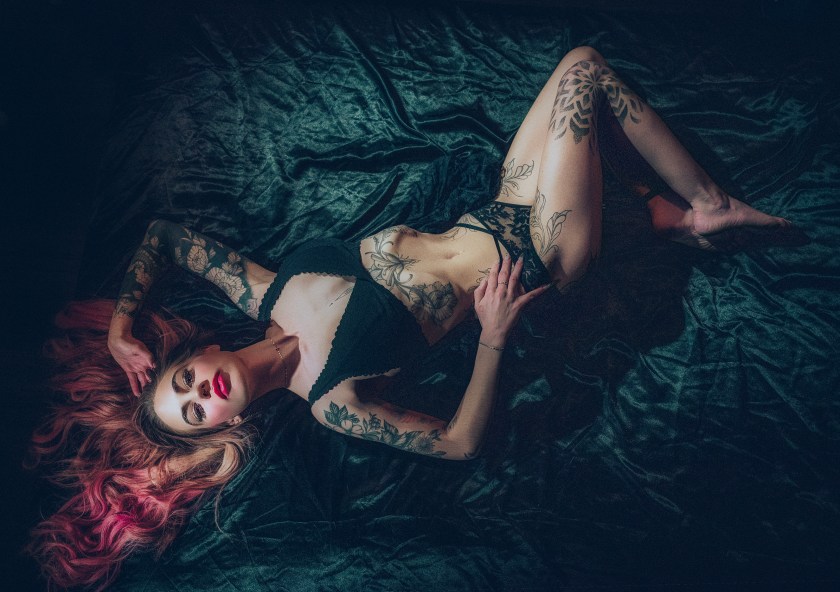
Overhead studio portrait of a tattooed woman reclining on dark fabric, wearing black lingerie under dramatic low-key lighting.
A studio portrait of model Strawberry Ravecake reclining on textured fabric during a themed photography workshop in Denver.

Within Chapter 6’s exploration of recent directions, this portrait represents a deliberate engagement with historical photographic language reimagined through contemporary aesthetics. Created during a workshop at RAW Studios in Denver focused on recreating film noir and 1940s Hollywood glamour, the photographer demonstrates how classical techniques can be subverted and reclaimed through modern sensibilities. The result is an image that exists in productive tension between eras, neither purely nostalgic nor entirely contemporary.

The composition draws immediate lineage to mid-century boudoir photography, yet the execution reveals crucial departures from those conventions. The model—Betty, known professionally as Strawberry Ravecake—reclines against luxurious teal-green velvet that recalls old Hollywood opulence. Her positioning, with head tilted back and limbs arranged in studied repose, references the languorous poses characteristic of 1940s pin-up and glamour photography. However, the extensive floral tattoo work covering her arms, legs, and torso fundamentally transforms the visual narrative. Where golden-age Hollywood demanded unmarked skin as a canvas for projected fantasy, here the body arrives already inscribed with personal history and deliberate aesthetic choices.

The lighting strategy merits particular attention. Deep shadows dominate the frame, with careful modeling that emphasizes dimensional form while maintaining areas of near-total darkness. This chiaroscuro approach—essential to film noir’s visual vocabulary—creates dramatic contrast between illuminated flesh and surrounding void. The photographer employs what appears to be a single key light positioned to camera right, allowing natural falloff to shape the subject rather than filling shadows with secondary sources. This restraint honors noir’s painterly treatment of darkness as an active compositional element rather than merely the absence of light.

Color becomes a strategic departure from strict period authenticity. While classic noir worked exclusively in black and white, the photographer retains the jewel tones of the velvet backdrop and the subject’s vibrant red-to-blonde ombré hair. The black lingerie and bold red lipstick provide chromatic punctuation, creating focal points that guide the viewer’s eye through the composition. This selective use of color acknowledges that contemporary audiences read images differently than their 1940s counterparts; pure monochrome might feel like affectation rather than interpretation.

The workshop context—Portfolio Building for Aspiring Photographers and Models—frames this image as both artistic output and pedagogical artifact. Workshop environments typically emphasize technical mastery and stylistic imitation, yet this photograph transcends mere exercise. The collaborative nature of such sessions, with multiple participants working alongside professional instruction, requires the photographer to synthesize learning in real-time while maintaining artistic vision. That this image earned placement in his Top 100 Journey suggests successful integration of classical technique with personal aesthetic development.

Within Chapter 6’s framework of ongoing exploration, the photograph demonstrates expanded engagement with historical photographic genres. The work reveals an artist comfortable moving between documentary observation, macro intimacy, and now studio-based portraiture. By choosing to engage with noir’s visual language through contemporary bodies and sensibilities, he participates in an ongoing cultural conversation about representation, desire, and the constructed nature of glamour across generations. The velvet wrinkles, the tattoo artistry, and the calculated pose coalesce into an image that respects its influences while asserting its moment.
Silhouette and Subversion: A Study in Controlled Drama

The portrait of Savage Van Sage by Greg Urbano in Chapter 4 of Top 100 Journey exemplifies refined environmental portraiture. It captures a blend of vulnerability and confidence through composition, lighting, and setting. The ivy backdrop, along with the model’s pose, invites viewers to engage with the complex narrative, reflecting Urbano’s artistic evolution and technical mastery.

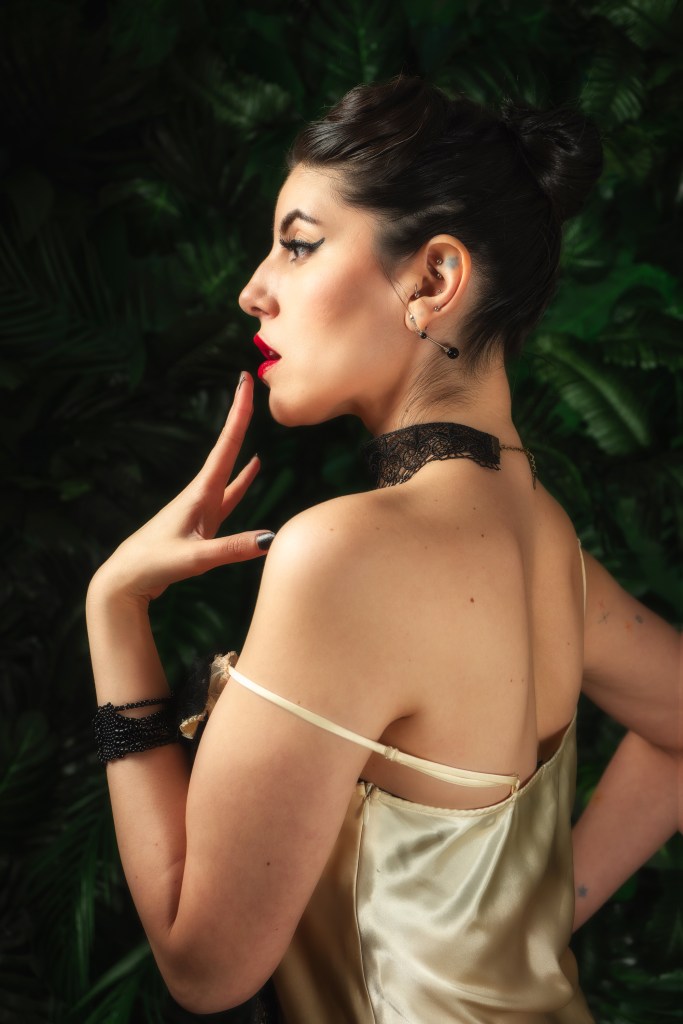
Woman in a satin dress shown in side profile against a dark leafy background, with hair in an updo and red lipstick.
Savage Van Sage poses in profile in a studio portrait with an ivy-covered wall near Denver, Colorado.

Within Chapter 4 of Greg Urbano’s Top 100 Journey—a section devoted to studio portraiture and collaborative workshop explorations—this photograph of model Savage Van Sage stands as a masterclass in theatrical restraint. Shot against an ivy-laden wall at the Headquarters studio near Denver, the image demonstrates the photographer’s evolving command of environmental portraiture, where setting and subject engage in a carefully choreographed dialogue.

The composition reveals sophisticated technical decision-making. Urbano positions his subject in profile, her face turned away from the camera yet fully engaged with the viewer through gesture and posture. The silhouette technique employed here—enhanced through post-processing in Adobe Camera Raw and Luminar 4—creates a striking interplay between illumination and shadow. Light sculpts the model’s features with precision, catching the curve of her jawline, the delicate architecture of her ear adorned with multiple piercings, and the bold contrast of crimson lips against porcelain skin.

What distinguishes this work within the chapter’s broader exploration of portrait photography is its willingness to embrace ambiguity. The model’s bare shoulder and the gossamer straps of her garment suggest vulnerability, yet her pose—hand raised to chin in a gesture of thoughtful poise—projects confidence and self-possession. The black lace choker and wrist accessory introduce elements of vintage glamour and contemporary subculture, positioning the subject at the intersection of multiple aesthetic traditions. This fusion of pin-up sensibility with darker, more enigmatic styling reflects Urbano’s interest in portraits that resist singular interpretation.

The natural ivy backdrop functions as more than mere decoration. Its organic chaos provides textural depth and creates a liminal space—neither entirely studio nor wholly natural environment. This choice aligns with the chapter’s documentation of the photographer’s studio and workshop methodologies, demonstrating how controlled environments can be manipulated to suggest narrative possibilities beyond their physical constraints. The deep greens recede into darkness, focusing attention on the figure while maintaining atmospheric richness.

Technically, the photograph showcases the photographer’s proficiency with studio lighting configurations. The illumination appears to originate from a single, directional source, creating the dramatic side-lighting characteristic of classic portraiture while maintaining sufficient fill to preserve detail in shadow areas. This approach—refined through workshop collaborations and repeated studio sessions—demonstrates a maturation from documentary impulses toward more deliberately constructed imagery.

The inclusion of this photograph in the Top 100 Journey marks a significant moment in Urbano’s artistic development. Where earlier chapters might emphasize spontaneity or environmental documentation, this studio work reveals an artist increasingly comfortable with artifice and construction. The model becomes collaborator rather than subject, her professional experience evident in the precision of her pose and the deliberate theatricality of her presentation.

Ultimately, this portrait succeeds because it understands the power of suggestion over declaration. The viewer receives fragments—a profile, a gesture, a carefully composed environment—and must construct meaning from these elements. It is portrait photography that honors both the technical traditions of studio work and the contemporary expectation that images should provoke rather than simply document. Within Urbano’s evolving practice, it represents a confident synthesis of technical skill and artistic vision.