Long Exposure Bay Pier

This long-exposure photograph from Fort De Soto Park captures the interplay between water and human infrastructure beneath the Bay Pier at sunset. The technical precision transforms the scene into a study of temporality, where smooth water contrasts with weathered concrete, exploring beauty in overlooked spaces. The image balances tranquility and depth, prompting contemplation.

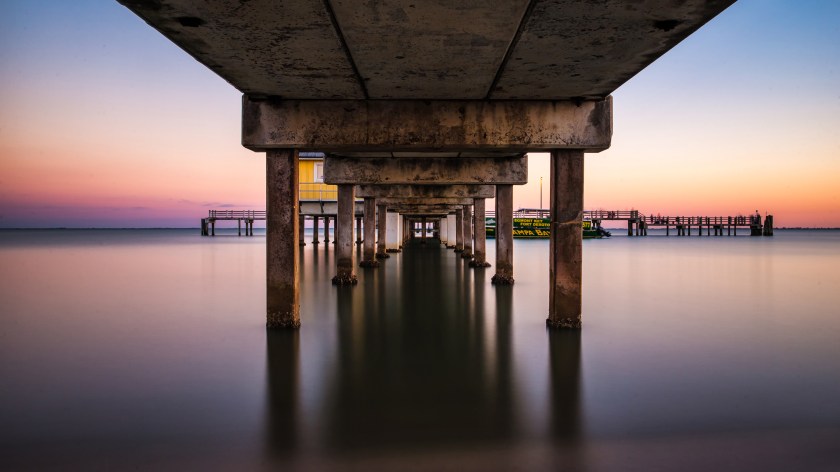
Long exposure sunset photograph taken beneath the Bay Pier at Fort De Soto Park, showing symmetrical concrete pilings and smooth reflective water.
Long exposure sunset view beneath the Bay Pier at Fort De Soto Park.

The photographer’s technical mastery and compositional restraint converge in this striking long-exposure study from Fort De Soto Park. Captured beneath the Bay Pier at sunset, the image demonstrates a sophisticated understanding of how extended exposure transforms the ephemeral into the architectural, rendering water as smooth as polished stone and reducing the atmospheric gradient to its essential chromatic progression.

The 124-second exposure at f/16 achieves precisely what such technical specifications promise: a complete metamorphosis of the transient into the permanent. The water’s surface becomes a mirror of silk, its glassy uniformity disrupted only by the weathered pier columns that puncture the frame with rhythmic precision. These pylons, darkened by time and barnacled at their waterline, create a vanishing perspective that draws the eye inexorably toward the distant horizon where structure meets light. The photographer has positioned himself not merely under the pier but within its geometric logic, allowing the concrete deck above to function as both literal and compositional ceiling, establishing boundaries that paradoxically expand the viewer’s sense of spatial depth.

What distinguishes this work within the Florida Landscapes & Cityscapes chapter is its meditation on infrastructure as organic form. The pier’s weathered concrete surfaces—mottled with rust stains and biological growth—speak to the peninsula’s relentless humidity and salt air. Rather than presenting Florida’s more commonly depicted pristine beaches or crystalline waters, he has chosen to explore the liminal space where human construction gradually surrenders to natural forces. The corroded texture of the support beams and deck creates a counterpoint to the water’s supernatural smoothness, establishing a dialogue between industrial decay and elemental transformation.

The color palette rewards careful attention. The sky transitions from pale lavender at the zenith through bands of peach and amber toward the horizon, while the water adopts cooler tones of green and slate. This chromatic division creates temperature contrast that enhances the image’s sense of tranquility without veering into sentimentality. A yellow structure visible in the middle distance—likely a utility building or navigation marker—provides a necessary accent of saturated color, preventing the composition from becoming too subdued.

The technical execution reflects deliberate choices rather than automatic settings. The 31mm focal length on a full-frame sensor provides sufficient width to encompass the pier’s structural rhythm while maintaining proper perspective correction, avoiding the distortion that might occur at the wide end of his 18-35mm lens. The ISO 100 setting ensures maximum detail in the shadows where barnacles cling to concrete, while the extended shutter speed required neutral density filtration to prevent overexposure during the lingering twilight.

Within the photographer’s larger journey, this image represents a maturation of vision—a willingness to find beauty not in Florida’s celebrated natural wonders but in the overlooked spaces where infrastructure and environment intersect. The pier becomes a study in temporality: concrete designed to last decades, water that renews itself constantly, and light that exists only for minutes. By freezing this convergence through long exposure, he creates a document that feels both immediate and timeless, a quality that defines his most successful landscape work. The photograph succeeds because it refuses spectacle in favor of contemplation, inviting sustained viewing rather than demanding instant admiration.
Pilot Boat Pier

This photograph of Fort De Soto Park’s pilot boat pier captures the harmony between utilitarian structures and aesthetics. Utilizing a long exposure, the image highlights light, geometry, and the duality of human activity and nature. The pier becomes more than functional; it represents Florida’s coastal identity, deserving appreciation alongside natural landscapes.

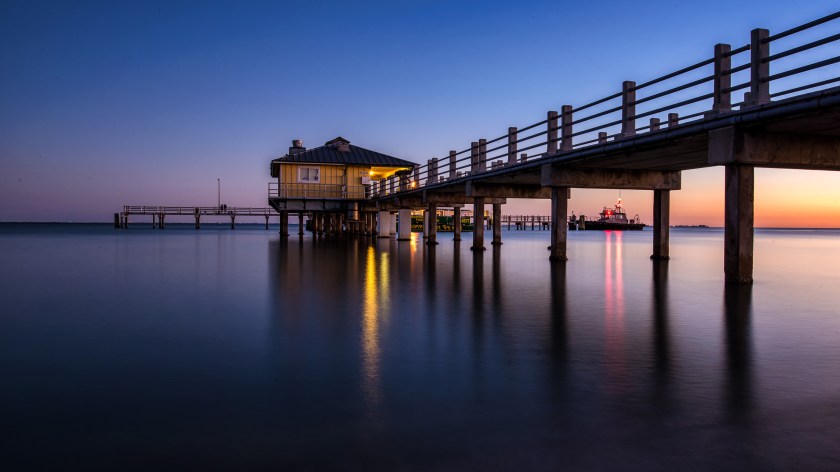
Long exposure twilight photograph of the Bay Pier at Fort De Soto Park in Florida, with a yellow pilot‑boat building illuminated over calm water.
Long exposure twilight view of the pilot boat pier at Fort De Soto Park.

In this carefully orchestrated study of maritime infrastructure at Fort De Soto Park, the photographer demonstrates his capacity to locate poetry within utilitarian structures. The pilot boat pier—a working facility that guides commercial vessels through Tampa Bay’s shipping channels—becomes here a meditation on light, geometry, and the quiet professionalism of coastal operations. Shot during the blue hour with a twenty-five-second exposure at f/16 on a Nikon D610, the image transforms functional architecture into something approaching minimalist sculpture.

The compositional intelligence reveals itself in layers. The pier’s diagonal thrust from left to right creates dynamic movement across the frame, while the elevated structure’s horizontal rails establish rhythmic intervals that lead the eye toward the distant vessel. The photographer has positioned himself to capture the pilings in perfect vertical alignment, their reflections doubling into the glassy water below—a mirror effect achieved through the extended exposure that renders Tampa Bay into polished obsidian. At ISO 100, the twenty-five-millimeter focal length provides sufficient context to establish spatial relationships without sacrificing the intimate scale of the pier house itself.

Light operates as the image’s true subject. The warm interior glow from the pier house casts golden striations across the water, creating a luminous pathway that contrasts with the cool blue-violet gradient dominating the sky. The distant pilot boat, its navigation lights punctuating the horizon in red, provides a crucial narrative element—evidence of the pier’s ongoing purpose even as twilight suspends it in apparent timelessness. This balance between ambient and artificial light, between natural phenomena and human activity, positions the work firmly within the chapter’s exploration of Florida’s developed coastlines.

What distinguishes this image from the photographer’s other coastal studies is its emphasis on infrastructure as architecture. The pier is not merely a platform for viewing nature but an elegant construction worthy of attention in its own right. The horizontal rails, repeating with mechanical precision, create a visual counterpoint to the organic curves of the shoreline visible in the distance. The photographer acknowledges that Florida’s landscape is fundamentally collaborative—nature and human intervention existing in constant dialogue rather than opposition.

The technical execution merits particular attention. The f/16 aperture ensures depth of field sufficient to hold both foreground pilings and horizon vessel in acceptable focus, while the twenty-five-second exposure smooths the water into a reflective plane that doubles the compositional impact of every vertical element. The choice to shoot at this precise moment—when daylight has drained from the western sky but hasn’t yet surrendered to complete darkness—captures that transitional state where artificial lights begin to assert themselves without overwhelming the scene’s natural tonal range.

Within the broader context of the Florida Landscapes & Cityscapes chapter, this photograph represents the photographer’s mature understanding of the state’s coastal identity. Fort De Soto’s pilot boat pier is neither wilderness nor urban environment but something uniquely Floridian—a working maritime facility embedded within a state park, where commerce and recreation, industry and leisure, coexist without apparent conflict. By rendering it with such formal rigor and aesthetic consideration, the photographer argues for expanded recognition of these hybrid spaces as legitimate subjects for contemplation, deserving the same careful attention traditionally reserved for pristine natural vistas.

See this image on:

500px

Flickr

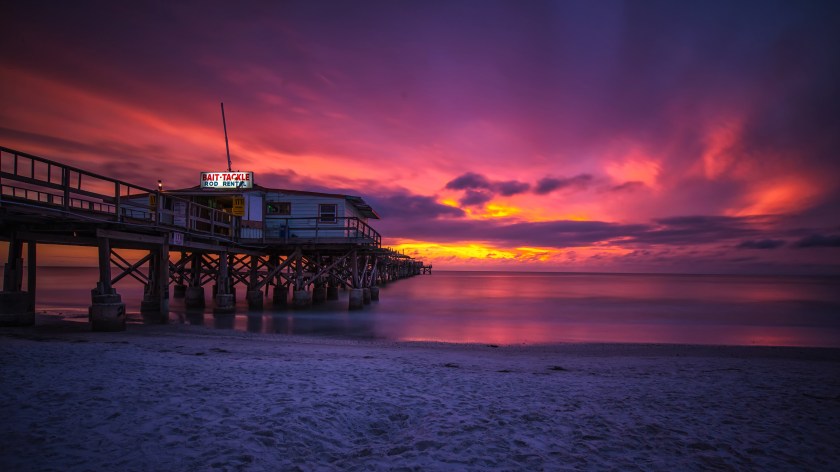
Redington Long Pier Sunset

The photograph of Redington Long Pier at sunset highlights the interplay between Florida’s coastal architecture and natural beauty. Captured with a long exposure technique, it merges structure and color, showcasing the significance of humble elements like a bait shop sign. This image advocates for a broader definition of landscape photography, embracing authenticity over idealization.

Long exposure photograph of the Redington Long Pier on Redington Beach, Florida, taken after sunset with vivid sky colors and calm reflective water.
Long exposure sunset view of the Redington Long Pier on Redington Beach.

The photographer’s approach to Florida’s coastal architecture reveals itself most compellingly in this extended exposure from Redington Beach, where a humble fishing pier becomes a study in structural grace against an incandescent sky. Captured on a Nikon D610 with an 18-35mm lens set to its widest focal length, the thirty-second exposure at f/8.0 transforms the Gulf of Mexico into liquid silk, while the pier’s weathered geometry provides essential counterpoint to the sky’s theatrical display.

What distinguishes this image within the Florida Landscapes & Cityscapes chapter is its subtle negotiation between the vernacular and the sublime. The “Bait·Tackle Rod Rental” sign—a modest beacon of commercial utility—anchors the composition with an authenticity that elevates rather than diminishes the scene’s natural grandeur. This juxtaposition speaks to the photographer’s evolving understanding of Florida’s coastal identity, where working piers and rental shacks exist not as intrusions upon beauty but as integral components of it.

The technical execution demonstrates considerable restraint. The eighteen-millimeter perspective captures the pier’s diagonal recession into the frame while maintaining clarity in the structural cross-bracing beneath the deck. The thirty-second exposure, calibrated to ISO 200, achieves that liminal smoothness in the water without sacrificing detail in the sky’s stratified clouds. The photographer has timed his capture for that brief window after sunset when the western horizon blazes with residual light while the zenith deepens toward purple—a moment lasting perhaps ten minutes when the dynamic range compresses just enough for a single exposure to hold both fire and shadow.

Color becomes the image’s primary language. The gradient from molten gold through crimson to violet speaks to the atmospheric conditions particular to Gulf Coast evenings, where humidity and marine air create these saturated transitions. The pier itself, rendered in silhouette, serves as a tonal anchor that prevents the composition from dissolving into pure chromaticism. The photographer’s choice to shoot into this gradient, rather than capturing the pier against a uniformly lit sky, reveals an understanding of how structure and color can modulate one another.

Within the broader trajectory of this chapter, the image represents a maturation of approach. Where earlier Florida work might have privileged either the natural landscape or the built environment, this photograph insists they cannot be separated. The pier extends from beach to horizon as a human gesture toward the infinite, its pilings disappearing into softened water that suggests both permanence and impermanence. The long exposure technique—a methodology that appears repeatedly throughout his landscape work—here serves not merely as technical flourish but as philosophical statement about time’s accumulation within a single frame.

The composition’s formal elegance belies its democratic subject matter. This is not a pristine wilderness or an architectural landmark, but a working-class fishing pier on a stretch of developed coastline. By rendering it with such visual authority, the photographer argues for an expanded definition of landscape photography—one that acknowledges Florida’s actual character rather than retreating to fantasies of unspoiled nature. The sunset may be spectacular, but it is the bait shop sign, glowing like a minor constellation above the water, that makes this image distinctly Floridian, distinctly true

See this image on:

Flickr

500px

Cocoa Beach Pier Sunrise: Architecture in Dialogue with the Atlantic

The photograph of Cocoa Beach Pier captures a sunrise through meticulous long exposure, transforming the landmark into a study of light and architecture. The image emphasizes structural details, blending engineering with nature. It highlights Florida’s coastal identity, embodying resilience and the interplay between human construction and natural forces against the backdrop of a serene seascape.

Long exposure sunrise photograph of the Cocoa Beach Pier in Florida, showing wooden pilings, warm light on the horizon, and reflections on wet sand.
Sunrise over the Atlantic Ocean at the Cocoa Beach Pier, captured in a long exposure.

Within Chapter 2 of the Top 100 Journey—Florida Landscapes & Cityscapes—this sunrise study of the Cocoa Beach Pier represents the photographer’s engagement with one of Florida’s most iconic coastal structures. Captured with deliberate technical restraint, the image transforms a familiar landmark into a meditation on light, time, and the intersection of human construction with natural forces.

The photograph was executed during the liminal hour of sunrise, that brief window when the sun emerges from the Atlantic horizon, casting warm, directional light across the scene. The photographer positioned himself beneath the pier’s substantial wooden framework, creating a composition that emphasizes the structure’s engineering and architectural presence. The pilings—weathered cylinders marked by barnacles and tidal wear—march in rhythmic repetition from foreground to background, their reflections doubling in the wet sand left by receding waves. This repetition creates visual cadence, leading the viewer’s eye through the layered space beneath the pier toward the glowing horizon.

The technical execution reveals calculated decision-making. Shooting at f/16 with a ten-second exposure on ISO 100, the photographer achieves several objectives simultaneously: the narrow aperture ensures sharpness throughout the deep composition, from the foreground sand texture to the distant pier house; the extended exposure time smooths the ocean into a misty, ethereal plane, contrasting with the solid geometry of wood and metal; and the low ISO preserves maximum image quality in the challenging dynamic range between shadowed understructure and brilliant sunrise. The 20mm focal length on a full-frame Nikon D610 provides sufficient width to capture the pier’s span while maintaining rectilinear integrity in the vertical pilings.

What distinguishes this work is its treatment of architectural form within the natural environment. Rather than photographing the pier as a tourist attraction—a vantage point from which to view the ocean—the photographer inverts the relationship, making the structure itself the primary subject while the seascape becomes supporting element. The underside perspective reveals construction details typically ignored: diagonal cross-bracing, the density of support columns, the engineering solutions required to anchor a recreational structure in shifting sand and relentless surf. The barnacle-encrusted pilings become textural studies, documenting the biological claim that marine life makes on human infrastructure.

The color palette reinforces the temporal specificity of the moment. Golden light bathes the right side of the frame, warming the wooden planks and casting long shadows that define the pier’s three-dimensional form. The left side remains in relative shadow, creating tonal gradation that adds depth and volume. The sky transitions from warm cream near the sun to deeper blue overhead, while the smoothed water reflects this gradient, creating visual harmony between sky and sea.

Within the broader context of Florida Landscapes & Cityscapes, this image represents the photographer’s recognition that Florida’s coastal identity includes not only pristine natural beauty but also the structures through which residents and visitors experience that environment. The Cocoa Beach Pier, a mid-century landmark rebuilt multiple times after hurricane damage, embodies Florida’s complicated relationship with its shoreline—simultaneously celebrating and challenging the power of the Atlantic.

The photograph ultimately documents persistence: of structures rebuilt after storms, of daily tides that reshape the beach, of light that returns each morning to illuminate the coast.

Under Naples Pier at Sunset: Architecture Meets the Ethereal

Greg Urbano’s long exposure photograph beneath Naples Pier captures the interplay of human architecture and nature, highlighting time and impermanence. Shot with meticulous technique, the image transforms a familiar locale into a contemplative space where smooth Gulf waters contrast with weathered pilings, emphasizing Florida’s geography and the enduring power of the natural world.

Long exposure photograph taken beneath the Naples Pier in Florida, showing weathered support columns receding into the distance with smooth, blurred water and soft sunset light.
Long exposure view beneath the Naples Pier in Florida, captured with softened water and warm evening light.

In Greg Urbano’s exploration of Florida’s coastal landscapes, this long exposure beneath Naples Pier represents a masterful convergence of structural geometry and natural fluidity. The photograph transforms a familiar tourist destination into something altogether more contemplative—a meditation on time, permanence, and the quiet persistence of natural forces.

The technical execution reveals deliberate artistic choices that elevate the image beyond documentary. Shot at a 30-second exposure with an aperture of ƒ/10, Urbano allows the Gulf waters to smooth into an almost supernatural plane of silk, while the pier’s wooden pilings remain sharply rendered, their weathered surfaces recording years of salt spray and tidal rhythms. The ISO 100 setting preserves exceptional clarity in both the concrete deck overhead and the barnacle-encrusted bases of each column, where marine life has claimed the structure as its own.

What distinguishes this photograph within the Florida Landscapes & Cityscapes chapter is its unique vantage point. Rather than capturing the pier from the beach or along its walkway—the conventional approaches—Urbano positions himself in the liminal space beneath, where human architecture and marine environment intersect. This perspective creates a vanishing point that draws the eye through the repetitive columns, suggesting infinity while simultaneously framing the horizon in measured increments. The composition speaks to Florida’s essential character: a place where human development exists in constant negotiation with water, weather, and an environment that ultimately cannot be controlled.

The color palette captures that transitional moment when day surrenders to evening. Soft blues dominate the frame, punctuated by warmer tones filtering through the gaps between pilings where the setting sun still reaches. The long exposure has rendered a handful of beachgoers as ghostly presences, barely perceptible in the distance—a reminder that even in this serene moment, human activity continues, though made insignificant by the photograph’s emphasis on timelessness over immediacy.

The textural contrasts throughout the frame reward sustained viewing. The smooth, almost liquid sand in the foreground shows subtle patterns from receding water, while the pier pilings display years of weathering—concrete cracking and staining, wooden supports silvered by sun and salt. Most striking are the organic clusters clinging to each column where water regularly submerges them, dark masses of mussels and barnacles that testify to the structure’s dual existence above and below the tideline.

This image exemplifies why Urbano selected Naples Pier for inclusion in his exploration of Florida’s diverse landscapes. The state’s geography is defined by its relationship with water—the Atlantic, the Gulf, the Everglades, countless rivers and springs. Here, that relationship is made architectural, structured, yet the photograph ultimately reveals nature’s quiet supremacy. The pier may impose order with its regular spacing and engineered strength, but the barnacles reclaim it, the water smooths away footprints, and time—made visible through long exposure—reveals the impermanence of even our most solid constructions.

Within the broader context of the Top 100 Journey, this photograph demonstrates Urbano’s ability to find fresh perspectives on familiar subjects, transforming a popular sunset location into a study of geometry, time, and the persistent dialogue between built and natural environments that defines Florida’s coastal identity.

Venice Fishing Pier Sunset: Mastering the Fundamentals of Light

Greg Urbano’s sunset photograph of the Venice Fishing Pier exemplifies the intersection of technical skill and artistic sensibility in landscape photography. Through meticulous use of exposure and composition, Urbano captures a moment where structured permanence meets the fluidity of nature, showcasing balanced tones and dynamic movement in a serene coastal scene.

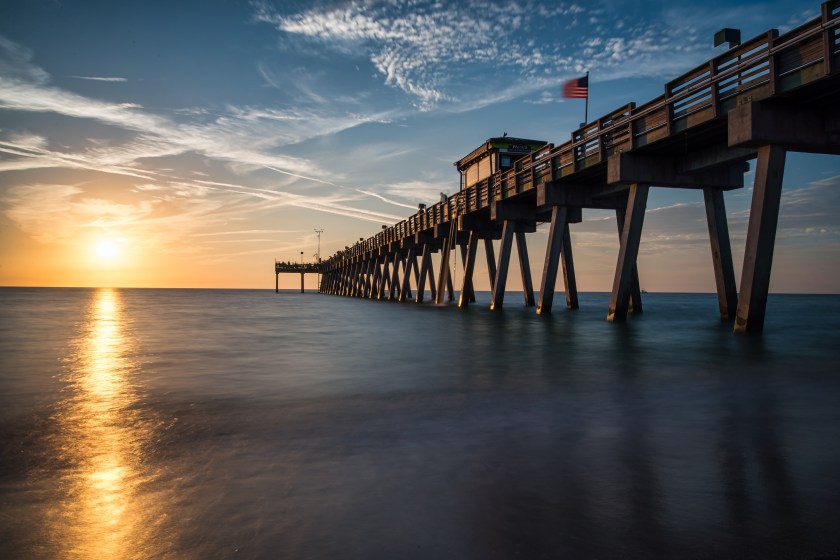
Sunset photograph of the Venice Fishing Pier in Florida, showing the pier extending into the Gulf of Mexico with golden reflections on calm water.
Sunset over the Gulf of Mexico with the Venice Fishing Pier in the background, captured in a long exposure.

Within Greg Urbano’s “Beginnings” chapter, this sunset photograph of the Venice Fishing Pier represents a photographer coming to terms with landscape photography’s essential discipline: the patient orchestration of light, water, and architecture. Shot along Florida’s Gulf Coast, the image demonstrates technical competence married to an emerging aesthetic sensibility—a combination that marks the transition from enthusiast to serious practitioner.

The technical execution reveals deliberate choices that elevate this beyond a simple sunset snapshot. Using a Nikon D610 with an 18-35mm lens set to 28mm, Urbano selected an aperture of f/18 to maximize depth of field, ensuring sharpness from the foreground water to the distant pier structure. The 13-second exposure at ISO 100 transforms the Gulf of Mexico into a silken plane, smoothing the texture of incoming waves into an ethereal blue gradient. This long exposure technique—fundamental to seascape photography—requires both technical knowledge and patience, waiting for the precise moment when light, tide, and atmospheric conditions align.

The composition demonstrates sophisticated spatial awareness. The pier’s diagonal thrust from lower right to upper left creates dynamic movement through the frame, leading the viewer’s eye from the silky foreground water toward the structure’s vanishing point. The rhythmic repetition of pier supports establishes a visual cadence, their angular geometry contrasting beautifully with the organic flow of water and clouds. An American flag atop the pier adds a vertical accent and a touch of patriotic iconography without overwhelming the scene’s natural beauty.

What distinguishes this photograph is Urbano’s treatment of light. The setting sun hovers just above the horizon line, its golden warmth reflected in a shimmering path across the water’s surface. The exposure balances multiple tonal zones expertly: the brilliant sun doesn’t blow out to featureless white, the shadowed pier structure retains detail, and the water holds both luminous highlights and cool, deep blues. This tonal control suggests a photographer who understands exposure compensation and potentially uses graduated neutral density filters or careful post-processing to manage the scene’s extreme dynamic range.

The sky deserves particular attention. Wispy cirrus clouds stretch across the frame in delicate streaks, their feathered patterns creating texture and visual interest in what might otherwise be empty blue space. The interplay between warm sunset tones near the horizon and cooler blues above establishes atmospheric depth, giving the image a sense of vast space and coastal openness.

As a “Beginnings” chapter work, this photograph represents mastery of landscape photography fundamentals. The long exposure technique, the careful attention to composition and leading lines, the patient waiting for optimal light—these are the building blocks upon which more experimental work can later be constructed. There’s confidence here, a photographer who has moved beyond technical uncertainty into intentional image-making.

The Venice Pier becomes more than a documentary subject; it transforms into a meditation on structure and impermanence. The solid, engineered permanence of the pier contrasts with the fluid, ever-changing water—a tension made visible through photographic technique. Urbano captures not just a place, but a moment of perfect equilibrium between human construction and natural forces, all bathed in the transient golden light that photographers chase endlessly along coastlines worldwide.

The Patient Observer: Greg Urbano’s “Showy Egret” and the Art of Coastal Intimacy

In Greg Urbano’s 2014 photo “Showy Egret” at Fort de Soto, the Snowy Egret’s elegance contrasts with human presence, highlighting a balance between wildlife and recreation. Urbano’s precise composition and technical skill enhance environmental storytelling, showcasing his early understanding that nature photography can embrace humor and human contexts without losing integrity.

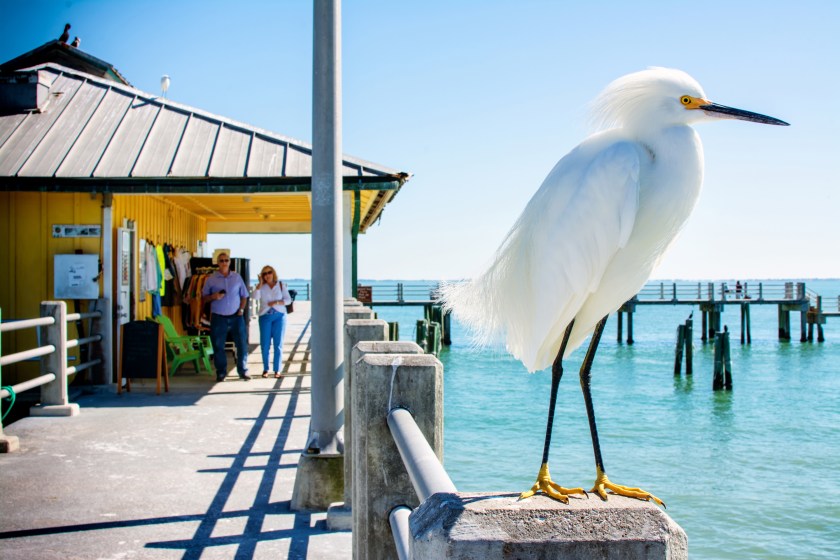
Snowy Egret standing on a concrete pier post with a yellow building, clothing racks, and tourists in the background, photographed with a Nikon D7100 and 35mm lens.
A 2014 photograph of a Snowy Egret perched on the Bay Pier at Fort De Soto Park in Florida.

In the opening chapter of Greg Urbano’s photographic journey, “Showy Egret” stands as a masterclass in compositional awareness and environmental storytelling. Captured in 2014 at Fort De Soto’s Bay Pier in Florida, this image reveals an artist already attuned to the delicate balance between wildlife photography and human context—a sensibility that would define his evolving practice.

The photograph’s immediate strength lies in its spatial intelligence. Urbano positions the Snowy Egret in the right third of the frame, allowing the bird’s pristine plumage to command attention while the weathered pier extends into the turquoise waters beyond. This compositional choice creates a natural visual flow from foreground subject to background environment, inviting viewers to experience both the bird’s individual presence and its coastal habitat simultaneously.

Technical precision underscores the image’s effectiveness. Shot with a Nikon D7100 at f/11.0, Urbano achieves crisp depth of field that renders the egret’s delicate feathers in remarkable detail—each plume distinct against the clear Florida sky. The choice of 1/200 second shutter speed at ISO 100 captures the bird in perfect stillness, transforming a fleeting moment into something approaching portraiture. The 35mm focal length, often considered a “normal” perspective, here proves ideal for environmental wildlife work, offering intimacy without the compression or distance of telephoto lenses.

What elevates this photograph beyond straightforward nature documentation is Urbano’s willingness to embrace the human element. Two tourists emerge from a yellow-trimmed pier building in the middle distance, their presence neither accidental nor intrusive. Rather than seeking the pristine wilderness imagery common in traditional wildlife photography, Urbano acknowledges the reality of modern conservation spaces—these are shared environments where human recreation and natural habitats coexist. The egret’s confident stance on the pier post, unfazed by nearby activity, speaks to this acclimatization, suggesting a more complex narrative about wildlife adapting to anthropogenic landscapes.

The photograph’s playful title—”Showy Egret” as wordplay on “Snowy Egret”—hints at Urbano’s understanding that wildlife photography need not adopt a purely reverential tone. The egret does indeed appear showy, posed almost theatrically on its concrete perch, its breeding plumage fully displayed, yellow feet gripping the weathered surface. This anthropomorphic reading, encouraged by the title, creates accessibility without diminishing the bird’s natural beauty.

Light plays a crucial supporting role. The high, clear Florida sun creates distinct shadows across the pier’s concrete surface while illuminating the egret’s white plumage to near-luminescence. The bird’s yellow lores and feet provide punctuation points of color that echo the building’s trim, creating subtle visual rhymes within the frame.

As a foundational piece in Urbano’s “Beginnings” chapter, “Showy Egret” demonstrates technical competence married to narrative intuition. The photographer shows early understanding that compelling wildlife imagery can exist within human-modified spaces, that environmental context enriches rather than dilutes subject focus, and that humor and play have legitimate places in nature photography. These insights would prove essential as his practice developed, but here, at Fort De Soto in 2014, they exist in nascent, confident form—a young artist finding his voice through patient observation and compositional thoughtfulness.