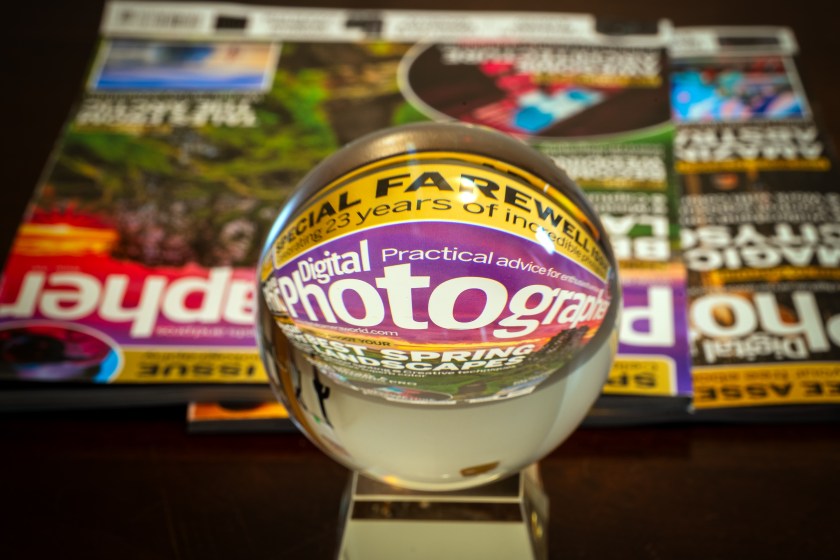
In this carefully orchestrated still life, the photographer employs a glass sphere as both subject and optical instrument, creating a work that functions simultaneously as technical demonstration and elegiac commentary on the evolution of print media. The composition centers on a crystal orb that inverts and refracts the image of Digital Photographer magazine—specifically, its final print edition—transforming a moment of cultural transition into a study of perception, preservation, and the inevitable passage of analog traditions into digital memory.
The technical execution reveals a photographer comfortable with the complexities of refractive optics. The sphere acts as a lens within the lens, compressing the magazine’s cover into a miniaturized, inverted world that paradoxically sharpens our attention to what might otherwise be overlooked. The purple masthead, readable despite its reversal, anchors the composition with bold color, while the surrounding magazines create a layered backdrop that suggests abundance even as the image mourns scarcity. The decision to flip certain magazines for the “extra credit of refraction” demonstrates a playful engagement with the assignment’s constraints, yet this playfulness does not diminish the work’s underlying melancholy.
What elevates this photograph beyond mere technical exercise is its timing and intentionality. The artist notes he possessed this glass sphere for years before deploying it—a detail that speaks to the patience required in photographic practice, the waiting for subject and tool to find their proper alignment. That this alignment occurred during the week Digital Photographer ceased print publication transforms the image into an unintentional requiem, a visual preservation of a medium announcing its own obsolescence.
Within Chapter 6 of the Top 100 Journey—titled “The Road Ahead: Recent Work & Ongoing Exploration”—this photograph occupies particularly rich territory. The chapter’s title suggests forward momentum, yet this image looks both forward and backward simultaneously. The glass sphere, an ancient optical device, refracts contemporary printed matter about digital photography, creating a temporal layering that mirrors the photographer’s position at a crossroads between mastered techniques and emerging possibilities. The work acknowledges what is being left behind even as it demonstrates facility with the tools of the present.
The composition’s formal qualities reward extended viewing. The shallow depth of field isolates the sphere against the deliberately blurred magazine stack, creating spatial hierarchy while maintaining contextual legibility. The lighting, presumably controlled given the studio-like precision of the setup, wraps around the sphere’s curved surface without harsh reflections, suggesting either diffused natural light or carefully positioned artificial sources. The wooden surface beneath provides warmth and texture, grounding the optical trickery in tangible materiality.
Conceptually, the photograph engages with themes of representation and mediation that recur throughout photographic history. The sphere presents the magazine not as it is, but as refracted, inverted, compressed—much as photography itself presents the world not as direct experience but as mediated image. This self-reflexive quality, combined with the specific poignancy of documenting a publication’s final issue, positions the work within broader conversations about photography’s relationship to preservation, memory, and loss.
As the photographer continues his ongoing exploration, this image suggests an artist increasingly interested in photography that thinks about photography—work that acknowledges the medium’s materiality, history, and transformations while demonstrating technical mastery that never becomes mere showmanship.
 Greg Urbano