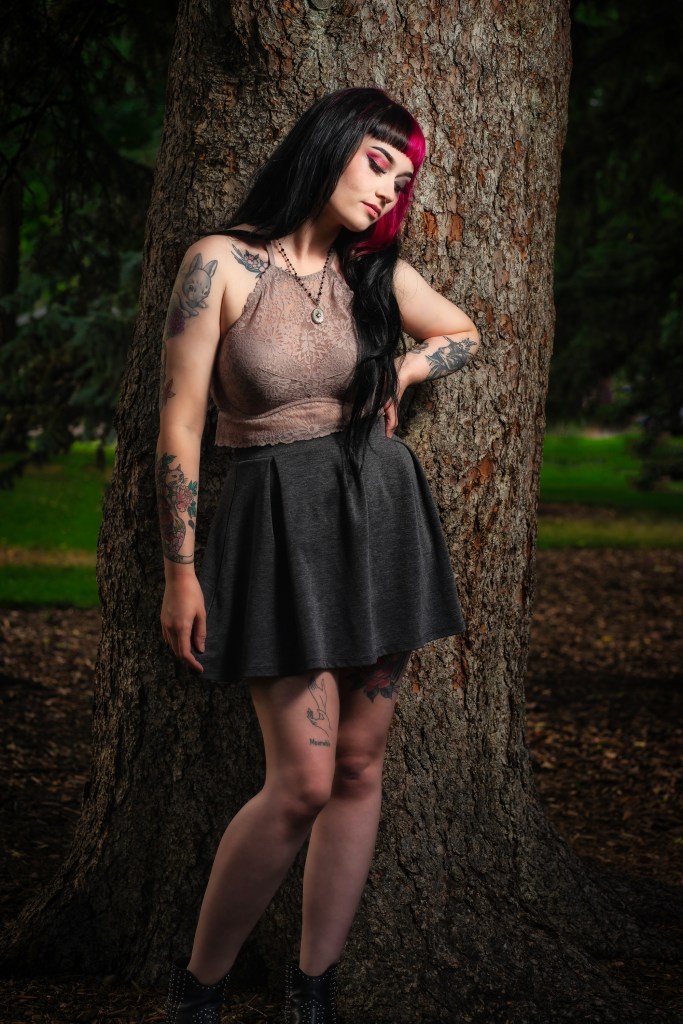
This portrait exemplifies the photographer’s nuanced approach to environmental portraiture, where natural settings are transformed into outdoor studios through strategic lighting and compositional choices. Photographed in City Park, Fort Collins, the image presents the subject leaning against the textured bark of a mature tree, her contemplative pose and distinctive styling creating a study in contrasts between the organic and the contemporary, the natural and the cultivated.
The technical foundation reveals a methodical approach to outdoor flash photography. Working with a Sony A7ii and the respected 85mm f/1.8 lens—a classic portrait focal length that provides flattering perspective and subject isolation—the photographer employed a Godox V1s flash modified with a shoot-through umbrella. This diffusion choice proves critical to the image’s success. The softened light wraps around the subject’s features and form, preventing the harsh shadows that plague poorly executed outdoor flash work while maintaining directionality that provides dimension and depth. The lighting appears to originate from camera left, creating subtle modeling across the face and body that complements rather than competes with the ambient forest light.
The compositional structure demonstrates careful consideration of both subject and environment. The tree trunk functions as more than backdrop; it becomes an active element in the visual narrative, its rough, organic texture providing counterpoint to the smooth skin and fabric surfaces. The subject’s positioning—slightly offset from center, body angled, one hand resting naturally against the bark—creates a relaxed asymmetry that invites extended viewing. The visible tattoos become graphic elements within the composition, their dark forms echoing the patterns in the tree bark and adding layers of personal narrative to the environmental context.
Color relationships within the frame merit attention. The earthy tones of the subject’s outfit—muted rose and deep charcoal—harmonize with the brown and gray palette of the bark while maintaining sufficient contrast to ensure separation. The vivid magenta accent in the hair provides a calculated color note that draws the eye upward to the face, where the complementary makeup palette reinforces this focal point. The defocused green background, rendered as soft bokeh by the 85mm lens at apparent wide aperture, provides color balance without competing for attention.
Within Chapter 4’s exploration of portrait methodologies, this photograph demonstrates the photographer’s ability to translate studio lighting principles into outdoor contexts. The controlled light quality typically associated with indoor work here interacts with natural ambient illumination, creating a hybrid aesthetic that benefits from both approaches. The umbrella modification prevents the artificial quality that often characterizes outdoor flash photography, instead producing a luminosity that feels organic to the wooded setting while maintaining the precise control necessary for professional portraiture.
The post-processing in Luminar 4 enhances the image’s tonal sophistication without sacrificing naturalism. Skin tones remain truthful, the detail in both highlights and shadows suggests careful attention to dynamic range, and the overall color grading supports the slightly cinematic quality of the final image. There’s a refinement present that indicates maturity in the photographer’s workflow—the recognition that technical excellence serves artistic vision rather than existing as an end unto itself.
This portrait represents a convergence of skills developed across multiple photographic disciplines: the lighting control of studio work, the adaptability required for location shooting, and the interpersonal dynamics essential to capturing authentic moments within directed sessions.
 Greg Urbano