Pears: A Chromatic Triptych in Measured Light

A still life photograph features three pears, highlighting the photographer’s evolving technique in transforming everyday produce into subjects for aesthetic contemplation. Using controlled lighting and a focused composition, the work emphasizes color variation and organic authenticity. This piece bridges classic and contemporary styles, encouraging viewers to appreciate the beauty in simplicity.

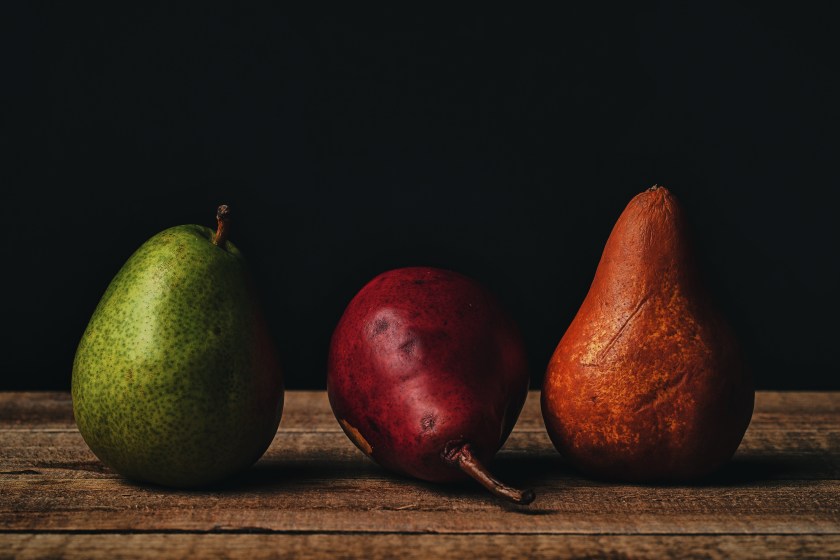
Tabletop still life of three pears arranged side by side on a wooden surface against a dark background.
A tabletop still life of three pears arranged on a wooden surface and lit against a dark background.

This composition of three pears exemplifies the photographer’s evolving approach to still life, transforming quotidian supermarket produce into subjects worthy of sustained aesthetic contemplation. Arranged in strict linear progression across weathered wood, the trio presents a study in chromatic variation and volumetric form that speaks to both classical still life traditions and contemporary minimalist sensibilities.

The technical framework mirrors the controlled approach evident throughout this body of work: a single Godox V1s strobe modified by softbox and grid, captured with a Sony A7ii paired with an 85mm f/1.8 lens. This choice of focal length proves particularly significant. Unlike the wider perspectives often employed in tabletop work, the 85mm compression subtly flattens spatial relationships while maintaining separation between subjects, creating a stage-like presentation where each pear occupies its designated position with theatrical clarity.

What distinguishes this image within the chapter’s trajectory is its bold embrace of color as primary subject matter. Where the earlier onion and garlic study operated within a narrow tonal range of earth and amber, here the photographer orchestrates a chromatic progression—verdant green, deep crimson, oxidized copper—that reads almost as a color theory exercise. Yet the natural imperfections of each fruit prevent the composition from becoming merely schematic. Surface blemishes, stem variations, and subtle textural differences assert the subjects’ organic authenticity.

The lighting strategy reveals sophisticated control over shadow placement and tonal gradation. The grid attachment concentrates illumination on the subjects while allowing the background to fall into near-absolute blackness, a technique borrowed from Old Master painting that isolates forms in dramatic relief. Light wraps around each pear’s curved surface with mathematical precision, creating highlight-to-shadow transitions that define volume without resorting to harsh contrast. The wooden platform receives just enough illumination to establish spatial grounding, its grain and weathering providing textural counterpoint to the fruits’ smooth skins.

Compositional decisions demonstrate a rigorous formal intelligence. The three pears, though similar in scale, exhibit distinct silhouettes—the green pear’s upright verticality, the red pear’s compressed roundness, the copper pear’s elongated diagonal lean. This variation within repetition creates visual rhythm while avoiding monotony. The spacing between subjects appears carefully calibrated, neither crowding nor isolating, allowing each fruit to maintain individual presence while contributing to the unified whole.

Post-processing through color grading has intensified chromatic saturation while preserving naturalistic tonality. The resulting palette suggests both heightened reality and painterly intention—colors feel amplified yet believable, enhanced rather than fabricated. This balance between documentation and interpretation positions the work at a productive intersection of photographic traditions.

Within the chapter’s arc from classic to experimental approaches, this image occupies transitional territory. Its formal rigor and single-light methodology align with classical practice, yet the chromatic boldness and almost Pop Art sensibility of three isolated, colored forms hint at more conceptual concerns. The photograph demonstrates that experimentation can emerge from treating simple subjects with exacting attention rather than through technical complexity alone.

The work ultimately asks viewers to reconsider the aesthetic potential residing in everyday objects, a question central to still life practice across centuries. By isolating these supermarket pears in dramatic light and formal precision, the photographer transforms the ordinary into an opportunity for visual meditation on color, form, and the enduring power of careful observation.
Onions and Garlic: A Study in Chiaroscuro and Culinary Stillness

The photograph captures a still life of onions and garlic on a wooden surface, showcasing classical principles through contemporary techniques. The controlled lighting and asymmetrical balance create depth, while post-processing enhances tonal richness. This artwork engages with historical traditions, revealing how ordinary subjects can convey significant meaning through careful observation and technical precision.

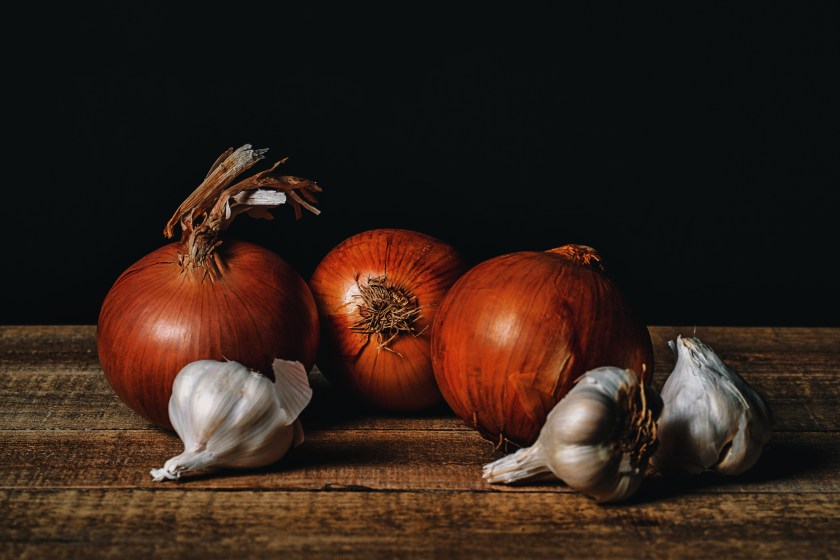
Tabletop still life of whole onions and garlic bulbs arranged on a wooden surface against a dark background.
A tabletop still life of onions and garlic arranged on a wooden surface and lit against a dark background.

In this deliberate composition, the photographer demonstrates a mastery of classical still life principles while working within the constraints of contemporary digital tools. The image presents three bronze-skinned onions accompanied by two heads of garlic, arranged on weathered wood against an impenetrable black void—a setup that immediately recalls the Dutch and Spanish still life traditions of the 17th century, where humble kitchen subjects were elevated to objects of contemplation.

The technical execution reveals a sophisticated understanding of light modulation. Working with a single modified light source—a Godox V1s paired with a softbox and grid—the photographer has created a tightly controlled illumination that wraps around the subjects’ curved surfaces while maintaining crisp shadow definition. The grid attachment proves essential here, preventing light spill into the background and preserving the dramatic contrast that gives the image its gravitas. This economy of means, using just one light to achieve such dimensional modeling, speaks to both practical skill and aesthetic intentionality.

What distinguishes this work within Chapter 5’s progression from classic to experimental tabletop photography is its conscious dialogue with art historical precedent. The photographer acknowledges drawing inspiration from a tutorial source, yet the resulting image transcends mere technical exercise. The onions’ papery skins catch light with a luminosity that suggests both fragility and age, their dried stalks creating gestural elements that break the otherwise spherical regularity. The garlic bulbs, positioned in the lower quadrant, provide tonal counterpoint—their pearl-white surfaces reflecting light with greater intensity than the warmer onions above.

The compositional arrangement follows classical principles of asymmetrical balance. The three onions occupy distinct spatial planes, their positioning creating depth through overlapping forms and subtle scale variation. The leftmost onion’s dramatic upward-reaching stem introduces vertical energy, while the garlic anchors the composition’s base. This triangular organization guides the viewer’s eye through the frame in a measured, contemplative rhythm appropriate to the subject matter.

Post-processing choices, implemented through color grading in Luminar 4, enhance the image’s tonal richness without sacrificing naturalism. The warm amber-to-sienna palette suggests candlelight or late afternoon sun, though the lighting setup confirms neither. This ambiguity of light source contributes to the image’s timeless quality—it could as easily have been captured in a 17th-century Dutch kitchen as in a contemporary studio.

The weathered wooden surface provides crucial textural contrast to the subjects’ organic forms. Its rough grain and worn patina introduce narrative suggestions of use and time, transforming a simple backdrop into an active compositional element. The wood’s horizontal planking creates subtle linear structure beneath the curved biological forms above.

Within the broader context of this chapter’s exploration, this photograph occupies the “classic” end of the spectrum—demonstrating that traditional approaches retain their power when executed with technical precision and compositional intelligence. The work proves that experimentation need not always mean formal rupture; sometimes it involves mining established vocabularies with fresh attention. Here, the photographer engages in a centuries-old conversation about how light reveals form, how arrangement creates meaning, and how the ordinary, when carefully observed, achieves a quiet monumentality that rewards sustained viewing.

Color Drip: Materiality and Motion in Contemporary Still Life

This photograph showcases multicolored paint dripping over a black mannequin head, representing the photographer’s exploration of paint as both subject and medium. By removing human elements, the focus shifts to paint’s properties and gestures, merging classic still life with contemporary material investigations. The composition embodies a dynamic interplay of control and chaos.

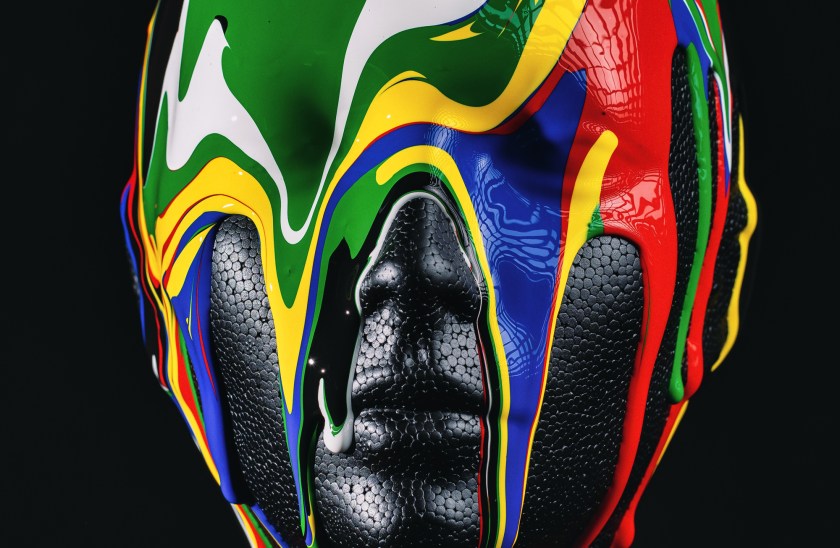
Close-up of a black mannequin head covered in glossy, multicolored paint dripping downward against a dark background.
Multicolored paint drips over a black mannequin head in a controlled studio setup.

Within the broader context of tabletop photography’s evolution from classical arrangement to experimental intervention, this photograph represents a decisive moment in the photographer’s exploration of paint as both subject and sculptural medium. The image captures viscous streams of color—green, yellow, red, and blue—descending across a black textured surface in fluid, organic patterns that suggest simultaneous control and surrender.

The composition reveals its conceptual origins while transcending them. Inspired by a live model photograph encountered on social media, the photographer sought to recreate similar effects using a styrofoam mannequin head painted black. This substitution proves significant: by removing the human element, the work shifts focus entirely to the material properties of paint itself—its weight, viscosity, and the temporal nature of its movement. The textured black surface, likely meant to simulate skin or hair, instead becomes an abstract topography across which color flows according to gravitational and physical laws.

Technically, the photograph demonstrates sophisticated handling of surface and light. The glossy quality of the wet paint creates highlights that map the three-dimensional contours beneath, while the matte black texture provides counterpoint and depth. The color palette—primary hues plus white—reads as deliberately elemental, avoiding the complexity of mixed tones in favor of pure chromatic statement. Each rivulet maintains its individual identity even as the colors converge and overlap, creating secondary interactions at their edges without complete integration.

The formal composition operates through diagonal movement and asymmetrical balance. The paint flows establish dynamic vectors across the frame, leading the eye downward and around the curved forms. The black areas function as negative space that gives structure to the chromatic chaos, while the textured surface adds a reptilian or industrial quality that complicates the otherwise organic flow patterns. This tension between the fluid and the fixed, the organic and the manufactured, activates the image beyond mere documentation of an experimental process.

As one of the first edits from this experimental series, the photograph captures the photographer working through ideas in real time. There exists a certain rawness here—an directness in the setup and execution that speaks to initial discovery rather than refined methodology. The black background isolates the subject completely, a studio technique that emphasizes formal relationships over contextual meaning. This approach aligns with classic tabletop photography’s concern with controlled environments, even as the unpredictable paint drips push toward the experimental end of the chapter’s spectrum.

Within Chapter 5’s framework, this piece marks a transition from static arrangement toward time-based phenomena. The dripping paint implies duration—the moment before and after this frozen instant. Unlike traditional still life’s carefully positioned objects, here the photographer choreographs a performance, then selects the decisive moment from its unfolding. The work thus bridges historical still life concerns with contemporary interests in process, materiality, and the indexical trace.

What emerges is less a portrait substitute than an investigation into how materials behave under specific conditions. The styrofoam head becomes armature, the paint becomes protagonist, and the photograph itself becomes evidence of an ephemeral sculptural event. It represents the photographer thinking through his medium, testing possibilities, and documenting the results with the clarity and precision his technical skill affords.

Marie Selby Roots, 2012

In Greg Urbano’s 2012 black and white photograph of banyan tree roots at the Marie Selby Botanical Gardens, the ordinary is elevated to extraordinary. Using a Nikon D5100, he emphasizes natural architecture and texture, inviting viewers to appreciate the monumental presence of the roots and their intricate details, symbolizing persistence and growth.

Black‑and‑white close‑up photograph of large banyan tree roots spreading across the ground at Marie Selby Botanical Gardens, taken with a Nikon D5100.
A 2012 black‑and‑white photograph of banyan tree roots at Marie Selby Botanical Gardens in Sarasota, Florida.

In the Marie Selby Botanical Gardens of Sarasota, Florida, Greg Urbano discovered a subject that speaks to photography’s essential pursuit: finding extraordinary vision in the ordinary world. His 2012 image of a banyan tree’s root system transforms what many visitors might walk past into a study of natural architecture, texture, and the quiet monumentality of growth.

Shot on a Nikon D5100 at 18mm, the photograph embraces the wide-angle perspective to emphasize the sculptural sprawl of roots as they emerge from and return to the earth. The technical choices here are deliberate—an aperture of ƒ/4.5 provides sufficient depth of field to keep the intricate root structures sharp from foreground to middle ground, while the 1/80s shutter speed at ISO 100 captures clean detail in what appears to be soft, overcast light. The conversion to black and white strips away the distraction of color, allowing the image to become purely about form, line, and the interplay of light across weathered surfaces.

What makes this photograph compelling is its invitation to reconsider scale and presence. Banyan trees are known for their dramatic aerial root systems, which drop from branches to establish new anchor points in the soil. These roots, over time, become massive supporting structures that can make a single tree look like an entire forest. Urbano positions his lens low and close, giving these roots the monumentality they deserve. They undulate across the frame like organic highways, their surfaces marked by the patient work of decades—moss-covered in places, smooth and silvered in others, each groove and crack a record of growth and adaptation.

The composition draws the eye through natural pathways. The roots create flowing curves that lead deeper into the frame, while pockets of accumulated leaves and debris provide textural contrast and visual rest stops. There’s an almost sculptural quality to the way light models the cylindrical forms, revealing their three-dimensionality through subtle gradations of gray. The photograph operates on multiple levels: as documentation of a specific botanical specimen, as an abstract study of natural form, and as a meditation on time, persistence, and the hidden infrastructure that supports visible life.

Within the context of the Top 100 Journey project, this image represents the photographer’s developing eye for architectural elements in nature. The banyan’s root system is, after all, a kind of natural architecture—functional, structural, and beautiful in its purposeful design. The black and white treatment connects this work to photography’s documentary traditions while simultaneously elevating the subject into the realm of fine art.

There’s something humbling about standing before such a root system, and Urbano’s photograph captures that sense of being in the presence of something both ancient and ongoing. These roots speak to persistence, to the slow but inexorable way living things claim their space in the world. The photographer’s choice to work at ground level, to get close and look carefully, reveals a fundamental photographic truth: the world rewards sustained attention. What appears as mere roots at first glance becomes, through the lens, a landscape unto itself—complex, textured, and worthy of extended contemplation.

See this image on:

500px

Flickr