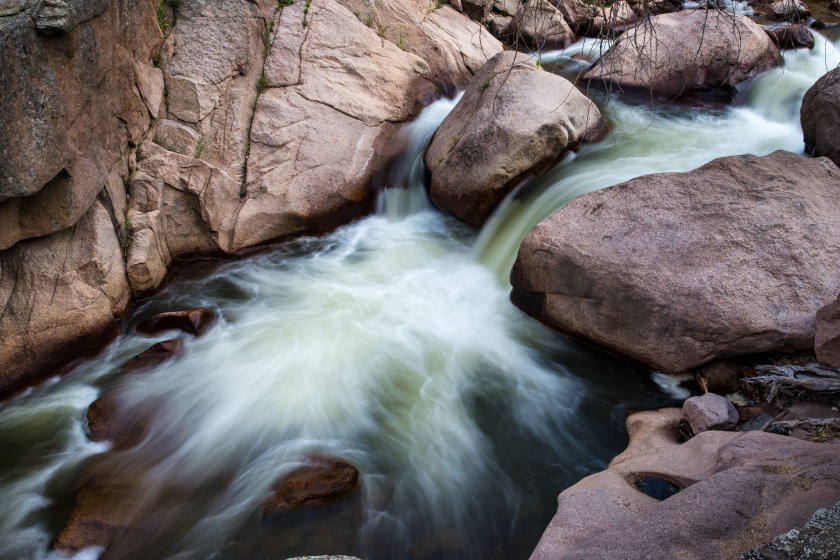
St. Vrain Waterfall: A Study in Motion and Permanence

The photograph of a small waterfall along St. Vrain Creek embodies the tension between geological permanence and water’s fleeting essence. Using long exposure, it transforms the scene into a contemplative study of motion and stillness. The intimate scale highlights the beauty of overlooked subjects, emphasizing the profound within Colorado’s landscapes.

Long exposure view of a small waterfall flowing through smooth granite boulders along St. Vrain Creek.
A small waterfall flows between granite rocks along St. Vrain Creek in northern Colorado.

Within the third chapter of Greg Urbano’s Top 100 Journey—devoted to Colorado Landscapes & Cityscapes—this long exposure photograph of the St. Vrain presents a meditation on the fundamental tension between geological permanence and hydrological flux. The image captures a modest cascade in Northern Colorado, yet its technical execution elevates what might be considered a commonplace subject into something altogether more contemplative.

The photographer’s decision to employ long exposure proves essential to the work’s success. Water, rendered as gossamer curtains of white and pale green, flows through the frame with an almost supernatural quality. This technique transforms the kinetic energy of rushing water into something visually paradoxical: movement frozen into silken stillness. The effect creates a temporal ambiguity that refuses to commit to either instant or duration, existing instead in a liminal space between photographic modes.

Compositionally, the work demonstrates a sophisticated understanding of how natural forms interact within the frame. Pink-hued granite boulders, weathered and moss-touched, provide structural anchors throughout the image. These stones—products of millennia—stand in stark contrast to the ephemeral blur of water that has shaped them. The photographer positions these elements with careful attention to visual weight and balance, allowing the eye to trace pathways through the composition that mirror the water’s own journey through the rocky terrain.

The color palette reveals itself as deliberately restrained. Warm earth tones of pink and tan granite dominate, punctuated by touches of green moss and the cool, milky whites of the flowing water. This chromatic restraint prevents the image from becoming overly dramatic, instead maintaining the documentary authenticity that characterizes much of this chapter’s work. The photographer resists the temptation to over-saturate or manipulate, trusting the natural beauty of the Colorado landscape to speak for itself.

What distinguishes this photograph within the broader context of the Colorado Landscapes & Cityscapes chapter is its intimate scale. Rather than pursuing the grand vistas often associated with Rocky Mountain photography, the work turns its attention to a more modest subject—a small waterfall that countless hikers might pass without particular notice. This choice reflects a maturing sensibility within the photographer’s practice, one that finds profundity in the overlooked rather than the obvious.

The technical execution warrants recognition as well. Managing long exposure in daylight conditions requires careful control of light through neutral density filtration and precise shutter speed calculation. The photographer has balanced these elements skillfully, maintaining detail in both the highlighted water and shadowed crevices of stone. Branches visible at the top of the frame remain relatively sharp, suggesting a shutter speed calibrated to render water motion without sacrificing all structural definition in the surrounding environment.

Within the arc of the Top 100 Journey project, this image represents an important moment of focus. The work demonstrates that landscape photography need not rely on sweeping panoramas or dramatic weather to achieve visual and emotional resonance. Instead, it proposes that careful attention to the quotidian—to the small waterfalls tucked into Northern Colorado’s piedmont—can yield images of equal contemplative depth. The St. Vrain Waterfall stands as evidence of a photographer learning to see not just the spectacular, but the quietly profound.

Fly Fisherman, Poudre River: Solitude and Seasonal Transition

The photograph of a fly fisherman in the Poudre River during autumn integrates human presence into Colorado’s natural landscape. Positioned mid-stream, the figure enhances the scene’s narrative and scale. This image balances aesthetics and documentary elements, showcasing a peaceful coexistence between nature and human activity amid vibrant seasonal colors.

A lone fly fisherman stands in a calm river beneath a small bridge, surrounded by autumn trees with yellow foliage.
A fly fisherman wades the Poudre River beneath a bridge during autumn in Colorado.

Among the works comprising Chapter 3—Colorado Landscapes & Cityscapes—this autumn scene along the Poudre River introduces a human presence that has been notably absent from much of the photographer’s natural landscape documentation. A lone fly fisherman stands mid-stream, his figure providing both scale and narrative focus within a composition dominated by seasonal color and the interplay of light on moving water. The image succeeds in balancing documentary observation with careful aesthetic consideration, capturing what appears to be a chance encounter during the photographer’s search for the last vestiges of fall color along this northern Colorado waterway.

The composition employs a classic landscape structure, divided roughly into thirds by the horizontal elements: the reflective water surface in the foreground, the bridge and human figure in the middle ground, and the autumn-touched forest rising beyond. The fisherman, positioned slightly off-center, serves as the crucial point of human scale that transforms what might otherwise be a standard seasonal landscape into something more contemplative. His solitary presence—the photographer notes he was likely the only other person at this remote turnoff—adds an element of quietude and shared appreciation for the conditions that drew both individuals to this location on a Saturday afternoon.

The treatment of water demonstrates technical proficiency with the Sony A7ii and kit lens combination. A moderate exposure time renders the river surface with subtle motion blur, smoothing ripples into gentle gradations of reflected light while maintaining enough definition to distinguish current patterns and submerged rocks. The right portion of the frame captures direct sunlight on the water, creating a bright zone of contrast against the darker, shadowed areas. This tonal range—from deep amber reflections to brilliant highlights—gives the water substantial visual weight and complexity.

Autumn color saturates the background, with golden aspens and cottonwoods forming luminous masses against the darker evergreens. The trees are captured at what the photographer sought—the final days of peak color—evident in the richness of the yellows and the beginning transitions toward bare branches. The small bridge, a modest steel and concrete structure, provides architectural grounding without overwhelming the natural elements. Its weathered construction suggests a rural access point rather than a major thoroughfare, reinforcing the sense of a discovered location rather than a destination.

What distinguishes this photograph within the broader chapter is its acknowledgment of human interaction with Colorado’s landscapes. Where other works present wilderness as untouched or urban environments as purely architectural, this image occupies a middle ground. The fisherman is neither intruder nor irrelevance; he belongs to this scene as much as the bridge or the turning leaves. His activity—fly fishing, with its requirements of patience, skill, and intimate knowledge of the water—suggests a relationship with place rather than mere passage through it.

The photographer’s decision to include this figure, captured during what he describes as a casual Saturday excursion, reveals an evolving understanding of how to represent place. Colorado’s identity encompasses not only its dramatic geology and seasonal transformations but also the quiet pursuits of those who seek out its rivers and forests during brief windows of perfect weather and fading color.