Tampa Night Skyline: The City as Light Performance

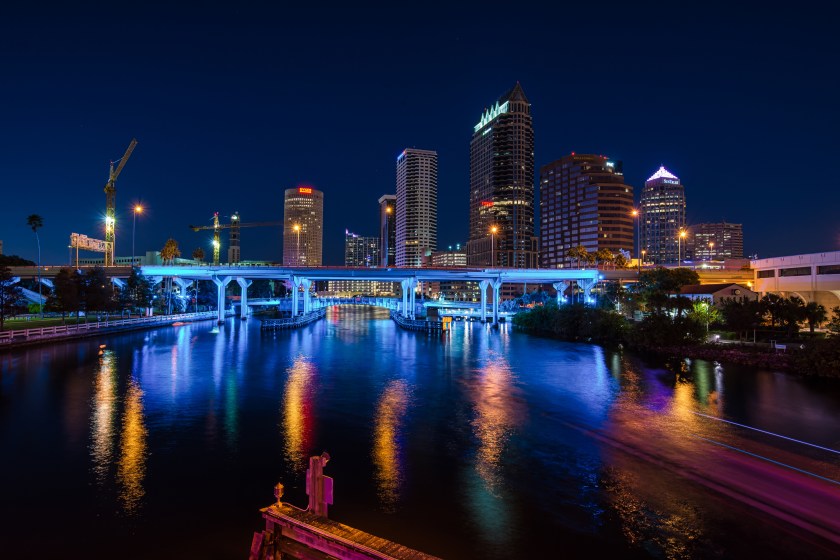
The photograph of Tampa’s skyline from the Platt Street Bridge highlights the vibrant interplay between urban light and architecture at night. With a balanced eight-second exposure, it captures the city’s dynamic illumination, showcasing rich colors reflected in water. The composition balances sleek design and texture, embodying Tampa’s architectural evolution.

Nighttime long exposure photograph of the Tampa, Florida skyline viewed from the Platt Street Bridge over the Hillsborough River.
Long exposure night view of the Tampa skyline from the Platt Street Bridge.

This nocturnal view of Tampa’s downtown district, captured from the Platt Street Bridge, represents a pivotal exploration within Chapter 2—Florida Landscapes & Cityscapes—where the photographer turns his lens toward the performative qualities of urban illumination. Unlike the contemplative stillness of his four-minute dusk exposure, this eight-second capture embraces the vibrancy of the city after dark, revealing Tampa as a stage for artificial light in conversation with architectural form.

The technical approach demonstrates confident command of night photography fundamentals. Shot at 21mm with an aperture of f/10.0, the image achieves comprehensive sharpness while managing the intense point-source lights that define the scene. The eight-second exposure strikes a careful balance: long enough to smooth the water’s surface into a receptive canvas for reflection, yet brief enough to preserve the individual character of each light source without excessive bloom or halation. An ISO of 160 keeps noise minimal while allowing the sensor to capture the full tonal range from the deep navy of the evening sky to the brilliant architectural accent lighting.

The composition is anchored by the dramatically illuminated bridge structure, its cyan LED lighting creating an almost theatrical proscenium that frames the skyline beyond. This choice of vantage point—shooting through the bridge rather than merely of it—adds dimensional complexity, transforming infrastructure into compositional architecture. The repeating vertical supports create rhythm and depth, while the horizontal span provides structural stability to an image otherwise dominated by vertical towers.

What distinguishes this photograph within the photographer’s evolving body of work is its embrace of saturated, polychromatic illumination. The water becomes a liquid prism, fragmenting and multiplying the city’s light signature into vertical streaks of cyan, magenta, amber, and emerald. These reflections possess an almost painterly quality, their chromatic intensity suggesting influence from both contemporary light art and the neon-soaked aesthetics of urban night photography. The contrast between the cool blue bridge lighting and the warmer tones emanating from building facades and street lamps creates visual tension that energizes the entire frame.

The foreground element—a wooden dock structure with visible weathering and industrial hardware—provides crucial textural counterpoint to the sleek glass and steel beyond. This detail grounds the image in physical reality, preventing it from dissolving into pure abstraction despite the transformative effects of artificial light on water. It’s a gesture toward documentary honesty within what might otherwise read as a celebration of spectacle.

Contextually, the inclusion of construction cranes in the left background speaks to Tampa’s ongoing transformation, capturing a specific moment in the city’s architectural timeline. These industrial silhouettes, backlit against the evening sky, add temporal specificity while contributing vertical accents that echo the tower forms they’re constructing.

Within the broader narrative of the Top 100 Journey, this image demonstrates the photographer’s expanding vocabulary for depicting Florida’s urban environments. Where natural landscapes might offer subtlety and organic complexity, cityscapes present their own challenges: managing competing light sources, finding order within density, revealing beauty in the manufactured. His success here lies in recognizing that the contemporary city at night is fundamentally an installation of light—one that reveals itself fully only through the camera’s ability to accumulate and organize photons across time.

Tampa Panoramic at Night: A Study in Urban Luminescence

The panoramic long exposure photograph of downtown Tampa captures its urban beauty at night from the University of Tampa. This 2014 composition emphasizes artificial light’s role in depicting the cityscape, blending architectural detail and varied illumination. It challenges perceptions of Florida, asserting urban environments as significant alongside natural landscapes, showcasing the photographer’s technical skill and versatility.

Panoramic long exposure composite of downtown Tampa, Florida, photographed at night from across the Hillsborough River, showing illuminated skyscrapers, waterfront reflections, and dramatic clouds.
Panoramic long exposure view of downtown Tampa at night, captured from the UT campus across the Hillsborough River.

In this commanding 2014 panoramic composite, the photographer captures downtown Tampa’s nocturnal identity with technical precision and compositional sophistication. Selected for Chapter 2 of his Top 100 Journey—Florida Landscapes & Cityscapes—the image represents a pivotal moment in his exploration of urban environments, where the built landscape becomes a canvas for light, reflection, and architectural rhythm.

The photograph was executed from the University of Tampa campus, positioned across the Hillsborough River to establish both physical and aesthetic distance from the subject. This vantage point proves strategic: the river functions not merely as foreground but as an active participant in the composition, its surface transforming into a liquid mirror that doubles the visual impact of the skyline. The long exposure technique smooths the water into a reflective plane, allowing the city’s illumination to paint streaks of gold, pink, and violet across the lower third of the frame.

What distinguishes this work within the chapter’s broader narrative is its treatment of artificial light as a defining characteristic of place. While Florida’s natural landscapes—its coastlines, wetlands, and subtropical flora—typically dominate photographic representations of the state, this image asserts the validity of the urban experience as equally worthy of documentation. The photographer approaches Tampa’s skyline not as an intrusion upon nature but as a distinct ecosystem of glass, steel, and light, possessing its own aesthetic logic and visual poetry.

The panoramic format extends the horizontal axis, emphasizing the sprawl and variety of Tampa’s architectural character. Twin residential towers anchor the composition’s center, their construction-phase lighting creating vertical counterpoints to the horizontal sweep of the skyline. To the right, a cylindrical high-rise glows amber, its illuminated facade creating a beacon within the frame. The building adorned with pink-magenta accent lighting introduces chromatic variation, preventing the warm-toned dominance from becoming monotonous. This diversity of illumination—commercial, residential, decorative—reveals the stratified nature of urban nightscapes, where different lighting purposes create unintentional visual harmony.

The technical execution merits attention. Creating a panoramic composite requires not only multiple exposures stitched seamlessly but also consistent exposure values across frames and careful management of the long exposure duration. The photographer balances ambient light with the stronger point sources of building illumination, preventing blown highlights while retaining detail in darker architectural elements. The clouded sky, rendered in motion-blurred copper tones, provides textural contrast to the sharp geometry below.

Within the context of the Top 100 Journey, this image demonstrates the photographer’s versatility in approaching Florida’s varied visual territories. While subsequent work in this chapter may explore the state’s natural drama—storm systems over the Gulf, the crystalline waters of its springs, the atmospheric density of its wetlands—this urban portrait establishes his comfort with diverse subject matter and technical approaches. The photograph argues for Tampa’s inclusion in the visual narrative of Florida, asserting that the state’s identity encompasses both wilderness and metropolitan sophistication.

The image remains a testament to the possibilities inherent in patient observation and technical mastery, transforming a familiar skyline into a study of light, color, and urban form.